Share
EQUALS: Reimagining Our Economy
THE “CASINO” OF GLOBAL FINANCE – with Ann Pettifor
Ann Pettifor joins Max and Nabil on EQUALS. She famously predicted the global financial crash in 2007/8 and she’s worried again. She says it’s not just simply supply and demand that’s driving global food system shocks - and tells the story of how gambling-like practices in global financial markets are affecting all of us.
She’s got some big ideas to on reining in capital, and why poorer countries being crushed under mountains of debt need to be able to declare themselves bankrupt.
The latest in our EQUALS season on the cost-of-living crisis. Do tune in!
Do leave us a review and follow us on social media. We’re at @EQUALShope on Twitter.
The views expressed on episodes do not necessarily represent the views of the podcast and its producers.
Don't just listen, join thousands of others reading our weekly digest on inequality. Sign up at https://www.equals.ink/
More episodes
View all episodes
3. “Austerity Is Not an Option!” — Isabel Ortiz on fighting back against IMF imposed spending cuts and price rises for food.
32:09||Season 9, Ep. 3This week Finance Ministers from across the world will attend the IMF–World Bank meetings in Bangkok, Thailand, and Kristalina Georgieva, the IMF’s boss has called on governments to implement swingeing cuts to their spending and increase costs of basic goods- known as austerity measures. As governments face an increasing debt crisis and rising global tensions these cuts are presented as unavoidable. But is this true?In this episode, Isabel Ortiz, one of the world’s leading experts on austerity, examines how this has become a global norm, harming billions of ordinary people. She explains how policies presented as technical reforms are in fact deeply political, benefiting the rich, deepening inequality, shifting the burden onto ordinary people and fuelling growing public anger.She explains how the IMF and national governments in drive austerity, why the claim that there is no alternative is a lie, and what other choices could look like. From taxing the rich and tackling illicit financial flows to restructuring debt and investing in essential public services, Ortiz suggests practical alternatives to policies that leave so many people paying the price.Time to fight back against austerity!If you enjoy the episode, please like, share, comment, and leave us a review. Follow us on X @EQUALShope and on LinkedIn.
2. Fighting Fascism, The Rise of Far Right, and the Battle of Cable Street
27:33||Season 9, Ep. 2The rise of the far right, and of fascism is all around us, all over the world. It is vitally important now more than ever to learn from history, from the rise of the far right in the 1930’s, what attracted people to fascism, and how people organised to fight back. 90 years ago, in East London, fascists mobilised to march through a very poor Jewish area. At Cable Street, tens of thousands of people from different communities stood together and refused to let them pass. This confrontation is today known as the Battle of Cable Street.At the same time, the Republicans were fighting against the fascists in the Spanish Civil War, and many young people from Cable Street went on to fight in Spain. This week, historian David Rosenberg and campaigner Dolores Long, whose father fought in Spain, explore what made that antifascist resistance possible. They join Max Lawson and Maaza Seyoum to connect Cable Street and the fight against fascism in Spain to what is taking place today all over the world, with the rise of far-right politics and increased racism, especially towards migrants. Together they examine how far right movements attract support across social classes and reflect on the need for solidarity across communities and the importance of working-class history and political education.
1. Is Neoliberalism Dead? with Branko Milanović
32:30||Season 9, Ep. 1We are back! EQUALS Season 9 is officially here.And we’re starting with a massive question: Is neoliberalism dead?To answer it, we are thrilled to welcome back one of the world’s greatest economists on inequality and globalization, Branko Milanović, to discuss his groundbreaking latest book, The Great Global Transformation.In this season premiere, we pull back the curtain on:The Changing Global Economic Order: Why the old-world order is giving way to a new doctrine of "national market liberalism," blending market economics with far-right nationalism.The Extraordinary Concentration of Capital and Income: The shocking underlying data showing how cash income from property is hyper-concentrated in the hands of the few.The Rise of a New Global Elite (Homopluteia): A look at the unique, workaholic class who are simultaneously rich through capital and highly paid through their labor—and how their strict view on meritocracy shapes modern inequality.The Hidden Link to International Conflicts: How extreme inequality historically pushes powerful countries toward zero-sum geopolitics and imperial expansion.We also dive into how artificial intelligence is poised to drastically pivot income inequality, why the economic ideology of the 1990s managed to disguise itself as mere "common sense", and Branko’s thoughts on establishing an International Panel on Inequality.If you enjoy the episode, please like, share, comment, and leave us a review. Follow us on X @EQUALShope and on LinkedIn.This is Branko’s second appearance on EQUALS. If you missed his first incredible insights, listen to the previous episode here.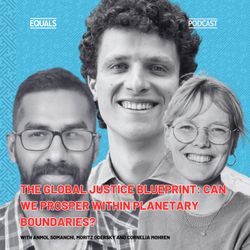
25. The Global Justice Blueprint: A Roadmap to Equality, Shared Prosperity and Climate Justice
30:27||Season 8, Ep. 25Following our conversation with Olivier De Schutter on A Roadmap to End Poverty Beyond Growth, this episode concludes our two-part series exploring bold roadmaps for a just and sustainable future.Too often, climate breakdown and economic inequality are treated as separate crises. But what if they're two sides of the same problem, and one cannot be solved without confronting the other?In this episode of EQUALS, Nafkote Dabi and Max Lawson speak with Anmol Somanchi, Moritz Odersky, and Cornelia Mohren from the World Inequality Lab about the Global Justice Report, an ambitious blueprint for building an economy that delivers shared prosperity while keeping global warming within planetary boundaries.We explore the report's most radical proposals, including a Global Justice Fund financed through progressive global wealth and income taxes, with wealth tax rates of up to 20% for billionaires and top income tax rates of up to 90% for the world's highest earners. The authors argue that these measures could dramatically reduce extreme concentrations of wealth, progressively bringing an end to the billionaire class while financing investments in clean energy, healthcare, education, and sustainable development around the world.The conversation also wrestles with the inevitable criticisms. Is such a transformation politically possible? Can societies move beyond an economic model built on endless growth? And how do we build public support for climate action that improves people's lives rather than asking them to bear the costs of a crisis they did little to create?GuestsAnmol Somanchi is an Indian economist, researcher, and PhD candidate at the Paris School of Economics. He is the Global Justice Coordinator at the World Inequality Lab.Moritz Odersky is an economist and research fellow at the World Inequality Lab.Cornelia Mohren is an economist, Environmental Coordinator at the World Inequality Lab, and a PhD candidate in Economics at Sciences Po Paris.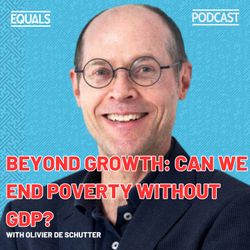
22. Beyond Growth: Can We End Poverty Without GDP?
27:57||Season 8, Ep. 22For decades, governments have measured success with GDP growth. But even with years of economic expansion, poverty persists, inequality is growing and climate crisis is worsening. In this episode, we speak with Olivier De Schutter, the UN Special Rapporteur on Extreme Poverty and Human Rights, about his groundbreaking roadmap to end poverty without relying on endless GDP growth. Drawing on years of country visits and a global collaboration involving hundreds of economists, academics, unions and civil society organizations, Olivier argues that governments have become trapped by an obsession with growth at the expense of people's wellbeing.Together, we unpack why rising GDP hasn't stopped inequality from deepening, how extreme wealth concentration is undermining democracy, why "business-friendly" policies often leave people behind, and what a post-growth economy focused on meeting human needs could actually look like.Join us for a conversation that challenges one of the biggest assumptions in economics and offers a bold vision for a fairer future.This is the first episode in a two-part EQUALS series exploring some of the most ambitious ideas for building a fairer and more sustainable future. Next, we'll examine the World Inequality Lab's groundbreaking Global Justice Report, speaking with members of the team behind the report about their bold proposals to transform the global economy and confront inequality, climate change and global injustice.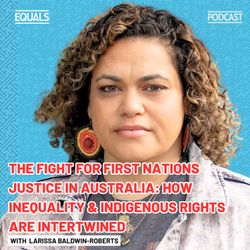
21. The Fight for First Nations Justice in Australia: how inequality and indigenous rights are intertwined
31:26||Season 8, Ep. 21For many Indigenous communities, inequality is not simply about income or opportunity. It is about power, representation and land.In this episode, Nafkote Dabi and Max Lawson speak with Larissa Baldwin-Roberts, a Widjabul Wia-bal woman, climate justice advocate, and one of Australia's leading campaigners for First Nations rights.Drawing on her experience working across Indigenous justice, refugee rights, and climate advocacy, Larissa explores how structural racism continues to drive economic inequality for Indigenous peoples, not only in Australia but around the world.From the fight to reclaim January 26 as a day of truth-telling, to the growing influence of far-right politics, climate negotiations, and the challenge of building genuinely community-led movements, Larissa explains why inequality cannot be separated from questions of race, history, and power.The conversation also examines what meaningful inclusion really looks like, why Indigenous peoples are rights holders rather than stakeholders, and how building broad coalitions for justice may be essential to confronting today's intersecting crises.If we want a fairer economy, Larissa argues, we must first reckon with the systems that continue to exclude those on the frontlines of inequality.If you enjoy the episode, please like, share, comment, and leave us a review. Follow us on X @EQUALShope, Bluesky and on LinkedIn.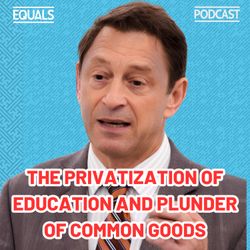
20. The Privatization of Education and Plunder of Common Goods
31:15||Season 8, Ep. 20What happens when basic public goods become a private, paid for service, education becomes a profit-turning treadmill and meanwhile millions live in chronic insecurity?In this episode Max and Grazielle interview renowned economist Guy Standing, exploring his argument that the privatization of public goods or what he calls the “plunder of the commons” has produced a new global class, the Precariat, and fuelled rising inequality.Guy explains why a basic income is a matter of common justice, freedom, and security, which are human rights. He further dives into his most recent book that describes how private equity and financialization have transformed schools and universities into profit machines, and why restoring the education system with slower, ethical, democratic learning matters for society.From privatized education to the future of basic income, this episode is a timely conversation about inequality, insecurity, and what it will take to build systems that serve people instead of profit.If you enjoy the episode, please like, share, comment, and leave us a review. Follow us on X @EQUALShope, Bluesky and on LinkedIn.
19. Muskism: How Big Tech Is Reshaping Power, Politics, and Democracy
31:50||Season 8, Ep. 19This week on EQUALS, we explore “Muskism” — the growing power of tech billionaires and what it means for democracy, inequality, and the future of society.Authors Quinn Slobodian and Ben Tarnoff argue that Elon Musk is not just a billionaire entrepreneur, but a sign of a deeper transformation in capitalism, technology, and political power.From AI and social media to electric vehicles, digital infrastructure, and government dependence on private tech companies, the episode asks what happens when essential systems are controlled by a handful of corporations and billionaires.We discuss the rise of “sovereignty as a service,” the growing influence of Big Tech over public life, and whether societies can reduce their dependence on tech monopolies while building more democratic alternatives.Later in the episode, Hana Ivanhoe joins the conversation to unpack who loses most in this new tech order — and what it would take to reclaim power in an increasingly unequal digital world.If you enjoy the episode, please like, share, comment, and leave us a review. Follow us on X @EQUALShope, Bluesky and on LinkedIn.
18. War, Oil, and Inequality: Who Wins and Who Loses
25:24||Season 8, Ep. 18In this episode, Adam Hanieh explains why crises like war, financial shocks, and pandemics don’t stay where they start. They move through the structures of the global economy. He explains how the effect of the Middle East war is going to move beyond borders through energy prices, food prices and security and consequently high cost of living, hitting the poorest of the population the hardest. Drawing on the aftermath of the 2008 financial crisis and the COVID-19 pandemic, Adam shows how these shocks consistently deepen inequality, hitting the most vulnerable hardest.He unpacks the central role of the Gulf countries in global supply chains, from oil and gas to fertilisers and industrial materials, and how disruptions in the region can drive inflation, strain food systems, and raise the cost of living worldwide.The conversation also explores the risks of continued dependence on fossil fuels, and why responding to these interconnected crises requires international cooperation rather than fragmented, national responses.