Share
Women Leaders
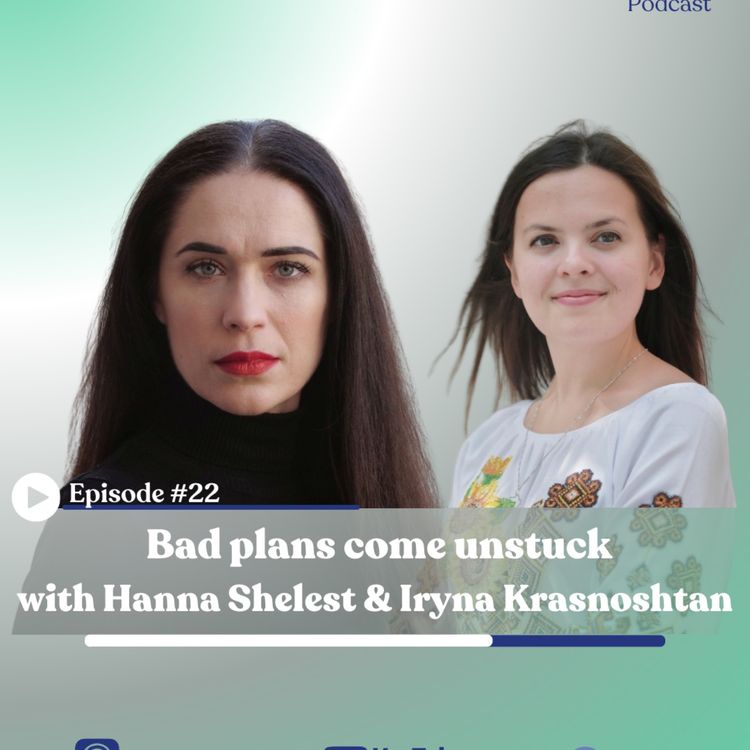
Bad plans come unstuck with Hanna Shelest & Iryna Krasnoshtan
According to Wikipedia, 28 is “approximately the number of grams in an ounce, and used as such in commercial trade.” This may explain why there were 28 points in the US plan to end Russia’s war on Ukraine: it was drafted by people interested in commerce and trade, and the US stands to gain some US$ 300 billion from this deal. However, the US financial gain is the only original element in the plan, the rest being a list of Russian demands denying Ukraine sovereignty by taking land from it, defining its military, its constitution and its elections, and forcing cultural and religious issues upon it.
That this draft was cooked up by US forces friendly to Russia is common knowledge, but that does not make the event, let alone the plan, less of an abomination: Ukraine was treated as no more than item, while the EU was not consulted — despite being listed as liable to underwrite much of the programme.
At base, this is a plan to reward aggression and the taking of land by force while imposing penalties upon those who object.
To understand what exactly is wrong with the proposals, and where Ukraine goes from here, Ilana Bet-El is joined by two true women leaders: Dr Hanna Shelest, Director of Security Programmes at the Foreign Policy Council "Ukrainian Prism (https://prismua.org/en/)", and Iryna Krasnoshtan, Programme Director at the International Center for Ukrainian Victory (https://ukrainianvictory.org/). With the facts at their fingertips and the passion of fighters, this conversation explains what is at stake for the world as well as Ukraine.
This episode was recorded on 27 November 2025
Chapters
- Dissecting the 28 point “peace proposal”
- The international dynamics of the war in Ukraine
- Why Ukrainians and Europeans are left out of the conversation?
- What would a Ukrainian peace plan look like?
Mentions
Ukraine Analytica Ukraine Institute
Washington roiled by leaked transcript of Witkoff-Ushakov call
Agathe Demarais article on the US-Russia Plan , De Wever Overstates Belgium's Risks
Follow
Iryna Krasnoshtan LinkedIn Hanna Shelest LinkedIn
Ilana Bet-El Women Leaders Instagram & YouTube
Credits
Production: Florence Ferrando
Music: Let Good Times Roll, RA from #Uppbeat
Contribute to the conversation with a comment & a 5-⭐️
Reach us on our Instagram and follow for updates @women_leaders_podcast
Watch now our episode on Youtube
More episodes
View all episodes
16. Life, Love and War with Katherine Saad Feghali
46:51||Season 3, Ep. 16Women Leaders continues its summer series with women authors.Much has been written about the current horrors of Lebanon, but they really started long ago, in the civil war that raged between 1975-1990.As part of our women authors summer season, we turn to a novel written about coming of age in that period — to the brutality of war alongside the attempts at keeping normality alive, of food and family and nostalgia, of young love and loss, of the harsh destruction of commonality amongst different ethnicities in the face of brutality.Katherine Saad Feghali is the author of Glass Cedars, a roman à clef in which she recounts her love for Lebanon while observing its disintegration. A lyrical book that in many ways tells far more about the reality of Lebanon than any factual reporting. A touching and interesting conversation about destruction, PTSD and Lebanon!This episode was recorded on 11 August 2026ChaptersThe origins of Glass CedarsTurning personal tragedy into a missionThe universal human experience of migration and conflictThe role of women in Lebanon and the USThe importance of human stories over political narrativesMentionsBook - Glass Cedars - Amazon US & Amazon UKPoem - Epic of Gilgamesh - BritannicaAssociation - Education and Opportunities for LebanonFollowKatherine Saad Feghali LinkedIn InstagramIlana Bet-ElInstagram @women_leaders_podcastListen to this episode on our YouTube channelOur partner European Leadership Network Twitter LinkedIn Facebook websiteCreditsProduction: Florence FerrandoMusic: Let Good Times Roll, RA from #Uppbeat (free for Creators!): https://uppbeat.io/t/ra/let-good-times-roll License code: ZXIIIJUU2ISPZIJT
15. Our life in the classics with Mary Beard
47:32||Season 3, Ep. 15Women Leaders is having a relaxing summer with women authors.The Odyssey is a big summer hit, but it has been a hit for 3000 years: it is both a classic, and part of the classics, a broad field of study that Western culture has long been obsessed with. From legalities to laughter and from battles to bread, the ancient Greeks and Romans seem to have lived our lives then, while we seek out their lives now.Mary Beard is undoubtedly the most prominent classicist of our times, and her new book, Talking Classics: The Shock of the Old reflects most clearly on our longstanding relationship with the classical period and its ongoing relevance. A strong woman leader, she has authored many books, including the important Women & Power: A Manifesto.In a fun and fabulous conversation, Mary Beard discusses the significance of many issues past and present — and what she really thinks of The Odyssey, the film. Don’t miss it!This episode was recorded on 4 August 2026Chapters:What is a classicist?Use and abuse of classical culture in politicsOrigins of the silencing of women's voicesNolan’s Odyssey impact on female charactersMentionsThe Booker PrizesPodcast - Instant Classics with Charlotte Higgins: YouTube Spotify Apple Podcasts InstagramInstant Classics - Podcast Book Club on the OdysseyBook - Women in Power, a Manifesto (2017), AudibleBook - SPQR, a history of Ancient Rome (2015)Book - Talking Classics, The Shock of the Old (2026), AudibleBook - Samuel Butler The Authoress of the Odyssey (1922)Book - H.R Trevor-Roper History & imagination (1981)The Odyssey movieFollowMary Beard Cambridge University, InstagramIlana Bet-ElInstagram @women_leaders_podcastListen to this episode on our YouTube channelOur partner European Leadership Network Twitter LinkedIn Facebook websiteCreditsProduction: Florence FerrandoMusic: Let Good Times Roll, RA from #Uppbeat (free for Creators!): https://uppbeat.io/t/ra/let-good-times-rollLicense code: ZXIIIJUU2ISPZIJT
14. Security, Cooperation and Conflict with Rose Gottemoeller
42:56||Season 3, Ep. 14We are living in a world of open conflicts existing alongside peaceful life: while life in many parts of Europe and the US are focused upon summer holidays, Ukrainian cities are being pounded by Russian missiles and their soldiers are fighting Russian ones in the Donbas, while missiles are flying across the Middle East and Iran. It is a contradictory and jarring reality, which the various instigators of the violence claim to be necessary, and inevitable — notably Vladimir Putin, President of Russia.In first illegally annexing Crimea in 2014, then mounting a full-scale invasion in 2022, Putin claimed not only that Ukraine was not a legitimate state but rather a part of Russia — but also that it was necessary as part of Russia’s defence against an ever-expanding and threatening NATO. This narrative is rooted in a malignant Russian reading of the end of the Cold War, US and NATO intentions, and Russian dreams of world significance. It is also the subject of a new book by Rose Gottemoeller, former NATO Deputy Secretary General, and the guest of this episode.From the current situation in Russia and Ukraine, to the intricacies that led to it, this is a great conversation on one of the most important periods of recent history.This episode was recorded on 22 July 2026Chapters:What is the START Treaty?Nuclear forces & deterrence rationaleThe impact of Ukraine conflict on Russia and global securityPutin's leadership, decision-making, and strategic mindsetThe future of Russia-US relations and cooperationThe importance of international cooperation and stabilityMentionsBook - Security Through Cooperation: Space, Nuclear Weapons, and US-Russia Relations After the Cold WarUK website with a 20% discount code: RGOT20US websiteRose’s previous Women Leaders episodes:“A historic 2022 International Women’s Day” 8 March 2022“Back and big – Geopolitics with Rose Gottemoeller, an IWD special” 8 March 2024Putin’s options: an oligarch speaks outs - The EconomistFollowRose Gottemoeller LinkedInIlana Bet-ElInstagram @women_leaders_podcastListen to this episode on our YouTube channelOur partner European Leadership Network Twitter LinkedIn Facebook websiteCreditsProduction:Florence FerrandoMusic: Let Good Times Roll, RA from #Uppbeat (free for Creators!): https://uppbeat.io/t/ra/let-good-times-rollLicense code: ZXIIIJUU2ISPZIJT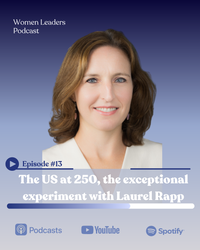
13. The US at 250, the exceptional experiment with Laurel Rapp
49:50||Season 3, Ep. 13The United States is celebrating the 250th anniversary of its founding on July 4th. Whilst the country is living through deep changes in its global perception, it is well to remember that as an entity it has always been different: the first declared republic, rejecting monarchy or any form of inherited rule in favour of government by the people and for the people. A nation created by a Declaration of Independence, governed by a balance of power between the legislative, executive and judicial branches. These have now become the obvious markings of democratic rule, but at the time they were a startling innovation. Or, as the US likes to think of itself, an exception.The past two years have definitely seen many global examples of US exceptionalism, be it in Greenland, Venezuela or Iran, as well as internal radical changes related to immigrants, the structure of government and the role of religion. But it may be that many of these were foretold, not least in the last lines of the US national anthem:“Then conquer we must, when our cause it is just,And this be our motto - “In God is our trust”And the star-spangled banner in triumph shall waveO’er the land of the free and the home of the brave.”Laurel Rapp, Director of the US and North America Programme at Chatham House, is an excellent guide to the US experiment and exceptionalism. In a conversation that takes her back to her work in the State Department and her school days, the foundations and meaning of US identity and uniqueness are beautifully revealed - and explain a lot of today’s realities!This episode was recorded on 1 July 2026ChaptersThe US 250th Anniversary significanceUnderstanding American exceptionalismThe legacy of Manifest DestinyContradictions and cultural wars over US historyIs the American dream dead?What is it to be a US diplomat?MentionsUS Declaration of IndependenceUS ConstitutionChatman House US and North America programmeEvent (17 September 2026) US at 250: Separation vs. concentration of power – America’s enduring constitutional debateFollowLaurel Rapp LinkedIn, Chatman House pageIlana Bet-ElInstagram @women_leaders_podcastListen to this episode on our YouTube channelOur partner European Leadership Network Twitter LinkedIn Facebook websiteCreditsProduction: Florence FerrandoMusic: Let Good Times Roll, RA from #Uppbeat (free for Creators!): https://uppbeat.io/t/ra/let-good-times-rollLicense code: ZXIIIJUU2ISPZIJT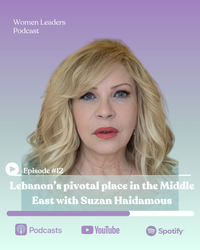
12. Lebanon’s pivotal place in the Middle East with Suzan Haidamous
44:51||Season 3, Ep. 12The war in Iran, and the broader Middle East, is apparently over — at least according to US President Trump. A 14-point agreement between the US and Iran has been signed - in Versailles Palace, where the ill-fated agreement ending World War I was signed - largely giving Iran all it asked for. The world economy may eventually return to some semblance of normality as the Strait of Hormuz reopens, assuming it really does, but the region as a whole is far from at peace, and somewhat far from comprehending a deal that stablizes remarkably little. This is especially true to Lebanon: torn apart by its own sectarian violence and economic deterioration, it has become the core issue of dispute. For Iran, Hezbollah must remain intact and in control, with Iranian oversight of the whole country; for Israel, Hezbollah must be disarmed and removed from Lebanon’s southern border.Neither Israel nor Lebanon are parties to the newly signed 14-point agreement, though both have now embarked upon some kind of talks sponsored by the US. That may not matter, as in the complex web of Lebanese politics, Hezbollah is more powerful than the government. However, it has been weakened dramatically by Israel, that is also pushing back on it while licking its wounds from what seems like a humiliating defeat.Suzan Haidamous, Beirut-based correspondent for the Washington Post, is the perfect person to make some sense of Lebanon’s predicaments. In a great and wise conversation, she brings lived experience of Lebanon coupled with great insight and compassion.Chapters:Understanding Lebanon and Syria todayReporting from the ground: experiences in SyriaHezbollah's role and influence in LebanonThe future of Lebanon and regional dynamics with IranIs there still hope for peace in the Middle East?Mentions2024 beeper attack on Hezbollah2024 walkie talkie attack on HezbollahSusannah George - Washington post pageLiz Sly - Washington post pageUN Security Council resolution 1701UN News - Explainer: What is Security Council resolution 1701?Women Leaders - As missiles flySuzan Haidamous article “An airstrike trapped a journalist”FollowSuzan Haidamous Washington Post page LinkedInIlana Bet-ElInstagram @women_leaders_podcastListen to this episode on our YouTube channelOur partner European Leadership Network Twitter LinkedIn Facebook websiteCreditsProduction: Florence FerrandoMusic: Let Good Times Roll, RA from #Uppbeat (free for Creators!): https://uppbeat.io/t/ra/let-good-times-rollLicense code: ZXIIIJUU2ISPZIJT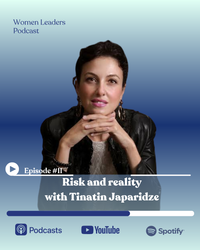
11. Risk and reality with Tinatin Japaridze
44:31||Season 3, Ep. 11It remains unclear whether the US President had requested a full risk assessment before deciding to launch airstrikes against Iran, or whether the option of Iran closing the Strait of Hormuz was highlighted then. However, the reality of the closed Strait, the global economic impact and the resulting rapidly changing international order highlight a core reality: our lives are underpinned by risk.From individual issues of choice such as investments or acquisitions to state-level realities such as pandemics, wars or climate change, understanding and assessing risk is integral to both events - and decision making. Ultimately, all events are an outcome of a decision based (or, equally, not) on an assessment of risk.Assessing risk is a vast and growing realm, made ever more complex and wide by the introduction of technology and especially AI. In our rapidly changing reality, understanding the possibilities and consequences of a decision is no longer a simple act of sequencing but also of modelling and so much more. To best understand these complex and rapidly evolving concepts, Tinatin Japaridze, Director of Geopolitics at Anadyr Horizon joins us in a fabulous and philosophical discussion.This episode was recorded on 3 June 2026.Chapters:Role of AI in decision makingUnderstanding geopolitical risk and cascading effectsChanges and shifts in world order over the 20 past yearsFine lines and interdependencies between technologies and humansMentionsAnadyr Horizon website LinkedInLarge language models (LLM) - European data protection supervisor1914: The unspoken assumptions of James Joll - War on the Rocks articleFollowTinatin Japaridze LinkedIn, X/TwitterIlana Bet-ElInstagram @women_leaders_podcastListen to this episode on our YouTube channelOur partner European Leadership Network Twitter LinkedIn Facebook websiteCreditsProduction: Florence FerrandoMusic: Let Good Times Roll, RA from #Uppbeat (free for Creators!): https://uppbeat.io/t/ra/let-good-times-rollLicense code: ZXIIIJUU2ISPZIJT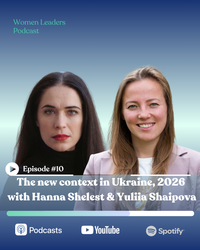
10. The new context in Ukraine, 2026 with Hanna Shelest & Yuliia Shaipova
48:46||Season 3, Ep. 10Long wars evolve and change, sometimes due to innovation and weapons other times due to politics and personalities — but in all cases there is a sharp change of context: the realities in which the war started cease to apply, and the new ones dictate events. The war in Ukraine has now reached this situation.While Russia claims to still be fighting the same war for the same reasons, it is poorer, weaker, with a staggering amount of casualties and a population increasingly disgruntled. Conversely, while the people of Ukraine are tired of war and of Russia’s malicious bombing of civilian targets, it remains united in its opposition to Russia’s claims upon its lands and people, and ever more inventive in its capabilities and international outreach.To better understand these shifting realities and the position of Ukraine Ilana Bet-El is joined by Hanna Shelest, Director of Security Studies at Foreign Policy Council Ukrainian Prism, and Yuliia Shaipova, Affiliated Expert at Ukrainian Prism. A deep and flowing conversation with many important insights!This episode was recorded on 19 May 2026ChaptersWhat changed in the battlefield dynamics?Evolutions inside Ukraine and current political landscapeThe impact of the Middle-East war on UkrainePerceptions of EU accession and future aspirationsHow could the negotiations progress?MentionsUkrainian PrismRussian lossesTimothy Garton Ash, Homelands: A Personal History of EuropeHanna’s previous Women Leaders episode (November 2025)FollowHanna Shelest LinkedInYuliia Shaipova LinkedInIlana Bet-ElInstagram @women_leaders_podcastListen to this episode on our YouTube channelOur partner European Leadership Network Twitter LinkedIn Facebook websiteCreditsProduction: Florence FerrandoMusic: Let Good Times Roll, RA from #Uppbeat (free for Creators!): https://uppbeat.io/t/ra/let-good-times-rollLicense code: ZXIIIJUU2ISPZIJT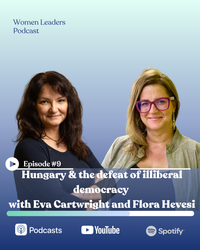
9. Hungary and the defeat of illiberal democracy with Eva Cartwright and Flora Hevesi
01:02:28||Season 3, Ep. 9There are certain events that are so important they signify a word now rarely used: possibility. The victory of the opposition Tisza party in Hungary over the long-ruling illiberal Fidesz party embodies the idea of possibility — a possible new and better future, a possible reconciliation with the EU, a possible end to corruption, and so many other possibilities.As the Tisza party headed by Péter Magyar takes office, we wanted to establish how the victory was achieved: not as an abstract question, but as a reality of Hungarians who objected to Orban’s illiberal democracy and joined forces to fight it to victory. Eva Cartwright and Flora Hevesi, two such activists, join a dynamic and heartfelt conversation that explores what living in the Hungary of Fidesz really meant, in cities and villages, and how victory was finally achieved.This episode was recorded 7 May 2026ChaptersRecognising the signs of democratic erosionHungary’s experience of democracyThe shift from Fidesz to TiszaComplexities of political activismMentionsFull Circle event - 19th May 2026FollowEva Cartwright LinkedInFlora Hevesi LinkedInIlana Bet-ElInstagram @women_leaders_podcastListen this episode on our YouTube channelOur partner European Leadership Network Twitter LinkedIn Facebook websiteCreditsProduction: Florence FerrandoMusic: Let Good Times Roll, RA from #Uppbeat (free for Creators!): https://uppbeat.io/t/ra/let-good-times-rollLicense code: ZXIIIJUU2ISPZIJT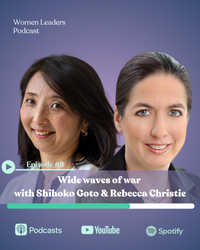
8. Wide waves of war with Shihoko Goto & Rebecca Christie
43:49||Season 3, Ep. 8As all eyes remain on Iran, the US and the Strait of Hormuz, the global repercussions of the Iran war are becoming ever more evident. Food is an issue slowly hitting many parts: fertilisers are by products of fossil fuels, and the blocked Strait will constrain sowing seasons around the world. As regards the fuels themselves, many airlines are cutting flights as jet fuel supply is becoming a real problem.Asia has been particularly hard hit by the war, with some 20% of its needs imported from the Gulf states. Europe imports far less, but the global shortage of oil and LNG has sent prices skyrocketing, while stocks are rapidly diminishing. At the same time, these economic hits are also pushing states in Asia and the EU to rethink their geostrategic interests in a collapsing world order, seeking to balance an ever more unpredictable - and vindictive - US with China and potentially other new alliances.Shihoko Goto is the Vice President of Programs and Director of the Asia Program at the Foreign Policy Research Institute (FPRI), and a fascinating expert on all things Asia. Rebecca Christie is Senior Fellow at Bruegel and an expert with great insights into the economic aspects of the EU. They join Ilana Bet-El in this great conversation really unpacks these and many other implications of the war in Iran - in Europe, Asia and across the globe.This episode was recorded on 22 April 2026ChaptersImpact of the war on Asia's economiesWhat are the geostrategic shifts in Asia and Europe?The role of the US in global energy dynamicsAsia-Europe cooperation in an instable worldChina's long game in global politicsMentionsThe Sound of Economics - Rebecca’s podcastZhōngHuá Mundus - Bruegel’s podcast on China economyIran Energy and Indo-Pacific Realignment - FPRIThe Forces of Scarcity Hitting Asia May Soon Spread Across the World - The NewYork TimesFollowShihoko Goto LinkedIn & Foreign Policy Research Institute webpageRebecca Christie LinkedIn, X/Twitter, Bluesky, Bruegel pageIlana Bet-ElInstagram @women_leaders_podcastListen this episode on our YouTube channelOur partner European Leadership Network Twitter LinkedIn Facebook websiteCreditsProduction: Florence FerrandoMusic: Let Good Times Roll, RA from #Uppbeat (free for Creators!): https://uppbeat.io/t/ra/let-good-times-roll License code: ZXIIIJUU2ISPZIJT