Share
Wicked Problems - Climate Tech Conversations
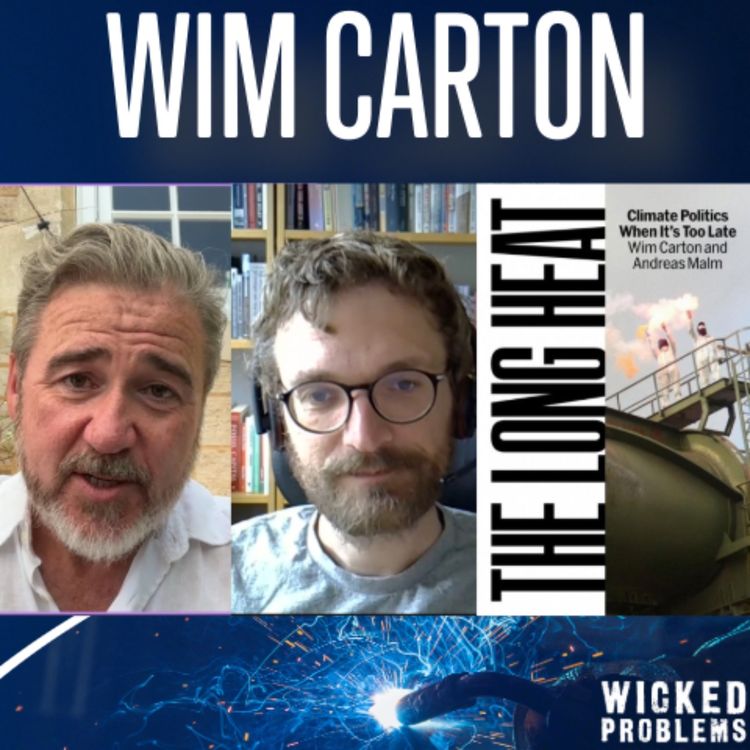
The Long Heat (with Wim Carton)
Get full show notes and bonus content at wickedproblems.earth
In 2024, Wim Carton and Andreas Malm released Overshoot - How the World Surrendered to Climate Breakdown. It was praised and critiqued in various quarters - but we included it in our books of the year because it’s a) beautifully written - with plenty of lateral-thought LOLs and b) was perfectly timed to come out just as the data was increasingly at odds with the “Keep 1.5 Alive” stuff of “incantatory governance” - the magical thinking that seems to be a really complicated way of avoiding some obvious, but difficult, choices. But Overshoot was just the first half of a 2-parter.
In the final part, out in October, The Long Heat - Climate Politics When It’s Too Late, Carton and Malm take up the challenge about what to do about it. Will adaptation, carbon dioxide removals, and geoengineering be topics seriously engaged with? Or will they just be a new version of finding ways to avoid the fossil fuels “stranded assets” conversation we’ve avoided having for 35 years of climate politics?
In this conversation, we spend a lot of time talking about carbon dioxide removal (CDR) technologies, revealing their roots in extending fossil fuel use, and argues for the necessity of political change to make meaningful progress.
But we ended up in an unexpected place. The book, surprisingly to me when I read it, concludes (however reluctantly) that CDR is going to be necessary. But that it needs to be decoupled from a system full of perverse incentives and moral hazard on meth and towards a re-framing of CDR as a public good.
What’s in the Conversation
00:00 Introduction and Opening Remarks
00:17 Host Introduction and Upcoming Events
02:27 Guest Introduction: Wim Carton
04:48 Discussing 'Overshoot' and Climate Politics
06:13 The Role of Fossil Fuel Companies
16:38 Adaptation Strategies and Challenges
18:43 Technological Solutions and Their Limits
20:07 Carbon Dioxide Removal (CDR)
20:51 The Concept of Negative Magic
21:41 Problematizing Reversibility
22:43 Political Economy of Carbon Dioxide Removal
24:08 Klaus Lachner and Carbon Removal
28:05 Startups and the Political Economy
31:07 Challenges in Carbon Removal Market
35:36 The Role of the State in Carbon Removal
40:12 Concluding Thoughts and Future Discussions
Get the Books
Like the authors we’re speaking with? Want to get their books, support the author, independent booksellers, and this show?
Come get em at our Bookshop.org shop!
Next episode out very soon is with Solitaire Townsend - talking about her debut novel - a cli-fi/alt-history/Roman-Empire mashup - Godstorm. What if Rome invented the combustion engine, so it never fell?
More episodes
View all episodes
178. Everybody Wants to Rule a Warmer World: Arthur Snell on his new book, Elemental
46:38||Season 6, Ep. 178Former British diplomat Arthur Snell is about to publish a book that explains how climate is rapidly changing the geographic assumptions on which geopolitics is built. Buy it now — Elemental: The New Geography of Climate Change and How We Survive It. But first, check out this Wickedproblems.earth conversation with Arthur Snell about his new book, the first comprehensive account of the geopolitics of climate change.In this conversation:00:00 Arctic Ice Wake Up00:45 War Crowds Out Climate02:32 Chokepoints Aren’t Fixed04:08 Meet Arthur Snell04:22 Why Climate Is Geopolitics08:05 Alps Collapse Story11:01 Skiing Lobbies And Emissions12:40 Geopolitics Map Gets Redrawn14:59 Arctic Shipping Routes Open18:37 Trump Greenland And Minerals22:46 Panama Canal China Leverage24:20 Panama Canal Leverage25:56 Who Shapes Strategy28:24 Migration as Hard Reality34:55 Greenland Plans Accelerate39:27 Russia China North Shift42:28 Wine and Adaptation44:36 Book Plug and Farewell
177. Renewables as Reistance in Ukraine. w Svitlana Romanko of Razom We Stand
39:20||Season 6, Ep. 177For ad-free listening, articles, and newsletter go to wickedproblems.earth and sign up.On Wicked Problems, host Richard Delevan interviews Svitlana Romko, founder of Razom We Stand, at the Laudato Si “Raising Hope” conference about linking Ukraine’s war to global fossil fuel dependence. Romko says We Stand formed in early 2022 to coordinate a coalition of 900 organizations from 60 countries urging bans on Russian fossil fuels and investment, and rebuilding Ukraine with renewables to cut financial flows fueling wars. She argues “all gas is bad,” criticizes replacing Russian gas with US LNG, and urges Europe to accelerate renewables for peace, energy security, climate, and human rights. She describes vast destruction, displacement, population decline to about 20 million, and energy capacity collapsing from 54 GW to 9 GW, while 17–18 GW is needed for winter. She highlights faith-led divestment successes, distributed renewables powering communities, and Ukraine’s renewable potential of 653 GW as a basis for rebuilding and hope.00:00 Ukraine in Ruins00:21 I ntro00:21 Confrontation and Repression00:59 Intro01:40 Podcast Intro and Guest03:20 Meet Svitlana at Conference03:50 We Stand Mission05:42 No Such Thing as Clean Gas07:58 Faith Groups and Divestment10:46 Populism and Fossil Money15:50 Ukraine Power Grid Under Attack22:13 Panel Clip Fossil Fuels and Dictators34:40 Hope Resilience and Closing
176. A Perfect Storm: Dana R. Fisher & Green Party CEO Harriet Lamb
54:28||Season 6, Ep. 176“Wicked Problems,” hosted by Richard Delevan, returns after a long hiatus and links escalating repression - newly including climate activists - with a high-stakes by-election in Greater Manchester. It opens with concerns about confrontational protest being met with violence and political repression, alongside Nigel Farage's Reform proposing a “UK deportation command,” expanding detention with “no chance of bail,” and “detention will mean deportation.” Devin cites New York Times reporting that the FBI has begun targeting climate activists, including people who have not protested in years, and frames this as part of a broader effort to quash dissent.Professor Dana R. Fisher of American University discusses what she describes as a “perfect storm” in the US: federal occupations of cities (highlighting Minneapolis), the murder of two American citizens while they were bearing witness to ICE actions, the president getting rid of the endangerment finding underlying US climate policy, and FBI investigations focusing on the "radical fringe" of the climate movement. Fisher argues these groups are “low hanging fruit” because their confrontational tactics (e.g., throwing paint, smearing food, blocking traffic, bird-dogging elected officials) are widely unpopular, making it easier for authorities to target them first as part of a broader slide toward autocracy that also threatens media freedoms. She says repression and violence against peaceful activists historically mobilize larger protests, even as it can lead to persecution, jail, and martyrdom. She also describes survey results from a Women’s March–coordinated “Free America walkout” showing over 75% support for a movement becoming more confrontational and 65% willingness to personally engage in confrontational activism; she notes the participants were largely white, female, older, and highly educated.Prof. Fisher's Apocalyptic Optimist podcast.Britain has already jailed nonviolent climate protestors and restricted defenses in court, with ongoing debates about protest trials and labeling Palestine Action a terror group. The Gorton and Denton by-election seems to be between Reform, seeking to import Trump’s climate and migration agenda, and the surging Green Party, treating climate, inequality, and migration as realities to face without losing humanity. The show notes a single constituency poll with Green candidate Hannah Spencer ahead of Reform’s Matt Goodwin, with Labour (which has held the seat for a century) behind; as Labour is consumed by Epstein-linked arrests and scandal involving Peter Mandelson and former Prince Andrew.In an interview recorded late in 2025, Harriet Lamb, CEO of the Green Party of England and Wales, describes rapid growth following Zach Polanski’s leadership, with membership doubling to over 150,000. Lamb connects her background in international development and environmental and social justice to party politics, argues the UK has shifted into a multi-party system creating both dangers and opportunities, and emphasizes a “people and planet” platform focused on the cost-of-living crisis, inequality, wealth taxes, and strong public support for climate action. She discusses candidate development through a “Greens to Parliament” program aimed at building a diverse slate for 2029, and says coalition politics must protect Green principles and public trust, citing German coalition negotiations and the Scottish Greens’ Bute House agreement as examples.00:00 Confrontation and Repression01:35 Wicked Problems Returns04:11 FBI Targets Climate Activists07:42 Low Hanging Fruit and Autocracy19:18 UK By-Election and Green Surge29:32 Hope Surge and Outreach31:28 Broad Coalition and Core Values36:28 Vetting New Recruits38:39 Road to Parliament and Coalitions45:24 Milestones and Closing Reflections
7. Rumble in the Jungle COP
40:12||Season 4, Ep. 7Full show notes, transcripts, and more at wickedproblems.earth Welcome to Belém, where the world (with some notable exceptions) has gathered to talk about saving the Amazon as if it weren’t already on fire. Cataloguing the chaos leading up to COP30 Ben Cooke of The Times. His team’s reporting makes clear why the mood isn’t exactly jubilant: the clean-power alliance with zero members, the rainforest pledges with little progress, and the renewed swagger of fossil petrostates. Even potential bright spots, like the Tropical Forest Forever Facility announced last week, were somewhat dimmed by the spectacle of UK prime minister Keir Starmer reversing an earlier decision not to go to COP, only to make the trip to then announce his government wouldn’t be part of the hoped-for signature initiative out of this event.We chat with Ben about all of that and more.
6. Trump nukes Net Zero Shipping
01:26:07||Season 4, Ep. 6Full show notes and ad-free listening at wickedproblems.earthShipping is one of those things that’s just supposed to work. Post-Titanic, we created a set of rules that currently are looked after by the International Maritime Organization (IMO), which successfully removed much of the drama from shipping — so successful that Britain’s “Shipping Forecast” is now soothing ASMR for bedtime listening. But last month at the IMO in London, what should have been a procedural meeting on decarbonising shipping turned into something far messier. According to a Financial Times investigation, U.S. officials didn’t just lobby against a global carbon levy on shipping — they allegedly threatened, intimidated and black-mailed delegates from smaller nations. Developing-country delegates said they were warned their ships would face higher U.S. port fees, their officials denied visas, and their trade punished if they didn’t abandon support for the Net Zero Framework the IMO had endorsed only six months earlier. “It was like dealing with the Mob,” one diplomat told the FT. In the end, it worked. The deal — the world’s first carbon-pricing mechanism for global shipping — was postponed for a year. The IMO, normally the most technocratic of international bodies, was left “in a state of complete shock.” For the uninitiated this may sound arcane. But shipping matters. Roughly 90 % of global trade moves by sea; the sector accounts for about 3 % of global CO₂ emissions — more than Germany — and until now has been largely outside the reach of meaningful climate regulation. The Net Zero Framework was meant to change that. It had already been provisionally agreed by a majority of countries in April. But by October, something changed. Countries like China, India, Panama, Liberia — and even Greece and Cyprus, who broke with the EU line — suddenly voted to adjourn. news.wickedproblems.ukAnd the shift didn’t come from nowhere: it came from pressure. From a U.S. administration that now treats climate policy as an existential threat to American interests.🎧 Who we spoke toCarly Hicks (Chief Strategy & Impact Officer, Opportunity Green) explains how the IMO had once seemed one of the last genuinely global forums where climate ambition could meet technical reality — until the process was capsized by politics. Ariane Morrissey (Senior Editor, Ship.Energy) was in the building as the talks imploded, describing a surreal scene where delegates who came to discuss fuel standards found themselves under threats of sanctions and visa bans. Professor Tristan Smith (University College London) gave the longer-view: this is less a failure of climate tech than a warning shot about the fragility of multilateralism itself. He argues the US may have bought time — but may also have triggered the rise of regional regulation. The EU’s carbon-trading scheme now covers shipping; Singapore and Japan are exploring carbon levies. The patchwork world is arriving faster than the ships can adjust. 🎵 Outro music: “Sailing By” (1963) layered with a long-wave “Shipping Forecast” transmission — that calm voice reading “Viking, North Utsire, South Utsire…”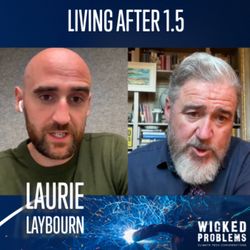
5. Laurie Laybourn on Overshooting 1.5°C
43:26||Season 4, Ep. 5Bonus content at wickedproblems.earth Overshoot, a new four-part documentary series from climate strategist and Wicked Problems alum Laurie Laybourn—goes further than nearly anyone has before. And he came back to unpack some of the key ideas in Overshoot and what he hopes people will do with it.In Overshoot the story starts with the fact that we can no longer avoid the storm, we’ve enetered it. How to survive and steer through it—generation after generation—is the conversation we urgently need to have now. Drawing on interviews with diplomats, scientists, and communities on the frontlines, Laybourn dismantles the win/lose logic that has dominated climate politics since Paris and asks what it means to live in an age of overlapping crises and hard adaptation choices.Our conversation ranges from the myth of Easter Island to the politics of “carbon sucking,” from managed retreat in Wales to the legal aftershocks of 1.5°C’s failure. It’s a clear-eyed look at what comes next—and why, even at the moment of “net zero,” we’ll be living in the most dangerous period in human history.
4. Touch the Feckin' Grass. w Bishop Martin Hayes, Jane Mellett, Eamon Ryan
01:08:54||Season 5, Ep. 4Discussing the Irish contingent at the Raising Hope conference and the future of faith and climate action -Bishop Martin Hayes of Kilmore; former Irish environment minister and Green Party leader Eamon Ryan; and campaigner Jane Mellett, church manager at Irish Catholic overseas development agency Trocaire. More information at climatepilgrim.com.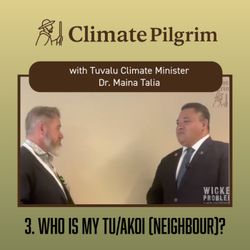
3. Who is my Tu/Akoi (Neighbour)?
32:21||Season 5, Ep. 3Who is my neighbour? 1.5°C is about neighbours, not numbers. Climate Minister Maina Talia of Tuvalu speaks to Richard Delevan about moral clarity in climate and denies the Australian 'climate visa' is about relocating his population. More information at climatepilgrim.com.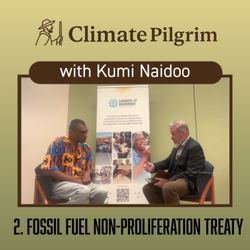
2. The Fossil Fuel Non-Proliferation Treaty, with Kumi Naidoo
55:13||Season 5, Ep. 2Should Pope Leo endorse a Fossil Fuel Non-Proliferation Treaty at COP30? Climate Pilgrim Episode 2: Dr. Kumi Naidoo 'cautiously optimistic' the Vatican and others will add up to 44 countries endorsing Treaty initiative by landmark April conference in Colombia. More detail at climatepilgrim.com.