Share
When Diplomacy Fails Podcast
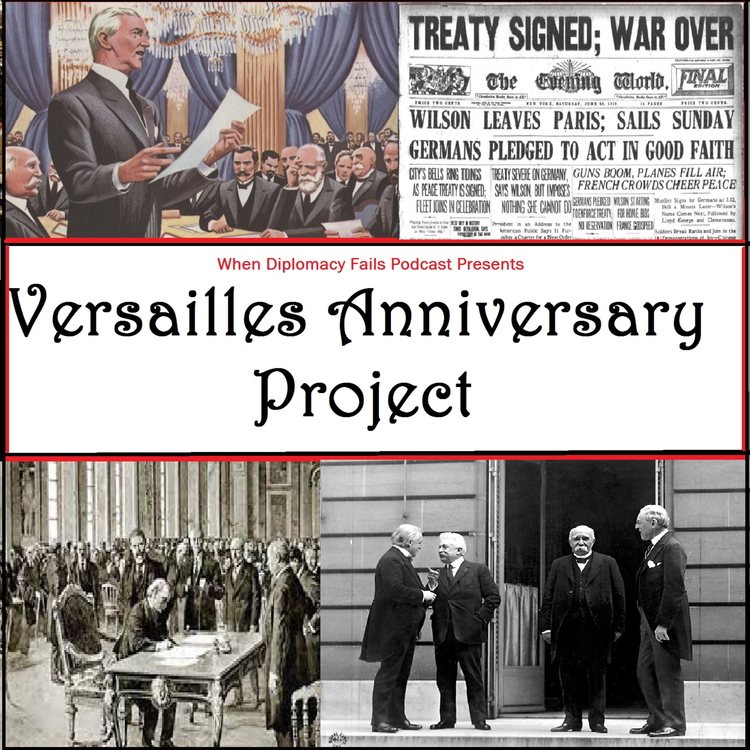
Versailles #75: Destructive Divisions
My agora friends and others are going to be in New York for a special conference on 29th June - meet Mike Duncan, Kevin Stroud, David Crowther and more! Search Intelligent Speech Conference now! Use the code WDF to get 5% off your ticket!
Between 5 to 10 June 1919, one could be forgiven for imagining that the allies would be far too buys discussing the German counterproposals and their intended reply to do anything else. In fact, what we see on the morning of 5th June is a significant exchange between Paderewski and the big three, as Poland was placed on trial for its recent actions. It was almost as though the big three had nothing else to do, as their attentions were well and truly occupied with this largely unrelated issue.
Or...was it so unrelated? After all, unless the border with Germany and Poland was finalised, and the question of Upper Silesia affirmed, there could be no clarity on the German Treaty as a whole. Furthermore, it was entirely possible that if the Poles were unclear about where they would have to stop in thier claims to nationhood, a conflict could erupt as soon as the peace was signed. As it happened, this conflict did erupt, but between Poles and Soviets rather than Poles and Germans. Solving the borders between the two states was just another divisive mission which the big three would have to accomplish, and it was plain that each individual had a different stake in the debate.
Was it possible that while en route to the resolution of the peace treaty, the big three could get so tied up in other questions equally in need of resolution that they might never make it to the end? Possibly; at the very least, these destructive divisions which always remained under the surface, and which moved the French, Americans and British to grow their own positions on the different aspects of the peace refused to go away. Until compromise could be reached, a final settlement would thus be out of reach altogether.
********
The Versailles Anniversary Project is possible because of your support and interest - make sure to spread the word, engage with the debate, and look at the different ways you can help this project succeed!
->Visit the homeland for this new project!
->Become a delegate and play the Delegation Game for just $6 a month!
->Support the podcast financially and access ad free episodes with transcripts from just $2 a month!
More episodes
View all episodes

Goodbye For Now
14:12|Between working full time and the impending arrival of baby WDF, I would be lying if I pretended as if nothing was going to change. It is, in fact, time to accept that I am only one man. But that's okay, because soon this man will be a daddy! A huge thanksss to you for sticking with the show, and although I cannot say when I'll be back, I promise you I will be...soon.
#70: July Crisis Q&A
58:33|During this series we have encountered a wide variety of fascinating characters and controversial decisions, but even though the story of why the world went to war in 1914 is finally finished, that doesn't mean we covered everything. After over a year of content, I felt it was only right to turn the mic over to you. What still leaves you puzzled? What do you think deserves more attention? What part of the story did I miss? What decision needs more explanation? Here, I delve into the questions you sent me over the last few weeks, and we bring this series to its deserved end. Thanksss so much for your questions, not to mention your support and attention, you're the best history friends a podcaster could ask for!
State of the Podcast Address 21 July 2025
29:02|It's been a while since I last checked in with you, and I've been sitting on some incredible news for a while now. If you'd like to know how things are about to change, then make sure you listen in!
#69: The First World War - Whose Fault Is It Anyway? Part 3
49:02|In our final part, we bring this saga of a series to an end by focusing our attention on the most focused on country of all - Germany. We know what Germany did from 1 August, from the declarations of war to the rape of Belgium, but what about before? What about the period 29-30 July, when the war truly became inevitable? Would it surprise you to learn that the Germans were the ones attempting to pull back from ledge?For a preciously brief period of time, Berlin was flying the flag for peace, even if they did so with insufficient skill and far too late. Germany's sins were many, but she was among good company. As we conclude here, none of the three eastern powers emerges without fault, but what does this mean for our understanding of the July Crisis? How does it change our view of the First World War? Join me here to find out, as I propose an alarmingly simple yet nuanced way of looking at this overwritten story. Thanksss so much for joining for the ride.Send your questions to our Q&A on the July Crisis!You can also send them through Facebook!
#68: The First World War - Whose Fault Is It Anyway? Part 2
37:56|For generations, examinations of the First World War excluded arguably the most important actor - Russia. In this episode, we will hone in on the Tsar's court and his ministers. We will analyse their mindset at crucial moments in the crisis, particularly the 29-30 July, where general mobilisation was approved against Austria and Germany. What was the meaning of this act? Was it based on sound logic, or something more problematic, and did this act mean that Russia - rather than Germany - was mostly responsible for what followed? Listen in to find out history friend!Make sure you visit our Q&A, to have your say on any questions you want answered on the July Crisis!
#67: The First World War - Whose Fault Is It Anyway? Part 1
45:09|By now we've seen the absolute worst that Europe had to offer in 1914. We've seen naive statesmen, misinformed statesmen, distrustful statesmen, desperate statesmen, and everything in between. But when it comes to the question of who was responsible or whose fault the outbreak of war actually was, how can you condense the last 60+ episodes into a coherent, satisfying answer? In this first instalment, we look at Austria-Hungary's clear role in the crisis, whether from pushing for war with Serbia, sabotaging negotiations, or keeping its German ally in the dark. Austria had a lot to answer for, and we are determined to pull no punches!Support the July Crisis series, join the conversation, and find out more through these links:Do you want ad-free episodes with scripts attached, and bonus content? Support us on Patreon and you can suggest July Crisis episodes!Join our Facebook group as we make our way through this fascinating series!Click here to see our July Crisis workspace in Perlego, you'll find every source you need
The Unreality of Realism w/ Alexander von Sternberg
02:18:43|Something special for you here - Alex and I had a great conversation about realism in international relations on his History Impossible podcast, and he was good enough to let me publish it on my feed. If you like political discussions, current affairs, and hearing a bit more about my academia journey, then have a listen to this episode. A huge thanksss to Alex for having me on, and make sure to check out History Impossible!Check out History Impossible
#66: The July Crisis - Conclusion
41:06|What have we learned after 65 episodes of background, analysis, and day-to-day coverage of the most consequential diplomatic failure in human history? What can we say about those responsible for what happened, and is there any value in searching for guilt? Can we distinguish between guilt or responsibility? Is it a cop out to not look for culprits? Should we search for reasons instead?The July Crisis is a story of human failure on a catastrophic scale, but not all failures were made equally. One is drawn to the behaviour of Austria, Russia, and Germany - the three Eastern powers - who made the war possible. But did they know what they were doing? Were they knowingly moving the world towards disaster, or simply making what they believed was the best choice available to them? Here we wrap up, as much as possible, this incredible story. Support the July Crisis series, join the conversation, and find out more through these links:Do you want ad-free episodes with scripts attached, and bonus content? Support us on Patreon and you can suggest July Crisis episodes!Join our Facebook group as we make our way through this fascinating series!Click here to see our July Crisis workspace in Perlego, you'll find every source you need!
#65: 5 August 1914 - 'This Frantic Stampede to Hell'
45:30|The world was at war, and there was much to do. In London, attention turned to the British Expeditionary Force. The BEF had been ruled out several times before, but that did not have to matter. How many divisions could Britain send, and to where? What of the Dominions, or India, or Egypt? How could one balance imperial possessions with European defence imperatives? At least, the Cabinet was mostly on the same page, and in Parliament, war credits were approved, though not without some vocal dissent.The mood in Germany was both anxious and defiant. The sheer extent of the challenge posed by the Triple Entente made gathering more allies all the more urgent, but it also entailed a kind of desperation, where Germany must be prepared to fight to the end. Austria would also be pressured to clarify matters, and declare war on Russia and France. The First World War as we know it was taking shape, yet very few fully understood how it had happened. Where complex analysis was unavailable and sources lacking, governments turned to propaganda and noble causes. The war could still be seen as a kind of adventure, but within weeks, romanticism would collide with the brutal reality of industrial slaughter.Support the July Crisis series, join the conversation, and find out more through these links:Do you want ad-free episodes with scripts attached, and bonus content? Support us on Patreon and you can suggest July Crisis episodes!Join our Facebook group as we make our way through this fascinating series!Click here to see our July Crisis workspace in Perlego, you'll find every source you need!