Share
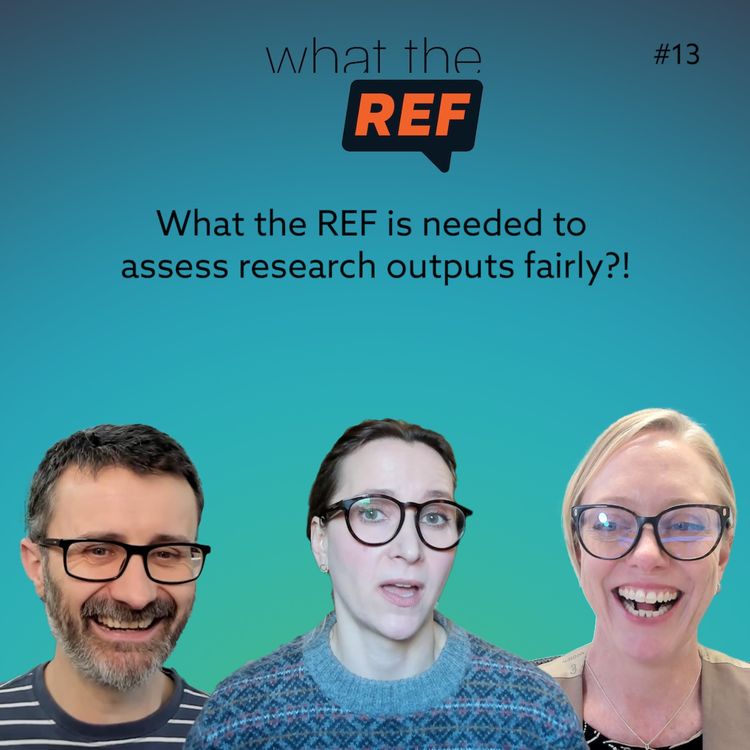
What the REF?!
What the REF is needed to assess research outputs fairly?!
A new year of ‘REF-iness’ kicks off as the What the REF team unpack the fallout from December’s REF changes and look ahead to what 2026 holds. With the dust now settling, the conversation turns from reaction to reckoning: what do the new rules actually mean in practice, and who stands to gain or lose?
The team highlight two must-read reflections on the reforms, including analysis of the removal of ‘culture’ from the former PCE and the disproportionate impact this may have on early career researchers, who often rely on less easily measurable contributions. While opinions differ on whether the shift from ‘culture’ to ‘strategy’ is substantive or merely semantic, there is consensus on one thing: the rules are set, and it is time to get on with it.
Much of the episode focuses on findings from the Hidden REF’s recent ‘think-aloud’ experiment, where evaluators assessed non-traditionally submitted outputs (NTOs) in real time. Drawing on 68 detailed observations across outputs ranging from software and databases to music composition, the team explore how assessors actually operationalise significance, originality, and rigour when familiar academic heuristics fall away. The results expose recurring challenges: inconsistent 300-word descriptions, reliance on inappropriate proxies from traditional publishing, and the subtle creep of aesthetics and personal taste into judgement.
The discussion moves from diagnosis to action. The team outline plans to translate these findings into practical assessment guidelines, to be tested and refined through workshops and the next Hidden REF competition. With submissions opening in March and an awards ceremony planned for November, the competition is positioned as both a low-risk testing ground and a rare source of joy in an otherwise anxiety-ridden REF cycle.
The episode closes with a shared ambition: to shift non-traditional outputs from the margins to the mainstream through evidence, dialogue, and sustained collective effort.
Our hosts are all members of the Hidden REF committee based at the universities of Southampton and Bristol: Gemma Derrick - a self-confessed REF junkie - Simon Hettrick and Ola Thomson, and our producer is Ben Thomas.
Find out more about the HiddenREF campaign at Hidden-REF.org
'What the REF' is made possible by the Embedding Trust in Evaluation (E-TIE) research grant from Research England.
Want to get in touch? Email: WTreF@hidden-ref.org
WTreF is co-produced by Simon Hettrick, Gemma Derrick, James Baker and Ben Thomas. Video and Sound production by Ben Thomas.
More episodes
View all episodes

25. What the REF do you get out of submitting to the Hidden REF Competition?!
46:04||Season 1, Ep. 25The Hidden REF competition is back! Bigger, busier and more diverse than ever. But why should you enter? In this episode, the What the REF team hears from three previous winners about what they gained from taking part. Jenni Adams explains how winning a Hidden Role award recognised work that often goes unseen. Jamie Davies reveals how a competition win helped his team secure funding for a vital global database. And Professor Lynne Bianchi shares how entering helped her team reflect on, evidence and articulate their impact. Plus: why submitting might be valuable even if you do not win. Ready to enter?Our hosts are all members of the Hidden REF committee based at the universities of Southampton and Bristol: Michael Donney, Lyndsey Ballantyne, and Ola Thomson, and our producer is Ben Thomas.
24. What the REF is it like to start the REF?!
01:07:36||Season 1, Ep. 24How do you do your first REF when there is no instruction manual? In this episode of What the REF, we meet Arts University Plymouth as they prepare for their very first REF submission. Alexandra Murphy and Ian Hutchinson share the excitement, confusion and opportunities of building a REF culture from scratch at a specialist arts university. We explore practice-based research, "not-traditionally submitted outputs", creative portfolios and the relationship between art and research. Plus, we discuss the demise of Research Professional, REF and research integrity, and why REF 2029 might be a live experiment for the future of research assessment.Our hosts are all members of the Hidden REF committee based at the universities of Southampton and Bristol: Gemma Derrick - a self-confessed REF junkie - Ola Thomson and Simon Hettrick. Our producer is Ben Thomas.
23. What the REF did we learn at ARMA?!
35:58||Season 1, Ep. 23Episode 23 of What the REF looks back at the recent ARMA Conference and the team’s take on various sessions there on the Research Excellence Framework. Gemma, Ola, and James discuss uncertainty around REF 2029, proposals to broaden what counts as research outputs, and gaps between policy language and what actually happens in institutions. They also dig into some of the bigger critiques of the REF — from Stefan Collini’s call to scrap it altogether, to counter-arguments that stress the need for accountability and a fair way of distributing research funding. Along the way, they share reflections from ARMA workshops, swap insights from creativity-focused university events, and dive into some REF folklore.Our hosts are all members of the Hidden REF committee based at the universities of Southampton and Bristol: Gemma Derrick – a self-confessed REF junkie – Ola Thomson, and James Baker.Our producer is Ben Thomas.
22. What the REF: In conversation with Steven Hill
43:47||Season 1, Ep. 22
21. What the REF?! It's the 2026 Hidden REF Competition!
20:44||Season 1, Ep. 21In this special episode of What the REF, the team officially launches the 2026 Hidden REF Competition and explores how it has evolved from a one-off initiative into a wider movement for research culture change. New co-host Michael Donnelly joins Lyndsey and Simon to discuss why the competition exists, who it supports, and how it helps spotlight overlooked research roles and outputs. They unpack this year’s REF-aligned submission process, share success stories from past entrants, and reflect on the morale boost, recognition and institutional change the competition has already inspired across the sector.Our hosts are all members of the Hidden REF committee based at the universities of Southampton and Bristol: Simon Hettrick, Lyndsey Ballantyne and Michael Donnay, and our producer is Ben Thomas.
20. What the REF can be measured?
30:56||Season 1, Ep. 20This episode of What the REF explores some of the biggest tensions shaping REF and the wider research sector. Gemma, Simon and Lyndsey discuss a criticism of the measurement of research culture, arguing that accountability and lived experience matter more than simplistic metrics. They then examine growing enthusiasm for AI in research assessment, questioning whether evaluation can ever be automated without losing human judgement, trust and responsibility. The conversation also unpacks the uncertainty surrounding non-traditional outputs in REF submissions, from software and databases to exhibitions and performances, highlighting confusion around portfolios, supplementary evidence and what information panels actually need to make fair assessments.Our hosts are all members of the Hidden REF committee based at the universities of Southampton and Bristol: Gemma Derrick - a self-confessed REF junkie - Simon Hettrick and Lyndsey Ballantyne, and our producer is Ben Thomas.
19. What the REF do REF institutional leads do?!
58:36||Season 1, Ep. 19Inside the REF machine: this episode of What the Ref lifts the lid on life as an institutional lead. Featuring Gemma Fitzsimmons and Julie Northam, we explore the realities of coordinating submissions, navigating ambiguous guidance, and building confidence across entire universities. From data security concerns to the challenge of representing diverse research outputs, the conversation blends practical insight with sector-wide reflection. Expect candid discussion on pressure, collaboration, and the surprisingly supportive REF community. If you have ever wondered how the REF really works behind the scenes – or how decisions get made – this episode offers a clear, human perspective on a complex national exercise.Our hosts are all members of the Hidden REF committee based at the universities of Southampton and Bristol: Simon Hettrick and Ola Thomson, and our producer is Ben Thomas.
18. What the REF is happening with books?!
01:00:40||Season 1, Ep. 18This week on What the Ref, the team heads to Plymouth for a lively workshop on non-traditional outputs before diving into a fascinating interview with Gareth Cole on the future of open access books. From monographs to “long-form” research, they unpack the challenges of defining openness, funding models beyond book processing charges, and the tension between flexibility and REF policy. Is the system sidelining books—and entire disciplines? Plus, new REF folklore debunked: can novels and trade books really be submitted? A sharp, thought-provoking episode on where research publishing is heading next.Our hosts are all members of the Hidden REF committee based at the universities of Southampton and Bristol: Simon Hettrick, James Baker and Ola Thomson, and our producer is Ben Thomas.
17. What the REF is work/life balance?!
34:20||Season 1, Ep. 17Dive into the latest episode of What the REF?, where the team unpacks shifting UK research funding, REF 2029 updates, and what an interim director could mean for the sector. From curiosity-driven research and “hidden roles” to the challenges of assessing non-traditional outputs, this episode explores how academia is evolving in real time. The conversation also tackles bigger cultural questions: joy in research, slow scholarship, and whether academia should just be ‘a job’. Plus, insights from NTO workshops, early career concerns, and the future of research assessment—practical, honest, and thought-provoking throughout.Our hosts are all members of the Hidden REF committee based at the universities of Southampton and Bristol: Simon Hettrick, Ola Thomson and James Baker. Our producer is Ben Thomas.