Share
What The Fraud?
Designing for Trust in the Age of Agents — Money20/20 Europe
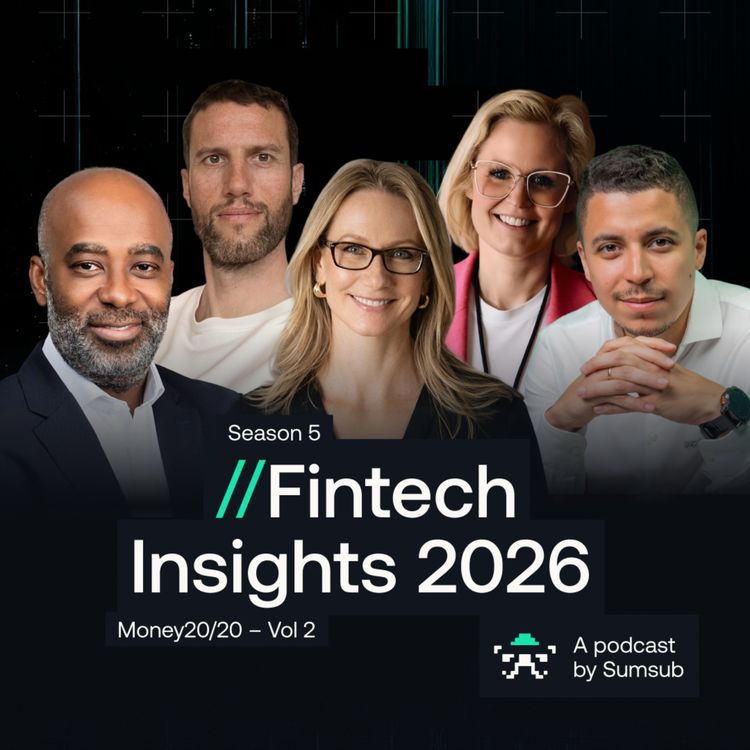
For Part 2 of our special coverage from Money20/20 Europe in Amsterdam, we continue the conversation on AI, trust, and fraud with a fresh set of leaders from across digital banking, payments, and regulation. Where Part 1 focused on AI transformation at scale, this episode digs into invisible banking, digital identity, agentic commerce, and the regulatory frameworks needed to make cross-border payments work safely.
Direct from the Sumsub booth, Thomas Taraniuk, Head of Partnerships at Sumsub, speaks with leaders from across the financial services ecosystem about what trust looks like when more of banking happens quietly, behind the scenes, and what it takes to keep fraud out without adding friction for the people and businesses who depend on these systems every day.
Our guests include:
- Mette Gade (Chief Product Officer, Lunar) on building "invisible banking," why trust means giving users back their agency rather than advising them, and why fraud prevention works best as a shared community effort.
- Breno Oliveira (Chief Product Officer, payabl.) on whether digital identity can solve Europe's fraud problem, the rise of selective disclosure, and how agentic commerce will change fraud signals as we know them.
- Bankole Falade (Chief Legal, Regulatory Affairs & Public Policy Officer, Flutterwave) on building payment infrastructure across 50+ African markets, what Europe can learn from African regulatory pragmatism, and why harmonisation is the "golden ticket" for stablecoins and cross-border payments.
- Antoine Dauchy (Head of Product Development, FLOA) on the unique fraud challenges of buy-now-pay-later, why 3DS doesn't protect against installment fraud, and how tokenisation is making it easier for fraudsters to cover their tracks.
- Conny Ploth (VP, Global AI Transformation, Santander) on what it actually means to become an AI-native bank, the cultural shift required to make it stick, and why open innovation, including sharing fraud research publicly, is part of responsible AI
Across these conversations, one theme keeps surfacing: as banking becomes quieter and more automated, trust has to be built into every micro-moment, and the institutions, regulators, and product teams that get ahead of fraud will be the ones willing to share data, rethink friction, and design for agents as much as for people.
Because the next wave of fraud won't announce itself. It will look exactly like normal traffic, until it isn't.
Thomas Taraniuk on LinkedIn: linkedin.com/in/tomtaraniuk
Mette Gade on LinkedIn: linkedin.com/in/mettehindborggade
Breno Oliveira on LinkedIn: linkedin.com/in/brenoaoliveira
Bankole Falade on LinkedIn: linkedin.com/in/oluwabankole-falade-10a5099
Antoine Dauchy on LinkedIn: linkedin.com/in/antoine-dauchy-aa99426
Conny Ploth on LinkedIn: linkedin.com/in/conny-ploth-a66730
More episodes
View all episodes

Is Anyone Too Smart to Be Scammed?
41:59|“Is anyone too smart to be scammed… or are we all just one bad moment away?”We all like to think we'd spot a scam a mile off. But vulnerability has far less to do with intelligence than with timing, emotion, and context, and fraudsters know exactly how to exploit all three.Welcome to the new season of What the Fraud, and to our brand-new host, investigative journalist Vicky Baker. This season, we're looking at the personal side of fraud: the human moments behind the headline numbers.Our special guests this week are Nick Harris, Head of Financial Crime, and Iain Orpen, Head of Fraud Prevention at Capitec Bank, South Africa's largest retail bank. They explain why everyone has a vulnerability scammers can find, and why judging victims only makes the problem worse.From a deliberate job scam run by journalist Joel Cedras and romance scams that play the long game, to deepfake calls and malware disguised as free streaming apps, this conversation explores how scams are becoming more personal and harder to spot in the moment.We also examine why shame and re-victimization keep reporting rates low, how banks can spot the signals of a scam before money moves, and why industry-wide collaboration and tools like "Trusted Approver" are essential to protecting vulnerable customers.Links:Sumsub's Website: sumsub.comSumsub's LinkedIn: linkedin.com/sumsubSumsub's Instagram: instagram.com/sumsubcomSumsub on X: x.com/SumsubcomSumsub's YouTube Channel: youtube.com/@sumsubcomVicky Baker on LinkedIn:https://www.linkedin.com/in/vicky-baker-2426263Nick Harris on LinkedIn: linkedin.com/in/nicholas-harris-67403a24Iain Orpen on LinkedIn: linkedin.com/in/iain-orpen-65810b1b9
Season 6 of What The Fraud?
00:53|Meet Vicky Baker, the new host of What The Fraud? from Sumsub.An investigative journalist specialising in fraudsters and con artists, Vicky is fascinated by the stories beneath the scams. The trust people place in others, the psychology behind manipulation, and the moments when a lie becomes believable.In season six, What The Fraud? looks beyond the technology and headline figures to explore the personal side of fraud. Why do we trust someone who is trying to steal from us? What makes any of us vulnerable? And what would it take to stop the crime before the money moves?The new season of What The Fraud? with Vicky Baker.
Building Trust in Africa’s Digital Economy
47:40|“Customers don't choose between security and convenience. They expect both."Africa's payments, banking, and digital commerce ecosystem is expanding at extraordinary speed, and fraud is scaling right alongside it. In this special episode of What the Fraud?, recorded live at Seamless Africa in Johannesburg, Chantal Lamprecht from Sumsub sits down with leaders across telecoms, mobile money, and digital banking to unpack how fraud actually works on the ground in Africa, and what it will take for the industry to stay ahead.Our guests include:Kgabo Seopa (Managing Executive: Products & Solutions, Vodacom Business) on the shift from telco to "techco" and why cybersecurity is now core to that transformation, the AI-versus-AI arms race between fraud teams and fraudsters ("it's a war that no one is a winner"), and why South Africa needs a SABRIC-style information-sharing body for telecoms and merchants, not just banks.Pulane Motlokoa (Group Senior Manager, Enterprise Risk, MTN) on embedding risk into product design from day one instead of treating it as a final checkpoint, why fraudsters increasingly target human psychology rather than technology itself, and how MTN standardizes risk principles across diverse African markets while leaving room for local flexibility.Bonolo Sebolai (Fraud Prevention, GoTymeBank) on why roughly 80% of fraud ultimately comes down to manipulating human psychology, what it really means to integrate AI "vertically" into a bank's fraud strategy, and why customer relationships, not technology alone, are a bank's real competitive edge against fraudsters.Links:Sumsub's Website: sumsub.comSumsub's LinkedIn: linkedin.com/sumsubSumsub's Instagram: instagram.com/sumsubcomSumsub on X: x.com/SumsubcomSumsub's YouTube Channel: youtube.com/@sumsubcomKgabo Seopa on LinkedIn: linkedin.com/in/kgabo-seopa-139a6b8/Pulane Motlokoa on LinkedIn: linkedin.com/in/pulane-motlokoa-ca-sa/Bonolo Sebolai on LinkedIn: https://www.linkedin.com/in/bonolo-s-83a5aa90/
The New Front Lines of Financial Crime in Africa
44:21|"The fraudsters have the same AI tools we do. The difference is who uses them faster."Africa's payments, banking, and digital commerce ecosystem is expanding at extraordinary speed, and fraud is scaling right alongside it. In this special episode of What The Fraud?, recorded live at Seamless Africa in Johannesburg, Chantal Lamprecht from Sumsub sits down with leaders across crypto, legal, and iGaming to unpack how fraud actually works on the ground in Africa, and what it will take for the industry to stay ahead.Our guests include:John Jacobs (Head of Financial Crime, VALR) on why crypto fraud runs on the same decades-old typologies as traditional finance, just faster and borderless, why attribution, not tracing, is the hardest part of on-chain investigations, and why Africa's crypto adoption boom is fueling a rise in money mule recruitment.Larry Cooke (Larry Cooke, Africa Head of Legal at Binance) on the regulatory gaps opening up as crypto credit products emerge, why "thoughtful" regulation beats "more" regulation, the rise of P2P fraud and reverse chargebacks, and why closing the trust gap between regulators, exchanges, and users is the real work ahead.Mandy Alexander (Head of Financial Crime and Customer Care Product, DigiOutsource / Super Group) on 20 years watching iGaming fraud teams evolve from chargeback-chasers into full-blown "FRAML" operations, why friction should only ever be justified by data, and why patience, not chasing shiny new tools, is what actually delivers ROI from AI and automation.Links:Sumsub's Website: sumsub.comSumsub's LinkedIn: linkedin.com/sumsubSumsub's Instagram: instagram.com/sumsubcomSumsub on X: x.com/SumsubcomSumsub's YouTube Channel: youtube.com/@sumsubcomJohn Jacobs on LinkedIn: linkedin.com/in/john-jacobs-87b183122Larry Cooke on LinkedIn: linkedin.com/in/larry-cooke-38390b115Mandy Alexander on LinkedIn: linkedin.com/in/mandy-alexander-8560a2a
Bury the Blockchain: Crypto's Fight for Trust
49:52|Cryptocurrency didn't invent financial fraud, but it changed how money moves and how criminals exploit it. Now, with new US legislation on the table, the industry faces a bigger question: can a system built on decentralization ever become trusted infrastructure?In this episode of What The Fraud, Tom sits down with the hosts of Crypto in America: Eleanor Terrett, Jacquelyn Melinek, and Gerald Gallagher, for a special crossover episode closing out Season 5.Together they unpack the Genius Act and Clarity Act and what they actually mean for stablecoins, market structure, and consumer protection, why institutions are finally treating crypto as a technology rather than a speculative bet, the surge in DeFi hacks driven by social engineering rather than code exploits, and the growing conversation around privacy, AI agents, and programmable payments as the next frontier.They also get personal, sharing their own brushes with fraud, the online behaviors they'd ban forever, and where they think crypto will be in ten years.Whether you work in fraud, fintech, payments, or policy, this episode offers a candid look at what it will really take for crypto to earn the public's trust.Sumsub's Website: sumsub.comSumsub's LinkedIn: linkedin.com/sumsubSumsub's Instagram: instagram.com/sumsubcomSumsub on X: x.com/SumsubcomSumsub's YouTube Channel: youtube.com/@sumsubcomThomas Taraniuk on LinkedIn: linkedin.com/in/tomtaraniukEleanor Terrett on LinkedIn: linkedin.com/in/eleanor-terrett-b9a77292Jacquelyn Melinek on LinkedIn: https://www.linkedin.com/in/jacquelynmelinekGerald Gallagher on LinkedIn: linkedin.com/in/gerald-gallagher-285040b6
Cash Out: Fraud's Final Act
51:04|"What happens when the moment of truth isn't onboarding - it's the moment the money moves?"Businesses pour resources into KYC, fraud modelling, and onboarding checks. But fraud doesn't really happen until the money goes out, and by then, it's often too late to get it back.This week's guest is Apurva Shrivastava, Product Lead for Global Payments Product at Amazon. He breaks down why payout fraud is one of the most underestimated risks in the industry, and why "we caught it at onboarding" isn't enough on its own.We cover the three phases of cash-out fraud: Account farming, waiting for a trigger event, and burst execution, why payout fraud often gets booked as an "operational loss" instead of a fraud loss, and what a disbursement-time identity assurance score could look like in practice.As Apurva puts it: platforms have to be right every time. Fraudsters only need to be right once.Sumsub's Website: sumsub.comSumsub's LinkedIn: linkedin.com/sumsubSumsub's Instagram: instagram.com/sumsubcomSumsub on X: x.com/SumsubcomSumsub's YouTube Channel: youtube.com/@sumsubcomThomas Taraniuk on LinkedIn: linkedin.com/in/tomtaraniukApurva Shrivastava on LinkedIn: linkedin.com/in/apurva-shrivastava/
Adapt or Fall Behind - AI & Fraud Insights from Money20/20 Europe
33:22|Recorded live on the floor of Money20/20 Europe in Amsterdam, this special episode of What the Fraud? brings together some of the sharpest minds in fintech to tackle the questions that matter most right now: how do you deploy AI at scale, build trust with users, fight increasingly sophisticated fraud, and keep growing without getting left behind?Direct from the Sumsub booth, Thomas Taraniuk, Head of Partnerships at Sumsub, speaks with leaders from across the financial services ecosystem about the forces reshaping the industry: from agentic AI and stablecoins to merchant fraud blind spots and the cost of compliance.Our guests include:Georgios Kolovos (Payments and Fintech Leader, EMEA, Nvidia) on whether a single AI model can power the entire payment stack, the value of transaction foundation models, and why collaboration between financial institutions is essential to staying ahead of fraudJoe Wilson (Chief Evangelist, Bunq) on building trust with expats and digital nomads, why brutal transparency is a competitive advantage, and the case for intervening on the user's side before fraud ever reaches the back endRik Goslinga (VP, Account Management, EMEA, Adyen) on the merchant blind spots that still plague the industry, why fraud is no longer just a checkout problem, and how machine learning is making the fraud-conversion-cost trade-off less of a zero-sum gameIvan Zhiznevsky (Founder and CEO, 3S Money) on unlocking new markets through modernised payments, the rise of stablecoins as a legitimate business currency, and why governments need to stop outsourcing compliance to the private sectorAcross every conversation, a common thread emerges: the fraudsters are moving faster, the technology is more powerful than ever, and the institutions that will win are the ones willing to share knowledge, question their assumptions, and embed intelligence across the entire stack, not just at the point of payment.Because in a world where fraud is being industrialised, defence can't afford to stay manual.Thomas Taraniuk on LinkedIn: linkedin.com/in/tomtaraniukGeorgios Kolovos on LinkedIn: linkedin.com/in/gkolovosJoe Wilson on LinkedIn: linkedin.com/in/risenujoeRik Goslinga on LinkedIn: linkedin.com/in/rikgoslingaIvan Zhiznevsky: linkedin.com/in/ivan-zhiznevsky-a0074190
Account Takeover: When Trust Gets Hijacked
43:22|Account takeovers have become one of the biggest challenges in fraud prevention.In this episode of What The Fraud, Tom is joined by Suz Lynch, Head of Financial Crime, and Paul Marsden, Head of Risk at Monavate, to explore how fraudsters gain access to trusted accounts, why account takeovers are becoming harder to detect, and how businesses can respond.From behavioural monitoring and AI-driven scams to the balance between security and customer experience, they discuss the warning signs, emerging threats, and practical steps organisations can take to stay ahead.Whether you're working in fraud, fintech, payments, or compliance, this episode offers valuable insights into one of the fastest-growing risks in digital finance.Sumsub's Website: sumsub.comSumsub's LinkedIn: linkedin.com/sumsubSumsub's Instagram: instagram.com/sumsubcomSumsub on X: x.com/SumsubcomSumsub's YouTube Channel: youtube.com/@sumsubcomThomas Taraniuk on LinkedIn: linkedin.com/in/tomtaraniukSuz Lynch on LinkedIn: linkedin.com/in/suzanne-lynch-68003667 Paul Marsden on LinkedIn: linkedin.com/in/paul-marsden-69a98838