Share
What I learned in business (that didn't kill me!)
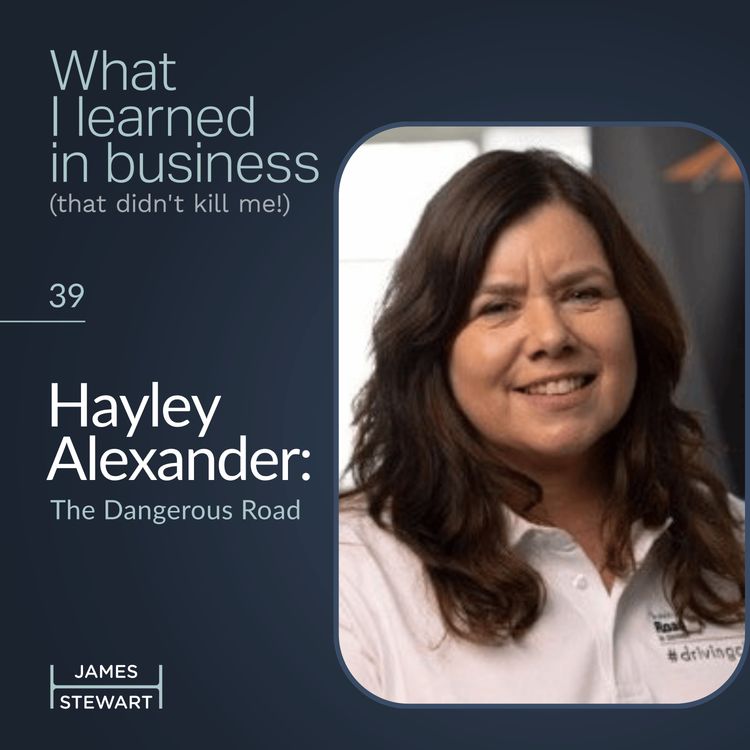
Hayley Alexander: The Dangerous Road
The Alexander Group is New Zealand's leading specialist dangerous goods logostics business.
James H Stewart sits down with Hayley Alexander, CEO of this 55-year-old family logistics business, to discuss the business remarkable journey and her personal evolution from a career in public service to CEO.
Hayley’s path to leadership was far from conventional.
Before joining the family business, she spent 10 years as a social worker in New Zealand and the UK, working in areas including domestic violence and child protection. She later joined Alexander Group in 2002 and has now led the business as CEO for more than eight years.
In this conversation, James and Hayley discuss family business succession, leadership, safety, governance, culture, sustainability, artificial intelligence and the realities of running a high-risk transport business. They also explore what it takes to lead a multi-generational family enterprise with a 100-year vision.
This episode is proudly supported by Family Business Association of Australia and New Zealand.
Important disclaimer: This podcast is for general information and entertainment purposes only. The views expressed are those of the participants and do not constitute financial, legal, investment, business or professional advice. Listeners should seek their own independent advice before making any business or investment decisions.
Connect with James:
LinkedIn: https://www.linkedin.com/in/james-h-stewart-gaicd-83b46a9/
Website: https://www.jameshstewart.com
Instagram: https://www.instagram.com/whatilearnedinbusiness/
YouTube: https://www.youtube.com/channel/UC_WgwbOVsSuzuvXEgqNTl4g
More episodes
View all episodes
41. Ian Fredericks: CEO Hilco Global Capital Solutions
53:38||Season 1, Ep. 41Why do some iconic businesses survive disruption while others disappear forever?In this episode James H Stewart sits down with Ian Fredericks, CEO of Capital Solutions (Americas) at Hilco Global, Global Head of Data & Innovation, and one of the world's leading experts in corporate restructuring, distressed investing and retail turnarounds.Having advised on some of the largest retail restructurings in the United States, Ian provides a rare insider's perspective on what really happened behind the collapses of Circuit City and Toys "R" Us, and why many great companies fail long before they run out of money.The conversation explores the warning signs of corporate distress, the impact of leveraged buyouts, how investors identify businesses worth saving, the explosive growth of private credit, and how artificial intelligence is reshaping the future of retail.Ian also reflects on his own journey—from restructuring lawyer to global business leader—and the lessons he's learned from helping businesses navigate their toughest moments.In this episode we discuss:• Why Circuit City and Toys "R" Us ultimately failed• The role debt plays in corporate collapse• What turnaround investors look for in distressed businesses• The changing dynamics of the U.S. retail market• How Amazon, Temu and Shein are reshaping consumer behaviour• The rapid rise of private credit and what it means for business• Practical applications of AI in retail and data-driven decision making• Leadership lessons from decades of restructuring and business transformationWhether you're a business owner, retailer, investor, lender or simply fascinated by how companies succeed and fail, this episode offers practical insights from someone who has spent his career helping organisations navigate uncertainty.Connect with James StewartLinkedIn: https://www.linkedin.com/in/james-h-stewart-gaicd-83b46a9/Website: https://www.jameshstewart.comDisclaimerThe views expressed by guests on What I Learned in Business (That Didn't Kill Me!) are their own and are provided for general information and discussion purposes only. Nothing in this episode constitutes financial, investment, legal or professional advice. Listeners should obtain independent advice before making any business, financial or investment decisions.
40. Alister Haigh: The Chocolate Man
32:04||Season 1, Ep. 40For more than 110 years, Haigh's Chocolates has delighted Australians while remaining proudly family-owned, manufacturing locally and resisting the lure of supermarket shelves.James H Stewart sits down with fourth-generation family leader Alister Haigh to explore the remarkable story behind one of Australia's most respected premium brands.After leading Haigh's Chocolates for almost three decades as CEO, Alister recently stepped aside, handing the reins to the company's first non-family chief executive. Together, James and Alister discuss what it takes to preserve a family legacy while continuing to evolve in an increasingly competitive and rapidly changing retail landscape.They explore:• How Haigh's Chocolates has grown from a small Adelaide business into a nationally recognised premium brand over 110 years.• The unique challenges of leading a fourth-generation family business.• Why succession planning may be the most important decision any family business will ever make.• The appointment of Haigh's first non-family CEO and the governance lessons behind that decision.• Why Haigh's has deliberately stayed out of supermarkets despite intense competition.• Building and protecting a premium brand in a commoditised market.• Consumer behaviour, changing chocolate consumption trends and the future of premium retail.• How Haigh's responded to unprecedented increases in global cocoa prices.• The strategic thinking behind the company's $130 million investment in advanced Australian manufacturing.• Leadership, stewardship and the responsibility of leaving a business stronger for the next generation.Whether you lead a family business, work in retail, manufacture products in Australia or simply enjoy hearing the stories behind iconic Australian brands, this conversation offers valuable insights into leadership, long-term thinking and building enduring competitive advantage.A special thank you to the Family Business Association of Australia and New Zealand for sponsoring this episode. The FBA supports family businesses through education, networking, advocacy and governance, helping business families thrive across generations.Connect with James StewartWebsite: https://jameshstewart.comLinkedIn: https://www.linkedin.com/in/james-h-stewart-gaicd-83b46a9Instagram: https://www.instagram.com/whatilearnedinbusiness/YouTube: https://www.youtube.com/@WhatILearnedInBusinessIf you enjoyed this episode, please subscribe or follow the show, leave a review and share it with your colleagues and friends.DisclaimerThe views expressed by guests on this podcast are their own and do not necessarily reflect those of the host or any organisation with which they are associated. This podcast is intended for general information and educational purposes only and should not be relied upon as financial, legal, investment or professional advice. Listeners should obtain independent professional advice relevant to their own circumstances before making business or financial decisions.
39. Paul Martin: Alix Partners Global Retail Growth Leader
59:41||Season 1, Ep. 39Retail is changing faster than ever. But are today's retailers really growing—or have they simply been riding a wave of inflation?James H Stewart sits down with Paul Martin, Global Retail Growth Leader and Partner at AlixPartners, one of the world's leading advisory firms specialising in retail transformation, performance improvement and turnaround.Having advised many of the world's largest retailers, consumer brands, boards and private equity firms across Europe, North America and Asia, Paul offers a unique global perspective on the forces reshaping the retail and consumer landscape.Together, James and Paul explore:Why inflation may have disguised underlying weakness across the retail sectorThe health of global retail and what lies ahead for consumer spendingHow tariffs, geopolitics and supply chain disruption are changing retail economicsThe explosive growth of Chinese marketplaces such as Temu and their impact on traditional retailersWhy the resale economy is becoming one of retail's fastest-growing sectorsWhether social media has become the new front door to retailHow artificial intelligence and Agentic AI are transforming customer engagement, merchandising and business modelsWhy the fundamentals of great retailing still matter in an increasingly digital worldThe retailers and business models Paul believes are best positioned to win over the next decadeWhether you're a retailer, supplier, investor, executive, entrepreneur or simply fascinated by how consumer behaviour is evolving, this episode provides practical insights from one of the world's leading retail advisers.Connect with James Stewart🌐 Website: https://jameshstewart.com💼 LinkedIn: https://www.linkedin.com/in/james-h-stewart-gaicd-83b46a9/📸 Instagram: https://www.instagram.com/whatilearnedinbusiness/▶️ YouTube: https://www.youtube.com/@WhatILearnedInBusinessIf you enjoyed this episode, please follow the podcast, leave a review and share it with your network. Your support helps us continue bringing world-class business leaders and thinkers to the show.DisclaimerThe views expressed by guests on What I Learned in Business (That Didn't Kill Me!) are their own and are shared for general information and discussion purposes only. They do not constitute financial, investment, legal or professional advice and should not be relied upon as such. Listeners should seek independent professional advice before making business, financial or investment decisions based on any matters discussed in this episode.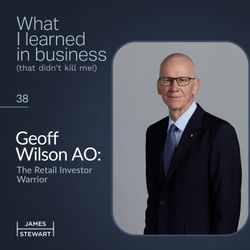
38. Geoff Wilson AO: The Retail Investor Warrior
56:53||Season 1, Ep. 38Geoff Wilson AO is one of Australia's most outspoken advocates for retail shareholders.As the founder and Chairman of Wilson Asset Management, Geoff has spent almost five decades navigating financial markets, building one of Australia's leading investment firms and becoming a powerful voice on corporate governance, shareholder activism and public policy.James H Stewart sits down with Geoff to discuss his journey from research analyst to managing billions of dollars on behalf of more than 130,000 investors. He shares the lessons learned through multiple market cycles and discusses the defining issues that have shaped Geoff's career, including his campaigns for better corporate governance, his activism during the AMP board upheaval following the Royal Commission, and the highly publicised franking credits campaign that became one of the biggest political issues of the 2019 Federal Election.The conversation then turns to today's economic landscape, where Geoff offers his perspective on Australia's competitiveness as a destination for investment, the 2026 Federal Budget, proposed changes to capital gains tax, productivity, regulation, and what governments should be doing to encourage business growth, entrepreneurship and long-term investment.Finally, Geoff discusses the remarkable success of the Future Generation investment companies, which have directed more than $100 million to Australian charities supporting children, youth and mental health.Whether you're an investor, business owner, company director or simply interested in Australia's economic future, this is a wide-ranging conversation about leadership, markets, governance and the importance of backing your convictions.In this episode we discuss:Geoff's journey to founding Wilson Asset ManagementLessons from nearly 50 years in investment marketsShareholder activism and corporate governanceThe AMP board renewal following the Royal CommissionThe 2019 franking credits campaignAustralia's competitiveness for investment capitalCapital gains tax, productivity and the 2026 Federal BudgetFuture Generation and investing for social impactLeadership, philanthropy and building a lasting legacyIf you enjoyed this episode, please follow the podcast, leave a review and share it with someone who enjoys thoughtful conversations about business, leadership and investing.Connect with James StewartLinkedIn: https://www.linkedin.com/in/james-h-stewart-gaicd-83b46a9/Instagram: https://www.instagram.com/whatilearnedinbusiness/YouTube: https://www.youtube.com/@WhatILearnedInBusinessDisclaimerThe views and opinions expressed by Geoff Wilson and James H Stewart in this episode are their own and are provided for general information and discussion purposes only. Nothing in this podcast should be construed as financial, investment, taxation, accounting or legal advice, or as a recommendation to buy, sell or hold any investment or financial product. Investment markets involve risk, and past performance is not a reliable indicator of future performance. Before making any investment or financial decision, you should seek advice from a suitably qualified professional who understands your individual objectives, financial circumstances and needs.The discussion in this episode may reference companies, investment strategies, taxation policy, legislation and market conditions that were current at the time of recording and may change over time.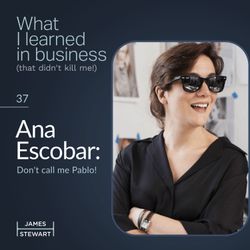
37. Ana Escobar: Don't Call Me Pablo!
59:57||Season 1, Ep. 37LMND may be the hottest female fashion brand in Australia right now.James H Stewart sits down with Ana Escobar, founder of Australian fashion label LMND, to explore an extraordinary entrepreneurial journey spanning two continents, some of Australia's best-known retail brands, and the challenges of building a self funded premium fashion business.Born in Australia before moving to Colombia as a young child, Ana shares her remarkable story of growing up in Medellin, during one of Colombia's most turbulent periods before returning to Australia to pursue a career in fashion. From starting as a sales assistant at Oroton to becoming Brand Director, leading private label innovation at Big W, and ultimately launching LMND in 2018, Ana's career demonstrates the power of resilience, creativity and customer obsession.In this episode we discuss:• Growing up between Australia and Colombia and the experiences that shaped her outlook.• Building a career through Oroton, Apparel Group and Big W.• Why she left corporate retail to launch LMND.• Identifying a gap in the market for premium wardrobe essentials.• Why LMND opened a physical store before launching online.• Building an international brand stocked by retailers including Myer, Selfridges and Neiman Marcus.• Growing a business without external investors or private equity.• Customer-led product development and the importance of listening over ego.• Social media strategy without relying on paid influencers.• Scaling a founder-led business while protecting brand integrity.• The lessons Ana has learned from building one of Australia's fastest-growing independent fashion brands.Whether you're an entrepreneur, retailer, designer, business owner or simply fascinated by the journey of building a successful brand, Ana's story offers practical insights into leadership, innovation and disciplined business growth.Connect with James StewartLinkedIn: https://www.linkedin.com/in/james-h-stewart-gaicd-83b46a9/Website: https://jameshstewart.comInstagram: https://www.instagram.com/whatilearnedinbusiness/YouTube: https://www.youtube.com/@WhatILearnedinBusinessIf you enjoyed this episode, please subscribe, leave a review and share it with your network.DisclaimerThe information, opinions and views expressed by guests on What I Learned in Business (That Didn't Kill Me!) are their own and are provided for general information and discussion purposes only. They do not constitute financial, legal, investment or professional advice and should not be relied upon as such. Listeners should obtain independent professional advice relevant to their own circumstances before making any business, financial or investment decisions. While every effort is made to ensure accuracy, neither the host nor the producers accept responsibility for any loss arising from reliance on information contained in this episode.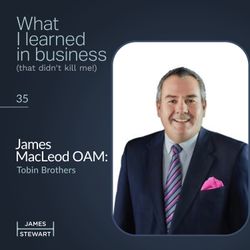
35. James MacLeod OAM: Tobin Brothers.
47:54||Season 1, Ep. 35What can a funeral business teach us about leadership, trust, innovation and family business governance?Quite a lot, it turns out.In this episode of What I Learned in Business (That Didn't Kill Me), I sit down with James MacLeod OAM, Managing Director of Tobin Brothers Funerals, one of Australia's largest and most respected family-owned businesses.James's journey is remarkable. Starting as a coffin trimmer as a young boy, he worked his way through virtually every role in the organisation before becoming the first non-family Managing Director in the company's history. Today, he leads a team of approximately 280 people delivering around 7,000 funerals each year.This conversation goes far beyond the funeral industry.We explore the realities of leading a business that operates 24 hours a day, 365 days a year, supporting families through some of the most difficult moments of their lives. We discuss succession planning, governance, culture, innovation, customer trust and the unique challenges of balancing family ownership with professional management.James also shares the story behind Tobin Brothers' bold decision to launch Fixed Price Cremations, a low-cost, no-service offering designed to compete directly with emerging disruptors in the market. It is a fascinating case study in self-disruption, strategic thinking and the lessons he brought back from executive education programs at INSEAD and Harvard.We also discuss:• The history and evolution of Tobin Brothers• The changing nature of funerals and memorial services• Cremation versus burial trends• Virtual funerals and the impact of COVID• Governance in multi-generational family businesses• The appointment of independent leadership and directors• Employee culture in a business built around grief and service• AI, automation and the future of funeral services• Emerging technologies including aquamation and environmentally sustainable alternatives to traditional burial and cremationThis is a thoughtful, insightful and at times surprising conversation about an industry every one of us will engage with, but very few of us truly understand.Whether you're a business owner, director, executive, family business leader or simply curious about how great organisations build trust over generations, you'll find valuable lessons in this discussion.This episode is proudly supported by the Family Business Association (FBA), which supports, connects and advocates for family businesses across Australia and New Zealand.Connect with James H StewartLinkedIn: James H StewartInstagram: @whatilearnedinbusinessYouTube: What I Learned in Business (That Didn't Kill Me)If you enjoy the show, please subscribe, leave a review and share the episode with your network.DisclaimerThe views, opinions and experiences expressed by guests on this podcast are their own and do not necessarily reflect the views of the host or any affiliated organisations. This podcast is intended for general information and educational purposes only and should not be relied upon as financial, legal, investment, taxation or other professional advice. Listeners should seek independent professional advice relevant to their own circumstances before making any business or investment decisions.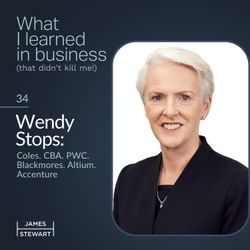
34. Wendy Stops: Coles. CBA. PWC. Blackmores. Altium. Accenture.
01:08:53||Season 1, Ep. 34Born and raised on a dairy farm near Shepparton and the first person in her extended family to attend university, Wendy built a remarkable 32-year career with Accenture that took her from regional Victoria to leadership roles across Asia, New York and the global technology consulting sector.Following her executive career, Wendy became one of Australia's most respected Non-Executive Directors, serving on the boards of organisations including Coles, Commonwealth Bank, Blackmores, Altium, Melbourne Business School and most recently PwC Australia. She also has a long association with Fitted For Work, the NFP supporting women in the workplace.In this wide-ranging conversation, Wendy shares lessons from the boardroom and beyond, including:Her journey from country Victoria to global leadership.Building and leading large technology businesses across multiple countries.The hardest leadership lessons she learned during periods of organisational change.Governance under pressure and how boards respond when public scrutiny intensifies.The evolving relationship between shareholders, regulators and community expectations.The realities of CEO succession planning and why it remains one of the most important responsibilities of any board.The growing impact of artificial intelligence and technology disruption on corporate strategy.Why culture, relationships and authenticity remain critical ingredients for long-term business success.The challenges facing not-for-profit organisations and the importance of creating sustainable operating models.Wendy brings a rare combination of technology expertise, governance experience and practical leadership wisdom.Whether you're a director, executive, business owner, investor or aspiring leader, there are valuable lessons throughout this conversation.If you enjoyed this episode, please subscribe, leave a review and share it with your network.Connect with James Stewart:LinkedIn: James H Stewart GAICDInstagram: @whatilearnedinbusinessYouTube: What I Learned in Business (That Didn't Kill Me!)Website: www.jameshstewart.comDisclaimerThe views expressed by guests on this podcast are their own and do not necessarily reflect the views of the host, associated organisations, employers, clients or affiliates. This podcast is intended for general information and entertainment purposes only and should not be relied upon as financial, legal, tax, investment or professional advice. Listeners should obtain their own independent professional advice before making any decisions based on matters discussed in this episode.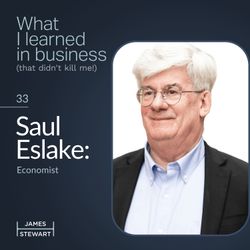
33. Saul Eslake: The Lucky Country?
01:16:57||Season 1, Ep. 33If we are the "lucky country", why does life feel hard for so many of us?Saul Eslake is one of Australia's most respected independent economists and his conversation with James H Stewart cuts through the political noise and examines the true state of Australia's finances.Drawing on decades of experience advising governments, financial institutions and businesses, Saul provides a candid assessment of Australia's economic performance over the past quarter century and discusses the major challenges that will shape the nation's future.Together they explore:• How Australia's economy compares with global peers including the United States, United Kingdom, Canada and New Zealand• Whether Australians are genuinely better off today than they were 20–25 years ago• The country's productivity challenge and why meaningful economic reform has become increasingly difficult• The role of minority parties and the Senate in shaping Australia's policy agenda• The impact of global geopolitical tensions, tariffs and changing international trade relationships• The 2026 Federal Budget and whether it is a genuine reform agenda or simply a revenue-raising exercise• Housing affordability, negative gearing, capital gains tax and discretionary trust reforms• Victoria's growing debt burden and whether the state is facing a long-term fiscal challengeThis is a wide-ranging conversation about economics, government policy, productivity, living standards and the choices Australia will need to make if it wants to remain prosperous in the decades ahead.Whether you're a business owner, investor, director, executive, student or simply someone trying to understand where Australia is heading, this episode provides valuable insight into one of the most important conversations facing the nation.CONNECT WITH JAMES STEWARTLinkedIn: https://www.linkedin.com/in/james-h-stewart-gaicd-83b46a9/Instagram: whatilearnedinbusinessYouTube: What I Learned in Business (That Didn't Kill Me!)If you enjoyed this episode, please follow, subscribe and share it with your network.DISCLAIMERThe views expressed by guests on this podcast are their own and do not necessarily reflect the views of the host or any affiliated organisations.This podcast is intended for general information and educational purposes only and does not constitute financial, taxation, legal, investment or professional advice. Listeners should obtain independent professional advice relevant to their own circumstances before making any financial, business or investment decisions.