Share
What I learned in business (that didn't kill me!)
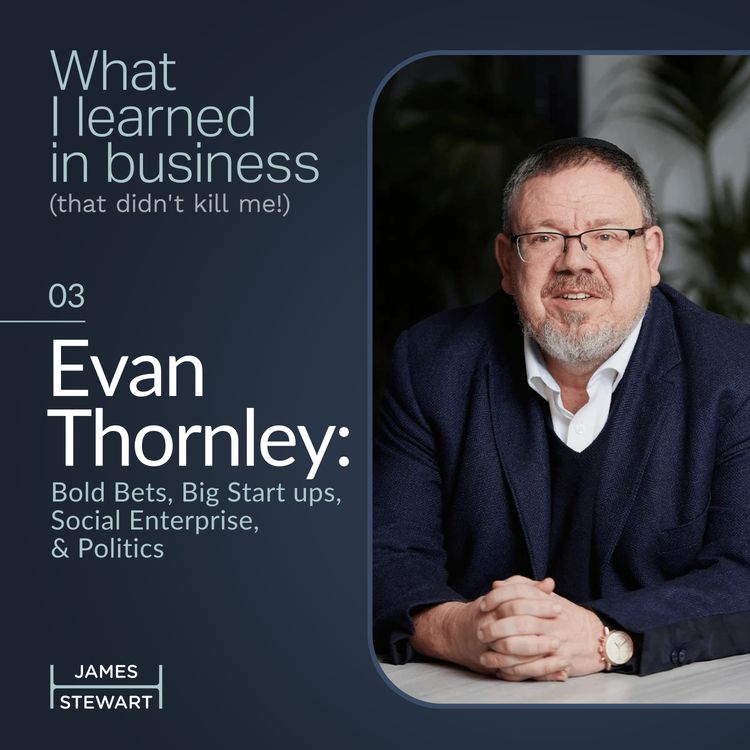
Evan Thornley: Bold Bets, Big Start ups, Social Enterprise, & Politics
Evan Thornley is an entrepreneur, investor, reformer, and one of Australia’s most original thinkers on business and social change.
Evan’s career has been anything but conventional. He co-founded LookSmart, one of Australia’s first tech companies to list on NASDAQ at the height of the dot-com boom, before riding out its spectacular crash. He later entered Victorian politics, led the global Better Place electric-vehicle venture, helped rescue ABC Learning through the creation of Goodstart Early Learning, and today chairs LongView, a business tackling housing affordability and generational inequality.
James and Evan explore:
- What it was like to ride the rise and fall of the dot-com bubble
- The lessons from taking billion-dollar risks — and losing
- Why Evan left politics to lead change from outside government
- The story behind Goodstart and the ABC Learning rescue
- How LongView is rethinking housing and wealth inequality in Australia
- What Evan's learned about resilience, risk, and purpose across every chapter
This is a conversation about big ideas, bold failures, and rebuilding success with meaning.
Key Takeaways:
- How failure can sharpen strategy and conviction
- Why purpose-driven business models are the future
- What leadership looks like in times of technological and ethical disruption
About Evan Thornley:
Evan Thornley is an Australian tech entrepreneur, investor, and impact leader. He co-founded LookSmart, led Better Place Australia, was a driving force behind the GoodStart consortium that rescued 650 childcare centres from the financial collapse of ABC learning and now heads LongView, a purpose-driven property business focused on long-term wealth and housing reform.
Connect with Evan:
LinkedIn | https://longview.com.au
🎧 Listen on Apple Podcasts or Spotify — and don’t forget to follow, rate, and share.
What I Learned in Business (That Didn’t Kill Me!) — hosted by James H. Stewart, exploring the real lessons from business, innovation, and resilience.
Connect with James:
🌐 JamesHStewart.com | LinkedIn
Disclaimer: The views and opinions expressed in this podcast are those of the individuals involved and do not necessarily reflect the views of their organisations, affiliates, or of the host. This podcast is for general informational purposes only and should not be taken as business, financial, or professional advice. Listeners should seek their own independent advice before making decisions related to any topics discussed.More episodes
View all episodes
45. Eric Morris: A Week in Retail I'll Never Forget.
41:14||Season 1, Ep. 45What happens when you spend 15 years building a business, take it public—and then find yourself leading it into voluntary administration as COVID hit?Eric Morris has experienced almost every stage of the business lifecycle.In this episode James H Stewart sits down with one of Australia's most experienced retail executives and advisers for a candid conversation about building businesses, acquisitions, private equity, leadership under pressure and what really happens when a company enters voluntary administration.Eric's career spans more than three decades in retail and consumer products. After working internationally with Reebok and Disney Consumer Products, he joined Myer, where he helped build its private-label business.In 2005, Eric founded The PAS Group with private equity backing and embarked on an ambitious buy-and-build strategy. PAS assembled a portfolio that included brands and businesses such as Review, Black Pepper, Yarra Trail, Marco Polo, Metalicus, JETS and Designworks, before listing on the ASX in 2014.Then came COVID.In 2020, as the pandemic brought much of Australian retail to a standstill, PAS entered voluntary administration. Eric takes us inside that experience: the circumstances leading to the appointment of administrators, what the process looks like from the CEO's chair, the pressures on directors and management, the things he wasn't prepared for, and what he would do differently with the benefit of hindsight.PAS's story didn't end there. The business was acquired by Larry Kestelman's LK Group, Eric continued as CEO, and PAS subsequently combined with Brand Collective, with Eric going on to lead the enlarged business.Today, Eric has moved from the CEO's chair to the boardroom. Through Albany Advisory and his portfolio of board and advisory roles, he now brings the lessons of his operating career—including the difficult ones—to other businesses and their leaders.We discuss:Eric's early career with Reebok, Disney and MyerBuilding Myer's private-label businessHow private equity approached the creation of PAS GroupThe acquisition strategy behind PAS's growthWhat makes a brand worth acquiringThe economics of owned versus licensed brandsTaking PAS Group public in 2014What happened when COVID hit Australian retailThe reality of voluntary administration from a CEO's perspectiveThe decisions Eric would make differently todayWhat directors should understand before their company reaches a crisisEric's transition from CEO to chairman, director and adviserThe lessons he now applies when deciding whether to join a boardIt's a conversation about the successes that build a career—but also the setbacks that ultimately shape a leader.DISCLAIMERThis podcast is provided for general information, education and entertainment purposes only. Nothing discussed in this episode constitutes, or should be relied upon as, legal, financial, investment, insolvency, accounting or other professional advice.The views, opinions and recollections expressed by the host and guest are their own and may be based on their personal experiences, perspectives and recollections of events. References to companies, individuals, transactions, financial performance, corporate restructurings or other events should not be taken as a complete or definitive account of those matters.Circumstances surrounding corporate decisions, restructurings and insolvency appointments are often complex and may involve information that is confidential, contested or not publicly available. No adverse inference should be drawn about any individual or organisation from matters discussed in this episode.Listeners should conduct their own enquiries and obtain appropriate independent professional advice before acting on anything discussed in this podcast.
44. Jamie Kristow: CEO Cotswold Outdoor Group
51:33||Season 1, Ep. 44From Country Rd & Witchery, to Topshop TopMan Australia, to Hudsons Bay, and now the Cotswold Outdoor Group, James H Stewart sits down with someone who is already a global retail veteran.Jamie Kristow, is the CEO of Cotswold Outdoor Group, one of the UK's leading specialist outdoor retailers and home to brands including Cotswold Outdoor, Snow+Rock and Runners Need.Jamie's career has spanned the UK, Australia, South Africa and Canada, with senior leadership roles at House of Fraser, Myer, Country Road Group, Witchery, Woolworths South Africa, Target Australia, Sportsgirl, Hudson's Bay Company and now Cotswold Outdoor Group.Along the way, he has experienced retail booms, corporate turnarounds, international expansion, the collapse of Topshop Australia, the transformation of department stores and the reinvention of specialist retail in an increasingly digital world.In this conversation, Jamie shares what he's learned from leading businesses through change, why physical stores remain critically important, and how data, retail media, artificial intelligence and customer experience are reshaping the future of retail.We also explore the remarkable turnaround of Cotswold Outdoor Group following its 2019 Company Voluntary Arrangement (CVA), the impact of COVID on the business, and what it takes to grow a retailer that has survived multiple crises.Whether you're a business owner, retailer, investor, director or simply fascinated by leadership and transformation, this episode is packed with practical insights from someone who has spent his career navigating change at the highest level.In this episode we discuss:• Jamie's international retail career across four countries• Lessons from the collapse of Topshop Australia• The turnaround and growth trajectory of Cotswold Outdoor Group• Why physical stores still matter in an omnichannel world• Retail media and the next generation of customer engagement• AI, data and the future of retail• Sustainability, premiumisation and changing consumer behaviour• Leadership lessons from more than 30 years in retailIf you enjoy conversations about leadership, retail, strategy, private equity and business transformation, don't forget to follow the podcast and leave a review.Connect with James StewartLinkedIn: https://www.linkedin.com/in/james-h-stewart-gaicd-83b46a9/Website: https://jameshstewart.comDisclaimerThe views expressed by guests on What I Learned in Business (That Didn't Kill Me!) are their own and are provided for general information and discussion purposes only. They do not necessarily reflect the views of the host and should not be relied upon as financial, legal, investment or professional advice. Listeners should seek independent professional advice before making decisions based on the matters discussed in this episode.
43. Angela Brown: Brown Brothers & All Saints Estate
32:21||Season 1, Ep. 43Brown Brothers is one of Australia's famous wine brands. So, What does it take to steward a family business through generations while the industry around you is undergoing profound change?In this episode James H Stewart sits down with Angela Brown, fourth-generation shareholder and director of the Brown Family Wine Group and Sales and Marketing Director and co-owner of All Saints Estate in Rutherglen.The Brown family's involvement in Australian wine stretches back more than a century. Today, the Brown Family Wine Group has a portfolio that includes Brown Brothers, Devil's Corner, Tamar Ridge, Pirie and Innocent Bystander, while Angela and her siblings separately own the historic All Saints Estate.Angela shares the story of growing up in a wine family, the sudden death of her father in 2005, and the challenges of succession, governance and maintaining family relationships while running businesses together.James and Angela explore the commercial realities facing Australia's wine sector, including falling consumption, changing drinking habits among younger consumers, low- and no-alcohol alternatives, excess wine production and inventories, pressure on grape growers and margins, climate change and the impact of geopolitical and trade disruption.They also discuss the recently agreed Australia–European Union Free Trade Agreement and what greater access to European markets—and potentially greater competition from European wine in Australia—could mean for local producers.The conversation goes inside the Brown Family Wine Group's multi-brand model, including how the business thinks about vineyards, sourcing fruit, different wine regions, direct-to-consumer sales, wholesale distribution, brand positioning and the role of Innocent Bystander.It's a conversation about much more than wine. It's about succession, resilience, brand building, adapting to structural change and the responsibility that comes with handing a family business from one generation to the next.This episode forms part of a special series produced with the support of the Family Business Association Australia & New Zealand.Connect with James StewartLinkedIn: James H Stewart GAICDWebsite: jameshstewart.comFollow What I Learned in Business (That Didn't Kill Me!) on your favourite podcast platform, Instagram and YouTube.IMPORTANT DISCLAIMERThis podcast is produced for general information, education and entertainment purposes only. Nothing contained in this episode constitutes, or should be relied upon as, financial, investment, legal, taxation, accounting, business or other professional advice. The views and opinions expressed by guests are their own and do not necessarily represent those of James H Stewart, the podcast, the Family Business Association, the Brown Family Wine Group, All Saints Estate or any other organisation referred to in the episode.The discussion may include commentary about companies, industries, markets, government policy, international trade arrangements and economic conditions. Such matters may change over time, and information discussed was believed to be relevant at the time of recording but may subsequently become outdated, incomplete or inaccurate.References to particular companies, brands, individuals, transactions or industry events are for discussion purposes only and should not be interpreted as an endorsement, criticism, recommendation or representation as to their current or future financial or commercial performance.Listeners should undertake their own enquiries and obtain appropriate independent professional advice before making any financial, investment, business or other decisions based on matters discussed in this podcast.
42. Jamie Sprayregen: The 'Mick Jagger' of US Bankruptcy law
54:03||Season 1, Ep. 42The “Mick Jagger of US bankruptcy”. That's Jamie Sprayregen's nickname, and after more than 35 years at the centre of some of the world’s biggest corporate crises, it’s not hard to see why.Jamie built the restructuring practice at Kirkland & Ellis into a global powerhouse, advised on landmark restructurings including United Airlines and the City of Detroit, spent two extraordinary years at Goldman Sachs as the Global Financial Crisis unfolded, and was named by the National Law Journal as one of the decade’s most influential lawyers.After leaving Kirkland in 2024 and joining Hilco Global as Vice Chairman, Jamie has now returned to law as Co-Head of Restructuring & Debt Capital Solutions at Paul, Weiss.Jamie discusses the inside story of some of America’s largest bankruptcies, what he witnessed during the Global Financial Crisis, why Chapter 11 remains such a powerful restructuring tool, and how private credit, cross-border insolvency and AI are changing the profession.After decades advising CEOs, boards, creditors and investors when billions of dollars — and sometimes thousands of jobs — are on the line, Jamie also shares what he has learned about decision-making, negotiation and the human side of corporate failure.Connect with James H. StewartLinkedIn: https://www.linkedin.com/in/james-h-stewart-gaicd-83b46a9/Website: https://jameshstewart.comFollow What I Learned in Business (That Didn’t Kill Me!) on Apple Podcasts, Spotify, YouTube and your favourite podcast platform.DisclaimerThis podcast is provided for general information and entertainment purposes only. Nothing discussed in this episode constitutes, or should be relied upon as, legal, financial, investment, insolvency, restructuring or other professional advice.The views and opinions expressed by the host and guest are their own and do not necessarily represent the views of any current or former employer, client, firm, organisation or other person with whom they are or have been associated.The discussion of companies, restructurings, insolvencies, litigation, transactions and other matters is based on publicly available information and the participants’ personal perspectives and recollections. References to allegations, disputes or claims should not be taken as findings of fact or wrongdoing unless expressly stated as such. Some matters discussed may have involved contested facts, confidential information or subsequent developments that are not addressed in this episode.Listeners should undertake their own enquiries and obtain appropriate independent professional advice before making any business, legal, financial or investment decision.
41. Ian Fredericks: CEO Hilco Global Capital Solutions
53:38||Season 1, Ep. 41Why do some iconic businesses survive disruption while others disappear forever?In this episode James H Stewart sits down with Ian Fredericks, CEO of Capital Solutions (Americas) at Hilco Global, Global Head of Data & Innovation, and one of the world's leading experts in corporate restructuring, distressed investing and retail turnarounds.Having advised on some of the largest retail restructurings in the United States, Ian provides a rare insider's perspective on what really happened behind the collapses of Circuit City and Toys "R" Us, and why many great companies fail long before they run out of money.The conversation explores the warning signs of corporate distress, the impact of leveraged buyouts, how investors identify businesses worth saving, the explosive growth of private credit, and how artificial intelligence is reshaping the future of retail.Ian also reflects on his own journey—from restructuring lawyer to global business leader—and the lessons he's learned from helping businesses navigate their toughest moments.In this episode we discuss:• Why Circuit City and Toys "R" Us ultimately failed• The role debt plays in corporate collapse• What turnaround investors look for in distressed businesses• The changing dynamics of the U.S. retail market• How Amazon, Temu and Shein are reshaping consumer behaviour• The rapid rise of private credit and what it means for business• Practical applications of AI in retail and data-driven decision making• Leadership lessons from decades of restructuring and business transformationWhether you're a business owner, retailer, investor, lender or simply fascinated by how companies succeed and fail, this episode offers practical insights from someone who has spent his career helping organisations navigate uncertainty.Connect with James StewartLinkedIn: https://www.linkedin.com/in/james-h-stewart-gaicd-83b46a9/Website: https://www.jameshstewart.comDisclaimerThe views expressed by guests on What I Learned in Business (That Didn't Kill Me!) are their own and are provided for general information and discussion purposes only. Nothing in this episode constitutes financial, investment, legal or professional advice. Listeners should obtain independent advice before making any business, financial or investment decisions.
40. Alister Haigh: The Chocolate Man
32:04||Season 1, Ep. 40For more than 110 years, Haigh's Chocolates has delighted Australians while remaining proudly family-owned, manufacturing locally and resisting the lure of supermarket shelves.James H Stewart sits down with fourth-generation family leader Alister Haigh to explore the remarkable story behind one of Australia's most respected premium brands.After leading Haigh's Chocolates for almost three decades as CEO, Alister recently stepped aside, handing the reins to the company's first non-family chief executive. Together, James and Alister discuss what it takes to preserve a family legacy while continuing to evolve in an increasingly competitive and rapidly changing retail landscape.They explore:• How Haigh's Chocolates has grown from a small Adelaide business into a nationally recognised premium brand over 110 years.• The unique challenges of leading a fourth-generation family business.• Why succession planning may be the most important decision any family business will ever make.• The appointment of Haigh's first non-family CEO and the governance lessons behind that decision.• Why Haigh's has deliberately stayed out of supermarkets despite intense competition.• Building and protecting a premium brand in a commoditised market.• Consumer behaviour, changing chocolate consumption trends and the future of premium retail.• How Haigh's responded to unprecedented increases in global cocoa prices.• The strategic thinking behind the company's $130 million investment in advanced Australian manufacturing.• Leadership, stewardship and the responsibility of leaving a business stronger for the next generation.Whether you lead a family business, work in retail, manufacture products in Australia or simply enjoy hearing the stories behind iconic Australian brands, this conversation offers valuable insights into leadership, long-term thinking and building enduring competitive advantage.A special thank you to the Family Business Association of Australia and New Zealand for sponsoring this episode. The FBA supports family businesses through education, networking, advocacy and governance, helping business families thrive across generations.Connect with James StewartWebsite: https://jameshstewart.comLinkedIn: https://www.linkedin.com/in/james-h-stewart-gaicd-83b46a9Instagram: https://www.instagram.com/whatilearnedinbusiness/YouTube: https://www.youtube.com/@WhatILearnedInBusinessIf you enjoyed this episode, please subscribe or follow the show, leave a review and share it with your colleagues and friends.DisclaimerThe views expressed by guests on this podcast are their own and do not necessarily reflect those of the host or any organisation with which they are associated. This podcast is intended for general information and educational purposes only and should not be relied upon as financial, legal, investment or professional advice. Listeners should obtain independent professional advice relevant to their own circumstances before making business or financial decisions.
39. Paul Martin: Alix Partners Global Retail Growth Leader
59:41||Season 1, Ep. 39Retail is changing faster than ever. But are today's retailers really growing—or have they simply been riding a wave of inflation?James H Stewart sits down with Paul Martin, Global Retail Growth Leader and Partner at AlixPartners, one of the world's leading advisory firms specialising in retail transformation, performance improvement and turnaround.Having advised many of the world's largest retailers, consumer brands, boards and private equity firms across Europe, North America and Asia, Paul offers a unique global perspective on the forces reshaping the retail and consumer landscape.Together, James and Paul explore:Why inflation may have disguised underlying weakness across the retail sectorThe health of global retail and what lies ahead for consumer spendingHow tariffs, geopolitics and supply chain disruption are changing retail economicsThe explosive growth of Chinese marketplaces such as Temu and their impact on traditional retailersWhy the resale economy is becoming one of retail's fastest-growing sectorsWhether social media has become the new front door to retailHow artificial intelligence and Agentic AI are transforming customer engagement, merchandising and business modelsWhy the fundamentals of great retailing still matter in an increasingly digital worldThe retailers and business models Paul believes are best positioned to win over the next decadeWhether you're a retailer, supplier, investor, executive, entrepreneur or simply fascinated by how consumer behaviour is evolving, this episode provides practical insights from one of the world's leading retail advisers.Connect with James Stewart🌐 Website: https://jameshstewart.com💼 LinkedIn: https://www.linkedin.com/in/james-h-stewart-gaicd-83b46a9/📸 Instagram: https://www.instagram.com/whatilearnedinbusiness/▶️ YouTube: https://www.youtube.com/@WhatILearnedInBusinessIf you enjoyed this episode, please follow the podcast, leave a review and share it with your network. Your support helps us continue bringing world-class business leaders and thinkers to the show.DisclaimerThe views expressed by guests on What I Learned in Business (That Didn't Kill Me!) are their own and are shared for general information and discussion purposes only. They do not constitute financial, investment, legal or professional advice and should not be relied upon as such. Listeners should seek independent professional advice before making business, financial or investment decisions based on any matters discussed in this episode.
38. Geoff Wilson AO: The Retail Investor Warrior
56:53||Season 1, Ep. 38Geoff Wilson AO is one of Australia's most outspoken advocates for retail shareholders.As the founder and Chairman of Wilson Asset Management, Geoff has spent almost five decades navigating financial markets, building one of Australia's leading investment firms and becoming a powerful voice on corporate governance, shareholder activism and public policy.James H Stewart sits down with Geoff to discuss his journey from research analyst to managing billions of dollars on behalf of more than 130,000 investors. He shares the lessons learned through multiple market cycles and discusses the defining issues that have shaped Geoff's career, including his campaigns for better corporate governance, his activism during the AMP board upheaval following the Royal Commission, and the highly publicised franking credits campaign that became one of the biggest political issues of the 2019 Federal Election.The conversation then turns to today's economic landscape, where Geoff offers his perspective on Australia's competitiveness as a destination for investment, the 2026 Federal Budget, proposed changes to capital gains tax, productivity, regulation, and what governments should be doing to encourage business growth, entrepreneurship and long-term investment.Finally, Geoff discusses the remarkable success of the Future Generation investment companies, which have directed more than $100 million to Australian charities supporting children, youth and mental health.Whether you're an investor, business owner, company director or simply interested in Australia's economic future, this is a wide-ranging conversation about leadership, markets, governance and the importance of backing your convictions.In this episode we discuss:Geoff's journey to founding Wilson Asset ManagementLessons from nearly 50 years in investment marketsShareholder activism and corporate governanceThe AMP board renewal following the Royal CommissionThe 2019 franking credits campaignAustralia's competitiveness for investment capitalCapital gains tax, productivity and the 2026 Federal BudgetFuture Generation and investing for social impactLeadership, philanthropy and building a lasting legacyIf you enjoyed this episode, please follow the podcast, leave a review and share it with someone who enjoys thoughtful conversations about business, leadership and investing.Connect with James StewartLinkedIn: https://www.linkedin.com/in/james-h-stewart-gaicd-83b46a9/Instagram: https://www.instagram.com/whatilearnedinbusiness/YouTube: https://www.youtube.com/@WhatILearnedInBusinessDisclaimerThe views and opinions expressed by Geoff Wilson and James H Stewart in this episode are their own and are provided for general information and discussion purposes only. Nothing in this podcast should be construed as financial, investment, taxation, accounting or legal advice, or as a recommendation to buy, sell or hold any investment or financial product. Investment markets involve risk, and past performance is not a reliable indicator of future performance. Before making any investment or financial decision, you should seek advice from a suitably qualified professional who understands your individual objectives, financial circumstances and needs.The discussion in this episode may reference companies, investment strategies, taxation policy, legislation and market conditions that were current at the time of recording and may change over time.
37. Ana Escobar: Don't Call Me Pablo!
59:57||Season 1, Ep. 37LMND may be the hottest female fashion brand in Australia right now.James H Stewart sits down with Ana Escobar, founder of Australian fashion label LMND, to explore an extraordinary entrepreneurial journey spanning two continents, some of Australia's best-known retail brands, and the challenges of building a self funded premium fashion business.Born in Australia before moving to Colombia as a young child, Ana shares her remarkable story of growing up in Medellin, during one of Colombia's most turbulent periods before returning to Australia to pursue a career in fashion. From starting as a sales assistant at Oroton to becoming Brand Director, leading private label innovation at Big W, and ultimately launching LMND in 2018, Ana's career demonstrates the power of resilience, creativity and customer obsession.In this episode we discuss:• Growing up between Australia and Colombia and the experiences that shaped her outlook.• Building a career through Oroton, Apparel Group and Big W.• Why she left corporate retail to launch LMND.• Identifying a gap in the market for premium wardrobe essentials.• Why LMND opened a physical store before launching online.• Building an international brand stocked by retailers including Myer, Selfridges and Neiman Marcus.• Growing a business without external investors or private equity.• Customer-led product development and the importance of listening over ego.• Social media strategy without relying on paid influencers.• Scaling a founder-led business while protecting brand integrity.• The lessons Ana has learned from building one of Australia's fastest-growing independent fashion brands.Whether you're an entrepreneur, retailer, designer, business owner or simply fascinated by the journey of building a successful brand, Ana's story offers practical insights into leadership, innovation and disciplined business growth.Connect with James StewartLinkedIn: https://www.linkedin.com/in/james-h-stewart-gaicd-83b46a9/Website: https://jameshstewart.comInstagram: https://www.instagram.com/whatilearnedinbusiness/YouTube: https://www.youtube.com/@WhatILearnedinBusinessIf you enjoyed this episode, please subscribe, leave a review and share it with your network.DisclaimerThe information, opinions and views expressed by guests on What I Learned in Business (That Didn't Kill Me!) are their own and are provided for general information and discussion purposes only. They do not constitute financial, legal, investment or professional advice and should not be relied upon as such. Listeners should obtain independent professional advice relevant to their own circumstances before making any business, financial or investment decisions. While every effort is made to ensure accuracy, neither the host nor the producers accept responsibility for any loss arising from reliance on information contained in this episode.