Share
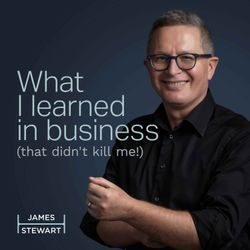
What I learned in business (that didn't kill me!)
The inside story of success, failure, and leadership, when it matters most.
Latest episode
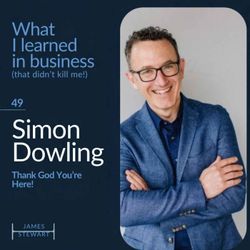
49. Simon Dowling: Thank God you're here!
01:02:46||Ep. 49What can improv comedy teach us about leadership?More than you might think.In this episode James H Stewart sits down with Simon Dowling, whose career has taken an unusual path through commercial law, executive education, leadership — and improv comedy.Simon began his professional career as a commercial lawyer with Gadens before moving into executive education, negotiation and communication. At the same time, he spent around 16 years as an ensemble performer in improvisational comedy, including with Impro Melbourne and on Working Dog Productions’ hit television show Thank God You’re Here.Today, Simon works with CEOs and leadership teams on trust, communication, collaboration and building more effective teams. He is also the author of Work With Me: How to Get People to Buy Into Your Ideas.In this conversation, James and Simon explore what the principles of improv can teach business leaders about listening, trust, adaptability and performing under pressure.They also discuss:• Why leadership teams become dysfunctional• The respective roles of leadership, team composition and culture• How leaders build trust — and earn it from their teams• The difference between leadership and getting genuine buy-in• When collaboration becomes counterproductive and leaders simply need to make a decision• Simon's concepts of focus, flow and care in effective teams• The lost art of conversation and the importance of genuinely listening• Managing emotion when leadership gets difficult• The mistakes Simon sees CEOs repeatedly make• What Simon believes about leadership today that he didn't believe 20 years agoIt's a conversation about what happens when leadership theory meets human behaviour — and what a career spent performing without a script can teach you about leading when things don't go according to plan.DISCLAIMER: What I Learned in Business (That Didn’t Kill Me!) is produced for general information and entertainment purposes only. The views, opinions and experiences expressed by guests are their own and do not necessarily represent those of James H Stewart, the podcast, or any organisation with which either the host or guest is associated. Nothing in this episode constitutes legal, financial, investment, business or other professional advice and should not be relied upon as such. References to individuals, companies or organisations are made in the context of the discussion. Listeners should make their own enquiries and obtain appropriate professional advice before acting on any information discussed in this episode.
More episodes
View all episodes
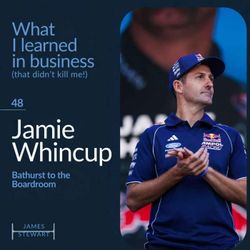
48. Jamie Whincup: Bathurst to the Boardroom
01:21:52||Ep. 48Jamie Whincup is one of the most successful drivers in Australian motorsport history — a seven-time Supercars champion, four-time Bathurst 1000 winner and winner of 125 Supercars races. But his journey to the top was anything but straightforward.Jamie joins James H Stewart to talk about starting out in karting, winning the Australian Formula Ford Championship at just 19, being hired — and then fired — by Garry Rogers Motorsport at 20, and fighting his way back into professional racing.He shares the story of joining Triple Eight Race Engineering, racing alongside Craig Lowndes, winning three consecutive Bathurst 1000s together and building one of the most successful careers in Australian motorsport.But this conversation isn't just about racing.Jamie discusses becoming a shareholder in Triple Eight, what he learned from Roland Dane and some of the successful businesspeople around the team, and the very different challenge of retiring from full-time racing and becoming Triple Eight's Managing Director and Team Principal.We explore the economics of running a professional racing team, the role of data versus instinct, managing elite performers, transitioning from individual competitor to business leader, and Triple Eight's major decision to move from GM to Ford in 2026.It's a conversation about resilience, competition, leadership and what happens when your job changes from winning yourself to creating an organisation capable of winning without you.Disclaimer: This podcast is provided for general information and entertainment purposes only. The views and opinions expressed by guests are their own and do not necessarily reflect those of James H Stewart, What I Learned in Business (That Didn’t Kill Me!), or any associated organisation. Nothing discussed in this episode should be regarded as financial, investment, legal or other professional advice. Listeners should make their own enquiries and seek appropriate professional advice before making decisions based on matters discussed in the episode.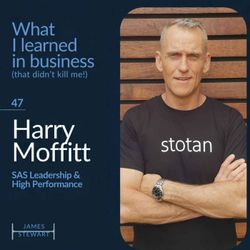
47. Harry Moffitt: SAS Leadership & High Performance
01:10:58||Ep. 47What can almost 30 years with the elite SAS teach business about leadership, resilience and building teams that perform?In this episode James H Stewart sits down with Harry Moffitt—former SAS soldier, registered psychologist, author and founder and CEO of the Stotan Group.Across 11 operational deployments, Harry spent close to 1,000 days on Special Operations missions. He was seriously wounded in Afghanistan in 2008 and later became the SAS Human Performance Manager, bringing together his operational experience and study of psychology to better understand what enables people and teams to perform under extreme pressure.Harry and James explore the lessons from that extraordinary career and, importantly, how they translate into business. They discuss leadership and decision-making under pressure, resilience and mental health, the importance of trust in elite teams, whether character matters more than talent, what business leaders misunderstand about high performance, and how leaders should respond when organisations find themselves in crisis.Harry also discusses his love of cricket and his first book, Eleven Bats, as well as his latest book, The Fourth Pillar, which explores why physical, psychological and social wellbeing may not be enough—and why having a philosophical foundation can be critical to living and leading well.It’s a fascinating conversation about character, purpose and what it really takes to perform when things get difficult.In this episode:• Leadership lessons from almost 30 years in the military including 11 deployments with the SAS• Recovering after being seriously wounded in Afghanistan• Making decisions when the consequences really matter• Resilience, psychology and mental health• Why trust is fundamental to high-performing teams• Character versus talent• Stoicism and its relevance to modern leadership• What Special Forces can—and can't—teach business leaders• Leading organisations through crisis• Eleven Bats and the unlikely connection between cricket and combat• The Fourth Pillar and the importance of purpose and philosophyWhat I Learned in Business (That Didn't Kill Me!) explores the lessons learned through success, failure and everything in between.Disclaimer: The views and opinions expressed in this podcast are those of the host and guest in their personal capacities and do not necessarily represent the views of any current or former employer, organisation, government agency or other entity with which they have been associated. The discussion is provided for general information and entertainment purposes only and should not be relied upon as professional, psychological, medical, financial or other advice.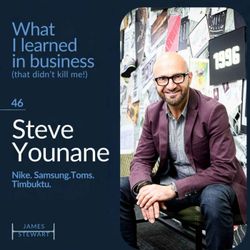
46. Stephen Younane: Nike. Samsung. Toms. Timbuktu.
55:55||Ep. 46He never planned on a career in retail.Growing up in Sydney as one of seven children, Stephen was more interested in music than school and dreamed of becoming an audio engineer. When that didn't work out, he fell almost accidentally into the Myer Grace Bros trainee management program — beginning a remarkable 40-year career in retail.After 12 years at Myer, Stephen joined Nike, where he spent seven years in senior retail operations roles across Asia Pacific and the United States and helped open NIKETOWN Melbourne — the first NIKETOWN outside North America.He went on to run Sunglass Hut's Australasian operations for Luxottica before becoming CEO of Jeanswest.Then, in 2011, Stephen made the leap from corporate executive to entrepreneur, co-founding Retail Prodigy Group with former Nike Global Retail Director Charlie Baker.Starting with the licence to operate Nike stores across Australia and New Zealand, RPG grew into a significant retail operation representing brands including Nike, Samsung, TOMS, Timbuk2 and Mattel. Stephen talks about raising the capital required to fund an ambitious store rollout, managing relationships with some of the world's biggest brands, building culture and leadership capability, and navigating the extraordinary disruption caused by online retail and COVID.In 2024, Stephen sold Retail Prodigy Group and brought his four-decade retail career to a close.But that's where the story comes full circle.More than 40 years after first wanting to become an audio engineer, Stephen returned to his passion for music, launching Sabre Sound Studio with legendary Australian audio engineer Ern Rose, whose credits include John Farnham's Whispering Jack, The Angels and Little River Band.In this episode, Stephen and I discuss:His accidental entry into retail and 12 years at MyerWhat working inside Nike taught him about world-class retailOpening the first NIKETOWN outside North AmericaHis first CEO role at JeanswestBuilding Retail Prodigy GroupRaising capital and building a multi-brand licensed retail businessThe challenges of leading bricks-and-mortar retail through enormous disruptionWhy he decided to sell RPG in 2024The biggest business and leadership lessons from his 40-year careerWhy he finally returned to his teenage ambition of working in musicBuilding Sabre Sound Studio with Ern RoseThe lessons he learned in business that nearly broke himIt’s a fascinating conversation about retail, entrepreneurship, leadership, reinvention — and ultimately finding your way back to where you wanted to be in the first place.Contact:Website: Jameshstewart.comLinked In: https://www.linkedin.com/in/james-h-stewart-gaicd-83b46a9Instagram: https://www.instagram.com/whatilearnedinbusinessYouTube: https://www.youtube.com/channel/UC_WgwbOVsSuzuvXEgqNTl4gSabre Sound studio: https://sabresoundstudio.com.auDisclaimer: The views and opinions expressed in this podcast are those of the host and guest and are provided for general information and discussion purposes only. They should not be relied upon as financial, investment, legal or business advice. Listeners should obtain their own independent professional advice before making any business, financial or investment decisions.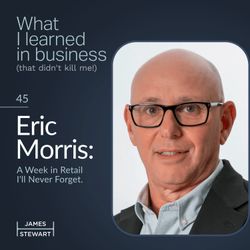
45. Eric Morris: A Week in Retail I'll Never Forget.
41:14||Season 1, Ep. 45What happens when you spend 15 years building a business, take it public—and then find yourself leading it into voluntary administration as COVID hit?Eric Morris has experienced almost every stage of the business lifecycle.In this episode James H Stewart sits down with one of Australia's most experienced retail executives and advisers for a candid conversation about building businesses, acquisitions, private equity, leadership under pressure and what really happens when a company enters voluntary administration.Eric's career spans more than three decades in retail and consumer products. After working internationally with Reebok and Disney Consumer Products, he joined Myer, where he helped build its private-label business.In 2005, Eric founded The PAS Group with private equity backing and embarked on an ambitious buy-and-build strategy. PAS assembled a portfolio that included brands and businesses such as Review, Black Pepper, Yarra Trail, Marco Polo, Metalicus, JETS and Designworks, before listing on the ASX in 2014.Then came COVID.In 2020, as the pandemic brought much of Australian retail to a standstill, PAS entered voluntary administration. Eric takes us inside that experience: the circumstances leading to the appointment of administrators, what the process looks like from the CEO's chair, the pressures on directors and management, the things he wasn't prepared for, and what he would do differently with the benefit of hindsight.PAS's story didn't end there. The business was acquired by Larry Kestelman's LK Group, Eric continued as CEO, and PAS subsequently combined with Brand Collective, with Eric going on to lead the enlarged business.Today, Eric has moved from the CEO's chair to the boardroom. Through Albany Advisory and his portfolio of board and advisory roles, he now brings the lessons of his operating career—including the difficult ones—to other businesses and their leaders.We discuss:Eric's early career with Reebok, Disney and MyerBuilding Myer's private-label businessHow private equity approached the creation of PAS GroupThe acquisition strategy behind PAS's growthWhat makes a brand worth acquiringThe economics of owned versus licensed brandsTaking PAS Group public in 2014What happened when COVID hit Australian retailThe reality of voluntary administration from a CEO's perspectiveThe decisions Eric would make differently todayWhat directors should understand before their company reaches a crisisEric's transition from CEO to chairman, director and adviserThe lessons he now applies when deciding whether to join a boardIt's a conversation about the successes that build a career—but also the setbacks that ultimately shape a leader.DISCLAIMERThis podcast is provided for general information, education and entertainment purposes only. Nothing discussed in this episode constitutes, or should be relied upon as, legal, financial, investment, insolvency, accounting or other professional advice.The views, opinions and recollections expressed by the host and guest are their own and may be based on their personal experiences, perspectives and recollections of events. References to companies, individuals, transactions, financial performance, corporate restructurings or other events should not be taken as a complete or definitive account of those matters.Circumstances surrounding corporate decisions, restructurings and insolvency appointments are often complex and may involve information that is confidential, contested or not publicly available. No adverse inference should be drawn about any individual or organisation from matters discussed in this episode.Listeners should conduct their own enquiries and obtain appropriate independent professional advice before acting on anything discussed in this podcast.
44. Jamie Kristow: CEO Cotswold Outdoor Group
51:33||Season 1, Ep. 44From Country Rd & Witchery, to Topshop TopMan Australia, to Hudsons Bay, and now the Cotswold Outdoor Group, James H Stewart sits down with someone who is already a global retail veteran.Jamie Kristow, is the CEO of Cotswold Outdoor Group, one of the UK's leading specialist outdoor retailers and home to brands including Cotswold Outdoor, Snow+Rock and Runners Need.Jamie's career has spanned the UK, Australia, South Africa and Canada, with senior leadership roles at House of Fraser, Myer, Country Road Group, Witchery, Woolworths South Africa, Target Australia, Sportsgirl, Hudson's Bay Company and now Cotswold Outdoor Group.Along the way, he has experienced retail booms, corporate turnarounds, international expansion, the collapse of Topshop Australia, the transformation of department stores and the reinvention of specialist retail in an increasingly digital world.In this conversation, Jamie shares what he's learned from leading businesses through change, why physical stores remain critically important, and how data, retail media, artificial intelligence and customer experience are reshaping the future of retail.We also explore the remarkable turnaround of Cotswold Outdoor Group following its 2019 Company Voluntary Arrangement (CVA), the impact of COVID on the business, and what it takes to grow a retailer that has survived multiple crises.Whether you're a business owner, retailer, investor, director or simply fascinated by leadership and transformation, this episode is packed with practical insights from someone who has spent his career navigating change at the highest level.In this episode we discuss:• Jamie's international retail career across four countries• Lessons from the collapse of Topshop Australia• The turnaround and growth trajectory of Cotswold Outdoor Group• Why physical stores still matter in an omnichannel world• Retail media and the next generation of customer engagement• AI, data and the future of retail• Sustainability, premiumisation and changing consumer behaviour• Leadership lessons from more than 30 years in retailIf you enjoy conversations about leadership, retail, strategy, private equity and business transformation, don't forget to follow the podcast and leave a review.Connect with James StewartLinkedIn: https://www.linkedin.com/in/james-h-stewart-gaicd-83b46a9/Website: https://jameshstewart.comDisclaimerThe views expressed by guests on What I Learned in Business (That Didn't Kill Me!) are their own and are provided for general information and discussion purposes only. They do not necessarily reflect the views of the host and should not be relied upon as financial, legal, investment or professional advice. Listeners should seek independent professional advice before making decisions based on the matters discussed in this episode.
43. Angela Brown: Brown Brothers & All Saints Estate
32:21||Season 1, Ep. 43Brown Brothers is one of Australia's famous wine brands. So, What does it take to steward a family business through generations while the industry around you is undergoing profound change?In this episode James H Stewart sits down with Angela Brown, fourth-generation shareholder and director of the Brown Family Wine Group and Sales and Marketing Director and co-owner of All Saints Estate in Rutherglen.The Brown family's involvement in Australian wine stretches back more than a century. Today, the Brown Family Wine Group has a portfolio that includes Brown Brothers, Devil's Corner, Tamar Ridge, Pirie and Innocent Bystander, while Angela and her siblings separately own the historic All Saints Estate.Angela shares the story of growing up in a wine family, the sudden death of her father in 2005, and the challenges of succession, governance and maintaining family relationships while running businesses together.James and Angela explore the commercial realities facing Australia's wine sector, including falling consumption, changing drinking habits among younger consumers, low- and no-alcohol alternatives, excess wine production and inventories, pressure on grape growers and margins, climate change and the impact of geopolitical and trade disruption.They also discuss the recently agreed Australia–European Union Free Trade Agreement and what greater access to European markets—and potentially greater competition from European wine in Australia—could mean for local producers.The conversation goes inside the Brown Family Wine Group's multi-brand model, including how the business thinks about vineyards, sourcing fruit, different wine regions, direct-to-consumer sales, wholesale distribution, brand positioning and the role of Innocent Bystander.It's a conversation about much more than wine. It's about succession, resilience, brand building, adapting to structural change and the responsibility that comes with handing a family business from one generation to the next.This episode forms part of a special series produced with the support of the Family Business Association Australia & New Zealand.Connect with James StewartLinkedIn: James H Stewart GAICDWebsite: jameshstewart.comFollow What I Learned in Business (That Didn't Kill Me!) on your favourite podcast platform, Instagram and YouTube.IMPORTANT DISCLAIMERThis podcast is produced for general information, education and entertainment purposes only. Nothing contained in this episode constitutes, or should be relied upon as, financial, investment, legal, taxation, accounting, business or other professional advice. The views and opinions expressed by guests are their own and do not necessarily represent those of James H Stewart, the podcast, the Family Business Association, the Brown Family Wine Group, All Saints Estate or any other organisation referred to in the episode.The discussion may include commentary about companies, industries, markets, government policy, international trade arrangements and economic conditions. Such matters may change over time, and information discussed was believed to be relevant at the time of recording but may subsequently become outdated, incomplete or inaccurate.References to particular companies, brands, individuals, transactions or industry events are for discussion purposes only and should not be interpreted as an endorsement, criticism, recommendation or representation as to their current or future financial or commercial performance.Listeners should undertake their own enquiries and obtain appropriate independent professional advice before making any financial, investment, business or other decisions based on matters discussed in this podcast.