Share
Visionary
A few ideas on avoiding extinction
Remember the 1998 film "Armageddon", when Bruce Willis leads a team of oil drillers to save Earth from an asteroid? It might seem fanciful — but in this episode of Visionary, we explore the real-life innovations that could one day prevent the end of the world.
Our guest is journalist and author Tom Ough, whose new book "The Anti-Catastrophe League" investigates the world's most catastrophic risks — and the remarkable people working to prevent them. From super-volcanoes and lab-made pandemics to solar storms, AI takeovers, and even the dream of transcending death, Tom explains how the worst-case scenarios might be closer than we think — and how they could also unlock transformational breakthroughs in science and society.
With humour and clarity on subjects that are often sensationalised, Tom argues that the most powerful tool we have is human ingenuity. His call is simple: take the threats seriously, support the people solving them... but don’t forget the water and torch.
More episodes
View all episodes
52. Visionary Live with the V&A's Gus Casely-Hayford
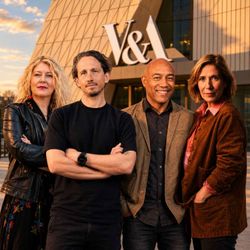
22:45||Season 1, Ep. 52How does creativity shape urban design and placemaking? Not just the look and feel of a neighbourhood, but the kind of energy that draws major institutions to a place. Recorded live at Here East, this week's special edition of Visionary features Georgina Godwin in conversation with three people at the forefront of that question: Gus Casely-Hayford, Director of V&A East, fresh from the museum's triumphant opening in Queen Elizabeth Olympic Park; Tamsin Ace, Director of East Bank, the organisation coordinating one of Europe's most ambitious cultural districts; and Richard Broom of Jason Bruges Studio, whose immersive public installations — from Wembley underpasses to international stages — turn data and code into experiences that stop people in their tracks.Over the next few weeks, Visionary will be sharing conversations from Here East's It All Starts Here event. Subscribe to the podcast now and discover the stories of business leaders, investors, and experts who are building our future.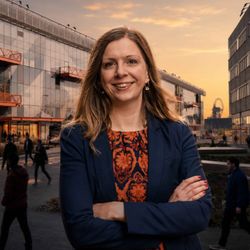
51. The first deepfake election
21:07||Season 1, Ep. 51It took four days for a forged letter to bring down a government in 1924. Today, the same thing could happen before breakfast.The Zinoviev Letter — a fabricated document purportedly inciting British communists to revolution — was fake. But by the time that became clear, the election was over and the damage was done. A century later, the mechanics of political manipulation have changed beyond recognition. Anyone with a laptop and freely available AI tools can now put any words into any politician's mouth, with their face, their voice and their mannerisms, and have it in front of millions of people within minutes.The question is whether the law — much of which dates to the nineteenth century — has any hope of keeping up.Georgina Godwin speaks with writer and policy thinker Frances Lasok, whose recent report on AI deepfakes and elections is one of the clearest-eyed assessments of this rapidly evolving threat. Lasok sets out the four categories of deepfake misuse now emerging — intimate image abuse, fraud, election misinformation and the monetisation of someone's face or voice without consent — and explains why existing legislation, however well-intentioned in its principles, was simply never written for this world.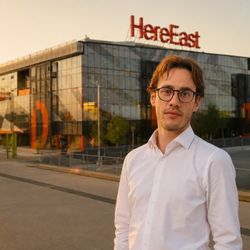
50. What makes a city creative?
19:57||Season 1, Ep. 50NABA – the Nuova Accademia di Belle Arti – has been shaping Italy's creative talent since 1980, first in Milan, then Rome. Now it has arrived at Here East in London, and the choice of location is anything but accidental. For Diego Mattiolo, Head of Education at NABA, London's density of cultures, institutions and creative energy made it the only logical first step for the school's international expansion.Georgina Godwin speaks with Diego about what the great creative cities of the world actually have in common – and what they risk losing. He reflects on growing up in Milan surrounded by design weeks and fashion shows, taking it all for granted until distance gave him perspective, and on what NABA's particular philosophy – that combination of rigorous thinking and hands-on making – produces in students that more conventional institutions do not. The goal, he explains, is not to teach students what to think, but to help them find their voice.The conversation ranges from the deep cultural roots of Italian style to the question of whether cities like Milan and London are in danger of becoming victims of their own polish – and why Diego thinks the next genuinely surprising creative hub is more likely to be found in Tokyo, Singapore or India.
49. New York's Lincoln Center isn't afraid of tech
18:10||Season 1, Ep. 49When Shanta Thake became Chief Artistic Officer at New York's Lincoln Center — home to the Metropolitan Opera, the New York Philharmonic and the New York City Ballet — she inherited one of the most storied platforms in global culture. But she also inherited its assumptions: about which art forms deserve the grandest stages, which audiences are welcome and where the boundaries of a great institution should end.Georgina Godwin speaks with Shanta about the art and politics of curation at scale — and why the most urgent question facing the Lincoln Center right now isn't what to programme, but how to ensure that the work stays genuinely ahead of the world rather than just responsive to it. Shanta argues that artists are always ten steps ahead of the rest of us, and that a curator's job is less to follow the news than to trust the artists who are already living in tomorrow.The conversation ranges from the collision of salsa and symphony to the Lincoln Center's Collider programme — a remarkable cohort of artists working at the frontier of technology and performance, from 4D sound compositions to art that generates new forms when two people hold hands and complete a human circuit. And it ends with a question we're all asking: in an age of AI and humanoid machines, what is it that makes art uniquely human — and how do we hold onto it?
48. Palantir's UK chief: London's already winning at AI
22:38||Season 1, Ep. 48The country that accidentally incubated Google DeepMind, that draws one in five of Palantir's global workforce to its shores, that saw AI startups raise nearly eight billion pounds in a single quarter of 2026. Britain is already a major player in the AI race, but can we counter the familiar narrative of decline?In this special edition of Visionary, recorded live at the Margaret Thatcher Conference in London, Charlotte Crosswell chairs a sharp conversation with Tom Westgarth, Head of Growth at British AI chip designer Fractile, and Louis Moseley, Head of Palantir Technologies UK. Together they make the case that Britain sits at a rare and potentially fleeting intersection: world-class machine learning talent, a legal and cultural framework that global companies trust, and a geography compact enough to allow the kind of creative collision – technologist meets creative director, chip designer meets software engineer – that Silicon Valley has to take transcontinental flights to replicate.Visionary is brought to you by Here East, London's home of innovation and creativity.
47. Can movies survive AI?
18:24||Season 1, Ep. 47There's an uncomfortable truth settling across the media industry. AI is already inside the production pipeline – generating imagery, animating characters, building virtual worlds, and doing it faster and cheaper than any human team. For some, that's the promise. For others, it's an existential threat. But the more interesting question lives somewhere between those two positions. Because the history of entertainment has always been, at its core, a history of technology forcing change. From the Fleischer brothers to Disney to Pixar, every era has had its disruption – and every era has found that the human appetite for story, for wonder, for experiences that make us genuinely feel something, has survived it.Michael Stein was on the frontline of cinematic innovation during Pixar's early years. He's now the Chief Technology Officer at Journey, one of the world's most ambitious experience design agencies. And he's spent his career adapting – reading where technology is heading and figuring out what it means for the people making things. AI, he tells Georgina Godwin, isn't the end of creativity. It might just be the beginning of something we haven't had the imagination to picture yet.
46. Why where you work changes everything
39:05||Season 1, Ep. 46The most important decision you'll make about your business might not be what you're building – it's where you build it.Gavin Poole has spent fourteen years proving that point. And what he's built at Here East is, at its core, an argument: that proximity to ambition is itself a competitive advantage. Georgina Godwin sits down with the CEO of Here East to explore what it really means to engineer a place for success. Gavin talks about the concept of creative collision – those unplanned, unchoreographed moments that happen when the right people share a building, a canteen, a yard – and how Here East has made the deliberate cultivation of those moments the foundation of its model. When an Oxford Economics study found that over ninety percent of Here East tenants had collaborated with another business on campus, and that those collaborations had directly increased revenue and headcount, it confirmed what he'd had long believed: that community isn't a soft benefit. It's a growth strategy.He's candid too about the stubbornness it took to get here – the reports that predicted failure, the holidays cut short, the promotions turned down – and what he'd tell any leader serious about building something that endures.
45. Beauty is serious business
25:02||Season 1, Ep. 45Britain's beauty industry is worth more than £30 billion, growing at four times the rate of the national economy – and until recently, the government was still classifying it alongside dry cleaners and funeral parlours.That gap between perception and reality is precisely what Millie Kendall has spent her career trying to close. The entrepreneur and co-founder of the British Beauty Council has worked in almost every corner of the industry – from shampoo girl at thirteen to brand founder to policy advocate – and few people understand its contradictions better. An industry where 86% of businesses are owned by women, and yet the top jobs still tend to go to men. An industry that outsizes automobile manufacturing but receives none of the same political attention. An industry that has thrived through financial crisis, pandemic and the cost of living squeeze, but still can't quite shake the charge of being frivolous.In this episode, Georgina Godwin speaks with Kendall about the forces reshaping beauty right now: the rise of aesthetics and what it means for the future of makeup; why fragrance is quietly becoming the category to watch; what heritage brands get wrong in their panic to compete with challengers; and why biotechnology – creating ingredients in labs rather than sourcing them globally – may be the industry's shrewdest hedge against geopolitical instability. Kendall is also blunt about the fight to regulate the aesthetics industry, the limits of social media, and why the lipstick effect, far from being a marketing myth, tells us something true about how people cope.Sharp, funny and unexpectedly political – this is the business of beauty, taken seriously at last.Visionary is brought to you by Here East, London's home of innovation and creativity.
44. Easter Special: Forces Shaping the Global Economy
28:03||Season 1, Ep. 44In a world of economic uncertainty, stagnant growth, and existential risk, what does it take to build something that lasts? This Easter special brings together four sharp thinkers to examine the forces reshaping how we create value, spend it, protect it — and whether any of it will matter in the long run.Paul Krutko makes the case that economic turbulence is often the best time to start something new, explaining why the most resilient regional economies are built through patient "gardening" of local talent rather than chasing headline investments. Dana Thomas revisits her landmark argument that luxury lost its soul the moment it started answering to shareholders instead of customers — and finds the industry has only doubled down since. Tom Ough surveys the researchers and scientists working to prevent civilisation-ending catastrophes, from supervolcanoes to engineered pandemics to runaway AI. And Jeremy Hunt reflects on why the tax and welfare reforms that could genuinely unlock growth are precisely the ones that take the longest to show up in the numbers.Guests:Paul Krutko — President & CEO, Ann Arbor SPARKDana Thomas — Author, Deluxe: How Luxury Lost Its LusterTom Ough — Author and journalistJeremy Hunt — Former UK Chancellor of the ExchequerPresented by Georgina Godwin and Marc Sidwell.