Share

UCL Sarah Parker Remond Centre Podcast
What Does Eugenics Mean To Us? Episode 1: The stories we tell are powerful
It has often been argued that eugenicists were not real scientists, but almost all of their ideas were grounded in late nineteenth and early twentieth-century scientific discourse. Science is a social and a socialised endeavour. Scientists are people, and their work is embodied in the social and historical contexts in which they live. In this episode, Subhadra speaks to science historians and communicators who are experts in exploring and uncovering the stories around our science. Together they look at how eugenic thinking can be perpetuated, but also confronted by the stories we tell.
Transcript: www.ucl.ac.uk/racism-racialisation/transcript-what-does-eugenics-mean-us-episode-1
This conversation was recorded on 23rd March 2021
Host: Subhadra Das, Critical Eugenics Researcher, UCL Sarah Parker Remond Centre
Guests: Chiara Ambrosio, Associate Professor in History and Philosophy of Science in UCL Department of Science and Technology Studies, with a special focus on the history of art and science. Chiara is one of the co-founders of Muso at IMPROPERA, the improvised opera production inspired by objects from science museums.
Emily Dawson is Associate Professor in Science Communication at UCL Science and Technology Studies. She was awarded The Philip Leverhulme Prize in 2020 for her work on the sociology of science and education, getting people to talk across the science/non-science disciplinary divide. Emily is the author of Equity, Exclusion & Everyday Science Learning, which was published by Routledge in 2019.
Rokia Ballo is part of the team who run Science London, a volunteer-led organization dedicated to training and enabling scientists and science communicators to employ equitable practise within their work. Science London have been nominated for the National Diversity Awards 2021.
Angela Saini is an award-winning writer, science journalist and broadcaster whose two most recent books tackle and challenge the inbuilt inequalities in the life sciences. In Inferior, she looked at the science of gender, and in Superior, she looked at the science of race.
Producer: Cerys Bradley
Music: Blue Dot Sessions
www.ucl.ac.uk/racism-racialisation/what-does-eugenics-mean-us
More episodes
View all episodes
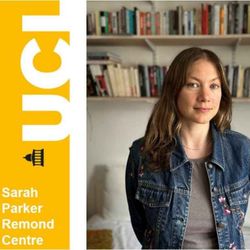
SPRC In Conversation with Gala Rexer
42:44|In this episode of the SPRC podcast, Gala Rexer speaks about her book Demographic Anxieties: Bodies, Borders, and Reproductive Injustice in Palestine/Israel (University of California Press, 2026). The conversation explores how reproductive justice in Palestine/Israel is shaped by borders, incarceration, and the global histories of eugenics. Drawing on ethnographic research with Palestinian patients navigating fertility treatment in Israeli medical institutions and Israeli fertility doctors, Rexer also discusses the experiences of Palestinian health-workers in Israeli fertility clinics, and the informal networks through which Palestinians sustain reproductive futures. It also considers the ethical challenges of researching Palestine/Israel, the responsibilities of the ethnographer, and methods of “fugitive anthropology”: a feminist approach to research that remains accountable to the embodied realities of colonialism, conflict and racialised violence. The episode closes by reflecting on feminist debt, and the responsibilities of scholars working from positions of relative safety.Gala Rexer is a feminist sociologist whose research examines gender, sexuality, race, health inequalities, and the body. She is known for her work on reproductive and environmental injustice in Palestine/Israel, Germany, and the UK. She is a Leverhulme Early Career Fellow at the University of Warwick, where she also co-directs the Social Theory Centre, and Honorary Research Fellow at UCL Sarah Parker Remond Centre. Her current research explores the effects of pollution and toxic infrastructures on reproduction, health, and family life in London. She is the co-editor of a special issue ofThe Sociological Review on "Sociology in the Times of Genocide". This conversation is about her new book, Demographic Anxieties: Bodies, Borders, and Reproductive Injustice in Palestine/Israel, published by the University of California Press in 2026.Lara Choksey is Lecturer in Colonial and Postcolonial Literatures at UCL English.This podcast was recorded in September 2026.
SPRC In Conversation with Dr Chenchen Zhang
42:58|Luke de Noronha is joined by Chenchen Zhang, Associate Professor in International Relations at Durham University. Chenchen’s book Easting the West: Theorizing the Postliberal Conjuncture from China, was published by Oxford University Press in June 2026. The book examines how ideas of ‘the West’ and articulations of China-West difference are produced and mobilized in contemporary China, with a focus on reactionary political discourse in Chinese cyberspace. Chenchen situates the Chinese case study within a wider critique of the global far right and postcolonial nationalisms. This podcast was recorded in June 2026.
SPRC In conversation with Rahul Rao: Statues, idols and why we love the idea of an animate object
52:56|A conversation about Rahul Rao’s book, ‘The Psychic Lives of Statues’. The conversation considers the agitation caused by attempts to remove celebratory statues of figures involved in the violence of the Atlantic Slave trade or of colonialism. Are statues made into ‘idols’ by people who want to defend these histories? How should we understand the sudden ‘coming alive’ of these previously forgotten and unnoticed representations of the human form? What can we learn from the distinctive erection of statues by corporate or state projects in our time and should we view these recent attempts to mark and control space through statues as a continuation of the spatial and representation tactics of European colonialism?The conversation was recorded in July 2025.Speakers: Gargi Bhattacharyya and Rahul Rao.
SPRC In conversation with Gavan Titley
39:17|Luke de Noronha is joined by Gavan Titley, Professor in the Department of Media Studies at Maynooth University. Gavan has written several books on race, racism and multiculturalism, with a particular focus on the generative role of media and communication, including Is Free Speech Racist? with Polity Press in 2020. They discuss the question of free speech, which has become so central to questions of native entitlement and authoritarian populism in the present. The conversation was recorded in November 2025. Speakers: Luke de Noronha and Gavan Titley
SPRC In Conversation with Sita Balani
32:01|Luke de Noronha welcomes Sita Balani, Senior Lecturer in English at Queen Mary University of London and the author, most recently, of Deadly and Slick: the Sexual Life of Race in Britain (Verso Press, 2023). They discuss Sita’s recent writings on culture wars, melodrama as a mode of political communication, and the difference between the ordinary and normal. This conversation was recorded in November 2025Speakers: Luke de Noronha and Sita BalaniProducer: Trisha HartEditor: James Fox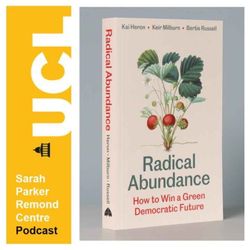
3. SPRC In Conversation with Keir Milburn and Kai Heron: Part 3
20:23||Ep. 3Radical Abundance – understanding the reconfiguration of the global economy and how we might survive itKeir Milburn and Kai Heron in conversation with Gargi Bhattacharyya. This conversation was recorded in the summer of 2025 and discusses the changing role and approach of the United States and the extreme hardships arising from climate catastrophe as triggers to re-imagine the global economy.The conversation was recorded before the publication of Kai and Keir’s excellent and celebrated book, ‘Radical Abundance’, but the themes of the conversation echo the preoccupations of the book.There was a lot to discuss here – as a result we have split the conversation into three sections for ease of listening.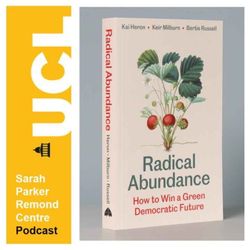
2. SPRC In Conversation with Keir Milburn and Kai Heron: Part 2
20:41||Ep. 2Radical Abundance – understanding the reconfiguration of the global economy and how we might survive itKeir Milburn and Kai Heron in conversation with Gargi Bhattacharyya. This conversation was recorded in the summer of 2025 and discusses the changing role and approach of the United States and the extreme hardships arising from climate catastrophe as triggers to re-imagine the global economy.The conversation was recorded before the publication of Kai and Keir’s excellent and celebrated book, ‘Radical Abundance’, but the themes of the conversation echo the preoccupations of the book.There was a lot to discuss here – as a result we have split the conversation into three sections for ease of listening.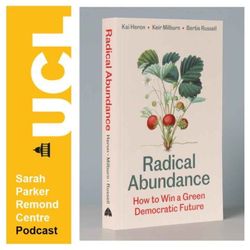
1. SPRC In Conversation with Keir Milburn and Kai Heron: Part 1
22:47||Ep. 1Radical Abundance – understanding the reconfiguration of the global economy and how we might survive itKeir Milburn and Kai Heron in conversation with Gargi Bhattacharyya. This conversation was recorded in the summer of 2025 and discusses the changing role and approach of the United States and the extreme hardships arising from climate catastrophe as triggers to re-imagine the global economy.The conversation was recorded before the publication of Kai and Keir’s excellent and celebrated book, ‘Radical Abundance’, but the themes of the conversation echo the preoccupations of the book.There was a lot to discuss here – as a result we have split the conversation into three sections for ease of listening.
SPRC In Conversation with Edna Bonhomme
34:07|Gala Rexer talks to Edna Bonhomme, culture writer, historian of science, journalist, and author of “A History of the World in Six Plagues: How Contagion, Class, and Captivity Shaped Us, from Cholera to COVID-19” (2025). The conversation covers theoretical and methodological questions about the relationship between confinement and disease, Edna’s anti/inter-disciplinary approach to writing, health and illness in literature, and how the intersectional fight for prison abolition relates to struggles for health equality. This conversation was recorded in June 2025Speakers: Dr Gala Rexer, Leverhulme Fellow at the University of Warwick and Honorary Research Fellow at the SPRC // Dr Edna Bonhomme Producer: Gala Rexer and Trisha HartEditors: James Fox