Share
Threat & Theory
OP INTEL UPDATE
Episode Description:
Last week, diplomacy appeared to be back on the table. This week, U.S. forces are striking inside Iran, Iranian missiles are targeting American bases, and tensions are rising across the Middle East.
Has diplomacy failed—or is military force now part of the negotiation?
In this episode of Threat & Theory, retired U.S. Naval Intelligence Captain Howard Hart explains why the current conflict may represent a new "enforcement phase," where military action isn't replacing diplomacy—it's shaping it. Howard breaks down the intelligence concept of coercive bargaining, why Washington may be trying to restore leverage before returning to the negotiating table, and the three indicators he'll be watching to determine whether this crisis moves toward a larger regional war or renewed negotiations.
If you've been following the headlines but want to understand what's happening beneath the surface, this episode provides the strategic context the news often misses.
Topics covered:
- Why the U.S. resumed strikes against Iran
- Iran's missile attacks and escalating rhetoric
- What "coercive bargaining" means in intelligence and military strategy
- How military operations influence diplomatic outcomes
- The biggest risks of miscalculation
- The three signals that could determine whether this escalates into a wider war
Because understanding global conflict isn't just about watching events unfold—it's about understanding the strategy behind them.
More episodes
View all episodes
34. The Secret Plan to Topple Iran
16:51||Season 1, Ep. 34For decades, Iran built an "Axis of Resistance" stretching across the Middle East. Today, much of that network has been weakened—but does that mean Iran is actually losing?In this episode of Threat & Theory, retired U.S. intelligence officer Howard Hart breaks down how the strategic landscape has shifted over the past two years. From Hamas and Hezbollah to the Houthis and Syria, we examine what's left of Iran's regional influence—and why the biggest threat to Tehran may now be inside its own borders.We also discuss:Why Iran's proxy network is weaker than everHow Israel has reshaped the regional balance of powerThe alleged behind-the-scenes plan to remove Iran's regimeWhy that plan never materializedChina's role in the conflictWhy Israel may believe the mission isn't overWhat intelligence professionals are watching for nextIf you want analysis that goes beyond the headlines and explains how intelligence officers think about global conflict, this episode is for you.Subscribe to Threat & Theory for weekly conversations on intelligence, geopolitics, military strategy, and national security.
33. America's Biggest Mistake With Iran
24:50||Season 1, Ep. 33What if America's biggest mistake with Iran isn't military strategy, diplomacy, or intelligence, but a fundamental misunderstanding of what the Iranian regime actually wants?In this episode of Threat & Theory, retired U.S. Naval Intelligence Officer Captain Howard Hart examines the ideological foundations of the Islamic Republic and explains why decades of sanctions, negotiations, military strikes, and diplomatic agreements have failed to resolve the underlying conflict.While Washington often views negotiations as a path toward peace, Iran's revolutionary leadership may see them as another instrument of a much larger strategic struggle.We explore the difference between tactical concessions and strategic objectives, the role of the Islamic Revolutionary Guard Corps, and why Iran's nuclear ambitions, ballistic missiles, and proxy networks represent far more than military capabilities.From the lessons of World War I and World War II to the dangers of nuclear deterrence and the possibility of fundamental regime change, Howard challenges conventional thinking about what it actually takes to end a war.The central question: Can America negotiate lasting peace with a regime whose ultimate vision may be fundamentally incompatible with its own?Because ending a war and ending the conflict that caused it are two very different things.
32. Is Your Phone Really Listening?!
25:13||Season 1, Ep. 32Is your phone actually listening to your conversations? Can the FBI or NSA legally spy on Americans? What did Edward Snowden really expose—and what did he cost the intelligence community? In this episode of Threat & Theory, retired U.S. intelligence officer Howard Hart separates Hollywood myths from reality.From FISA courts and Executive Order 12333 to the Patriot Act, metadata, the Snowden leaks, and the Trump-Russia investigation, we unpack how intelligence collection actually works—and why the question, "Are they spying on me?" may be the wrong one entirely.If you've ever wondered what intelligence agencies are legally allowed to collect, how oversight works, or where privacy ends and national security begins, this episode is for you.Topics Covered:Is your phone really listening?What the NSA, CIA, and FBI can legally doFISA courts explainedExecutive Order 12333The Patriot Act after 9/11Edward Snowden: hero, whistleblower, or traitor?Metadata vs. surveillanceTrump, Russia, and the FISA controversyWhy capability and intent are not the same thingSubscribe for weekly conversations where intelligence meets insight and today's headlines are explained by decades of real-world experience.
31. Inside the Intelligence Playbook
09:33||Season 1, Ep. 31Why do intelligence professionals seem to see the world differently?In this episode of Threat & Theory, Howard Hart breaks down two of the most important frameworks used throughout the intelligence and national security community: DIME and PMESII-PT.Forget the intimidating acronyms. These aren't military buzzwords—they're practical thinking tools that help analysts understand how nations use power, predict consequences, and avoid dangerous blind spots.Using real-world examples like Iran and the Strait of Hormuz, Howard explains how intelligence professionals separate actions from effects, identify second-order consequences, and make sense of increasingly complex geopolitical crises.If you've ever wondered how intelligence officers actually think, this episode gives you a rare look inside the analytical process.In this episode:What DIME actually stands forHow PMESII-PT maps complex systemsWhy intelligence relies on structured thinkingHow analysts predict second- and third-order effectsA real-world case study using Iran and the Strait of HormuzSubscribe for weekly conversations that cut through headlines and explain the world through the lens of intelligence, strategy, and geopolitics.
30. What My Daughter Taught Me About Iran
17:18||Season 1, Ep. 30What happens when a retired US intelligence officer sits down with his own daughter, a Princeton PhD candidate specializing in Iran and the Middle East?In this special episode of Threat and Theory, Howard Hart and Krista Hart explore one of the world's most misunderstood countries. They discuss whether the Islamic Republic is truly in decline, how sanctions have reshaped Iran's economy, why the Iranian people are often overlooked in geopolitical debates, and what history may ultimately say about this pivotal moment.The conversation also turns personal as Krista reflects on growing up after 9/11 with a father serving in US intelligence, how those experiences shaped her academic journey, and why understanding people is just as important as understanding governments.This is an honest conversation about intelligence, history, family, and the human side of global conflict that rarely makes the headlines.Subscribe for weekly conversations where intelligence meets insight.
29. How Targeting Actually Works in War
20:10||Season 1, Ep. 29Kinetic strikes are dominating headlines—but what’s really happening behind the scenes?In this episode of Threat & Theory, we break down the real mechanics of military targeting, using U.S. doctrine (Joint Publication 3-60) to explain how targets are selected, prioritized, and acted on in modern warfare.We explore why targeting isn’t about destruction—it’s about achieving strategic effects.From the six-phase targeting cycle to battle damage assessment (BDA) and munitions effectiveness, this episode pulls back the curtain on what the public doesn’t see. We also connect these concepts to real-world operations, including current strikes and how campaigns are designed to degrade capabilities, increase friction, and ultimately influence behavior—not just destroy assets.You’ll learn:Why tactical success doesn’t equal strategic successHow targeting aligns with political and military objectivesWhat “friction” means in warfare—and why it mattersHow modern campaigns focus on systems, not just targetsWhy assessment—not explosions—determines successIf you want to understand what’s really happening in modern conflict, this is the lens you need.
28. You're Missing This
16:51||Season 1, Ep. 28Most people think intelligence is about secrets, satellites, and classified reports. But that’s not what actually decides outcomes.In this episode of Threat & Theory, we break down how intelligence really works — not as a collection of information, but as a process of turning chaos into clarity.From all-source fusion to pattern-of-life analysis, competing hypotheses, red teaming, and forward-looking indicators, we walk through the exact framework intelligence professionals use to understand what’s happening — and what’s coming next.Then we apply it in real time.Using a recent strike on an IRGC commander, we show how analysts move from raw data to decision-making — and why the event itself matters less than what happens after.Because intelligence isn’t about predicting the future.It’s about knowing what matters… and what to watch next.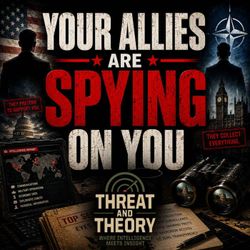
26. Your Allies Are Spying On You
34:53||Season 1, Ep. 26What happens behind the scenes when allied nations share intelligence… but don’t fully trust each other?In this episode of Threat & Theory, Howard and Evan break down the hidden mechanics of intelligence-sharing between allies, from the Five Eyes alliance and NATO partnerships to the uncomfortable reality that even friendly nations protect secrets from each other.Howard explains how trust, values, and shared interests shape global intelligence relationships — and why those relationships can fracture under political pressure. The conversation dives into the Jonathan Pollard spy scandal, Mossad’s penetration of Iran, NATO mistrust between Greece and Turkey, and the delicate balance between protecting sources and saving lives.The episode also explores how intelligence can be used not only to inform… but to influence.If you’ve ever wondered how intelligence partnerships really work behind closed doors, this episode pulls back the curtain.