Share
This Being Human
Episode 1 - Wajahat Ali
Season 1, Ep. 1
•
Wajahat Ali became one of the most high-profile Muslims in the American media following the September 11th attacks, making regular appearances on CNN, writing for The New York Times and hosting a show on Al Jazeera America.
He talks about growing up in a Pakistani-American household, writing an acclaimed play about the American Muslim experience, and dealing with his young daughter’s cancer diagnosis.
Visit the Aga Khan Museum’s website or follow us on Twitter, Facebook and Instagram.
If you enjoyed this episode and want to learn more, go to agakhanmuseum.org/thisbeinghuman
The Museum wishes to thank Nadir and Shabin Mohamed for their founding support of This Being Human.
More episodes
View all episodes
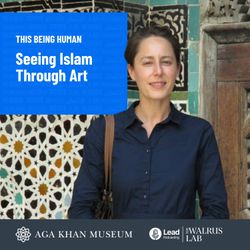
6. Seeing Islam Through Art with Christiane Gruber
34:37||Season 5, Ep. 6What ties an 8th-century mosaic in the Dome of the Rock to a contemporary abstract carpet? For Islamic art historian Christiane Gruber, that question has driven three decades of research—pushing her away from the idea of a single "Islamic art" and toward a field defined by plurality and contradiction.In this episode of This Being Human, Gruber joins host Mai Habib to read political meaning into sacred ornament, and to dismantle a persistent myth: that the Prophet Muhammad has never been depicted in Islamic art history. She traces how these depictions evolved from detailed faces to veiled figures wrapped in flame, and closes on her newest research interest—eco-Islamic art —and why stewardship and sacred water feel more urgent now than ever.*The Museum wishes to thank Nadir and Shabin Mohamed for their founding support of This Being Human.*Guest BioChristiane Gruber is the Mehmet Ağa-Oğlu Collegiate Professor of Islamic Art History in the History of Art Department at the University of Michigan, and founding director of Khamseen: Islamic Art History Online, a free digital platform for teaching Islamic art and visual culture. Her research spans medieval to contemporary Islamic art, with a focus on figural representation, depictions of the Prophet Muhammad, and book arts. She is the author of several books, including The Praiseworthy One: The Prophet Muhammad in Islamic Texts and Images (Indiana University Press, 2019).Links & ResourcesThis was just one example of Muslim art and culture that sparked curiosity and a great conversation. There is so much more to see at the Aga Khan Museum. Support the Museum's vision to impact lives and contribute to more inclusive and peaceful societies. Go to agakhanmuseum.org to plan your visit or make a donation.Explore Khamseen: Islamic Art History Online, Christiane Gruber's free digital platform for teaching Islamic art.Learn more about Christiane Gruber and her research at the University of Michigan.Read more in Anna Gade's Muslim Environmentalisms: Religious and Social Foundations, referenced in the episode's discussion of eco-Islamic art.Key Moments0:21 Introduction to This Being Human and Christiane Gruber 1:16 What comes to mind when we think of Islamic art 6:13 Moving beyond the idea of one "true" Islam 8:16 Reading political and religious meaning into the Dome of the Rock 10:50 The surprising history of depicting the Prophet Muhammad 13:52 The poetry behind the facial veil and the halo 18:57 Picture vs. picturation: representing the more-than-human 20:42 The Rose of the Prophet and the Sunnah of representation 22:19 Founding Khamseen, a "COVID baby" 25:07 Eco-Islamic art, from the Kaaba to climate change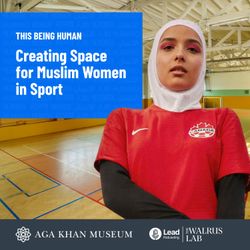
5. Creating Space for Muslim Women in Sport with Amreen Kadwa
30:14||Season 5, Ep. 5Amreen Kadwa didn't set out to build a nonprofit. She set out to find people like her: Muslim women who played sports and understood what it felt like to walk into a locker room and wonder if you belonged. In this episode of This Being Human, host Mai Habib talks with Amreen about the winding road from rugby pitches in Toronto to founding Hijabi Ballers, an organization that's grown from a single Facebook post into a multi-sport community reaching thousands of women across the GTA and beyond.They dig into what changes when an athlete finally sees someone who looks like her on the field, how a bad injury became an unexpected turning point, and why partnerships with brands like Nike and the Toronto Raptors matter—not for the validation, but for what they make possible. Amreen also shares the simple piece of advice she gives every coach and ally who wants to do right by Muslim women athletes: stop guessing what they need, and ask.The Museum wishes to thank Nadir and Shabin Mohamed for their founding support of This Being Human.Guest BioHijabi Ballers was founded in 2017 by Amreen Kadwa, a young Muslim rugby player who felt isolated by the lack of hijab-wearing role models in sport. After connecting with other Muslim women athletes and realizing many shared similar experiences of exclusion, she created a space for community. A single Facebook post quickly connected her with dozens of women, leading to the first Hijabi Ballers Sports Festival, which drew over 200 participants. The success of that event showed the need for inclusive, dedicated spaces for Muslim women in sports. Today, Hijabi Ballers is a non-profit organization that empowers Muslim girls and women through safe, inclusive sports programs that support both athletic and leadership development.Links & Resources:This was just one example of Muslim art and culture that sparked curiosity and a great conversation. There is so much more to see at the Aga Khan Museum. Support the Museum's vision to impact lives and contribute to more inclusive and peaceful societies. Go to agakhanmuseum.org to plan your visit or make a donation.Visit Hijabi Ballers online and follow them on Instagram.Explore the Hijabi Ballers Coaches Toolkit, designed to help coaches, parents, and allies support Muslim female athletes.Key Moments0:20 Intro to This Being Human and Hijabi Ballers1:21 Finding herself through rugby in high school5:48 An injury, a recovery, and the founding of Hijabi Ballers10:00 Creating a space where every Muslim woman belongs13:13 Going international: Nike, hate comments, and the app's rise and end17:10 The ten programs running today, from hockey to rugby19:42 Welcoming non-Muslim friends into the space21:43 Inside the Coaches Toolkit: "ask your athlete"24:59 Nike, the Raptors, and the rise of modest activewear27:08 A decade of cultural change and Amreen's message to allies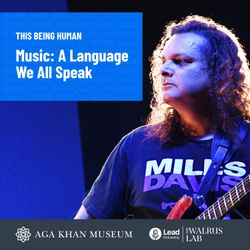
4. Music: A Language We All Speak with Mekaal Hasan
27:19||Season 5, Ep. 4"I don't want perfect. Perfect is boring.”In this episode of This Being Human, host Mai Habib chats with Mekaal Hasan, a renowned Pakistani musician to discuss his lifelong journey of connecting the worlds of traditional South Asian music with more contemporary genres like rock, jazz, and fusion.Growing up in Lahore, Pakistan, Mekaal was heavily influenced by his father, a music critic and a columnist. In 1995, he graduated from the Berklee College of Music in Boston, Massachusetts, and returned to Pakistan where he founded the Mekaal Hasan Band in 2001.Mekaal’s mission is to create music that connects cultures, lifts up other artists, and preserves tradition while redefining what Qawwali music can look like.The Museum wishes to thank Nadir and Shabin Mohamed for their founding support of This Being Human.Links & Resources:This was just one example of Muslim art that sparked curiosity and a great conversation. There is so much more to see at the Aga Khan Museum. Support the museum's vision to impact lives and contribute to more inclusive and peaceful societies. Go to agakhanmuseum.org to plan your visit or make a donation.Watch this video episode on YouTube.Visit Mekaal Hasan’s website and watch his band on YouTube.Mekaal Hasan | Aga Khan MuseumWhy Mekaal Hasan refuses to live in the past Key Moments0:00 Introduction to This Being Human and Mekaal Hasan2:57 Mekaal’s time at the Berklee College of Music 7:53 Breaking down barriers through music11:20 The cultural shift between 1990’s Pakistan and today 15:35 Honouring Qawwali legend Nusrat Fateh Ali Khan20:18 Comparing Eastern and Western music and performance styles25:32 The future of the Mekaal Hasan Band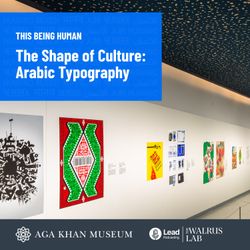
3. The Shape of Culture: Arabic Typography with Dr. Huda Smitshuijzen AbiFarès
30:41||Season 5, Ep. 3When Dr. Huda Smitshuijzen AbiFarès moved from Beirut to study in the United States, she found herself doing something she'd never had to do before: explaining her own visual culture to people who'd never seen it. That challenge changed everything. It sent her deep into the history of Arabic typography—how it grew from calligraphic tradition, was codified by ninth-century philologists in Baghdad, and is now being reimagined through algorithms and animation. And it gave her a lifelong mission: to show the world a side of SWANA creative culture that rarely makes it into the conversation.In this episode, host Mai Habib sits down with Dr. Smitshuijzen AbiFarès to go behind the scenes of her exhibition Inner Structures, Outer Rhythms, explore what makes Arabic letterforms so uniquely expressive, and make the case that contemporary graphic design from the SWANA region is one of the most direct living continuations of Islamic artistic heritage.*The Museum wishes to thank Nadir and Shabin Mohamed for their founding support of This Being Human.*Links & Resources:This was just one example of Muslim art that sparked curiosity and a great conversation. There is so much more to see at the Aga Khan Museum. Support the museum's vision to impact lives and contribute to more inclusive and peaceful societies. Go to agakhanmuseum.org to plan your visit or make a donation.Can't make it in person? Explore the 3D virtual tour of Inner Structures, Outer Rhythms from anywhere in the world.Check out more episodes in full video.Key Moments0:00 Introduction to This Being Human and the world of Arabic typography1:20 Dr. Smitshuijzen AbiFarès' background and how studying abroad sparked her passion for typography3:07 Defining typography, and how it differs from calligraphy and hand lettering5:59 How the Arabic script connects cultures across the SWANA region and beyond8:58 The Quran as connector: Arabic, Islam, and the preservation of a shared script11:51 What makes Arabic letterforms uniquely readable across wildly different styles13:36 Behind the scenes of Inner Structures, Outer Rhythms: vision, work, and journey18:11 How the exhibition adapted to audiences in Qatar, Germany, and Toronto21:10 Why sparking new conversations—not delivering answers—was the ultimate goal27:55 The future of Arabic typography: algorithms, animation, and a script that endures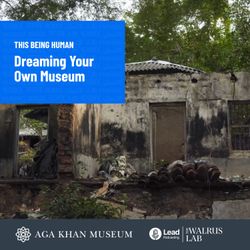
2. Dreaming Your Own Museum with Ohida Khandakar
27:41||Season 5, Ep. 2Some museums you visit. Others, you dream.In this episode of This Being Human, host Mai Habib sits down with artist and filmmaker Ohida Khandakar to discuss her award-winning film Dream Your Museum. Ohida reflects on how her Uncle Selim Khandakar’s collection of over 12,000 ordinary—yet utterly extraordinary—objects, acquired over 50 years, became a living museum through imagination and storytelling. From a mud house to the Victoria and Albert Museum, Dream Your Museum rethinks exhibition spaces, emphasizing dynamic engagement with culture and everyday life as their defining attributes. Follow along as Ohida shares her experience navigating the arts as a Muslim Indian woman, the process of curating and documenting a museum that comes to life, and why you should dream about the impossible. She also offers up the essentials to dream your own museum: inspiration, creation, and human connection.The Museum wishes to thank Nadir and Shabin Mohamed for their founding support of This Being Human.This was just one example of Muslim art that sparked curiosity and a great conversation. There is so much more to see at the Aga Khan Museum. Support the Museum's vision to impact lives and contribute to more inclusive and peaceful societies. Go to agakhanmuseum.org to plan your visit or make a donation.Visit Ohida Khandakar’s portfolio to see her gallery and more of her artistic background.For more information on Dream Your Museum’s 2025 exhibition at the V&A, check out Jameel Prize: Moving Images.Read more about Jameel Prize winner Khandakar Ohida: ‘Personal stories open universal memories’.Check out more episodes in full video.Key Moments[0:10] Introduction to This Being Human and Ohida Khandakar’s short film Dream Your Museum[1:18] Ohida Khandakar’s background in the arts and artistic interests[1:54] Pursuing a career in visual art as a Muslim Indian woman[5:59] From mud house to the moon: Dream Your Museum’s inspiration and creation[13:00] Curating and caring for the traveling museum[15:46] Collecting curiosities: how decades of artistic ritual became a museum[19:59] Sharing the subtle joys of simple objects[22:08] Living objects: the restorative power of imagination [23:40] Redefining museum spaces: dreaming, creating, and transforming our surroundings[26:40] Closing remarks on Dream Your Museum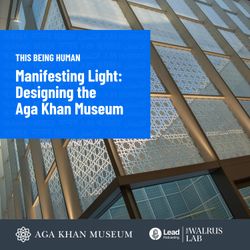
1. Manifesting Light: Designing the Aga Khan Museum
31:52||Season 5, Ep. 1Before the Aga Khan Museum became a landmark in Toronto, it started with a letter about light.In this episode of This Being Human, host Mai Habib sits down with principal architect Gary Kamemoto, who led the Museum’s design alongside the late Fumihiko Maki. He shares how that single idea—light—shaped everything, from the building’s geometry and materials to the way you move through the space.Along the way, you get a closer look at the thinking behind the Aga Khan Museum’s architecture, and how it draws on Islamic design and ideas of pluralism to create something that feels both timeless and distinctly contemporary.Gary also gets into the details you’d likely miss on a first visit: patterns that shift with the sun, geometry hiding in plain sight, and a subtle architectural tribute woven into the building itself—details that, once you know they’re there, change how you see it.*The Museum wishes to thank Nadir and Shabin Mohamed for their founding support of This Being Human.*Links & Resources:This was just one example of Muslim art that sparked curiosity and a great conversation. There is so much more to see at the Aga Khan Museum. Support the museum's vision to impact lives and contribute to more inclusive and peaceful societies. Go to agakhanmuseum.org to plan your visit or make a donation.Read more from Gary Kamemoto on the partnership between Maki and Associates and the AKDNCheck out this episode in full video.Key Moments[0:10] Introduction to This Being Human and the Aga Khan Museum as an architectural masterpiece[1:16] Gary Kamemoto on his background and navigating identity between cultures[3:46] The origin story: from the Delegation Building to the museum project[6:58] Working with His Highness the Aga Khan as a patron of architecture[8:56] The “letter about light” as an unconventional design brief[11:37] Reimagining the 17-acre site: why the garden—not the building—became central[18:38] Pluralism as process: translating philosophy into physical space[23:20] Designing for discovery: how the museum reveals itself over time[27:42] Hidden details: symbolism, geometry, and the significance of the number seven[31:18] Closing reflections on legacy, collaboration, and the museum’s ongoing lifeSeason 5 Teaser
01:26||Season 5New host. New format. Now on video.Welcome to the relaunch of This Being Human, the Aga Khan Museum’s podcast about Muslim art, global cultures and how we’re all connected. This season, new host Mai Habib talks with inspiring artists, writers, designers, and creators from across the Muslim world and beyond.Subscribe on YouTube so you don't miss a single video episode.The Museum wishes to thank Nadir and Shabin Mohamed for their founding support of This Being Human.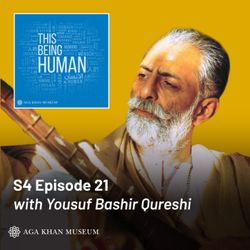
21. Beyond Boundaries with Pakistani Artist Yousuf Bashir Qureshi
41:15||Season 4, Ep. 21In this episode, we sit down with Yousuf Bashir Qureshi, known to many as YBQ, a visionary artist whose work blends music, culture, and storytelling to craft a truly global sound. From his roots to his rise, YBQ shares his journey of artistic discovery, the influences that shaped his music, and the profound themes of identity, belonging, and transformation that echo through his work. Whether you're a fan of his genre-bending soundscapes or curious about how art can bridge cultural divides, this episode will leave you inspired and enlightened. Tune in for an intimate, reflective conversation that celebrates creativity, resilience, and the power of connection.Learn more about YBQ's work at https://www.ybqds.com.If you enjoyed this episode and want to learn more, go to agakhanmuseum.org/thisbeinghuman.The Museum wishes to thank Nadir and Shabin Mohamed for their founding support of This Being Human.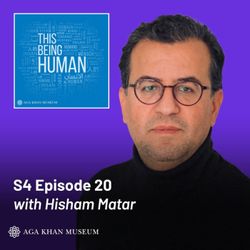
20. Hisham Matar on Friendship and Writing from the Margins
36:25||Season 4, Ep. 20Pulitzer Prize-winning author Hisham Matar joins This Being Human to discuss his latest novel, My Friends. He reflects on themes of friendship, exile, and the complexities of writing from the margins. Matar shares how his work explores life's central question: How might we live? Through meditations on cities, memory, and the human condition, he offers a tender and profound view of what it means to connect with others. To fill out our listener survey, go to agakhanmuseum.org/tbhsurvey. If you enjoyed this episode and want to learn more, go to agakhanmuseum.org/thisbeinghuman.The Museum wishes to thank Nadir and Shabin Mohamed for their founding support of This Being Human.