Share
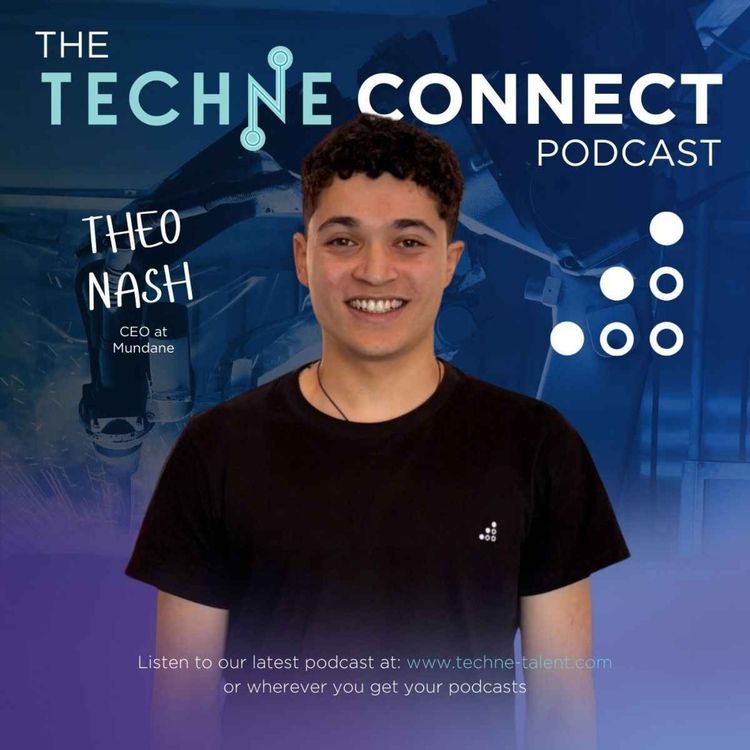
The Techne Connect
Theo Nash, CEO at Mundane
In this episode we speak with Theo Nash, CEO of Mundane, about building robots for real work and why the future of robotics should focus on labour amplification, not labour replacement.
Theo shares his journey from electrical engineering in the UK to studying in China and at Stanford, before co founding Mundane to tackle the dull, dangerous and repetitive work that robots are best placed to handle.
He explains why Mundane took a full stack approach, from hardware and control systems to human robot interfaces, and why the real challenge is not flashy demos but building robots that create economic value in real environments.
Thank you for listening to The Techne Connect Podcast - where we go behind the tech and ahead of the curve.
But we don’t just share stories, we help build them. At Techne Talent, we connect ambitious people with opportunities across the very industries we feature. If you’re inspired by what you hear, speak to us today about where your skills could take you.
👉 Don’t miss an episode: Follow and subscribe wherever you get your podcasts.
📸 For behind-the-scenes content, follow us on Instagram: @techne_talent
💼 Explore opportunities and connect with us on LinkedIn: Techne Talent
Inspire your future. Plug into what’s next.
More episodes
View all episodes
The Techne Connect Special: Ampaire, Behind the Vision with Kevin Noertker
45:46|In this episode of Behind the Vision, Kevin Nortker, Co-Founder and CEO of Ampaire, discusses how hybrid-electric propulsion is transforming the aviation industry and why practical electrification is the key to sustainable flight. He shares his journey from working on stealth technology and space robotics to leading one of the world’s most advanced electrified aircraft companies.The conversation explores the challenges of battery technology, charging infrastructure, aircraft certification, and why Ampaire believes hybrid-electric systems are the most scalable solution for aviation today. Kevin also shares insights into entrepreneurship, start-up culture, leadership, and what it takes to build meaningful innovation in aerospace.
Tom Yeshurun Founder & CEO of Civ Robotics
22:29|In this episode of Behind the Robot, we sit down with Tom Yeshurun, Co-Founder and CEO of Civ Robotics, to discuss how robotics is transforming the construction and renewable energy sectors.Tom shares his journey from civil engineering and construction management to building one of the leading robotics companies in infrastructure development. He discusses the challenges of scaling a startup, the importance of solving real-world problems, and how autonomous technology is helping address labour shortages while accelerating the deployment of renewable energy projects worldwide.
Ben Williams, Chief Operating Officer / Chief Product Officer at Exyn Technologies
29:07|In this episode of Behind the Flight, Tom Sloan is joined by Ben Williams, Chief Operating Officer at Exyn Technologies. Ben shares his journey from serving in the US Navy to becoming a serial entrepreneur and deep tech leader, reflecting on the lessons he learned transitioning from military service into industry and building innovative technology businesses.The conversation explores the future of autonomy, robotics and AI, as well as Exyn's mission to develop autonomous navigation systems that can operate without GPS, communications infrastructure or pre-existing maps. Ben also discusses leadership, startup growth and why understanding the "how" and "why" behind complex systems is critical for long-term success.
Lukas Werling, CEO & Co-Founder of ISP Tech
35:02|In this episode we speak with Lukas Werling, CEO and Co-Founder of ISPTech, about building in-space propulsion systems for the next generation of spacecraft.Lukas shares his journey from the German Aerospace Center to founding ISPTech, the importance of understanding customer pain points, and why propulsion will be a key enabler for future space infrastructure, from commercial space stations to lunar missions and in-orbit servicing.
Sumant Sharma, Co-Founder & CEO at EraDrive
35:04|In this episode we speak with Sumant Sharma, CEO & Co-Founder of EraDrive, about his journey from aerospace research at Stanford University into building autonomous systems for the future of space operations.Sumant shares insights into launching a venture-backed space startup, the growing need for self-driving spacecraft, and how AI, autonomy, and real-time decision-making will shape the next generation of the space industry.
John Quinn, CEO at Exos Aerospace
41:32|In this episode of Behind the Vision, we speak with John Quinn, Founder and CEO of Exos Aerospace, about his journey from nuclear submarines and power systems into reusable rocket technology.John shares how his background in high-risk engineering environments shaped his data-driven approach to building and scaling aerospace systems. The conversation explores reusable rockets, launch licensing, carbon composite structures, advanced propulsion, cislunar infrastructure, and why small, agile teams will play a major role in the future space economy.The episode also covers entrepreneurship, technical leadership, rapid prototyping, defence applications, and the skills needed to build reliable systems for space.
The Techne Connect Special: Twin Track Ventures, Behind the Capital, with Nicola Sinclair.
01:17:01|In this episode of Behind the Capital, Nicola Sinclair discusses venture capital, defence tech, and deep tech innovation across Europe. She shares insights on startup growth, founder resilience, fundraising challenges, and why clear communication and adaptability are critical for technical founders building in sectors like AI, aerospace, and defence.
Christine Matthews, Technology Programme Director at GKN Aerospace
30:56|In this episode we speak with Christine Matthews, Technology Programme Director at GKN Aerospace, about her journey from the Royal Air Force into sustainable aviation and aerospace innovation.Christine shares insights from her 22-year military career, the future of hydrogen and electrical propulsion systems, and why adaptability, diversity, and purpose-driven engineering will shape the future of the aerospace industry.
The Techne Connect Special: Kraken Technology Group Behind the Mission
45:10|In this episode of Behind the Mission, Alec Lynn Rogers, Development Design Director at Kraken Technology group, shares how the company is transforming autonomous maritime defence.From scaling Kraken from 7 to 170+ employees to building deployable autonomous vessels at unprecedented speed, Alec discusses engineering innovation, scalable manufacturing, defence modernisation, and the future of unmanned maritime systems.