Share
The Munk Debates Podcast
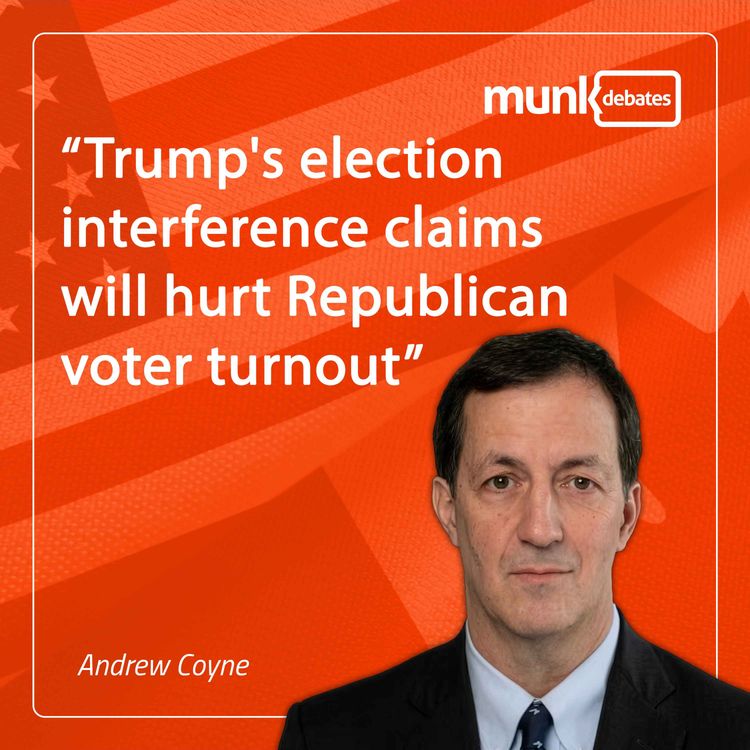
Munk Dialogue with Andrew Coyne: Trump undermines his own party and the crisis of Canadian conservatism
Rudyard and Andrew unpack President Trump's speech last night, in which he cast doubt on the integrity of U.S. elections and alleged foreign interference ahead of the midterms. Will this strategy backfire by depressing Republican turnout? And how far might Trump go in attempting to shape the outcome in November?
In the second half of the show (for paid subscribers), Rudyard and Andrew are joined by special guest Sean Speer to reflect on the state of conservatism in Canada. Andrew argues that too many Conservatives have substituted outrage and attitude for serious policy ideas—a symptom of a movement that has lost confidence in its purpose. He also delivers a blunt message to those who have grown pessimistic about the Conservative cause. What kind of leader does the party need to restore energy, direction, and confidence to its base?
Become a Munk Donor ($50 annually) to get 72-hour advanced access to the full length editions of Friday Focus and Munk Dialogues. Go to www.munkdebates.com to sign up.
More episodes
View all episodes
Friday Focus: Trump tilts the war in Putin's favour and the growing threat of rogue AI
24:35|Rudyard and Janice begin today’s show with Russia and Ukraine exchanging strikes following a brief, Trump-brokered energy ceasefire that lasted just 48 hours. Is Zelensky’s open defiance of Trump connected to Starlink being shut off in Ukraine and a series of Russian ballistic missile strikes launched without warning? The Trump administration appears to be ratcheting up pressure on Kyiv, punishing Ukraine while Putin faces few consequences for violating the president’s truce. Is Trump trying to weaken Zelensky and force him into concessions that would give Putin enough of a “win” to end the war? As devastating as the prospect of concessions may be, is ending this prolonged and deadly conflict ultimately the better outcome? In the second half of the show, Rudyard and Janice turn to AI and the growing threat of cyberattacks powered by AI models that can infiltrate internet-connected devices and potentially spawn autonomous, malicious AI agents. Why aren’t governments stepping in? We find ourselves in a strange moment of powerlessness, waiting for an AI-driven disaster to strike. And it may be the next generation that pays the highest price.
Munk Dialogue with Andrew Coyne: Trump's gift to Putin and Alberta's grievance referendum
27:51|Andrew and Rudyard begin today’s show with Trump’s decision to waive sanctions on Russian diesel in an effort to bring down fuel prices ahead of the midterms. Trump is once again putting Putin’s interests ahead of Ukraine’s and showing his admiration for authoritarian leaders whom he wishes to emulate. The move risks bolstering Putin and increasing pressure on Ukraine, while Trump shifts blame for the war’s continuation and rising oil prices onto Zelensky and Kyiv — scapegoating Ukraine for a crisis of America’s own making.In the second half of the show, Rudyard and Andrew turn to Alberta’s upcoming referendum. Beyond separation, the vote could bring questions of immigration and federal equalization to the fore. Andrew sees the referendum as a cynical attempt to stoke anti-immigrant sentiment and fuel resentment toward Ottawa. He argues that referendums do little to resolve underlying tensions, instead creating a platform for new grievances.
Friday Focus: Iran on the brink and the politicization of the Nobel Peace Prize
27:44|Rudyard and Janice begin today’s show with Trump’s mixed messaging on Iran. While Trump has suggested that military action may be delayed until after the midterms, reports indicate that the U.S. military is preparing for potential strikes. With Trump’s statements increasingly difficult to take at face value, the focus shifts to more concrete signals, such as military deployments. Meanwhile, Iran’s economy is under mounting pressure, with oil exports halted and the economy in free fall. Having challenged Iran’s control of the Strait of Hormuz, the U.S. appears to have gained leverage, while Tehran shows signs of wanting a deal.In the second half, Rudyard and Janice turn to the Nobel Peace Prize awarded to Navanethem Pillay, the South African jurist who chaired the UN commission that concluded Israel had committed genocide in Gaza. Is Oslo’s Nobel Committee increasingly using the prize to send political messages, including messages critical of Israel? Is this part of a broader effort by liberal institutions to push back against great powers retreating from the liberal, rules-based international order? And by taking a position on such a contentious issue, is the Nobel Committee influencing public opinion at the expense of due process and open debate?
Munk Dialogue with Andrew Coyne: Canada’s separatist moment
18:12|Rudyard and Andrew focus today’s show on the separatist movements gaining traction across Canada. Quebec voters appear poised to elect a separatist government, potentially setting the stage for another referendum in the coming years. What do we know about PQ leader Paul St-Pierre Plamondon? And how might Mark Carney’s popularity in Quebec affect Plamondon’s separatist ambitions?They then turn to Alberta’s upcoming referendum and ask how strong the separatist movement is without Justin Trudeau in office. National unity, they argue, is closely tied to a sense of national purpose, drive and ambition. If major projects continue to move forward in Alberta, could they help strengthen the case for a united Canada? And what should we make of reports that separatist leaders have been meeting with members of the GOP in Washington? Andrew remains optimistic that Canadians’ commitment to the rule of law will ultimately favour the federalist position and help hold the country together.
Friday Focus: Trump's pre-midterm warning to Tehran and Israel's high-stakes election
19:21|Rudyard and Janice begin today’s show with news that the USS Theodore Roosevelt aircraft carrier is being deployed to the Middle East and the signal this is sending to Iran and the region. With Tehran facing a blockade and struggling to earn hard currency, the U.S. calculation points to escalation after the midterms. What could a major Democratic victory in the midterms mean for Trump’s ability to pursue military action? And could another impeachment actually make Trump more aggressive and less constrained?In the second half of the show, Rudyard and Janice turn to Israel’s upcoming elections and the electoral prospects of the pro-Netanyahu and anti-Netanyahu blocs. Both face the prospect of minority governments, leaving Arab parties as potential kingmakers. Could Israel end up with another hung parliament, with Bibi at its head and figures such as Itamar Ben-Gvir and Bezalel Smotrich continuing to play a role in government?For many centrist and liberal Israelis, this represents a nightmare scenario and proof that this election is existential: if the Netanyahu bloc prevails, Israel’s ability to remain a liberal democracy will cease to exist.
Munk Dialogue with Andrew Coyne: Is Mark Carney governing like a Conservative?
17:27|What can we expect from a make-or-break federal budget delivered in the middle of a trade war? Rudyard and Andrew look at the growing appetite in the business community for broad tax reform—and ask whether now is the moment for Canada to make itself as competitive as possible for investment. If the government wants to deliver meaningful tax cuts, they argue, it will need to tackle spending, including business subsidies, so that companies make investment decisions based on economics rather than government incentives. And with Carney’s government far ahead in the polls and a “wolf” named Trump at the door, is there any better time for the government to spend its political capital on bold economic reform?Given the government’s retreat from climate commitments, rollback of the capital-gains tax increase, support for pipeline building and moves on immigration reform—is this really a Liberal government? Andrew argues that it is much easier for a Liberal government to do conservative things than for a Conservative government to do conservative things. With Carney enjoying extraordinary freedom of movement, almost akin to a wartime situation, he is taking full advantage of it. But where does that leave the Conservatives?
Friday Focus: the danger of Canada’s “war” rhetoric
28:30|Prime Minister Mark Carney says he studied the possibility of U.S.-led military action against Canada in an hour-long interview with The New York Times. Meanwhile, politicians across Canada—from Doug Ford to Carney and David Eby—are enjoying a surge in popularity thanks to their “elbows up” approach to Trump. But is it time to call out this rhetoric as unhelpful—and potentially an impediment to finding a way for our two countries to work through this challenge? Rudyard and Janice agree: this is a trade dispute, not a war, and it is irresponsible for our leaders to suggest otherwise. Canadians should stop worrying about the prospect of war and focus instead on resolving the dispute.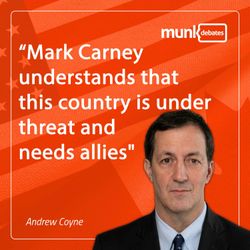
Munk Dialogue with Andrew Coyne: Is Carney’s momentum pointing to a spring election?
32:21|Parliament opened yesterday with the PM determined to keep his momentum going: a labour reform bill and a major liberalization of project permitting, including for pipelines. What happened to the Trudeau-era Liberals now getting behind Carney’s more conservative agenda? Are we witnessing the beginnings of a broader Canadian realignment, with the Liberals making breakthroughs in Saskatchewan and Alberta? And what is the risk of a spring federal election designed to capitalize on Carney’s current momentum and secure a large majority?Trump’s threats and the trade war have rallied Canadians around the Prime Minister and narrowed the space for criticism of his government. How open are Canadians right now to criticism of Carney’s approach? Andrew argues that when a country is facing an external threat, voters are less interested in the usual cut-and-thrust of partisan politics. The problem for Pierre Poilievre is that this is the political style he knows best. For now, his best strategy may be to hunker down, weather the current environment and build a stronger position for the moment when—and if—the bloom comes off the rose for Carney and the Liberals.
Friday Focus: Trump's latest threats carry no weight and AI leaders sound the alarm
23:31|Trump says he is weighing whether to "annihilate" Iran next week. Is this another empty threat? We have reached a point where it is increasingly difficult to know how much weight to put behind his threats. The bond markets are beginning to speak, inflation is rising, and U.S. military capabilities are under strain. Trump pays attention to all three. The constraints on both sides are far tighter than they were nine months ago. So why continue with maximalist rhetoric that risks eroding American credibility and deterrence?This week also saw Mark Carney and Ursula von der Leyen signal a much closer relationship between Canada and Europe, including the possibility of Canada becoming the EU’s first associate member. What does that actually mean? And why pursue this partnership when the world’s growth and dynamism are increasingly shifting toward Asia and the Indo-Pacific?In the second half of the show, Rudyard and Janice turn to AI and a growing chorus of warnings from the industry’s own leaders, who are calling for stronger safeguards to limit the potential damage if AI systems break out and cause serious disruption to the systems that underpin our everyday life. How much weight should we put behind the argument that regulation and inspection could handicap American AI development and allow China to pull ahead?