Latest episode
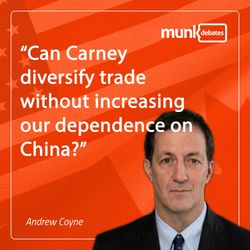
Munk Dialogue with Andrew Coyne: Autocrats attempt to carve out spheres of influence and Carney's "elbows down" approach to China
25:05|This week’s 49th ASEAN Leaders’ Summit brings together three of the world’s most powerful leaders: Donald Trump, Vladimir Putin and Xi Jinping. But is Trump representing American interests, or is he acting like a wannabe dictator, cozying up to two actual dictators as they seek to carve up the world into competing spheres of influence?They then turn to Mark Carney’s upcoming meeting with Xi Jinping at the summit. In an effort to protect Canada’s auto industry, Carney is unlikely to confront Beijing over its many transgressions against Canada, including foreign interference. There will be no “elbows up” when it comes to China. But dependency carries its own risks. Is Carney making the right trade-off in trying to diversify Canada’s trade away from the United States, only to become more exposed to China?And why is Carney increasingly cozying up to autocrats, from China to Turkey to Saudi Arabia? This is a moment that demands extraordinary Canadian diplomacy and new alliances to strengthen our position in an increasingly volatile world. But should there be limits to whom Canada is willing to negotiate with, and what it is willing to compromise in pursuit of a deal?
More episodes
View all episodes
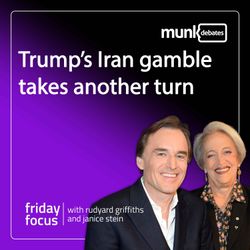
Friday Focus: Trump’s about-face on Iran and Nvidia’s big mistake
26:56|Rudyard and Janice begin with a recap of last night’s Munk Debate, America’s Liberal Reckoning, featuring Fareed Zakaria and Patrick Deneen. The debate highlighted growing fractures within the Republican coalition, with elements of the New Right increasingly distancing themselves from Trump, while deep anger over American inequality remains largely unaddressed. Patrick Deneen gave voice to the frustrations of younger Americans who feel the political establishment has failed to address their concerns.They then turn to Iran, where the president appears to be back on the offensive and JD Vance has stepped away from the file. Rumours of a possible Iranian strike are circulating across the region, raising fears that a single attack could reignite the conflict. Are Vance and Marco Rubio quietly positioning themselves for the exits, looking to distance themselves from Trump and protect their own political futures?In the second half, Rudyard and Janice examine a tumultuous week in big tech. Nvidia CEO Jensen Huang is facing scrutiny over an alleged relationship with an employee suspected of spying for China. But the story goes beyond an alleged affair: questions are being raised about his judgement, the transfer of AI chips to China, and what U.S. officials knew despite existing export restrictions.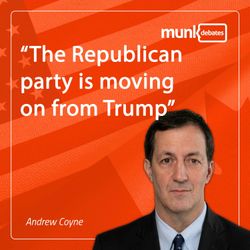
Munk Dialogue with Andrew Coyne: Trump loses his grip on the GOP and Mark Carney opens the spending taps
23:55|Rudyard and Andrew examine the aftershocks of the U.S. midterm elections, with Trump refusing to take responsibility for the Republicans’ heavy losses and some of his most loyal allies beginning to distance themselves. Has the president lost control of his party? One clear miscalculation was his failure to recognize just how unpopular the Iran war had become, even among his own supporters. Have we reached the uncomfortable conclusion that Iran has won the war on its own terms? What might a negotiated settlement look like? And for Canada, should the election results prompt a rethink of our approach to trade negotiations with Washington? In the second half of the program, Rudyard and Andrew turn to last week’s federal budget. What grade would Andrew give it? With revenues rising and spending falling, the government has roughly $30 billion a year in additional fiscal room. Yet rather than put that money toward reducing the deficit, the budget commits it to new spending. Why is the government choosing to spend rather than save? And does the budget signal that the prime minister may be preparing for a spring election?
Friday Focus: Iran’s Gains and America’s Political Reckoning
28:29|Rudyard and Janice examine the midterm results through the lens of the Iran conflict. Tehran may be the biggest beneficiary: a wounded U.S. president, a vice-president openly citing the war as a factor in the Republicans’ defeat, and Benjamin Netanyahu's political prospects diminishing Israel. If the Iranian regime can survive the conflict, it may emerge into a dramatically altered strategic environment. The next two weeks could prove decisive. What will Iran’s gains - as a relatively weak military power - signal to China and Russia about American power?In the second half of the show, Rudyard and Janice turn to what the midterms mean for Canada. A more moderate United States would be a welcome development, and Tuesday’s results may open the door to a return to political normalcy and a retreat from chaos. But Canada must also draw its own lessons: it needs to invest in its strength and resilience to protect itself against the next Trump-like threat.
Munk Dialogue with Andrew Coyne: What the blue tsunami means for the Canada-U.S. trade war
32:23|Andrew joins Rudyard to break down the U.S. election results and what they mean for the future of the Trump presidency—and for Canada. As a lame-duck president, will Trump moderate his behaviour or become even more extreme? Is Canada's hand in trade negotiations stronger today than it was 24 hours ago? And with Democrats seeking greater control over tariff policy, what might this mean for the Canada-U.S. trade relationship?Rudyard and Andrew then turn to the future of the Republican Party and Trumpism. Can Republicans rebuild, or will the movement endure beyond Trump? Andrew is less optimistic about the prospect of meaningful change, warning that “whatever succeeds Trump can still be very problematic.”Finally, they examine the role of big money in American politics. With deep-pocketed donors—particularly tech figures like Elon Musk—facing a rebuke at the polls, is there an opening for campaign finance reform?
Friday Focus: The backroom battle for Israel’s future and an exclusive interview with a former Israeli Prime Minister
23:09|Benjamin Netanyahu has emerged with the largest party in the Knesset, but the result is a hung parliament and an uncertain path to forming a government. Why did the polls and political analysts get his prospects so wrong? What follows will likely be weeks of cutthroat coalition negotiations and backroom political manoeuvring, all against the backdrop of a possible joint US-Israeli strike on Iran.To listen to the second half of the show and Rudyard's exclusive interview with a former Prime Minister of Israel, become a Munk Donor here: https://munkdebates.com/donations/
Munk Dialogue with Andrew Coyne: A new generation is reshaping politics around the world
28:08|Rudyard and Andrew examine a series of elections, from British Columbia and Toronto to Brazil and Israel, and the common thread connecting them: strong voter turnout, particularly among younger voters. How are young people reshaping the political landscape, and what might these results signal ahead of next week’s U.S. midterms?In Israel, Benjamin Netanyahu faces a difficult path to forming a governing coalition, while Brazil’s Luiz Inácio Lula da Silva defeated right-wing challenger Flávio Bolsonaro. Are these results part of a broader shift away from right-wing nationalist leaders?In the second half, Rudyard and Andrew turn to Canada’s upcoming federal budget. Andrew argues that Mark Carney’s government must rein in spending, confront the fiscal pressures of an aging population and rising healthcare costs, and, above all, make economic growth a national priority.