Share

The Laundry
E53: Why banks are increasingly worried about the shipping industry
In this episode, we're diving into the murky world of shipping and its challenges for banks. With little oversight and a global reach, the maritime industry presents complex problems for banks navigating regulatory compliance.
Our expert guests, Tom Cardamone and Michael Byrne, CEOs of Global Financial Integrity and the Institute of International Banking Law & Practice, respectively, take us through the increasing pressures on banks to combat sanctions and combat financial crime compliance evasion.
We explore the staggering statistic that 12.2% of active ships and vessels have unknown owners - and with 80% of all goods being imported by sea, the need for greater transparency in vessel ownership is more important than ever! Read the full report here.
But the shipping industry's complexity has caused anxiety among banks, who are struggling to keep up with the expertise and tools needed to navigate these challenges. Tom and Michael provide unique insights into the risks and solutions to help banks stay compliant and understand the importance of monitoring suspicious vessel behavior.
So grab a seat and get ready to uncover the secrets of the shipping industry and why it's causing such anxiety among banks.
From this exciting episode, you'll learn:
- The staggering statistic is that 12.2% of ships have unknown owners, and how this impacts overall compliance and regulatory challenges.
- Key policy recommendations from the report include vessel ownership as a risk assessment tool and establishing a beneficial ownership registry for vessels.
- The importance of a nuanced understanding of the maritime shipping industry and specific recommendations for banks and insurance companies.
- The challenges that small or medium-sized banks face in navigating the shipping industry and ways to increase their understanding.
- Future developments in shipping industry compliance trends and how financial institutions can prepare for them.
- The role of vessel group ownership information in assessing compliance risk and how government regulators and port security officials can require transparency.
- The need for banks and insurance companies to better identify commodities and trade corridors where transhipment and ship-to-ship transfers may occur.
- The consequences of failing to comply with recommendations and guidelines issued by OFAC and OFSI.
Tune in and enjoy!
More episodes
View all episodes

12. E182: Bank of America fined ONE BILLION!? Let's talk fines!
26:28||Season 12, Ep. 12Compliance professionals want one thing: to pore over the details of hefty AML fines and work out what went wrong.It’s not just about gloating (really!). It’s also about learning, so you don’t make the same mistake.So do big fines change anything, or are they just a cost of doing business?Our expert host, Robin Lycka, is joined again by Strise’s Fincrime Domain Lead, Asia Holt, to ask: what’s the gossip on the latest AML fines?The pair discuss: Bank of America’s $1.21 billion fine, The Star Casino in Australia, an unnamed foreign bank branch in the UAE, and the lack of fines in the UK.Executive Producer: Matthew Dunne-MilesEditor: Dominic DelargyVideo: Loïs DunfordSubscribe to our newsletter, Fresh Laundry, here.____________________________________The Laundry connects anti-money laundering, compliance and financial crime to the real world — the headlines, the regulation behind them, and what non-compliance actually costs.Hosted by Marit Rødevand, Fredrik Riiser and Robin Lycka, each episode brings on practitioners from banking, fintech, regulators and investigative journalism to unpack what's actually happening in the industry.The Laundry is proudly produced by Strise – manual fincrime works ends now.Get in touch: laundry@strise.ai
11. E181: INTERPOL’s advice is “laughable”?! How deepfakes are used in money laundering
32:13||Season 12, Ep. 11INTERPOL has just launched a public campaign warning that “AI is erasing the tell-tale signs of a scam.”Deepfakes now turn up at both ends of a laundering operation. They trick victims into sending money, and they open the accounts that move it on.We’ve come a long way from badly spelt phishing emails from a Nigerian prince.Our expert host, Fredrik Riiser, is joined by Sandy Kronenberg, Founder & CEO at Netarx, to reveal: how deep fakes are used in money laundering. The pair discuss: how deepfakes steal the money, open the accounts and supply the mules, how identity documents are fake, and whether we’re heading back to the bank branch to open accounts. Executive Producer: Matthew Dunne-MilesEditor: Dominic DelargyVideo: Loïs DunfordSubscribe to our newsletter, Fresh Laundry, here.____________________________________The Laundry connects anti-money laundering, compliance and financial crime to the real world — the headlines, the regulation behind them, and what non-compliance actually costs.Hosted by Marit Rødevand, Fredrik Riiser and Robin Lycka, each episode brings on practitioners from banking, fintech, regulators and investigative journalism to unpack what's actually happening in the industry.The Laundry is proudly produced by Strise – manual fincrime works ends now.Get in touch: laundry@strise.ai
10. E180: Is football ready for the AML rulebook?
31:20||Season 12, Ep. 10In 2018, emails leaked by a Portuguese hacker began exposing the inner workings of Europe’s biggest football clubs. Manchester City was one of them.The fallout is still one of the biggest stories in sport. It isn’t a money-laundering case, but anyone in compliance will spot the red flag straight away: the leaks suggested the company named on the sponsorship contract wasn’t the one paying.From July 2029, professional football clubs and agents in the EU will come under AML supervision.Our expert host, Fredrik Riiser, is joined by Carlo Boffa, EU Correspondent at AML Intelligence, and Isabel Lemes, Co-Founder of Lagom Sports Compliance, to ask: Is football ready for the AML rulebook?The panel discuss: why dirty money keeps finding its way into football, what the new rules ask of a club, and whether anyone will be ready in time.Producer: Loïs DunfordExecutive Producer: Matthew Dunne-MilesEditor: Dominic DelargySubscribe to our newsletter, Fresh Laundry, here.____________________________________The Laundry connects anti-money laundering, compliance and financial crime to the real world — the headlines, the regulation behind them, and what non-compliance actually costs.Hosted by Marit Rødevand, Fredrik Riiser and Robin Lycka, each episode brings on practitioners from banking, fintech, regulators and investigative journalism to unpack what's actually happening in the industry.The Laundry is proudly produced by Strise – manual fincrime works ends now.Get in touch: laundry@strise.ai
9. E179: Who is buying flowers at midnight? A money laundering walking tour
25:30||Season 12, Ep. 9What’s the key skill in fighting financial crime? Most people would say a head for data, spreadsheets and analytics.But maybe it’s walking past a florist that’s open at midnight and wondering: who’s buying roses at this hour?We put that kind of thinking to the test on the streets of Oslo, looking at how the world around us can be used to launder money.Robin Lycka is joined by Asia Holt, Fincrime Domain Lead at Strise, for a money laundering walking tour.They discuss the tourism industry, car washes, and the financial system it all ends up in.Executive Producer: Matthew Dunne-MilesEditor: Dominic DelargyVideo: Loïs DunfordSubscribe to our newsletter, Fresh Laundry, here.____________________________________The Laundry connects anti-money laundering, compliance and financial crime to the real world — the headlines, the regulation behind them, and what non-compliance actually costs.Hosted by Marit Rødevand, Fredrik Riiser and Robin Lycka, each episode brings on practitioners from banking, fintech, regulators and investigative journalism to unpack what's actually happening in the industry.The Laundry is proudly produced by Strise – manual fincrime works ends now.Get in touch: laundry@strise.ai
8. E178: Are criminals better at collaborating than we are?
40:10||Season 12, Ep. 8Recorded on stage at the International Anti-Financial Crime Summit in London.Are criminals better at collaborating than we are?If there’s one thing this industry loves, it’s the promise of a silver bullet – the thing that stops financial crime in its tracks. And the one that keeps getting proposed is information sharing: public with private, private with private, and every arrangement in between.So is it still worth believing in?Marit Rødevand is joined by Kathryn Westmore, Director of Financial Crime at UK Finance, Kevin Newe, Illicit Finance Threats Lead at HMRC, and Matt Donahue, CEO and Co-Founder of Kodex.The panel discuss why information sharing hasn’t always worked, what we’d build differently if we started from scratch, and what stops us being as creative as the criminal networks we’re chasing.Executive Producer: Matthew Dunne-MilesEditor: Dominic DelargyVideo: Loïs Dunford/Tinashe GutuSubscribe to our newsletter, Fresh Laundry, here.____________________________________The Laundry connects anti-money laundering, compliance and financial crime to the real world — the headlines, the regulation behind them, and what non-compliance actually costs.Hosted by Marit Rødevand, Fredrik Riiser and Robin Lycka, each episode brings on practitioners from banking, fintech, regulators and investigative journalism to unpack what's actually happening in the industry.The Laundry is proudly produced by Strise – manual fincrime works ends now.Get in touch: laundry@strise.ai
7. E177: How dangerous is crypto's hold on politics?
30:05||Season 12, Ep. 7Donald Trump in 2025: "I'm a big crypto fan. I've been that from the beginning."Donald Trump in 2019: "I am not a fan of Bitcoin and other Cryptocurrencies, which are not money, and whose value is highly volatile and based on thin air."What changed? Whatever the answer, Trump is only the highest-profile example of a growing trend.Our expert host, Robin Lycka, is joined by Peter Geoghegan, Director of Democracy for Sale, to ask: "how dangerous is crypto's hold on politics?"They discuss how crypto money is reshaping politics, what makes it such an effective tool of influence, and what comes next for AML enforcement.Executive Producer: Matthew Dunne-MilesVideo: Lois DunfordEditor: Dominic DelargySubscribe to our newsletter, Fresh Laundry, here.____________________________________The Laundry connects anti-money laundering, compliance and financial crime to the real world — the headlines, the regulation behind them, and what non-compliance actually costs.Hosted by Marit Rødevand, Fredrik Riiser and Robin Lycka, each episode brings on practitioners from banking, fintech, regulators and investigative journalism to unpack what's actually happening in the industry.The Laundry is proudly produced by Strise – manual fincrime works ends now.Get in touch: laundry@strise.ai
6. E176: Are Pokémon Cards fincrime’s hottest new toy?
33:48||Season 12, Ep. 6$190,000 of trading cards stolen in Tokyo with a hammer. One card sold at auction for $16.5 million.Somewhere between those two facts is the reason a children's card game became one of the most portable stores of value on the planet.We're talking about Pokémon: the Japanese phenomenon that has hooked generations of collectors. The game that told children to "Catch 'Em All" now has a much darker following.Our expert host, Robin Lycka, is joined by Paolo Aprile, Founder of DM Dirty Money, and Nick Jarman, Founder & CEO of Certified Trading Card Association, to ask: "Are Pokémon Cards fincrime’s hottest new toy?"The panel discuss: how a simple, fun card game turned into something else entirely, and what happens when a whole market sits outside every AML rulebook on earth.Producer: Lois DunfordExecutive Producer: Matthew Dunne-MilesEditor: Dominic DelargySubscribe to our newsletter, Fresh Laundry, here.____________________________________The Laundry connects anti-money laundering, compliance and financial crime to the real world — the headlines, the regulation behind them, and what non-compliance actually costs.Hosted by Marit Rødevand, Fredrik Riiser and Robin Lycka, each episode brings on practitioners from banking, fintech, regulators and investigative journalism to unpack what's actually happening in the industry.The Laundry is proudly produced by Strise – manual fincrime works ends now.Get in touch: laundry@strise.ai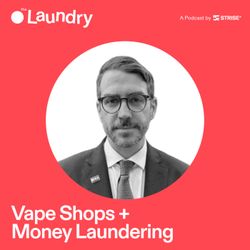
5. E175: How did vape shops become the frontline of money laundering?
32:20||Season 12, Ep. 5Last November in the UK, more than 2,000 vape shops, mini marts and candy stores were raided in a National Crime Agency (NCA) operation – with £11 million in cash seized.But despite the raids, 'hubs of polycriminality' persist on the high street. Solving it means following the money.Our expert host, Marit Rødevand, is joined by Sal Melki, Deputy Director of Illicit Finance at National Crime Agency, to ask: "How did vape shops become the frontline of money laundering?" The pair discuss: how high street stores became fronts for criminality, how that feeds into financial crime, and how to fight back.Producer: Matthew Dunne-MilesEditor: Dominic DelargyVideo: Loïs DunfordSubscribe to our newsletter, Fresh Laundry, here.____________________________________The Laundry connects anti-money laundering, compliance and financial crime to the real world — the headlines, the regulation behind them, and what non-compliance actually costs.Hosted by Marit Rødevand, Fredrik Riiser and Robin Lycka, each episode brings on practitioners from banking, fintech, regulators and investigative journalism to unpack what's actually happening in the industry.The Laundry is proudly produced by Strise – manual fincrime works ends now.Get in touch: laundry@strise.ai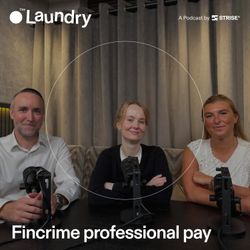
4. E174: Are fincrime professionals paid enough?
35:07||Season 12, Ep. 4We talk a lot about the dark money that makes the criminal world turn — but what about the money paid to the people fighting it?For all the responsibility, the stress, the expertise, and the constant need to adapt, compliance professionals are right to ask whether they're being paid what they're worth.Our expert host, Marit Rødevand, is joined by Quentin Downes, Divisional Director of Financial Crime, Compliance & Risk at Butler Rose, and Rebecca Robinson, Chief Risk and Compliance Officer at Tenora, to ask: "Are fincrime professionals paid enough?" The panel discuss what the market really pays right now, why so many roles feel stuck, training the next generation, and whether AI is about to rewrite salaries and job roles altogether.Producer: Matthew Dunne-MilesEditor: Dominic DelargyVideo: Loïs DunfordSubscribe to our newsletter, Fresh Laundry, here.____________________________________The Laundry connects anti-money laundering, compliance and financial crime to the real world — the headlines, the regulation behind them, and what non-compliance actually costs.Hosted by Marit Rødevand, Fredrik Riiser and Robin Lycka, each episode brings on practitioners from banking, fintech, regulators and investigative journalism to unpack what's actually happening in the industry.The Laundry is proudly produced by Strise – manual fincrime works ends now.Get in touch: laundry@strise.ai