Share

The History of England
419 Cromwell and his Reputation
Season 8, Ep. 61
•
"Never man was highlier extolled, and never man baselier reported of and vilified” write Richard Baxter - a contemporary of Oliver Cromwell, who was not a fan. In this he was closer to the truth than Samuel Johnson, who wearily wrote in the 18th century that "all that can be told of him is already in print.” Cromwell is makes a subject extraordinarily divisive, and extraordinarily rich, partly because, as some other clever person remarked, people find in him what they are looking for.
For maps, resources, transcripts or to become a member, head for https://thehistoryofengland.co.uk. (Please note the 'the' part!)
More episodes
View all episodes
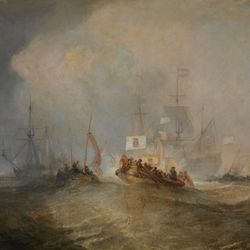
28. 458 Revolutions, Glorious or Otherwise
57:09||Season 9, Ep. 28In England, the settlement of 1689 achieved a compromise most could live with, if not to love. This episode compares England's experience with that of Scotland, Ireland and the Americas where the outcomes would be more conflicted, and have a longer tail.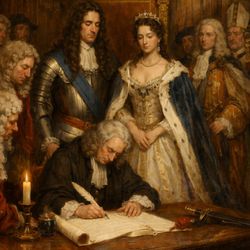
27. 457 The Bill of Rights
50:59||Season 9, Ep. 27As was becoming worryingly like a habit, since there was no king, so a Convention was called, and elections held. This Convention would debate the succession, redefine the loyalty oath, and embed in law for the first time, a degree of religious toleration. And they would create a document described by Edmund Bruke, a hundred years later, as 'the cornerstone of the British Constitution'.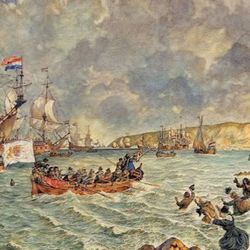
26. 456 Revolution
46:27||Season 9, Ep. 26On 5th November 1688 William landed, claiming to be here to force James to restore Scots and English liberties. His army of 15,000 faced a much larger royal force of 25,000 gathering at Salisbury. But as James waited for William falter in a struggle towards London though the mud and cold, he was assaulted by a stream of news - of riots and uprisings. From East Agnlia, from Cheshire, Yorkshire and the Midlands. London was gripped by rioting. But James' surely position was surely too strong for him to be beaten - and such a brave and experienced commander would be hard to beat.
The Uprising
14:12||Season 9Paul Greengrass' The Uprising covers the Peasant's Revolt in 1381 from start to bloody finish. Did you see it? What did you think? This is a few minutes from me about how I found it, and an invitation tio come along to post your views with other listeners on the History of England Podcast Group https://www.facebook.com/groups/314746805305339/
English Food with Neil Buttery
57:10||Season 9Eating in England and indeed Britain is delightfully varied, with a diversity mix of heritages and styles from across the world. Neil Buttery, chef, food historian and host of the British Food History Podcast, joins me to answer some questions, and consider the origins of a few iconic English dishes
25. 455 The Immortal Seven
43:22||Season 9, Ep. 25The very same day that the Seven Bishops were acquitted, another seven men met at a secret meeting, and together composed as letter. The ex-admiral, Arthur Herbert, smuggled it to the Netherlands, to present it to William of Orange. The Immortal Seven had sent William the invitation he needed.
24. 454 Trial of the Seven Bishops
43:44||Season 9, Ep. 24Full of confidence at his progress, in 1688 James decided he would suffer no more equivocation from the Church of England. The Indulgence was re-issued, this time with a command that it be read by every priest from every pulpit - thus aligning them with a policy they detested, making them royal servants. The atmosphere was hot with conflict - and everything was heightened by the news of a birth - of a royal prince and heir. The Three kingdoms would now permanently be held by a Catholic. At Whitehall, Seven Bishops decided it was time to stand their ground.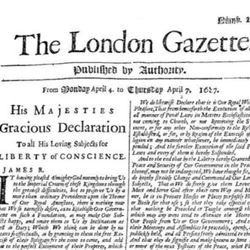
23. 453 Royal Indulgence
48:41||Season 9, Ep. 231686 had seen progress for James - but he was puzzled and frustrated by Anglican opposition from the English and Scottish parliaments. 1687 saw a continuation of the old strategy to raise the status of Catholics, and stifle independence of civil and military institutions. But it would also see a new strategy - to bypass parliament, and appeal to Dissenters as well as Catholics.
22. 452 A New Reformation
42:40||Season 9, Ep. 22From a happy start in 1685, James had begun to hit resistance in England to his campaign for Catholic emancipation. In 1686, he planned to accelerate the process. He expected rapid success in Ireland and Scotland, and confidently expected that education, propaganda, and the reality of supreme royal authority would subdue any resistance in England and Wales.