Latest episode
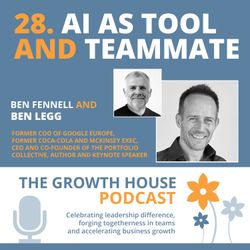
28. AI as TOOL and TEAMMATE
48:39||Season 1, Ep. 28Our latest podcast is with the wonderful Ben Legg, a man who has done so many different things in his career that it makes your head spin. He's been a British soldier, a McKinsey consultant, a Coca-Cola and Google Executive, Ben is now an entrepreneur and inspirational speaker in the AI space. I think it is the breadth and diversity of Ben's background that makes his perspective so insightful and so practical. Ben has just joined The Growth House speaker roster and so it's a very great pleasure to share this conversation.2:19 – Ben Legg's career journey British Army engineer → McKinsey → Coca-Cola (Greece, Poland, India) → COO of Google Europe → portfolio career in AI (speaking, investor advisory, board/mentoring work).5:12 – Running an agentic business How Legg runs a 6-person (1 + 5 fractional) consultancy by automating routine work and deciding the human/AI split per project.7:37 – Claude as the orchestration layer Claude sits at the centre of his tech stack (Notion, email/calendar, Gemini, Granola, Xero) and runs 62 personal agents.8:06 – Why Claude specifically Claude's edge isn't the LLM itself but its ability to organise, coordinate, and orchestrate across other tools.9:00 – Building confidence to adopt AI Two paths: quick wins (e.g., a 20-minute email agent) vs. going all-in over a fixed period, illustrated by Legg's own "power user in a month" experiment with Claude.12:30 – AI as teammate, not tool The "graduate trainee" analogy — training agents like a junior teammate who improves daily, vs. generic AI which resets every session.14:45 – Case study: Klarna Headcount cuts, partial rehiring, and eventually ~30–40% cost reduction with doubled revenue — mistakes made in public.~17:40 – Case study: IKEA Freed-up call centre staff retrained into design roles, generating $1.3bn in new revenue.19:06 – Freeing humans for higher-value work Parallel example from a telco client; AI takes the mundane, humans take the complex/creative.20:14 – Dual agenda: AI skills + critical thinking The future-of-work case for developing both; also why parents need to be AI power users to teach their kids.22:58 – Four levels of AI competence Legg's framework for gauging a room's AI maturity (from "not using AI" to "building agentic workflows").23:53 – Watchout: "Pilot purgatory" Individual productivity gains without solving big cross-functional problems — still needs proper change/project management.~25:20 – Watchout: "Shadow AI" Risks of employees using personal AI accounts with company data when organisations dither or over-restrict.26:36 – Token budgets and ownership Why giving AI budget ownership to line managers/P&L owners drives better trade-off decisions than IT-owned token systems.27:42 – Data quality as the foundation Why "rubbish in, rubbish out" becomes urgent once AI (not humans) is doing the reconciling — the "library with no organisation" analogy.30:24 – "Turkeys voting for Christmas"? Jevons paradox — efficiency increases demand rather than destroying jobs, especially in healthcare, entertainment, travel, education.33:51 – Case study: Radiologists Geoffrey Hinton's 2016 prediction vs. reality — radiologist numbers and pay have grown as scanning volume increased.36:54 – Gamifying learning with his kids Building Gemini "gems" (agents) for storytelling and colouring with his children as a way of teaching AI literacy through play.39:48 – AI and human connection Ben Fennell's own example (Suno + personalised song) and discussion of AI freeing time for higher-value human connection.41:08 – The "AI super user" in every team Why teams now need a designated AI champion alongside other core skill sets.43:03 – Closing three questions43:48 – Leadership behaviour: leading from the front on AI adoption45:07 – Teamship behaviour: "share and learn," including failures46:50 – Growth advice: use AI to find new opportunities, and always weigh human vs. AI split at every stage
More episodes
View all episodes
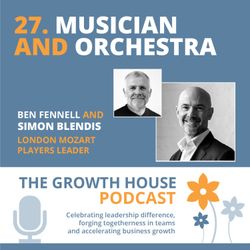
27. MUSICIAN and ORCHESTRA
45:45||Season 1, Ep. 27This episode of the Growth House podcast draws a rich extended metaphor between orchestral performance and business leadership, using Simon Blendis's experience leading the conductor-less London Mozart Players to explore what high-performing teams have in common. Chapter Summary0:09 – Introduction Ben introduces Simon Blendis, principal violinist and leader of the London Mozart Players, framing the episode around leadership, teamship, and high performance lessons from the orchestral world.1:48 – Simon's background Simon describes his unconventional path (Cambridge music degree rather than music college), his 23 years with the Schubert Ensemble (a piano quartet/quintet), and his move into orchestral leadership at the London Mozart Players — a conductor-less chamber orchestra of ~30 players.5:07 – Player and leader: staying sharp Discussion of maintaining top performance as a practitioner while leading — the role of continuous practice, self-awareness about declining ability, and using ongoing bookings from other orchestras as an informal performance indicator.7:53 – Orchestra structure and devolved leadership Simon explains section composition (violins, violas, cellos, basses, wind, brass), the role of section principals, and how authority and decision-making are distributed throughout the orchestra.10:01 – Rehearsal-to-performance ratios How limited (often single) rehearsal time before a concert demands efficiency, shaped by the orchestra's lack of state funding.11:05 – Feedback and psychological safety A detailed discussion on how feedback is delivered under time pressure — reframing criticism as "opportunities for improvement," directing comments to the group rather than individuals, and a cautionary anecdote about a conductor whose mockery bred fear and safe, uninspired playing.17:06 – Listening as a core skill Exploration of listening as fundamental to ensemble playing — learning to listen across sections and instruments, an anecdote about practicing in the dark, and how removing a conductor heightens collective listening and ownership (with a business parallel about a departing "chief people officer").22:03 – Organic responsiveness and roles by section How musical decisions unfold spontaneously through listening and response rather than command; the different "roles" of sections (melody, rhythm, harmony) and the concept of interdependence — even a "boring" repeated cello note can inspire the whole section.25:35 – No passengers: consistency and recovering from mistakes The idea that every player's contribution matters, the "carry on" protocol when something goes wrong, and the cricket analogy ("only focus on the next ball") about not compounding errors.27:01 – Building trust How trust is built quickly through clarity and consistency, illustrated by the "Podium" corporate demonstration exercise (the audience shouting "Simon" progressively louder).29:59 – Driving standards Maintaining high standards regardless of circumstances (poor venues, fatigue), plus an anecdote about conductor Charles Dutoit immediately setting a high bar with a new orchestra.32:32 – Individual flair within the team Balancing virtuosity with collective sound — the "playing like one instrument vs. playing like soloists" demonstration, and the rowing analogy of giving full effort while staying collegiate.35:07 – "Freedom in a framework" The rehearsal-builds-framework, concert-brings-freedom concept, described via Simon's "scales" metaphor of leadership versus teamwork shifting balance over time; parallels drawn to business pitch rehearsals.37:43 – Player, leader, coach Simon maps these three modes onto rehearsal (coaching), the ongoing act of leading while playing, and full creative freedom in performance — including "the art of under-rehearsing."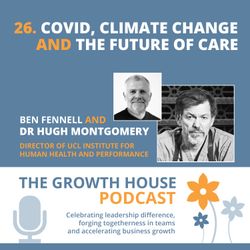
26. Covid, climate change and the future of care
55:41||Ep. 261. Introduction & Podcast Context00:00 – 02:20 Ben Fennell introduces The Growth House Podcast, its focus on leadership, teamship and growth, and welcomes Dr Hugh Montgomery, outlining his extensive background in intensive care medicine, COVID-19 response, climate change advocacy, and extreme endurance pursuits.2. Hugh Montgomery’s Unplanned Career Journey02:20 – 05:15 Hugh reflects on a career shaped by curiosity rather than fixed goals — from commercial diving and physiology to intensive care medicine, academic research, and eventually climate change leadership.3. Integrating Clinical Practice, Research & Personal Experience05:15 – 07:45 Discussion on how Hugh’s clinical work, academic research and adventurous personal life inform one another, including insights gained from mountaineering, hypoxia research, and personal loss influencing scientific breakthroughs.4. Work, Purpose & Why “Work–Life Balance” Misses the Point07:45 – 09:15 A shared reflection on why meaningful work doesn’t feel like “work” and how purpose, not balance, sustains long-term motivation and performance.5. Leadership & Teamship in Intensive Care09:15 – 14:50 Hugh explains intensive care as a fundamentally flat, team-based environment — emphasising collective responsibility, trust, and listening over hierarchical command-and-control leadership.6. Decision-Making Under Pressure14:50 – 16:05 Insights into how high-stakes medical teams operate during crises, including the paradox that the more serious the situation, the calmer and quieter effective teams become.7. What Intensive Care Actually Is16:05 – 17:10 A clear explanation of the role of intensive care units, how patients arrive there, and what “life support” really means in practice.8. The Future of Healthcare: Technology, AI & Human Factors17:10 – 24:15 A wide-ranging discussion on the unsustainable trajectory of modern healthcare, rising chronic disease, workforce strain, the limits of AI, and the growing loss of human connection in medicine.9. Human Connection vs. Transactional Care24:15 – 26:20 Why continuity, ownership and genuine human connection matter more than efficiency alone — and how responsibility transforms patient outcomes and trust.10. Leadership Lessons from the COVID-19 Pandemic26:20 – 31:45 Hugh recounts the UK’s intensive care response to COVID-19, highlighting rapid collaboration, suspended bureaucracy, academic–industry partnerships, and extraordinary acts of leadership at every level.11. Personal Resilience, Energy & Leading Through Enthusiasm31:45 – 34:55 Reflections on what the pandemic revealed about Hugh’s own leadership style — particularly the power of energy, optimism and emotional contagion in sustaining teams under extreme pressure.12. Climate Change, Leadership Failure & Collective Responsibility34:55 – 40:35 A powerful critique of global inaction on climate change, framed as a failure of leadership and personal responsibility — and a call for individuals and organisations to lead rather than wait.13. Motivation, Fear & Changing Behaviour40:35 – 45:45 Discussion on why fear-based messaging often fails, the importance of meaningful motivation, and personal stories that illustrate how long-term purpose drives real behavioural change.14. Leadership Behaviours That Enable Growth45:45 – 50:30 Hugh shares the leadership behaviours he values most: immersion, accessibility, enthusiasm, curiosity, and creating environments where people feel ownership and purpose.15. Meaning, Purpose & What Ultimately Matters50:30 – 54:40 A deeply personal reflection on meaning, love, responsibility and legacy — drawing on Viktor Frankl’s work and personal loss to articulate what sustains people through hardship.16. Closing Reflections & Farewell54:40 – 55:30 Ben thanks Hugh for a wide-ranging and deeply insightful conversation, closing the episode.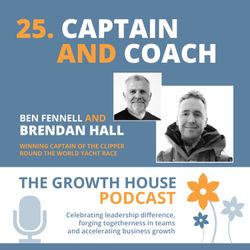
25. CAPTAIN and COACH
53:47||Ep. 25It gives me great pleasure to share our 25th and latest podcast. In this final pod of the year I'm in conversation with 'Clipper Round The World' winning Captain, Brendan Hall. I think that this conversation is loaded with insight and learning for business leaders at all levels. Brendan talks with such candour and vulnerability about the evolution of his leadership style as he watched his team step up and grow. Without sharing any spoilers, I'm sure that his deeply personal story, in one of toughest environments imaginable, will resonate with many. I really hope that you enjoy listening to Brendan as much as I did.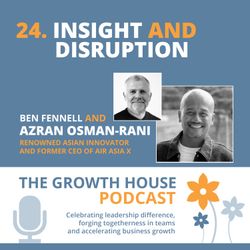
24. INSIGHT and DISRUPTION
47:19||Season 1, Ep. 24Azran is a serial Entrepreneur and Disruptor. I really enjoyed hearing him share his perspective on 'Finding customer insights that competitors might have overlooked', and 'Building a product offering that delivers against that unmet customer need'. To create a value proposition in the long haul airline industry is no small achievement, and I think that there are lessons for anyone trying to scale a business in the story of Air Asia X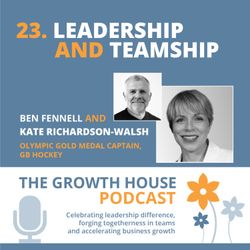
23. LEADERSHIP and TEAMSHIP
45:02||Season 1, Ep. 2300:00 – 03:00 | Introduction & Career OverviewHost Ben Fennell introduces the podcast and Kate Richardson-Walsh.Highlights Kate’s 375 caps for Great Britain hockey, 13 years as captain, and Rio 2016 Olympic gold.03:00 – 05:00 | Early Career & Team Development ChallengesKate discusses the turbulence of her first 10 years in the sport.Explains lack of full-time training due to funding and resulting inconsistency in performance.05:00 – 08:30 | Purpose, Vision & 'Gold Medal Standards'Insight into rebuilding after London 2012.Shift to using “Would a gold medallist do that?” as a daily behavioural check-in.Importance of turning abstract vision into actionable behaviours.08:30 – 12:00 | Strengths & Self-AwarenessTeam learned to recognise and value individual strengths through psychology work.Kate discusses her personal strength (consistency) and Helen Richardson-Walsh’s penalty goal at Rio.Power of knowing and using your strengths under pressure.12:00 – 15:20 | Good Day / Bad Day Exercise & TriggersImportance of knowing your personal signals of performance and self-awareness.Identifying emotional and behavioural cues that indicate decline or stress.Creating plans and asking for support when triggered.15:20 – 20:00 | Receiving Feedback WellKate’s story of receiving honest feedback from a junior teammate.Emotional reaction vs. self-control.Emphasises thoughtful, kind, and direct feedback as a gift.20:00 – 25:30 | Diversity, Inclusion & Belonging (DIB)Overview of diversity within the GB hockey team and its limitations.Leveraging cognitive, personality and strength-based diversity to enhance resilience and creativity.Transition from inclusion as a concept to belonging as a performance driver.25:30 – 30:00 | Inductions, Culture & StorytellingTeam’s cultural onboarding and welcome ceremonies before Rio 2016.Use of storytelling to share values and welcome new members.Importance of helping new joiners quickly understand and contribute to team culture.30:00 – 36:30 | Identity, Microaggressions & RepresentationKate’s personal experiences with prejudice and stereotypes.Subtle discrimination: e.g., “couldn’t you have used a prettier picture?”Significance of representation and embracing identity confidently.36:30 – 39:20 | Safe Spaces & Learning Through DiscomfortImportance of creating non-judgmental spaces for DIB conversations.Avoiding blame and “cancel culture.”Acknowledging fear but choosing to grow through discomfort.39:20 – 45:00 | Closing Reflections: Leadership, Teamship & GrowthLeadership: “Honesty” – authenticity and holding self to same standards as others.Teamship: “Selflessness” – showing up daily even if not selected. • • Growth: “Get comfortable with being uncomfortable” – personal and team development through challenge.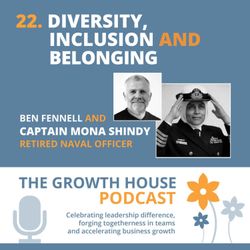
22. DIVERSITY INCLUSION and BELONGING
57:53||Season 1, Ep. 22As we launch our new Diversity Inclusion and Belonging programme, we wanted to share our podcast interview that I did with Mona. At a time where the DIB agenda is under attack from some very powerful leaders around the world it feels absolutely appropriate for us to double our efforts in the space. We hope that you enjoy the conversation I had with this incredible leader. My biggest takeaway is that Diversity can only truly flourish if you create sustained energy and focus on the I & B of DIB.Mona Shindy shares her experiences in the Navy, highlighting the challenges she faced as a woman in a male-dominated field. Mona discussed her journey from naval officer to leadership coach, emphasising the importance of vulnerability, resilience, and community in leadership development. Mona shares her 30-year career as an engineer in the Navy, including the challenges she faced as a mother trying to balance work and family life, and the difficulties of navigating gender roles and speaking up when incidents occur. Ben and Mona also discuss the importance of community, leadership, communication, respect, empathy, and acknowledging bias in creating an inclusive workplace culture, emphasising the need for leaders to prioritise diversity, inclusion, and belonging.0:00 Intro1:51 Mona’s career journey as a Naval officer and personal story.4:58 Belonging and inclusion after a family tragedy in Australia.10:57 Navy life, roles, and dynamics with a focus on women in the Australian Navy.14:01 Challenges of being a female engineer in the Navy, including balancing work and family life.22:25 Speaking up in the Navy, addressing unacceptable behaviors and cultural reluctance to report incidents.25:56 Workplace culture and the responsibility of leadership in creating an environment where employees feel comfortable speaking up about inappropriate behaviour.33:19 Exclusionary comments and microaggressions in workplace culture.36:04 Diversity, inclusion, and belonging in teams, with a focus on communication, empathy, and permission to make mistakes40:02 Diversity and inclusion in the workplace49:37 Leadership, teamwork, and growth with a focus on empathy, inclusivity, and lifelong learningBuy Mona’s bookShattering Identity Bias by Mona Shindy: Buy on Amazon Follow Monahttps://www.monashindy.comlinkedin.com/in/mona-shindy-csc-84ba54121Follow Ben and The Growth House Subscribe to The Growth House Podcasthttps://thegrowthhouse.comben@thegrowthhouse.co.ukhttps://www.linkedin.com/in/ben-fennell-tghhttps://www.linkedin.com/company/the-growth-house