Share
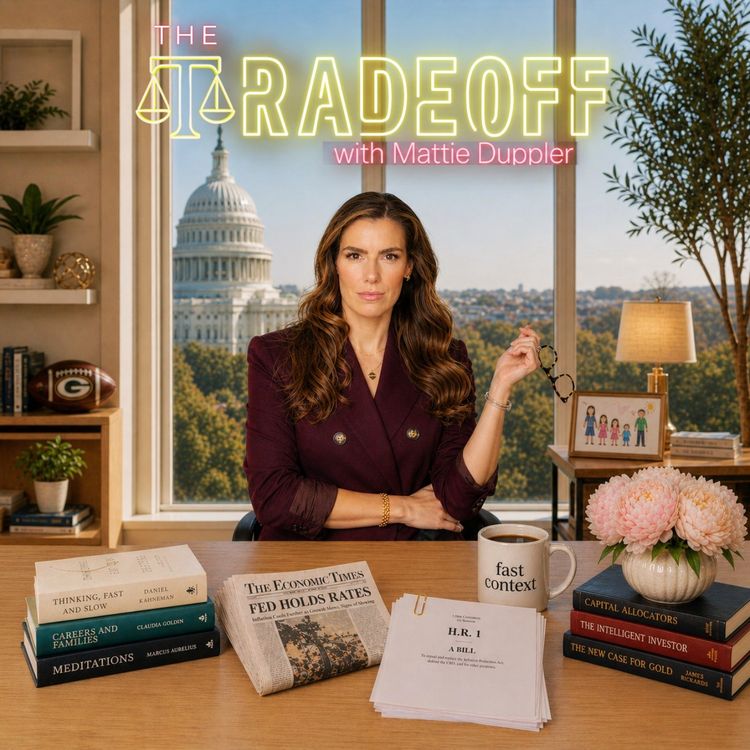
The Tradeoff with Mattie Duppler
Treasury Yields Explained: Who Pays When the 10-Year Hits 5%
Season 2, Ep. 4
•
Treasury yields just hit their highest level since 2007, and mortgage rates crossed 7% for the first time since January 2025. The headline is rising yields. The tradeoff is who pays for it. Mattie breaks down the vocabulary financial news uses to talk about debt (paper, yield, the spread), why the 10-year Treasury is the floor under your mortgage, your car loan and your credit card, why stocks shrugged this time, and how AI borrowing is now competing with the US government for the same dollars. Plus the number the show will keep coming back to: interest on the federal debt has crossed $1 trillion a year.
Sign up for more insights and updates at www.mattieduppler.com
Follow Mattie on Instagram @MattieDC and Youtube @MattieDC
More episodes
View all episodes

10. Military Spouse Unemployment: The Cost of Serving Hidden in Plain Sight
12:45||Season 2, Ep. 10Military spouses are unemployed at roughly 4x the rate of civilian spouses. An economics and policy podcast for professionals on why. On Veterans Day, Mattie decodes the second half of the cost of service: the spouse who starts over every time the military moves the family. Congress has fixed the licensing problem twice, and the Justice Department found the fix wasn't reaching the front desk. Federal law also moves a spouse's tax residency. It doesn't move her business. Then the capital: in 1944, the GI Bill capped a veteran's business loan at 4%. Today the ceiling on the smallest SBA loans is 13.5%.Resources for military spouses Career coaching, the SpouseWorks Scholarship and job listings (Military OneSource): https://www.militaryonesource.mil/education-employment/for-spouses/ Using your professional license after a military move, and how to report a problem (Department of Justice): https://www.justice.gov/servicemembers/2025-update-portability-professional-licenses Free business training, counseling and loans for military spouse entrepreneurs (SBA): https://www.sba.gov/business-guide/grow-your-business/military-spouse-businesses Boots to Business, the SBA’s entrepreneurship course, open to military spouses: https://www.sba.gov/b2b 12-week paid fellowship with civilian employers (Hiring Our Heroes): https://www.hiringourheroes.org/career-services/fellowships/internships/msfp/9. What Happens After the Midterms And How History Can Predict Future Economic Policy Decisions
12:02||Season 2, Ep. 9The headline is who won the election. The tradeoff is the people who just lost are still holding the checkbook. Government funding runs out December 11, which means the first big decision after this election gets made by the outgoing Congress. Mattie walks through the three lame ducks that set the rules: 2010, when a stopgap handed the pen to the new majority, 2018, when the same move ran into a president and a 35-day shutdown, and 2022, when a thin House margin broke the pattern. Then the math: 15 lame ducks since 1994, nine that kicked some or all of the work to the new Congress, and six of those nine after a chamber changed hands. Plus why what happens in December is less about who wins, and more about how they do it - because another big debt and spending fight looms large.8. Cheap Money, Locked Doors: The Generational Wealth Gap
13:32||Season 2, Ep. 8Americans have never been richer on paper. Household net worth hit $195.9 trillion this summer. The headline is record wealth. The tradeoff is who was standing in the right place when money got cheap. Mattie walks through the Fed's new Survey of Consumer Finances (families 75 and older now hold more than 15 times the median net worth of families under 35), why 49% of mortgages carry a rate below 4% while new loans sit above 7%, and how that locked-in cheap money pushed the typical first-time buyer to 40. Then the other side: millennials and Gen Z started investing a decade earlier than their parents, with more off-ramps than any generation before them. Our parents' ladder was a house. Ours may be a brokerage account.Listen on Spotify: https://open.spotify.com/show/1ZpiElTOOQSaXiz6YMzbGxApple Podcasts: https://podcasts.apple.com/us/podcast/the-tradeoff-with-mattie-duppler/id1867902434Subscribe to the Substack here: https://mattieduppler.substack.com/7. How the Midterms Show Us Society is Built for a Household That Doesn't Exist
12:37||Season 2, Ep. 7Campaigns have spent $5.7 billion on House, Senate and governor races this cycle. Cost of living, taxes, health care, energy and crime all made the top ten issues in the ads. Child care didn't - not for either party. The headline is that this election is about affordability. The tradeoff is that the biggest line in a lot of family budgets isn't in the conversation. Mattie walks through three numbers (7%, 10% and 33%), the 33 weekdays a year school is closed against 16 days of paid leave, what changes Washington has made recently (spoiler: not enough) to make raising kids more affordable in this economy, and Mattie uses her experience winning policy campaigns in Washington to explain why child care keeps losing the fight for airtime in Washington. From Dependent Care FSAs to tax credits, this episode tells you everything you need to know about how little America does to support working parents - and how far we have to go.6. The Stock Market Isn't the Economy - Why Bonds Will Send the Bill
13:30||Season 2, Ep. 6On October 2, the economy added 29,000 jobs against 90,000 expected, unemployment rose to 4.2%, and the stock market went up. The headline is that the economy had a bad day. The tradeoff is that the stock market had a good one, for the exact same reason. Mattie walks through why markets cheer bad news (it makes money cheaper), what 2009, 2022 and August 2024 show about where that rule breaks, and why the bond market is now the one sending the bill: the 10-year Treasury at 5.35%, its highest since 2002, a term premium at its highest since 2014, about $1 trillion a year in federal interest, and roughly $170 billion in AI bonds in six months. Plus what it means if you've been waiting for rates to fall.5. If "Consumer Spending is Strong" Why Does the Economy Feel Anything But?
11:12||Season 2, Ep. 5Consumer spending jumped 0.9% in August, and the economy grew at a 2.2% annual rate in the second quarter. The headline is that consumer spending is strong. The tradeoff is that it's coming out of savings. Mattie walks through the numbers under the headline: after-tax income grew a third as fast as spending, the personal saving rate fell to 4.1% from 5.2% a year ago, and consumer confidence hit its lowest level in more than 12 years. Mattie argues WHO is doing the spending is actually part of the answer for why the economy can feel so tough for so many, but the headlines all still draw the picture of a strong consumer.3. Can AI Price the Mental Load? The $6TR Question
10:28||Season 2, Ep. 3An economics and policy podcast for professionals. Mattie Duppler on AI doomerism, the GAO's $6 trillion unpaid labor estimate, and who pays. While everyone is debating if AI will end the world, Mattie wants to talk about a more important question: if we aren't going to look at our close history to determine how this debate might play out, how do we know who it benefits? Because the straight math is that if AI replaces labor that society values at zero, any number times zero is still zero.The Government Accountability Office just put the market value of unpaid household labor at close to six trillion dollars in 2024, roughly twenty percent of the economy, and even that undercounts. PwC estimates AI support for unpaid household care unlocks $330 billion in socioeconomic value at a 40% adoption rate. In Japan and the UK, automation of unpaid work was enough for 9.3% and 5.8% of working-age women to take a paid job. Ten minutes on the accounting question Washington has forgotten to ask - and why it matters now more than ever.2. Inflation Hit 3.4% but The Fed Can't Refine Diesel
08:49||Season 2, Ep. 2The economics and policy podcast for professionals who need the context, not the recap. Fast reads on the Fed, prices, and what they cost you.You are not filling your tank with diesel. But you are paying for it when you shop for groceries, book and airline ticket, or order something online. So what can be done when the Federal Reserve is supposed to tame inflation, but the only tool at their disposal can't increase supply? This episode of The Tradeoff gives you everything you need to know about inflation, the central bank, and the tradeoffs in the economic decisions showing up in your wallet.