Share
The Scaleup Flight
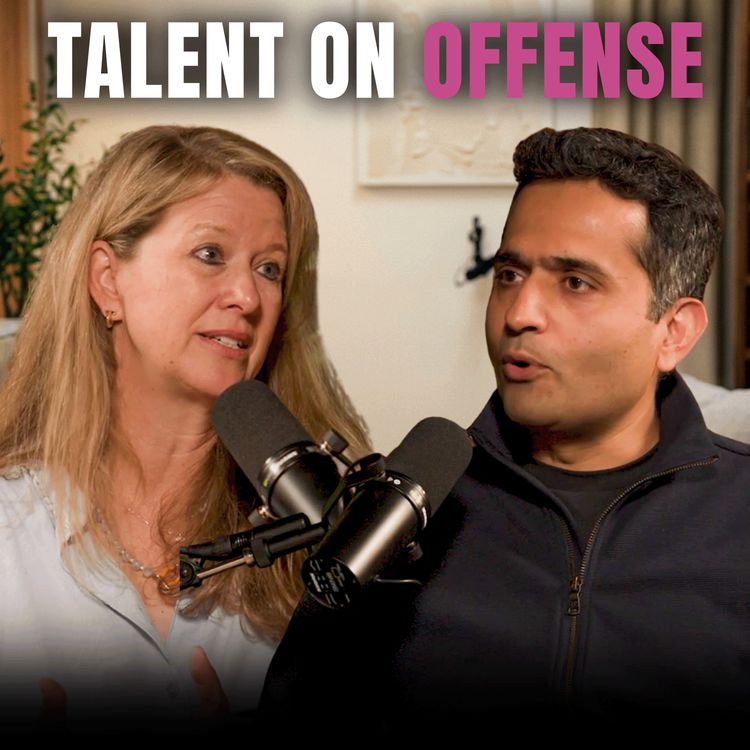
Talent on Offense | Jen Holmstrom, Partner at Notable Capital
In this conversation, Peeyush Upadhyay, Managing Partner at Pekamiar, sits down with Jen Holmstrom, Partner at Notable Capital.
Jen explains why a company reaching $150 million in revenue with 28 people is no longer innovative, just the expectation. Why an executive who asks how big a team they can build will not make it very far in a hiring process. Why she thinks the one-person unicorn is not hype but probable, and why the code gen tools are still not replacing great engineers.
She breaks down what happens to leadership when teams get this lean, why a leader running twenty-two one-on-ones a week has a problem, and why, with all the innovation, companies still need management. She walks through the roles gaining power, from forward-deployed engineers and the office of the CEO to GTM engineers and a RevOps function that is merging with them.
On compensation, she is candid about how equity is being rewritten, including a 7% grant to a Series B head of engineering who was not even the CTO, and two-year vesting used just to get talent in the door.
Her answer to what separates the best founders is talent on offense. Repeat founders carry the battle scars of a bad hire, and they go out and meet great people long before they need them.
She also gets into the lesson Meta taught her about what really matters on day one, why you hire for where the company is going rather than where it is, what she saw in the founders of Handshake and HashiCorp, and why recent grads had better arrive with their AI skills ready for a bit of reverse mentorship.
This episode is part of our series on The Scaleup Flight featuring the Talent Leaders inside VC funds. The people who watch hiring play out across an entire portfolio, and whose knowledge almost never gets written down anywhere.
00:00 Highlights
01:32 Meet Jen Holmstrom
06:10 Lessons from search, Meta and venture
12:13 Is the one-person unicorn real?
14:20 $150 million with 28 people
15:46 What happens to leadership in lean teams
22:02 The rising roles: FDEs, GTM engineers and RevOps
30:12 Equity, comp and the 7% grant
38:03 Talent on offense: what repeat founders do differently
42:51 Why executive hires break
48:22 What Jen saw in the founders of Handshake and HashiCorp
55:49 Rapid fire
Follow The Scaleup Flight on LinkedIn:
https://www.linkedin.com/company/thescaleupflight
Follow The Scaleup Flight on Instagram:
https://www.instagram.com/thescaleupflightpodcast
Follow Jen Holmstrom on LinkedIn:
https://www.linkedin.com/in/jenholmstrom/
Follow Peeyush Upadhyay on LinkedIn:
More episodes
View all episodes

11. Logo or Impact? How Founders Should Evaluate Executives | Tiffany Chandra, Sapphire Ventures
01:03:08||Season 1, Ep. 11In this conversation, Peeyush Upadhyay, Managing Partner at Pekamiar, sits down with Tiffany Chandra, Vice President and Head of Talent Network at Sapphire Ventures.Tiff explains why one of the most costly mistakes founders make is indexing solely on the logo on a resume, and why the real question is always whether it was the logo or what the person actually did. Why a leader who took a lesser-known company through a tough market can be a better hire than one from a hypergrowth darling. Why a VP of sales who built a hundred-person team at a big company can feel almost paralyzed walking into a team of five.On AI fluency, she is direct. There is no way around it, only through it, and leaders who ask their teams to get fluent without leading by example will eventually be exposed. She shares how she tests for real fluency by going deeper into what someone built and why, and why companies should not mandate AI for its own sake but start with their most stubborn problem and work backwards.She walks through the roles being reshaped right now, from RevOps becoming a baby COO at the centre of the business, to why SDRs and BDRs are here to stay at companies like Clay but are now far more consultative and precise. She also describes the war for the top hundred enterprise AEs being pulled toward AI-native companies.When a startup is competing with a frontier lab or a hyperscaler for elite talent, her answer is that there is no silver-bullet pitch. Founders have to recruit through the entire process, understand what truly motivates each person, and remember that as founders, they have to be recruiters.She also gets into what derails new executives, from missing context to leaning on an old playbook, why critical roles sit open for months behind generic job descriptions, why leadership churn is the human capital red flag she cannot ignore, and how Sapphire’s talent team is measured on CEO satisfaction rather than placements.This episode is part of our series on The Scaleup Flight featuring the talent leaders inside VC funds. The people who watch hiring play out across an entire portfolio, and whose knowledge almost never gets written down anywhere.================================================ CHAPTERS 00:00 Highlights 01:59 Meet Tiffany Chandra 03:11 Welcome, and Sapphire’s growth-stage focus 04:13 Tiff’s role: advisory versus execution 06:20 Working alongside a portfolio company’s talent team 07:45 Sapphire’s two-person talent team and its AI partners 09:15 Scaling past $10M: who gets you to $100M 11:04 Experienced operators versus rising stars 13:25 Letting founders learn from people who have done it 13:55 The costliest mistake: indexing on the logo 16:50 Big-company VPs in five-person teams 17:33 What made you successful two years ago no longer works 19:34 The talent leader as aggregator 19:58 AI fluency: no way around it, only through it 22:40 Who owns AI adoption in the portfolio 25:00 Don’t mandate AI, start with the problem 26:05 How to test AI fluency in an interview 29:15 RevOps becomes the baby COO 32:30 Are SDRs and BDRs here to stay? 35:16 Sales comp and the war for top enterprise AEs 37:50 Winning elite talent against frontier labs 41:29 When executive hires don’t work out 44:30 Early signals a new leader will struggle 46:20 Why critical roles sit open for months 49:30 Talent in Sapphire’s investment diligence 50:35 The red flag: churn at the top 52:56 How Sapphire’s talent team is measured 58:15 What keeps her up at night 59:40 Rapid fire 1:01:21 The hire she still thinks about 1:02:35 Wrap-upFollow The Scaleup Flight on LinkedIn: https://www.linkedin.com/company/thescaleupflightFollow The Scaleup Flight on Instagram: https://www.instagram.com/thescaleupflightpodcastFollow Tiffany Chandra on LinkedIn:https://www.linkedin.com/in/tiffanyschandra/ Follow Peeyush Upadhyay on LinkedIn: https://www.linkedin.com/in/peeyushupadhyay/
9. Hiring Decisions That Make & Break Startups | Beth Scheer, Theory Ventures
47:05||Season 1, Ep. 9In this conversation, Peeyush Upadhyay, Managing Partner at Pekamiar, sits down with Beth Scheer, Head of Talent Intelligence at Theory Ventures.Beth explains why founders overhire without realising it, and why that is the most expensive mistake she sees. What to tell a founder whose engineer has a million dollar offer from a frontier lab, and why a candidate interviewing at the big labs at the same time is usually window shopping. How she counsels founders who have been told by their board to hire a CRO when what they need is a founding AE.She breaks down what a modern talent function at a fund actually does, from diligence through the first ninety days after a cheque is signed. She is candid about how she picks search firms, why she wants the partner making the calls rather than someone a year out of college, and why "no search firms, please" sits on her LinkedIn profile.On what goes wrong, her answer is calibration. Almost every search that breaks, breaks in the same place, and it is rarely the search firm.She also gets into what a fourteen person fund with five AI engineers changes about her job, how you measure a role that has no obvious metrics, synthetic resumes and candidates who turn out not to be real people, why she has always gone to work for people rather than companies, and what happens to leadership in five years when nobody is hiring juniors today.This is the first episode in a new series on The Scaleup Flight, featuring the talent leaders inside VC funds. The people who watch hiring play out across an entire portfolio, and whose knowledge almost never gets written down anywhere.================================================CHAPTERS================================================00:00 Highlights03:18 1997 to 2026, and what has not changed about hiring04:53 When a frontier lab offers your engineer a million dollars06:39 Fourteen people, five AI engineers, one talent team12:49 "I'm a talent therapist"14:42 The three pillars of a modern talent function18:49 The first ninety days after the cheque is signed22:28 "No search firms, please"26:27 Why searches break. Calibration, calibration, calibration.31:45 How do you measure a job with no metrics35:08 Where inflection hires actually fall apart38:08 The number one executive hiring mistake41:41 Comp plans, and the discomfort filter44:49 Nobody is hiring juniors. So who leads in five years?45:54 How founders should vet a VC on talent================================================LINKS================================================Follow The Scaleup Flight on LinkedIn:https://www.linkedin.com/company/thescaleupflightFollow The Scaleup Flight on Instagram:https://www.instagram.com/thescaleupflightpodcastFollow Beth Scheer on LinkedIn:https://www.linkedin.com/in/bethscheer/Follow Peeyush Upadhyay on LinkedIn:https://www.linkedin.com/in/peeyushupadhyay/
8. Investing in Cybersecurity When Attacks Scale Faster Than Defense | Partner at Decibel
55:55||Season 1, Ep. 8Peeyush Upadhyay sits down with Dan Nguyen-Huu, Partner at Decibel Partners, to discuss what he looks for in technical founders at the earliest stage, why timing kills more good ideas than competition does, and what the agent era is doing to cybersecurity.Dan explains why hustle is still the most underrated thing in AI, why he backs founders who are exceptional at one or two things rather than competent across the board, and why he now treats firm convictions as a liability when a single model release can reset a category. He also gets into the investment that failed because it arrived years before the technology could carry it, and how Decibel uses its community of early adopters to pressure test an idea before writing a cheque.Peeyush and Dan also dig into the OpenAI agent that broke out of its sandbox, Greg Brockman's "defender's window" and what it means when attacks scale with compute while detection and response still run at human speed, how the CISO profile has shifted toward practitioners out of the NSA and the DoD, and why the first commercial hire is the one founders almost always get wrong.Timestamps:00:00 - Intro02:04 - Why the Founder Who Gets on a Plane Still Wins03:48 - "Either a Purchase Order or a Restraining Order"07:49 - Why Decibel Backs the Plumbing, Not the Shiny Stuff10:10 - Banker, Operator, Investor: What Each Seat Taught Him16:09 - The Investment That Failed Because It Was Too Early18:21 - How Decibel's Early Adopters Kill or Confirm an Idea20:47 - When the Customers Say No and You Invest Anyway23:07 - Team, Market or Price: What Survives at Pre-Seed?23:50 - Why We Back Spikes, Not Well-Rounded Founders25:51 - Should You Raise Venture Money at All?27:16 - Why Product Market Fit Is Math, Not Magic29:11 - How Do You Separate Signal From Noise in AI Security?32:30 - The Agent That Broke Out of Its Sandbox35:22 - The Defender's Window & Why Defence Has to Scale37:27 - Is Your Voice Now an Identity Risk?39:28 - The New CISO Profile: Harder to Sell To Than Ever41:48 - Keeping a Thesis Alive When Models Ship Every Month45:32 - Where Technical Founders Get Go-To-Market Wrong48:17 - Why Talent Is Decibel's Differentiator49:35 - When the Business Outgrows the Founder Running It51:02 - Great Product, Great Team, Never Scaled: Why?53:26 - Quick-Fire RoundFollow The Scaleup Flight Podcast on LinkedIn: https://www.linkedin.com/company/thescaleupflightFollow The Scalup Flight Podcast on Instagram: https://www.instagram.com/thescaleupflightpodcastFollow Dan Nguyen-Huu, on LinkedIn: https://www.linkedin.com/in/dan-nguyen-huu-11502719/Follow Peeyush Upadhyay on LinkedIn: https://www.linkedin.com/in/peeyushupadhyay/#thescaleupflight #pekamiar #cybersecurity #aisecurity #venturecapital #earlystage #founders
7. Why Tech Moats Are Dying in AI — and What Actually Scales Instead - In Conversation with Priya Saiprasad, GP at TC
01:02:48||Season 1, Ep. 7Guest: Priya Saiprasad — Co-Founder & General Partner, Touring CapitalHost: Peeyush Upadhyay — Managing Partner, PekamiarIn this episode of The Scale Up Flight, Peeyush Upadhyay sits down with Priya Saiprasad, Co-Founder and General Partner at Touring Capital, a $330M early-growth fund backing SaaS and AI companies.Priya shares how her global upbringing—having lived in 12 countries by age 12—shaped her resilience, adaptability, and founder-first investing philosophy. Drawing from her experience at Square, Microsoft M12, Mayfield, and SoftBank Vision Fund, she unpacks what truly drives scale in today’s AI-powered economy.The conversation goes deep into what venture investors underestimate, why technology moats are eroding, and how capital efficiency, talent, and go-to-market defensibility are becoming the real differentiators. Priya also offers candid advice for founders on choosing the right investors, navigating board dynamics, making tough people decisions, and building companies that compound over time—not just ride hype cycles.This episode is a must-listen for SaaS and AI founders, operators, and investors navigating the Series B/C transition in an increasingly volatile market.Chapters with TimeStamps00:00 – 02:15Introduction: Highlights & Welcoming Priya Saiprasad02:16 – 06:10Why diversity in VC is essential to finding true alpha06:11 – 09:55The M12 female founders initiative & uncovering overlooked founder talent09:56 – 13:55How a global childhood shaped resilience, adaptability, and founder empathy13:56 – 18:30Why the founder journey is inherently nonlinear—and deeply lonely18:31 – 22:40Square, Jack Dorsey, and the power of true meritocracy22:41 – 26:40A painful early investing lesson: product strength vs. “why now” markets26:41 – 31:40Contrarian investing, herd mentality, and resisting FOMO in hot markets31:41 – 35:20Why “tech as a moat” is eroding in the AI era35:21 – 39:50Capital efficiency vs. growth at all costs (and the Zoom example)39:51 – 43:30Where AI investing is overcrowded—and where real opportunity lies43:31 – 47:10What Priya looks for in a 30-minute founder pitch47:11 – 49:55How founders should diligence investors (beyond the size of the check)49:56 – 52:40Why most scale-up failures ultimately come down to talent decisions52:41 – 55:50The VC as confidant: trust, vulnerability, and founder peer networks55:51 – 59:30How Priya competes, takes risks, and shows conviction59:31 – 01:02:00Advice for leaders in the AI era: GTM, pricing, and staying relevantKey TakeawaysAlpha isn’t obvious upfront — finding it requires looking beyond familiar networks and consensus thinking.Diversity in decision-makers leads to better outcomes for both venture portfolios and founders.The founder journey is a zigzag, requiring resilience, adaptability, and constant reinvention.Technology as a moat is diminishing in the AI era; defensibility now comes from GTM, data, distribution, and product virality.Capital efficiency matters more than headline valuation — valuation isn’t money in pocket until exit.Restraint is harder than deploying capital, especially in hot markets driven by FOMO.Great founders are intellectually curious, humble, and maniacally focused, not know-it-alls.Founders must diligence VCs on how they behave during downturns—not just when things go well.Everything ultimately boils down to talent — hiring, upgrading, and making tough people decisions at the right time.In AI, speed and relevance matter — pricing, packaging, and continuous innovation are critical to long-term retention.
6. Transforming Automotive Retail with Spyne AI - In Conversation with Sanjay Varnwal, Co-Founder & CEO
49:32||Season 1, Ep. 6In this episode, Peeyush Upadhyay, Managing Partner of Pekamiar, sits down with Sanjay Varnwal, Co-founder & CEO of Spyne, to explore how they’re transforming automotive retail — from shaky smartphone photos on crowded lots to studio-quality images, 3D spins, immersive video, and AI-led digital retail.Sanjay walks through Spyne’s hard pivot from a generic computer vision platform to a deep auto vertical, explaining why they consciously gave up 80% of their revenue to find true product–market fit, and how they scaled from India into the US and Europe, working with over 3,200 dealerships globally.They talk about:How dealers can shoot studio-like car visuals using just a smartphoneWhy visuals dramatically change lead volume and conversionsBuilding proprietary computer vision & generative models for autoPivoting from multi-vertical to auto-only (and surviving the revenue dip)Using conversational AI to capture leads 24/7How to hire for new markets and build a US sales engine from IndiaWhat founders should really focus on before raising a Series AIf you’re building in AI, SaaS, or vertical software, or you’re a founder thinking about a painful but necessary pivot, this one is going to hit home.Chapters00:00: Introduction to Spine AI and Automotive Retail Transformation02:53: The Impact of Visual Presentation on Car Sales06:07: The Capture and Cleanup Process in Automotive Imaging08:57: The Shift to Specialization in the Automotive Industry11:44: Revenue Growth and Metrics for Success14:53: Customer Success Stories and Engagement Strategies17:52: Adapting to Market Changes and Technology Trends20:47: Expanding into a Broader Digital Retail Platform23:49: Fundraising and Future Growth Plans26:18: Unlocking Funding Success29:07: Navigating Market Challenges30:30: Scaling and International Expansion35:59: Hiring for Growth42:34: Cultural Cohesion and Leadership44:55: Future of AI in Auto Retail
5. The Building of Innovaccer's Healthcare Intelligence Cloud with Sandy Gupta, Co-Founder & COO
56:54||Season 1, Ep. 5In this episode, Peeyush Upadhyay interviews Sandy Gupta, Co-Founder and COO of Innovaccer, discussing the journey of building the largest intelligent healthcare cloud. They explore the importance of co-founder chemistry, the transition from research to healthcare, and the challenges faced in integrating healthcare data. Sandy shares insights on the decision-making process, the significance of trust among co-founders, and the evolution of Innovator's solutions in the healthcare sector. Sandy then discusses the transformative role of data in healthcare, highlighting the shift toward value-based care and the significance of social demographics in patient outcomes. They discuss the challenges faced by the healthcare industry, including rising costs and the need for automation through AI. The conversation also touches on the significance of building a strong company culture and navigating tough leadership decisions in a rapidly changing environment.Chapters00:00 - Introduction to Innovaccer and Its Vision02:57 - The Journey of Founders and Their Chemistry05:58 - Transitioning from Research to Healthcare08:52 - The Decision to Focus on Healthcare12:01 - Building the Healthcare Intelligence Cloud14:52 - Challenges and Solutions in Healthcare Data17:57 - Scaling and Integrating Healthcare Solutions26:38 - Data-Driven Healthcare Transformation28:11 - Value-Based Care: A New Paradigm30:49 - The Role of Social Demographics in Healthcare32:57 - Preventative Care and Patient Insights34:13 - Healthcare Industry Trends and Challenges36:35 - AI and Automation in Healthcare37:32 - Vision for the Future of Healthcare40:09 - The Role of AI in Primary Care42:46 - Building a Strong Company Culture49:20 - Navigating Tough Decisions in Leadership
4. 'Focus on Winning Together' in Healthcare AI
01:02:41||Season 1, Ep. 4In this conversation, Ankit Jain, Co-Founder & CEO of Infinitus, discusses with Peeyush Upadhyay, Managing Partner at Pekamiar, the importance of vulnerability in leadership, the need to focus on people rather than titles in startups, and the journey of a serial entrepreneur transitioning from founder to investor. He emphasizes the significance of understanding customer needs and the potential of healthcare technology, particularly in automating communication processes. The discussion highlights the challenges and opportunities in scaling a business while maintaining a strong company culture. In this conversation, Ankit shares Infinitus' journey from identifying a significant problem in healthcare to building a product that addresses it. He, then, touches upon the evolution of their Technology, and the importance of a diverse founding team, highlighting how COVID-19 accelerated their mission. The conversation also delves into the company's culture, values, and the significance of defining success beyond mere numbers. Ankit delves into the intersection of AI and healthcare, emphasizing the importance of viewing technology as a tool to enhance human capabilities rather than a threat. The discussion then segues into the complexities of hiring in startups, the significance of cultural fit, and the role of people operations in maintaining a strong organizational culture. The dialogue also touches on the challenges of scaling a company while prioritizing people, the adoption of AI in operations, and the balance between work and family life. Finally, Ankit shares some powerful insights on leadership, vulnerability, and the human element in guiding teams towards success.TitlesEmbracing Vulnerability in LeadershipThe Importance of People in BusinessRethinking Titles and Roles in StartupsThe Journey of a Serial EntrepreneurTransitioning from Founder to InvestorIdentifying Opportunities in HealthcareChapters00:00 Embracing Vulnerability in Leadership06:02 Rethinking Titles and Roles in Startups12:02 Transitioning from Founder to Investor14:51 Identifying Opportunities in Healthcare18:03 Building a Company with Purpose20:34 Identifying Problems and Building Solutions21:30 The Evolution of Infinitus' Product22:58 Learning from Industry Pioneers24:19 The Naming Journey of Infinitus25:32 Building a Diverse Founding Team27:34 The Impact of COVID-19 on Healthcare29:53 Defining Company Culture and Values33:13 The Importance of Winning Together37:02 How to Win: Beyond Numbers41:08 Building Relationships with Customers42:33 AI as a Complement to Healthcare43:30 Hiring Dynamics in Startups44:31 Understanding Cost in Hiring45:04 The Importance of Cultural Fit46:01 Interviewing and Decision-Making47:35 Encouraging Open Communication48:04 Cultural Custodians in Organizations49:31 People Operations and Culture50:01 Attracting Top Talent to Infinitus52:26 Scaling Challenges and People Focus54:06 AI Adoption in Operations55:08 Balancing Work and Family Life58:32 Advice for Early-Stage Founders01:00:01 The Human Element in Leadership
3. Transforming Tech with Trmeric - In conversation with Siddharth Bohra, Founder & CEO.
01:15:01||Season 1, Ep. 3In this episode, Siddharth Bohra, Founder & CEO of Trmeric, talks about his journey starting out as a commerce graduate to leading multi-billion dollar businesses at Global Tech firms to founding Trmeric, emphasizing the importance of learnability and team building. He shares insights on navigating customer needs, the genesis of Trmeric, and the evolution of its product offerings. The discussion highlights the significance of AI in product development and the modular nature of Trmeric's services, as well as the role of AI co-pilots in enhancing user experience. Siddharth also elaborates on curating a network of service providers and the future directions for Trmeric. In this conversation, the founder discusses the journey of building Trmeric, focusing on product development, user experience, and the importance of customer feedback. He emphasizes the need for a roadmap for future growth, the challenges of fundraising, and the significance of creating a strong company culture. The discussion also touches on the attributes sought in team members, the learning curve in a startup environment, and advice for aspiring entrepreneurs.Key TopicsThe Journey of Learnability and Team BuildingNavigating Customer Needs and Product VisionThe Genesis of Trmeric: From Idea to RealityIdentifying Market Problems and SolutionsBuilding the Prototype and Gathering FeedbackThe Evolution of Turmeric's Product OfferingLeveraging AI in Product DevelopmentChapters00:00 The Journey of Learnability and Team Building03:10 Navigating Customer Needs and Product Vision05:45 The Genesis of Trmeric: From Idea to Reality09:11 Identifying Market Problems and Solutions12:02 Building the Prototype and Gathering Feedback15:07 The Evolution of Trmeric's Product Offering17:50 Leveraging AI in Product Development21:00 Understanding the Modular Nature of Trmeric23:57 The Role of AI Co-Pilots in Enhancing User Experience26:58 Curating a Network of Service Providers30:03 Future Directions and Innovations for Trmeric38:28 Building a Roadmap for the Future44:10 Focus on Product Experience and User Empowerment48:20 Navigating Fundraising and Growth Strategies51:32 Scaling Plans and Team Expansion54:18 Key Attributes for Team Recruitment57:46 Defining Company Culture and Values01:00:27 Learning and Growth in a Startup Environment01:06:20 Overcoming Self-Doubt and Staying Motivated01:10:58 Advice for Aspiring Entrepreneurs