Share
The RIPE Labs Podcast
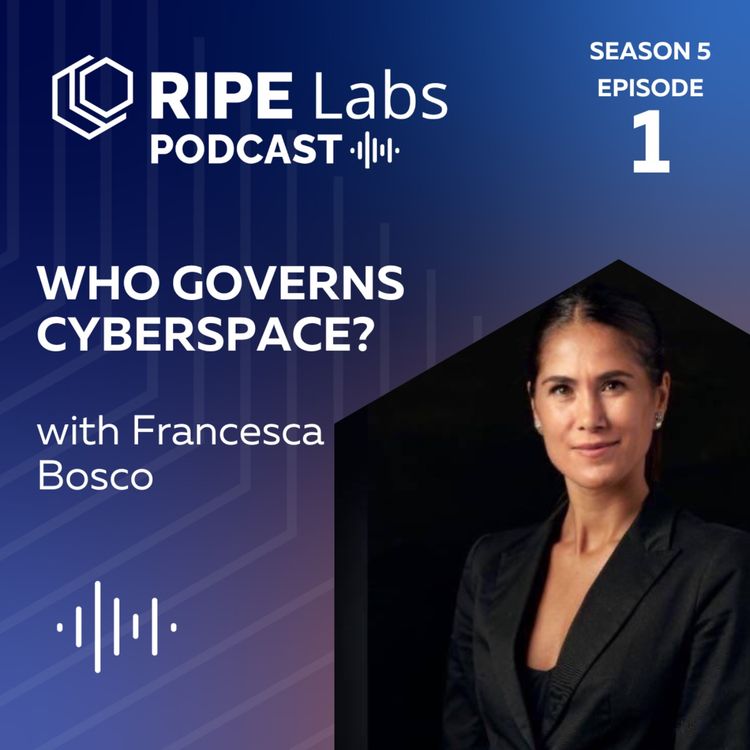
Who Governs Cyberspace?
Season 5, Ep. 1
•
In this episode, we dive deep into the evolving world of cyberspace and international cybersecurity law with Francesca Bosco from the CyberPeace Institute. As digital threats grow in complexity, how are governments and policymakers responding? What role does civil society play in internet governance? And can a multistakeholder approach truly bridge the gap between technical expertise and legislative frameworks?
More episodes
View all episodes
7. The Technical Impact of Rapid-Response Blocking: Italy’s Piracy Shield
50:39||Season 5, Ep. 7In our latest episode, Raffaele Sommese of the University of Twente shares insights from him and his colleagues on Italy’s Piracy Shield and how rapid-response blocking works in practice. We get into the technical impact, how it can be measured, and the consequences for connectivity.Raffaele is assistant professor at University of Twente’s Faculty of Electrical Engineering, Mathematics and Computer Science. For more details on the research he and his colleagues carried out on this topic, check out their academic paper on the impact of Piracy Shield or read the summarised version on RIPE Labs: Live-Event Blocking at Scale: Effectiveness vs. Collateral Damage in Italy’s Piracy Shield.00:20 - Piracy Shield on the AGCOM website00:50 - Read more about cases where Cloudflare and Google were blocked by Piracy Shield. Since recording this episode, things have escalated, with Cloudflare recently having threatened to pull out of Italy after receiving fines issued by AGCOM.05:10 - Some background on the law behind Piracy Shield10:20 - Watch Raffaele's talk on this topic from RIPE 91 (Bucharest, October 2025)16:40 - AGCOM website for checking blocked resources and an alternative page run by Infotech (an Italian ISP)42:30 - A 2025 article on anti-piracy developments in Spain46:50 - More on Piracy Shield's expansion to TV
6. ICP-2 In Review: Charting the RIR Lifecycle
31:45||Season 5, Ep. 6ICP-2 lays out the criteria for the recognition of new RIRs. But what about the rest of the lifecycle of the organisations that coordinate the allocation and public registration of unique IP numbers? In this episode, Andrei Robachevsky of the NRO NC talks about the ICP-2 review.In November 2023, the NRO EC requested that the ASO AC "review and consider improvements to ICP-2". The NRO NC (in its role as ASO AC - see notes on organisations and acronyms below) thereby began a comprehensive review of the original document and put together a process for the creation of an updated ICP-2 through open consultation with the community. Having reached step seven in that process, the NRO NC is now receiving community feedback on version 2 of the draft RIR Governance Document (until 7 November 2025). The entire ICP-2 review process has been documented in detail in the ICP-2 section over on the NRO NC website. A note on organisations and acronymsICP-2: 'Internet Coordination Policy 2: Criteria for Establishment of New Regional Internet Registries' - document published and accepted by the ICANN Board of Directors in 2001.RIRs: The Regional Internet Registries; who coordinate the allocation and public registration of unique IP addresses and AS numbers for their service regions:RIPE NCC: Réseaux IP Européens Network Coordination Centre (est. 1992)APNIC: Asia Pacific Network Information Centre (est. 1993)ARIN: American Registry for Internet Numbers (est. 1997)LACNIC: Latin American and Caribbean Internet Addresses Registry (est. 2002)AFRINIC: African Network Information Centre (est. 2004)ICANN (est. 1998): The Internet Corporation for Assigned Names and Numbers; oversees the global allocation of domain names and unique Internet numbers; delegates these resources to the RIRs in its IANA function.IANA: The Internet Assigned Numbers Authority; originally Jon Postel; now a function carried out by ICANN.NRO: The Number Resource Organisation; coordinating body for the five RIRs.NRO EC: The NRO Executive Council; executive body for the NRO; composed of five members, one from each RIR.NRO NC: The NRO Number Council; fills the role of ASO AC for ICANN; composed of fifteen members, three from each RIR community.ASO: The Address Supporting Organisation; advises the ICANN Board on global IP address policies.ASO AC: The ASO Address Council; role within ICANN's ASO to ensure the proper implementation of global policy development process across the RIR regions; filled by the NRO NC.
5. Break Ground! Plant Seeds! Rewild the Internet!
01:03:47||Season 5, Ep. 5The Internet has long been fertile ground for innovative technologies to grow and openly compete. But having emerged out of these conditions, certain services and the companies that offer them have come to dominate and stifle the very diversity that made their existence possible. Our guest in the episode of the RIPE Labs podcast, Maria Farrell, talks about why we must - and how we can - rewild the Internet.Show notes:00:00 - Find out more about our excellent guest, Maria Farrell02:26 - Maria at RIPE 9005:48 - More about Seeing Like a State by James C. Scott07:15 - Find out more about Robin Berjon08:46 - We Need to Rewind the Internet by Maria Farrell and Robin Berjon11:36 - Meredith Whittaker speaking at CCC16:32 - Leslie Daigle's The Internet Invariants ...and Leslie at RIPE 9020:10 - RFC 9518 'Centralization, Decentralization, and Internet Standards'21:30 - Hisham Ibrahim on RIPE Labs28:55 - Cory Doctorow on competitive compatibility ("comcom")37:45 - Interview with Jonathan Kanter on Big Tech, Antitrust Laws, and the Future of AI43:20 - On Ireland's relationship with U.S. tech51:45 - Anna Wilson at RIPE 90 It's ok to be smaller: how to not get overwhelmed52:10 - Bert Hubert on European cloud52:18 - Meredith Whittaker on the end of big tech01:00:48: - Bert Hubert on open source alternatives to big tech services
4. The Internet Is Not What You Think It Is
43:42||Season 5, Ep. 4What is “the Internet”? And why is it not just our access to a search engine or our favourite social media platform? In this episode, Hisham Ibrahim, RIPE NCC’s Chief Community Officer, breaks down the layers of the Internet ecosystem, explains what a stable and resilient Internet means, and clarifies the difference between digital governance and Internet governance.
3. Making Digital Sustainability Make Sense
42:22||Season 5, Ep. 3The digital infrastructure we're all so dependent on has a negative - and growing - impact on the environment. In this episode, Michael Oghia talks about strategies for breaking down the big problem of digital sustainability, strategies for building a more efficient Internet, and challenges that come with the adoption of more sustainable practices. Show notes01:40 - Michael on RIPE Labs08:20 - Our World in Data gives similar numbers for the % of global carbon emissions from the aviation industry, as does this broader report from the European parliament.11:00 - E-waste dumps in Ghana11:10 - Map of conflict mineral mines in the Democratic Republic of the Congo11:27 - Article from the Guardian on projected energy demands from AI data centres12:50 - Article on using 'waste heat' as a source of power13:20 - Michael RIPE Labs article on refurbishment as a strategy for digital sustainability15:30 - Michael's RIPE Labs article on Why Small and Medium-Size Operators Should Care About Sustainability17:15 - Read more about the origins of the term 'carbon footprint' in this nice piece by Tom Greenwood37:05 - The resources Michael is pointing us to here are available via the same article: Why Small and Medium-Size Operators Should Care About Sustainability
2. How the Internet Routed Around Damage in the Baltic Sea
39:08||Season 5, Ep. 2When two Internet cables in the Baltic Sea were reported as broken last November, researchers at the RIPE NCC turned to RIPE Atlas to examine the damage. In this episode, Emile Aben discusses what his analysis uncovered about the impact of these and similar incidents in the months that followed, and how the Internet remained resilient against them.Show notes00:44 - TeleGeography build and maintain massive data sets that are used to monitor, forecast, and map the telecommunications industry. Their submarine cable map is a valuable resource in tracking Internet cable incidents.00:52 - Some early reports on these incidents from Mobile Europe, Reuters, The Register01:08 - Visual guide from the Guardian exploring circumstances surrounding incidents in the Baltic Sea.01:13 - RIPE Atlas01:36 - On RIPE Labs: Does the Internet Route Around Damage? - Baltic Sea Cable Cuts; A Deep Dive Into the Baltic Sea Cable Cuts02:13 - First episode of the RIPE Labs podcast: Measuring Damage on the Internet03:14 - Emile's earlier articles on the Ukraine: The Ukrainian Internet05:25 - RIPE Atlas anchors12:40 - Help expand RIPE Atlas coverage! Learn more about what's involved in hosting a RIPE Atlas anchor.27:05 - The Internet in North Korea - Hanging by a Single Thread?32:50 - Lord Kelvin said both that "To measure is to know" and "If you cannot measure it, you cannot improve it".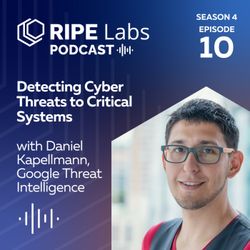
10. Detecting Cyber Threats to Critical Systems
34:31||Season 4, Ep. 10It is no longer unusual for Operational Technology systems to be connected to IT systems and the Internet, but this leaves them increasingly open to cyber threats. Daniel Kapellmann, Security Engineering Manager at Google Threat Intelligence, talks about how convergence of OT with IT systems amplifies risk and what’s involved in detecting threats.
9. Embracing Neurodiversity in the Internet Community
21:37||Season 4, Ep. 9Overcoming the various challenges involved in keeping the Internet running calls for different ways of thinking about those challenges. In this episode, Rob Lister talks to us about how and why the technical community can and should embrace neurodiversity.Back in May 2024 at RIPE 88, Rob Lister (Senior Network Engineer at LONAP) opened up to the community about his experience of having been diagnosed with ADHD during COVID. We talked more about how the Internet community can support neurodiverse individuals and how communication and awareness are key.Rob was kind enough to share some useful references and resources for interested listeners:Dolan, E (2024): Anendophasia: Scientists uncover the weird cognitive impact of life without an inner voiceADHD Adult Self-Screening ToolADHD and work - ideas for workplace accommodations.For eventsSunflower Lanyards from hidden disabilities"Social battery" pin badge - loads of version including this fancy LED badge.BooksChanning, C (2020): The First Minute: How to Start Conversations That Get Results (alternatively, you can also get it here)Channing, C (2022): Effective Emails: The Secret to Straightforward Communication at Work (alternative here)Archer, D (2016): The ADHD Advantage: What You Thought Was a Diagnosis May Be Your Greatest StrengthShankman, P (2017): Faster Than Normal: Turbocharge Your Focus, Productivity, and Success with the Secrets of the ADHD BrainMaskell, L (2022): ADHD an A-ZBanks, A (2021): Going Official! On getting a diagnosis of adult ADHD, and what to do with it