Share
The Resolution Room
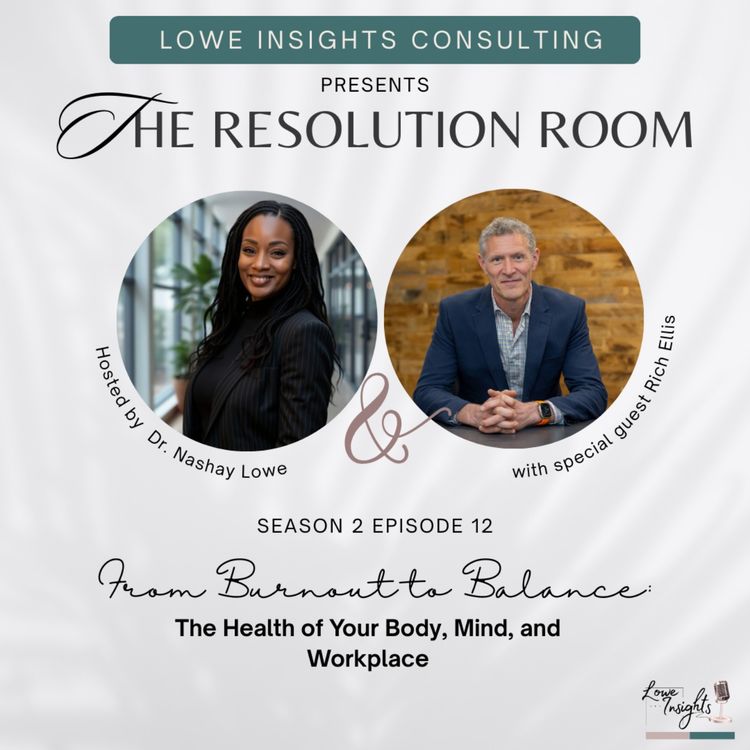
From Burnout to Balance: The Health of Your Body, Mind, and Workplace
In this conversation, Rich Ellis, a health coach from Auckland, New Zealand, discusses the intricate connections between physical health and workplace wellbeing. He emphasizes the importance of understanding individual needs in health interventions, the impact of workplace culture on employee health, and the necessity of consistency in health transformations. Rich also highlights the role of emotional intelligence in managing workplace dynamics and offers practical techniques for stress management. The discussion culminates in reflections on self-awareness and the importance of treating every interaction as an opportunity for growth and learning.
Key Takeaways
- Health interventions must consider individual circumstances.
- Workplace culture significantly impacts employee wellbeing.
- Emotional intelligence is crucial for effective leadership.
- Consistency is key in health transformations.
- Sleep is foundational for overall health and performance.
- Intrinsic motivation drives sustainable change.
- Self-awareness helps in managing workplace conflicts.
- Curiosity fosters better workplace relationships.
- Every interaction is an opportunity for learning.
- Leaders must address toxic behaviors promptly.
About Rich Ellis
Richard has worked in the exercise industry for 11 years and has worked with a diverse range of people over that time. He is an advanced holistic movement coach and mentor. He has a special interest in working with weight loss clients and those who suffer from fatigue. He uses a range of specific tests which allows clients to see the status of their internal health in black and white. He works with clients to develop a plan to deliver ultimate health and energy – giving people the freedom to do whatever they want.
Website: https://www.linkedin.com/in/richellis/
🌟 Rate: https://ratethispodcast.com/resolutionroom
🙆🏾♀️ Join the Community: https://theresolutionroom.supercast.com
🛍️ Shop: https://clarity-closet-shop.fourthwall.com
🎙️ 1:1 Sessions: https://intro.co/NashayLowe
🎤 Speaking Requests: https://forms.gle/XineBr3err9W1HD49
☕ Support the show: https://buymeacoffee.com/resolutionroom
🎶 Music License: YHLX3CWSWGWNCJZT
More episodes
View all episodes

17. Growth: Lived, Not Polished
10:56||Season 2, Ep. 17In this episode, Dr. Nashay Lowe explores three topics funneling to on shared lesson: 1) myth of perfect timing, emphasizing that waiting for the right moment often keeps us stuck. She discusses 2) how scars can become beauty marks, shaping our depth and leadership, and 3) shares insights from her travels on how perspective shifts when we step outside our comfort zones. The episode highlights that growth doesn't arrive polished but is lived through experiences.Key Takeaways: The myth of perfect timing often keeps us stuck.Scars can become beauty marks, shaping our depth.Travel shifts our perspective and assumptions.Growth doesn't arrive polished; it's lived.Readiness is a decision, not a feeling.Waiting too long has a cost on our dreams.Starting messy is still starting.Momentum teaches what preparation can't.Scars are evidence of resilience and growth.Travel deepens empathy and responsibility.
16. Beyond Survival: Rethinking Resilience in a World That Demands Too Much
30:20||Season 2, Ep. 16In this conversation, Sandra Martinez shares her journey as a humanitarian worker, discussing her experiences in conflict-affected areas and the importance of resilience and transitional justice. She emphasizes the need for emotional health, community support, and self-care in humanitarian work, while also addressing the distinction between survival and resilience. Sandra reflects on personal stories that highlight the power of collective resilience and the necessity of creating supportive systems for individuals and communities.Key TakeawaysSandra's journey into humanitarian work began during her master's program in 2014.Resilience involves not just enduring hardship but also transforming that experience into strength.Transitional justice aims for truth, accountability, and non-repetition of past violations.Survival mode can mask deeper trauma and hinder true resilience.Glorifying endurance can overlook the emotional toll of hardship.Creating safe spaces for grief is essential for healing and resilience.Collective resilience involves shared care and community support.Leadership that prioritizes compassion can shift individuals from survival to resilience.Self-care is crucial for humanitarian workers to effectively support others.Small actions can foster a culture of resilience in any community.About Sandra MartinezPolitical Scientist and Master in International Affairs with over seven years of international experience in human rights, peace, and protection across challenging regions in Africa and Latin America. I've worked with international organizations, specializing in providing strategic advice on crisis response, conflict resolution, and the implementation of projects with a focus on gender and inclusion.Website: https://www.linkedin.com/in/sandramartinezr/15. What a Room Teaches You: Lessons From Facilitating Conversations Across Industries
10:44||Season 2, Ep. 15Dr. Nashay Lowe shares insights from her experience in facilitating conversations across various industries, emphasizing the importance of understanding the unspoken dynamics in a room, the power of honest voices, and the patterns of conflict. She highlights how subtle shifts can indicate a change in group dynamics and the lessons learned from facilitating discussions that foster understanding and engagement.Key TakeawaysThe room has a tone and posture before anyone speaks.Good facilitation starts the moment you enter the room.Silence can indicate calculation rather than resistance.Honest voices can shift the entire room's energy.Conflict often stems from differing definitions and stakes.Recognizing subtle shifts can enhance group participation.Facilitation is about guiding and protecting conversations.Groups long to be understood and taken seriously.Creating safety allows for deeper engagement.Conversations can change how individuals interact with the world.
14. Resilience in Displacement: Stories of Refugee Women and the Power to Reclaim Identity
34:27||Season 2, Ep. 14In this episode, Dr. Nashay Lowe interviews Priscilla Adebayo, a PhD candidate in International Conflict Management, about her work with refugee women. They discuss the resilience and agency of refugees, particularly women, in the face of forced displacement and conflict. Priscilla shares her personal journey and research, emphasizing the importance of storytelling, community, and finding purpose in suffering. The conversation highlights the challenges refugees face, the power of resilience, and the need for a supportive framework to help them rebuild their lives.Key TakeawaysResilience is about finding purpose in suffering.Refugee women face unique challenges in displacement.Community support is crucial for refugee integration.Storytelling helps refugees reclaim their narratives.Priscilla Adebayo's framework aids refugee healing.Cultural barriers impact refugee experiences in the US.Refugees need to be seen as agents, not victims.Language barriers hinder refugee integration.Resilience involves courage and grit to move forward.Healing requires addressing psychological trauma.About Priscilla AdebayaoPriscilla Adebayo is a passionate leader and social entrepreneur dedicated to empowering women and youths. With over a decade of cumulative experience in non-profit leadership/administration, law, academic research, conflict resolution and coaching, Priscilla skillfully integrates her expertise to drive meaningful change. Priscilla is known for her ability to design, fund, implement, monitor, and evaluate projects, driving sustainable solutions that enhance organizational missions and deliver measurable results. Her collaborative leadership style fosters team development and promotes engagement.Website: https://sa4refugeewomen.comContact: https://www.linkedin.com/in/priscilla-adebayo-91062b141/13. When Your Voice Becomes a Mirror
09:35||Season 2, Ep. 13Dr. Nashay Lowe explores the essence of public speaking, emphasizing that it's not about confidence or performance but about alignment and authenticity. She shares personal experiences, including a TEDx pitch and a talk at Webster University Geneva, illustrating how vulnerability and presence can transform speaking into a powerful tool for connection and reflection.Key Takeaways:Public speaking is more about alignment than performance.Authenticity requires vulnerability and fear.Fear indicates that your voice matters in the space you're entering.Speaking can reflect possibilities and inspire others.The impact of a message often goes beyond the speaker's intentions.Humanity in delivery resonates more than polished technique.Presence and connection are more valuable than performance.A speaker's voice can become a mirror, reflecting both expertise and humanity.People remember how you made them feel, not just the content.Your voice can reveal possibilities for both the audience and yourself.11. Beyond Prevention: The Philosophy of Provention
07:49||Season 2, Ep. 11In this conversation, Dr. Nashay Lowe introduces the concept of Provention, a philosophy that goes beyond traditional prevention methods by focusing on designing systems that prevent conflict from arising in the first place. She emphasizes the importance of understanding the underlying human needs that drive conflict and advocates for a shift in mindset from reactive measures to proactive design. Through the Low Insights approach, organizations can build cultures that foster open dialogue, trust, and collaboration, ultimately leading to sustainable resolution and transformation.Key TakeawaysProvention is a deeper philosophy than prevention.Real peace comes from designing conditions that prevent conflict.Conflict is often a symptom of unmet human needs.Prevention focuses on systems thinking and root causes.Building capacity is more important than fixing problems.Prevention turns conflict work into culture work.Leaders should redesign systems to prevent recurring issues.Sustainable resolution is relational, not reactive.Transformation should not depend on crisis.Prevention is about understanding and meeting human needs.Disclaimer: This post contains affiliate links. If you make a purchase, I may receive a commission at no extra cost to you.300 Mindful Worksheets: These Mindfulness Worksheets offer practical tools to cultivate focus, calm, and clarity each day.
10. From Chaos to Clarity: Rebuilding Cultures—and Yourself
34:12||Season 2, Ep. 10In this conversation, Alfredo Borodowski, an expert in positive psychology, discusses the importance of flourishing in both personal and professional contexts. He highlights the cultural differences in leadership styles between South America and the United States, the emotional toll of leadership in the age of AI, and the significance of psychological capital in organizations. Alfredo shares his personal journey of overcoming adversity and emphasizes the need for strengths-based leadership and the importance of finding purpose in one's work. He concludes with practical advice for leaders to foster a positive workplace culture and achieve peak performance.Key TakeawaysPositive psychology is key to flourishing.AI introduces new challenges of uncertainty and anxiety.Cultural differences affect leadership styles and communication.Psychological capital is crucial for organizational performance.Strengths-based approaches can significantly enhance team dynamics.Resilience is about bouncing back and learning from challenges.Purpose drives clarity and fulfillment in leadership.Success should align with personal strengths and values.Every failure presents an opportunity for growth.Leaders should focus on character strengths to build strong teams.About Alfredo BorodowskiAlfredo Borodowski, PhD, MSW, is a keynote speaker, executive coach, and author of The Human Upgrade: The New Leadership for the AI Revolution. He helps organizations and leaders reach peak performance through Positive Psychology, resilience, and purpose. Alfredo has advised CEOs and executives from companies including Motorola, Lenovo and leading law firms across the Americas. Once paralyzed by mental illness, he rebuilt his life through the science of Positive Psychology, transforming adversity into strength. With over 30 years of experience as a rabbi, philosopher, and corporate consultant, Alfredo blends science, soul, and storytelling to help leaders turn toxic cultures into thriving ones — and rediscover the power of purpose in the age of AI. Website: https://www.linkedin.com/in/alfredo-borodowski/9. The Quiet Practice of Gratitude
06:19||Season 2, Ep. 9In this short yet impactful conversation, Dr. Nashay Lowe explores the concept of gratitude, emphasizing its role as a grounding practice rather than a mere performance. She discusses how gratitude helps us recognize the quiet support in our lives, especially during challenging times, and offers a reflective practice to deepen our appreciation for those who contribute to our growth.Key TakeawaysGratitude is a practice that helps us notice support.It's about recognizing what sustains us beneath the surface.Gratitude is less about listing blessings and more about recognition.Even in difficulty, something is carrying you forward.Gratitude often whispers, and we need to pause to hear it.There are quiet parts of our lives that sustain us.Gratitude becomes powerful during transitions and grief.It provides a lens to see resilience amidst pain.A simple gratitude practice can deepen appreciation.Gratitude is a conversation, not a performance.Disclaimer: This post contains affiliate links. If you make a purchase, I may receive a commission at no extra cost to you.300 Mindful Worksheets: These Mindfulness Worksheets offer practical tools to cultivate focus, calm, and clarity each day.Mindful Living Journal: The Mindful Living Journal helps you slow down, track growth, and bring mindfulness into each day.