Share
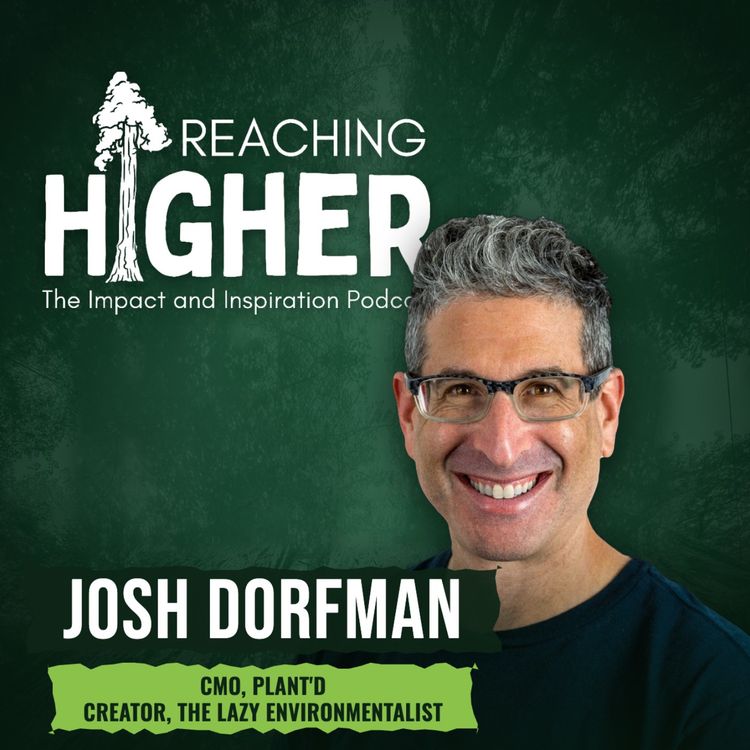
The Reaching Higher Podcast
The Lazy Environmentalist’s Lunch With Robert Redford (and Other Lessons in Climate Storytelling)
In this episode, Aaron Strout sits down with Josh Dorfman, co-founder of Plant'd, host of the Supercool podcast and newsletter, and creator of The Lazy Environmentalist, for a lively conversation about climate solutions, storytelling, and why the best climate pitch never leads with climate.
Josh shares how a Thanksgiving jab from his brother led him to stop being the guy who makes everyone feel guilty, and to start being effective instead. That shift launched Vivavi, then The Lazy Environmentalist, which grew into a Sundance Channel series, a daily SiriusXM radio show, and two books. Today he leads the brand at Plant'd, which makes carbon-negative building panels from fast-growing grass in the only factory with no smokestack on the roof.
Founded with two former SpaceX engineers, Plant'd has raised a seed round, a Series A, and a Series B, and now operates a 250,000-square-foot facility. Its panels solve a problem builders care about (moisture resistance), and the climate win rides along as the halo. D.R. Horton, the country's largest homebuilder, ordered 10 million panels.
Why the Best Climate Pitch Never Leads With Climate: Lessons From The Lazy Environmentalist
This conversation explores climate marketing, brand storytelling, overcoming inertia, building hardware with a SpaceX mindset, and how climate solutions can raise our quality of life while they cut carbon.
What You'll Learn
✅ Why Josh says to sell what the customer cares about and talk climate after they're happy
✅ How Plant'd turns grass that grows 10x faster than trees into carbon-negative building panels
✅ Why inertia, not lumber, is Plant'd's toughest competitor
✅ How to find early customers when big organizations resist change
✅ What SpaceX engineers teach startups about never over-engineering
✅ Why your brand message should be two or three things, repeated until people hear it
✅ How climate-positive schools show that solving climate can also improve learning
Chapters
00:00 Welcome and Josh's origin story
05:34 The Thanksgiving jab and the shift from being right to being effective
10:08 The van ride that sparked The Lazy Environmentalist, and why messages need repeating
17:10 Plant'd: building homes out of grass
20:25 Why inertia is the toughest competitor
23:36 How D.R. Horton changed everything for Plant'd
28:14 From founding CEO to CMO: building with a SpaceX mindset
35:16 The 99 percent rule: when to lead with benefits, not climate
39:03 Who profits and who gets left behind: the climate-positive school
43:04 Lightning round: the unread books and a great audiobook
46:05 The most impressive person: lunch with Robert Redford
49:15 The concert Josh wishes he could have seen
Powerful Quotes
"How do you be effective in the world, not how do you be right."
"We will talk about sustainability after the customer is happy with the product."
"Ours is the only factory that has no smokestack on the roof."
Resources
Supercool (Josh's podcast and newsletter): https://getsuper.cool/
Plant'd: https://www.plantdmaterials.com/
The Lazy Environmentalist by Josh Dorfman
The Women by Kristin Hannah
Special thanks to Sydney Williams for cover art and show intro/outros. James Cain for music. XDS [https://madebyxds.com/] for website design and Ben Strout as assistant executive producer and sound engineer.
More episodes
View all episodes
9. How Generosity Heals: Cynthia Kersey on Turning Pain Into Purpose
37:25||Season 3, Ep. 9In this inspiring episode, Aaron Strout sits down with Cynthia Kersey, founder and CEO of the Unstoppable Foundation, bestselling author of Unstoppable and Unstoppable Women, and creator of The Generosity Effect, for a powerful conversation about generosity, purpose, faith, and finding meaning through life's hardest moments.Cynthia shares how a painful divorce led her to build 100 homes in Nepal, how that experience taught her that giving and receiving are two sides of the same exchange, and how that lesson later carried her through a malignant brain tumor diagnosis. Her story is one of faith, gratitude, and the belief that every challenge can become an unexpected opportunity.Since 2008, the Unstoppable Foundation has worked in rural Kenya through a five-pillar model (clean water, food security, healthcare, income training, and safe learning environments), changing the lives of more than half a million people across 22 communities.How Generosity Helped Cynthia Kersey Heal and Find Purpose: The Story Behind The Generosity EffectThis conversation explores the science and spirit of generosity, how to turn pain into purpose, the power of receiving gracefully, and simple daily practices that can transform your life, your relationships, and your business.What You'll LearnWhy Cynthia sees a brain cancer diagnosis as an "unexpected opportunity"How to build a purpose bigger than your painWhy education alone isn't enough to break the cycle of povertyWhat The Generosity Effect reveals about how giving benefits the giverHow the "three degrees of generosity" create a ripple effectWhy receiving gracefully completes the circle of generosityA simple year-long practice: gratitude, self-generosity, giving to others, and generous receivingChapters00:00 Welcome and introduction01:30 The hospital epiphany: seeing a brain tumor as an unexpected opportunity05:59 Millard Fuller and the purpose bigger than your pain10:26 Building 100 homes in Nepal and raising $200,00013:08 The Unstoppable Foundation and the five-pillar model in Kenya17:06 The Generosity Effect: what the research shows22:10 The 29 gifts in 29 days story and Cynthia's year of generosity26:53 Why receiving is as important as giving30:53 Lightning round: books, mentors, and musicPowerful Quotes"When you have a great pain in your life, you need a greater purpose.""I accept the diagnosis, I deny the prognosis based on statistics, and I claim the divine prognosis." "Generosity generates. It activates receiving." ResourcesThe Unstoppable Foundation: https://unstoppablefoundation.org/Cynthia Kersey: https://cynthiakersey.com/The Generosity Effect (new book, coming March 2027)Receiving Style Assessment: https://cynthiakersey.simplero.com/page/710611Unstoppable and Unstoppable Women by Cynthia KerseyHabitat for Humanity29 Gifts by Cami WalkerMore Than Meets the EyeTheo of Golden by Allen LeviThe Reaching Higher Podcast, hosted by Aaron Strout, features conversations with influential people using their platforms to do good.
8. Type O Negative, Danzig & Quiet Riot Drummer Johnny Kelly on Bill Ward, Brooklyn, and Giving Back
45:00||Season 3, Ep. 8Aaron Strout sits down with Johnny Kelly, the Brooklyn-born drummer for Type O Negative who has also played with Danzig, Kill Devil Hill, and Quiet Riot. Johnny sets the record straight on how he actually joined Type O Negative (he started out driving the van for friends), why the band never believed it would last, and what it meant to record a tribute to his late bandmate Peter Steele alongside Black Sabbath’s Bill Ward. He also shares what it felt like to be trusted with Frankie Banali’s legacy, and talks about his charity work for breast cancer research during Breast Cancer Awareness Month.Chapters (approximate):00:00 Welcome and introductions01:19 How Johnny joined Type O Negative05:32 The early grind06:05 KISS, Black Sabbath, and growing up in Brooklyn08:21 Recording with Bill Ward11:31 The Howard Stern Show14:09 Taking over for Frankie Banali in Quiet Riot19:41 Playing with Danzig23:17 Favorite band and the Type O Negative legacy29:15 Breast cancer fundraising and giving back36:19 Lightning roundShow links:Type O Negative: https://typeonegative.net/Johnny Kelly: https://en.wikipedia.org/wiki/Johnny_KellyDrumathon X / Breast Cancer Can Stick It: https://www.breastcancercanstickit.org/Rescue Row: https://www.rescuerowinc.org/ Led Zeppelin, BBC Sessions: https://www.youtube.com/watch?v=kYcb2SiBgwwLed Zeppelin DVD (2003) with Earls Court and early footage: https://youtu.be/h9G3QeFPe8Y?si=VnHVUEcQEiBTkialFrankie Banali / Quiet Riot: https://quietriot.band/ Danzig: https://www.danzig-verotik.com/danzig/danzig2.html
7. From the International Space Station to the Ballot Box: Astronaut Ron Garan on Civic Duty
51:37||Season 3, Ep. 7Aaron Strout and guest co-host, Nancy Keach, sit down with retired NASA astronaut Ron Garan, who spent about six months aboard the International Space Station.During our conversation, Ron explains the overview effect, the orbital perspective, and why he tries to live a “Dolly Zoom” life that keeps the big picture and the small picture in view at once. He also talks about Mana Energy, a social enterprise that brought clean water to millions of people in Africa, and about Astronauts for America, a nonpartisan group urging civic engagement ahead of the midterms. Along the way, he shares why awe, not fear, drives lasting collaboration.Chapters (approximate)00:00 Welcome and introductions01:23 From Apollo 11 to the space shuttle03:24 The orbital perspective and the Dolly Zoom life13:30 Optimism, tribalism, and “there is no they”19:20 Mana Energy and clean water24:28 Astronauts for America27:41 Reaching college students and getting out the vote34:33 Infinite Simplicity37:33 Awe vs. fear and the lessons of the ISS41:34 Lightning roundShow Links:Astronauts for America: https://astronautsforamerica.org (includes the “Failure Is Not an Option” and “America, We Have a Problem” reports)Ron Garan’s book The Orbital Perspective: https://www.amazon.com/dp/1626562466Ron Garan’s book Floating in Darkness: https://www.amazon.com/Floating-Darkness-Evolution-Ron-Garan-ebook/dp/B09LYYRB52Infinite Simplicity on Substack: https://rongaran.substack.com/Muhammad Yunus, Banker to the Poor: https://www.amazon.com/Banker-Poor-Micro-Lending-Against-Poverty/dp/1586481983/ref=sr_1_1Frank White, The Overview Effect: https://www.amazon.com/Overview-Effect-Space-Exploration-Evolution/dp/197091601X/ref=sr_1_1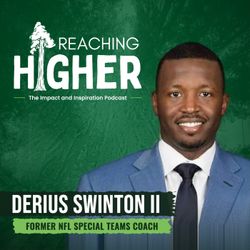
6. NFL Coach Derius Swinton II on Athlete Mental Health, Culture and the S.E.R.V.E. Mindset
01:05:49||Season 3, Ep. 6Longtime NFL coach Derius Swinton II joins Aaron Strout to talk about his path from Hampton University safety to special teams coordinator for the 49ers and Chargers. He explains what special teams actually are, what he learned from Pete Carroll, Chip Kelly, John Fox, and Steve Spagnuolo, and why he believes NFL culture needs time to build. Derius also shares the S.E.R.V.E. philosophy behind his work on athlete mental health, how a tragedy in Kansas City in 2012 changed the way he checks in with players, and why he is now moving toward sports media. The conversation ends with a Charles Barkley story from a Home Depot aisle and a few lighter picks.Key takeaways:Hampton and the HBCU experience shaped how Derius communicates with players.Special teams touch every part of a roster, and the coordinator speaks to the whole team.Winning culture takes stability and time, and Derius saw that firsthand across three head coaches in three years in Las Vegas.S.E.R.V.E. stands for Sacrifice ego, Encourage others, Responsibility in relationships, Vision forward, and Enthusiasm.Athletes need emotional and mental training tools, not just physical and tactical preparation.Real connection means asking “how are you?” and meaning it.Chapters:00:00 Welcome and introduction01:34 How Hampton and HBCU roots shaped his leadership03:55 From a Bills cut to coaching at Tennessee08:08 Letting go of the playing dream11:09 What special teams are and why they matter14:31 Lessons from Pete Carroll, John Fox, Chip Kelly, and Steve Spagnuolo18:36 Why culture takes time, from the Raiders to Belichick22:38 Earning trust in a brand new building26:03 S.E.R.V.E. and mental health in sports30:27 Lane Johnson, Stephen A. Smith, social media, and betting pressure35:26 Kansas City in 2012 and learning to ask better questions (a heavy topic, so you may want a content note)41:22 The missing voice in sports media48:19 What “reaching higher” means to Derius51:11 The Charles Barkley Home Depot story53:37 Book, show, and podcast picks55:40 Most impressive people he has met, and working with Josh McDaniels1:01:39 The concert he wishes he’d seen1:03:07 Closing thoughtsMentioned in this episode:Derius Swinton II: Wikipedia | LinkedInSituated by Angela Duckworth: Buy the bookThe Diplomat on NetflixClub 520 Podcast with Jeff TeagueAbout Derius Swinton II: Derius played safety at Hampton University and began coaching as a graduate assistant at Tennessee. He has coached for the Rams, Chiefs, Broncos, Bears, 49ers, Lions, Cardinals, Chargers, and Raiders, including stints as special teams coordinator in San Francisco and Los Angeles and as the Raiders’ interim coordinator in 2025. He was also a Bill Walsh NFL Diversity Coaching Fellow with the Cardinals.About the host: Aaron Strout is the author of Wired for Purpose: Why Humanity Is the Biggest Differentiator in a Digital World and founder of Aardwolf LLC. Reaching Higher features conversations with people doing good in the world.Thanks to Missy Veroniak for the introduction.Subscribe: https://podcasts.apple.com/us/podcast/the-reaching-higher-podcast/id1815857206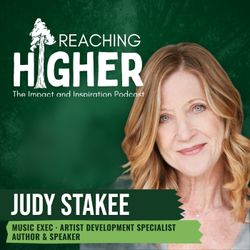
5. Judy Stakee on Discovering Sheryl Crow and Jewel: Songwriter Advice From a Warner Chappell Legend
42:15||Season 3, Ep. 5Judy Stakee, the “champion of the songwriter,” joins Aaron Strout on the Reaching Higher Podcast. Her career started as an assistant at Arista under Clive Davis and led to 20 years as Senior VP of Creative at Warner Chappell Music, where she helped launch artists like Sheryl Crow and Jewel. Judy shares how gut instinct and a lifelong love of music guide her, why professionalism and fun belong together, and what she learned from Carole King, Barry Mann, and Cynthia Weil. She explains what separates artists who keep going from those who stall out (hint: cut the word “hard” from your vocabulary), and why a human songwriter’s lived experience can’t be replicated by AI. They also cover music as energy and vibration, the art of mentoring and letting go, and a few book and podcast picks. Thanks to Jenn Greenhut for the introduction.Show LinksJudy Stakee: https://judystakee.comInstagram, Facebook, and TikTok: @judystakeeBook: The Songwriter’s Survival Guide by Judy Stakee - https://www.amazon.com/dp/0692470654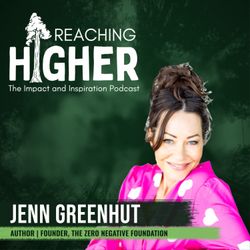
4. Stage 4 Breast Cancer Survivor Jenn Greenhut on Turning Cancer Into a Gift
36:36||Season 3, Ep. 4Former U.S. national team gymnast, actress, and singer-songwriter Jenn Greenhut joins Aaron for an honest, funny, and deeply moving conversation about turning life's hardest moments into purpose. Diagnosed with stage IV triple-negative breast cancer just months after a third failed round of IVF, Jenn was given a 12% chance of surviving five years. Then her oncologist told her something that changed everything: had she gotten pregnant, it likely would have killed her. Jenn shares how that moment helped her see cancer as a gift, how she and her husband Larry wrote Everyone Needs a Larry from both the patient and caregiver perspectives, and why she founded Love, Zero Negative and the Zero Negative Foundation to support patients and fund cancer research. Plus, the wild story of landing a scene alongside her sister in Nancy Meyers' What Women Want, her live storytelling nights, and her new definition of a good life.Show LinksLove, Zero Negative: https://lovezeronegative.comThe Zero Negative Foundation: https://zeronegativefoundation.orgEveryone Needs a Larry (Amazon): https://www.amazon.com/Everyone-Needs-Larry-Twist-Cancer/dp/B09YDZSPBTJenn's Thriver List on WeGotThis.org: https://wegotthis.org/blogs/thriver-list/jenn-greenhutJenn's TEDx Talk: https://www.youtube.com/watch?v=6to49cuSJFE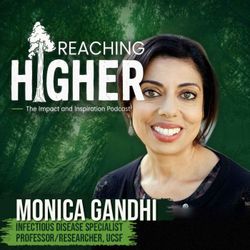
3. Can Public Health Rebuild Trust? UCSF's Dr. Monica Gandhi on Talking Across the Divide
37:51||Season 3, Ep. 3On this episode of the Reaching Higher Podcast, host Aaron Strout talks with Dr. Monica Gandhi, UCSF infectious disease physician, medical director of San Francisco's Ward 86 HIV clinic, and author of Endemic: A Post-Pandemic Playbook. Dr. Gandhi explains how lessons from the HIV epidemic shaped her public voice during the pandemic and why harm reduction, meeting people where they are, should guide public health messaging. She shares how Ward 86 pioneered long-acting injectable HIV therapy for unhoused patients, helping change national DHHS guidelines in 2024. The conversation covers integrating mental health into HIV care, protecting early career NIH scientists, low-cost urine adherence tests for global HIV care, the real-world impact of PEPFAR and USAID cuts, and the Ebola outbreak in DRC. She closes with her best advice for young doctors and researchers: play the long game, stay data driven, and don't succumb to despair.Show LinksEndemic: A Post-Pandemic Playbook (Mayo Clinic Press): https://mcpress.mayoclinic.org/product/endemicDr. Monica Gandhi on X: https://x.com/MonicaGandhi9Dr. Monica Gandhi, UCSF profile: https://profiles.ucsf.edu/monica.gandhiInternational Rescue Committee (IRC): https://www.rescue.orgamfAR, The Foundation for AIDS Research: https://www.amfar.org
2. Vilas Dhar on Responsible AI: What Leading a $1.5B AI Foundation Taught Him
50:48||Season 3, Ep. 2Vilas Dhar, President of the Patrick J. McGovern Foundation and a member of the UN Secretary-General's High-Level Advisory Body on AI, joins host Aaron Strout to define what responsible AI actually means.A former computer scientist turned human rights lawyer, Dhar now leads a $1.5 billion philanthropy funding AI for public good. He unpacks "system agenticness," the risk of outsourcing moral responsibility to machines and explains why boardrooms need new questions for AI strategy, not just adoption metrics. The conversation covers AI's real-world impact on blood-supply logistics and tax preparation, his global policy work at the UN and World Economic Forum, and why he believes hope, love, and human dignity belong at the center of AI governance. They close with quick-fire picks on favorite shows, mentors, and dream concerts.Show Links:Vilas Dhar bio — Patrick J. McGovern Foundation: https://www.mcgovern.org/about-president-vilas-s-dhar/Patrick J. McGovern Foundation: https://www.mcgovern.orgVilas Dhar — Wikipedia: https://en.wikipedia.org/wiki/Vilas_DharVilas Dhar on LinkedIn: https://www.linkedin.com/in/vilasdhar/ How Change Really Works by Julia Dhar (Vilas's wife, mentioned as his most-admired person): https://bigthink.com/people/julia-dhar/Queen's Live Aid performance at Wembley, 1985 (Vilas's dream concert): https://en.wikipedia.org/wiki/Queen%27s_performance_at_Live_Aid