Share
The Parenting Cipher
Your Child Missed ESY: What Parents Can Still Do
Did your child's IEP team say no to Extended School Year (ESY) services this summer — or was the “assistive tech” box never checked at all? In this episode, The Parenting Cipher breaks down why an ESY denial isn't the end of the conversation, how to recognize if your child needs assistive technology, and the concrete steps you can take to build your case before September.
The conversation focused on demystifying both sides of the summer gap: how ESY decisions get made (and how to challenge them) and what assistive tech actually looks like, from low-tech solutions like pencil grips and fidgets to high-tech software that turns speech into text and highlights words as they're read aloud. The discussion explored how to identify if your child's IEP is missing critical services, what to document over the summer, and why it's so important to keep communication lines open — not just with schools, but with your child themselves.
- An ESY denial is reviewable — “didn't qualify” is not the final word, and the documentation you gather this summer is what makes a September appeal possible.
- Assistive technology is broadly defined — from simple tools like pencil grips and graphic organizers to sophisticated programs for text-to-speech and speech-to-text, all designed to help children bridge academic gaps and express themselves more fully.
- Many schools overlook assistive technology supports, and parents are often surprised to learn their child is eligible — or already receives them without the IEP “tech” box checked.
- The documentation and observations you gather over summer about regression or lost progress will be powerful evidence if you need to challenge ESY or IEP decisions in the fall.
- Tools like Learning Ally and Sora provide age-appropriate, accessible reading for students with reading challenges — making a huge difference in motivation and comprehension.
- Parents are encouraged to review their child's IEP, identify missing tech supports, and advocate assertively for new or better technology — using provided scripts and strategies.
- Maintaining open, trusting conversations with your child about school, technology needs, and teacher relationships builds their confidence and ensures their voice is heard.
Chapter Markers
- 00:00 — Importance of assistive technology
- 06:26 — Assistive tech for learning support
- 08:41 — Using assistive tech for ADHD
- 12:09 — Text to speech for dyslexic kids
- 16:05 — Using assistive tech for writing
- 20:06 — Assistive technology benefits for students
- 23:04 — Discussing child's communication skills
- 25:47 — Teacher-parent relationship dynamics
- 28:59 — Inviting listeners to subscribe
Links & Resources:
- Advocate with Confidence: Advocacy Letter Library and Templates
- Parent Centers (nationwide support)
- “It’s Time to Prioritize Assistive Technology for Neurodiversity” – Fast Company article
- Read&Write – Assistive Tech Tool
- Understanding Assistive Technology for Your Child’s Academic Success (Episode Link)
- Child Trends Report
Quotes:
“The documentation you build this summer, the regression you’re seeing right now, the progress they’ve lost, the services they’re missing is the evidence you’ll need. The work you do in July is what September's IEP meeting will be built on.” – Genie Dawkins“It only takes one parent to come out and really advocate for their child. When I advocated for assistive tech, now the whole school has it.” – Genie DawkinsShort Biography:
Genie Dawkins is a passionate parent advocate, author, and special education consultant committed to empowering families navigating the special education landscape. Drawing from personal experience and professional expertise, Genie Dawkins helps parents decode school systems, collaborate with educators, and ensure their children receive the supports and services they deserve. Through “The Parenting Cipher,” she creates a supportive community dedicated to demystifying special education and uplifting every family’s journey.
🎙️ Stay connected with Genie Dawkins and The Parenting Cipher! Get expert support for special education, advocacy, and family success. Book a complimentary strategy session here, download your free guide “Top 10 Advocacy Mistakes to Avoid”, or inquire about podcast/media collaborations here. Follow on Instagram @geniedawkins and visit www.geniedawkins.com. Thanks for listening — let’s build powerful journeys together!
More episodes
View all episodes
75. The Ultimate Back-to-School List for Neurodivergent Kids
33:30||Ep. 75Standard back-to-school lists are built for a typical student — and if you're raising a neurodivergent child, they leave out most of what actually gets your kid through the day. In this episode, Genie breaks down the sensory, adaptive, and academic tools that belong on your list, what schools are legally required to provide under IDEA and Section 504, and exactly how to request them in writing so support doesn't stay a verbal promise.In this episode:02:26 Choosing a low-friction backpack — wide opening, bright lining, one clean sleeve so nothing gets lost03:34 Sensory-friendly clothing: tagless shirts, seamless socks, flat seams to prevent morning meltdowns05:13 Adaptive writing tools — ergonomic pencil grips, thick gel pens, erasable friction pens06:11 Color-coded folders, tinted exercise books, and large grid paper for dyslexia and dyscalculia08:52 Reading rulers to help dyslexic students focus one line at a time09:46 Noise-reducing earplugs and headphones for loud classrooms, cafeterias, and assemblies10:54 Discreet fidgets and resistance bands for sensory regulation and ADHD support12:23 Visual timers, dry-erase schedule cards, and nonverbal break cards for anxiety and transitions17:12 Text-to-speech scanning pens and calculators for reading and math support21:27 Where to find these tools for free: State Assistive Technology Act programs, the International Dyslexia Association, CATS, and local Special Education PTAs24:40 How to request an assistive technology evaluation in writing — and the language that gets resultsKey Takeaways:Neurodivergent kids need more than the standard list — sensory-friendly clothing, adaptive writing tools, and noise-reducing headphones are real classroom support, not extras.If a supply or tool is necessary for your child to access their education, the school is legally responsible for providing it under IDEA and Section 504.Request an assistive technology evaluation in writing, tie it to a specific goal, propose a 30-day trial, and get it written into the IEP or 504 — a verbal promise from a teacher doesn't legally bind the school district.Being prepared doesn't mean buying everything. It means knowing exactly what helps your child participate.The power of documentation and follow-up: Why checking in weekly matters, and how to get tools written into your child's IEP so support continues year-roundLinks and Resources:State Assistive Technology Act Programs – Find your state’s lending library for adaptive equipmentInternational Dyslexia Association – Local chapters offering reading tool grantsChildren’s Assistive Technology Service (CATS) – Free refurbished adaptive equipmentSpecial Education PTAs (SEPTA) – Local support and supply exchangesAssistive Technology: The Parenting Cipher Podcast Episode – Deep dive into AT optionsTemplate for requesting AT evaluationQuotes:“Prepared does not mean buying everything. It means knowing what helps your child participate.”- Genie Dawkins“When requesting items, frame them not as helpful tools, but as necessary bridges to accessing learning.”- Genie DawkinsGenie DawkinsGenie Dawkins is the creator and host of The Parenting Cipher podcast, a dedicated advocate for neurodivergent children, and a parent with lived experience navigating the education system. Genie empowers families with practical tools, legal knowledge, and self-advocacy strategies to support their children’s learning, emotional wellbeing, and unique brilliance. Whether she’s breaking down school policies or sharing empowering music, Genie’s mission is for every child to enter the classroom knowing their differences are valued—and supported.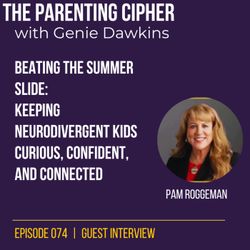
74. Beating the Summer Slide:
58:22||Ep. 74Are you worried your child might forget crucial academic skills during the summer break?Wondering how to keep them engaged, confident, and ready for the new school year without turning your home into a classroom?In this episode of The Parenting Cipher, Pam Roggeman, Dean of the College of Education at the University of Phoenix and a former award-winning high school English teacher, joins Genie to demystify the "summer slide." She shares stories from her years in the classroom, explains what the summer slide really is, and gives practical, realistic ways to weave learning into everyday summer routines for every kind of learner — neurodivergent or not.Key TakeawaysUnderstanding the Summer Slide: what it means and why kids lose academic ground over the break if learning routines stop entirely.Routines Matter: why routines around sleep, meals, and learning support kids' social-emotional health and prepare them for the transition back to school.Everyday Academics: practical, low-pressure ways to practice math (grocery store challenges), writing (letters, journals, song lists), and reading (comic books to audiobooks) that don't feel like schoolwork.Boosting Confidence & Connection: strategies to help reluctant readers and writers feel curious, connected, and confident — and how to build on what already interests them.Social-Emotional Prep: easing the transition back to school, from visiting the building in advance to writing letters that introduce your child to a new teacher.Real-Life Skills: how self-advocacy, social practice, and simply being present set kids up to thrive in and out of the classroom.Quotes"The summer slide is just what it sounds like. It is the academic loss that all of our kids, unless we combat it, experience over the summer."— Pam Roggeman [02:22]"Learning over the summer doesn't necessarily have to look and feel like school, because our kids do need a break."— Pam Roggeman [04:18]"We're keeping them curious, we're keeping them confident, and we're keeping them connected."— Pam Roggeman [06:22]"Consistency over time — that's what builds results. We fall back to our habits."— Pam Roggeman [57:47]"There are a lot of reasons to cry in this world, but homework is not one of them."— Pam Roggeman [03:29]Links and ResourcesBook lists: search your local librarian's picks or favorite teacher accounts on Instagram for age-appropriate young adult and children's titles.Local library programs: check your public library or high school for free summer reading programs and events.Audiobook platforms: many libraries offer free audiobook access through apps like Libby or Hoopla.Related listening: The Parenting Cipher's homework episode, for more on easing academic pressure at home.Speaker BiographiesPam RoggemanPam Roggeman is the Dean of the College of Education at the University of Phoenix. Before moving into higher-education leadership, she spent 18 years as an award-winning high school English teacher in Arizona. She's passionate about teacher preparation, accessible learning, and the ways academic and social-emotional growth go hand in hand.Genie DawkinsGenie Dawkins is the host of The Parenting Cipher, a podcast for parents of neurodiverse children, especially Black and brown families navigating IEPs, ADHD, autism, and everything in between. She brings both a parent's lived experience and years of advocacy work to every conversation on the show.
72. Assistive Tech for Neurodivergent Kids: Summer Support Guide
29:34||Ep. 72Why did the school say my child doesn’t need assistive technology this summer and what should I actually be asking for?ABOUT THIS EPISODESummer is here and school support has faded, but your child's needs haven't. Many Black and brown families are left out of decisions about assistive technology, or are told their child doesn't qualify, often without explanation. This episode breaks down what counts as assistive tech from pencil grips to software and why not having it over the summer can set kids back. You’ll learn what belongs in your child’s IEP, how to gather real evidence when school isn’t stepping up, and how culturally informed advocacy changes the game for neurodiverse kids who are often overlooked or misunderstood.KEY TAKEAWAYSIf your child was denied extended school year services or assistive tech, you have the right to challenge the IEP team's decision and document what your child is missing at home.Assistive technology isn't just high-tech gear it can be simple tools like pencil grips or text-to-speech apps your child may already use, even if the school isn't calling it that.Black and brown children are often overlooked for these supports because schools assume they "don’t need it" or don’t offer clear answers; asking the right questions and insisting on documentation is advocacy, not pushback.You can gather proof of regression or missing services during the summer and bring it to your next IEP meeting that evidence matters.Naming what IS and is NOT being given to your child helps close learning gaps and disrupts a system that rarely centers our needs.EPISODE QUOTES"If your child's IEP team determined they didn't meet the criteria and you believe that was wrong, you can challenge it."— Genie"There are a lot of things our children are given at school, but the assistive technology box is not being checked."— Genie"A calculator is also considered assistive tech. How about that? As well as graphing calculators."— GenieLINKS AND RESOURCESRESOURCES MENTIONED:Learning Ally: An audio reading program that provides age-appropriate, highlighted texts for students who struggle with decoding —https://learningally.org/abs-more-info?utm_source=google&utm_medium=cpc&utm_campaign=brand&gad_source=1&gad_campaignid=21171656042&gbraid=0AAAAADw72-8m3ETuJQu_X1PwfmH-G6ng1&gclid=CjwKCAjwvNfSBhBiEiwAyaGMCXK5Mz0uInwKZfvpvW4Re3i8XYG3T25q7zafYRcDgYZTBm2kOhFHBhoCsxgQAvD_BwESora:A school-based reading app that provides audiobooks and text highlighting — https://soraapp.com/welcomeFROM GENIE:The Parenting Cipher Beacon Library — ADD LINKFive Advocacy Scripts — Instant download copy-and-paste scripts for when school services disappear — ADD LINKRescue Strategy Session — 1:1 session for complex advocacy needs — ADD LINK
71. Before You Head to an Amusement Park This Summer: What Every Family of a Child with Disabilities Needs to Know"
29:58||Ep. 71Are you planning a summer adventure to an amusement park but worried about how to make the experience accessible and enjoyable for your child with disabilities? This episode dives deep into the essential tools, systems, and mindsets families need to know before heading out for summer fun—so you can spend more time making memories and less time feeling overwhelmed.The conversation focused on the various accommodation systems available at major amusement parks, including Disney and Universal, to support families of children with disabilities. One concept discussed was that these access services are not “special favors” but necessary accommodations you are entitled to request and use—no apology needed. The discussion explored how to find and use these resources strategically, from avoiding long lines to planning meals and managing sensory needs. Several points were raised, including personal experiences of what happens when families don’t know what’s available, and actionable tips on preparing for the best possible trip.Key Takeaways:Understand the range of accessibility programs at amusement parks, such as Disability Access Service (DAS), Express Pass, Rider Switch Pass, and ride reservation systemsWhy you should always visit the accessibility or customer service office—even if you think you know what’s availableHow to clearly communicate your child’s needs and how their disabilities present (rather than only stating a diagnosis)Tips for strategic planning: using maps and apps to group rides, securing appropriate food options, and packing sensory essentials like noise-canceling headphonesThe importance of giving your child flexibility to say “no” to rides—honoring their boundaries can prevent meltdowns and set up positive future experiencesAlways check if physical accommodations like wheelchairs are accessible inside the park (and when to secure them in advance)How to leverage early entry or late park hours, especially for families staying on siteThe psychological reassurance of planning ahead—and how that planning turns into real joy for the whole familyLinks and Resources:Empower Your Adventure: The Inclusive Amusement Park Guide for Parents of Special Needs Children (available on Amazon)Includes accessibility system walkthroughs, planner pages, sample communication scripts, and a resource directory.Disney Parks Disability Access Service infoCheck your local amusement park’s website for accessibility or guest services informationThe Parenting Cipher Blog (for upcoming cheat sheets and guides): [Link in show notes]Disney Parks App for ride reservations, menus, and mobile ordering (gluten-sensitive/special diet menus available)Quotes:“The Disability Access Service at Disney is not a special favor. It is an accommodation. You are entitled to know about it, request it, and use it without apology.” 00:47“Always if you have an accessibility where you need a chair, really check and make sure that they have that accessible. It might be something that you want to get before you hit go at the beginning of the park.” 08:38“The more detailed and specific that you can be about your child’s challenges and needs, the better the amusement park staff is able to accommodate you.” 18:42“If you ain’t never been on that ride before and they’re like, that’s a no...Accept that no.” 27:11Short BiographyThe creator and host of this episode is a passionate advocate for families navigating life with children who have disabilities. Drawing from firsthand experience as a parent and a wealth of research and resources, the host empowers caregivers with practical strategies, relatable stories, and step-by-step guides to turn challenging moments into empowering adventures—both inside and outside the classroom. Through The Parenting Cipher, listeners receive straightforward advice in a supportive, community-building space.
70. Break Free From Burnout: Simple Self-Care Tips to Reclaim Your Energy
36:10||Ep. 70Why do I always put my kids first — until I am completely drained and barely recognize myself?ABOUT THIS EPISODEBurnout sneaks up on Black and brown parents raising neurodiverse kids. There’s this pressure to grind, stay strong, and ignore your own needs while holding everything together for your family. But exhaustion is not just part of life; it's a warning sign that your body and mind can’t be last on the list. In this conversation, Genie and Cassandra break down how burnout shows up in our community, the hidden ways it impacts our health, and what it really looks like to reclaim space for yourself without guilt. For parents constantly in advocacy mode, caring for yourself is not a luxury; it is how you protect your children and model healthy boundaries.KEY TAKEAWAYSBurnout doesn’t always look like falling apart; sometimes it’s feeling numb, disconnected, or doing everything for everyone but yourself.Black women are taught to be strong and never rest, but this grind culture can actually hurt us and our families in the long run.Asking for help, carving out even small moments for yourself, and saying “no” is necessary, not selfish, and helps your child in the end.When you notice you’ve stopped doing things you love, or your inner voice turns harsh, it’s a sign to be as gentle with yourself as you are with your child.Burnout can affect physical health, not just your mood, and Black and brown parents have the right to prioritize their own well-being, even when the world says otherwise.EPISODE QUOTES"It's okay to be sad sometimes. It's okay to be tired. It's okay to experience all the ranges of emotion that come with being a human."— Cassandra"If you can outsource, it’s okay. It does make you less of a woman, make you less of a parent. None of those things."— Cassandra"When it comes to identifying burnout, it’s important to really do some deep diving to get to know yourself and then to treat yourself the way you treat somebody that you really, really love and adore. Like your kids."— CassandraLINKS AND RESOURCESRESOURCES MENTIONED:Octavia Butler's books — Example of how anxiety shows up in daily parenting life — https://amzn.to/4v7OyV7FROM GENIE:The Parenting Cipher Beacon Library — https://beacon.by/resources/genie-dawkins/the-parenting-cipher-advocacy-resource-libraryCONNECT WITH CASSANDRA:Website — Be Well, SisInstagram — bewellsis_podcastABOUT CASSANDRACassandra Dunbar is a medical doctor, wellness advocate, and host of the Be Well Sis podcast. She helps Black millennial women find practical ways to center wellness and self-care, even in the busiest seasons of life. Her work is rooted in breaking cycles of burnout and teaching communities how to prioritize wellbeing without shame. For Black and brown parents raising neurodiverse kids, Cassandra’s approach gives permission to support yourself as deeply as you support your child.
69. Why Homework Gets harder at the End of the year: How to survive the Last Three Weeks
38:41||Ep. 69Why is homework such a battle at the end of the year—especially when my child is already struggling, and the school's answers don't add up?ABOUT THIS EPISODEHomework always gets harder in the last weeks of school, not because our kids are lazy, but because their brains and bodies are tired from months of pushing through systems that rarely meet their needs. For Black and brown parents raising neurodiverse children, this can feel like one more place you have to advocate alone. Genie breaks down why homework becomes such a fight, why schools may suddenly stop assigning it, and what parents can do right now to protect learning and sanity for everyone. This episode is about changing the narrative: homework time can be reclaimed as a space for growth, connection, and even a little joy, no matter what the school sends home.KEY TAKEAWAYSSchools are moving away from traditional homework, but that does not mean your child is being supported, especially if they’re already behind.Black and brown neurodiverse children often have gaps in skills because the system isn’t built for them; you can use workbooks, dedicated spaces, and routines at home to help your child catch up.You have the right to ask questions, call meetings, and collaborate with teachers about exactly what your child needs to practice at home. Don’t wait for the school to tell you what’s missing.Homework doesn’t have to look like schoolwork; you can turn it into “family co-working” time, making it positive so your child feels included and not punished.Showing your child that learning at home can be joyful helps change harmful narratives leftover from your own school experiences and helps your child feel safe and seen.EPISODE QUOTES"It's the last three weeks of school. Not because your kids are lazy, they're just tired because school's wrapping up. They still have to do homework. They're overstimulated."-Genie"Most often, these children are behind. So this is why my client is so adamant about this homework."-Genie"If you have a neurodiverse child at home and you got them buying in all the way, let me tell you, they will remind you...and that's why I always say it's important that you're having conversations with your child as much as possible."-GenieLINKS AND RESOURCES:Save the School Year Youtube videoSummer toolkit:Rescue the School Year Strategy Session- https://lunacal.ai/geniedawkins/rescue-strategy-session-iep-crisis-planning-callRESOURCES MENTIONED:10-Minute Rule (Homework guideline)—Mentioned as a way some schools frame assignmentsRecommended workbooks —For filling in skill gaps at home—https://roundups.ai/pub/get-ready-for-summer-2026-with-these-engaging-workbooks-for-special-needs-children-cbbf56FROM GENIE:The Parenting Cipher Beacon Library — https://beacon.by/resources/genie-dawkins/the-parenting-cipher-advocacy-resource-libraryCommunication Kits for Parents — Templates and tools for talking with your child's school
68. Why School Anxiety Spikes in the Spring-And what Actually helps
57:15||Ep. 68Why does my Black autistic or anxious child’s school anxiety get worse every spring, and nothing the school suggests actually helps?ABOUT THIS EPISODESpring is when many of our kids’ anxiety spikes, and the usual school advice is not made for Black and brown neurodiverse families. For children with an autism or anxiety diagnosis, the end of the year is a pressure cooker. Family fears, generational trauma, and the constant push for our children to “just toughen up” make it even harder. This episode breaks down why standard strategies miss the mark, how anxiety really works in the body and mind, and what Black and brown families can do differently to support self-worth and resilience in their kids instead of just telling them to get over it.KEY TAKEAWAYSAnxiety is not just worry, it’s a leftover fear response the body holds onto even when your child isn’t in danger.Black and brown parents pass down protective anxiety for good reasons, but it can keep our children feeling unsafe and alone at school.You have the right to ask teachers and counselors for specific ways to support your child’s anxiety, not just vague “calming” tips.Naming, instead of shaming, anxiety helps talking about it openly removes the blame from both child and parent, especially in families with a history of trauma.Helping kids notice their own strengths and giving them real agency in problem-solving is more powerful than trying to control every anxious moment for them.EPISODE QUOTES"Anxiety comes with all our other problems, right. It's like, attached to them, and it doesn't really separate from anything because it's so connected to our biology, our mind, our emotions, and really our spirituality, too." — Jodi"When you build that self-trust, you really are healing that trauma. Like our epigenetics says that, you know, when things happen to us, it does change or affect our DNA."— Jodi"The anxiety does not protect us, right? That's important to know."— JodiLINKS AND RESOURCES MENTIONED:Anxiety...I'm So Done With You (book by Jodi Aman) — A book for teens on understanding and managing anxiety — https://amzn.to/4eM85WiTEDx Wilmington Talk by Jodi Aman — Explains how kids can access sustainable power over anxiety —https://www.youtube.com/watch?v=oPojr1MZ7rYJodi Aman’s blog and classes — Parenting, anxiety, and emotional resilience resources —https://www.youtube.com/user/JodiAmanFROM GENIE:The Parenting Cipher Beacon Library — https://beacon.by/resources/genie-dawkins/the-parenting-cipher-advocacy-resource-libraryGahmya Drummond-Bay's Love Connections program — https://www.evolvedkid.com/homeMiddle School Matters book — https://amzn.to/3RawY43 Rescue the School Year Youtube video for more tips to end the school year strong: https://youtu.be/lKnNo8qR6GU?si=9DrtddkI6h54OGicCONNECT WITH JODI:Website- https://jodiaman.com/Instagram — https://www.instagram.com/doctorjodiaman/ABOUT JODIJodi Aman helps young people and families manage anxiety with practical steps that center on self-worth and resilience, not just symptom control. She is a therapist and author who uses more than 20 years of experience to show kids and parents how to find their own agency and power. Her book, “Anxiety...I’m So Done With You,” and her speaking work provide direct tools for families, especially those whose needs are overlooked in mainstream mental health. For Black and brown parents raising neurodiverse kids, Jodi’s approach offers validation and strategy beyond “just calm down.”
67. Why Neurodiverse Kids Hit a Wall in the Final Weeks of School
20:22||Ep. 67Why does my neurodiverse child start shutting down, acting out, or refusing work when we’re so close to the end of the school year?ABOUT THIS EPISODEWhen your child seems to hit a wall in the final weeks of school, it’s not a character flaw or your failure as a parent. Their brains have been in overdrive all year, working harder than most people realize just to keep up — and by May, the tank is empty. For Black and brown families raising neurodiverse kids, this exhaustion can get misunderstood or dismissed by schools, leaving you to carry the blame. This episode breaks down what’s actually happening with your child’s executive functioning, how it shows up at home, and what you can do to support them (and yourself) through the home stretch. Your child’s struggles are not a reflection of your parenting — they reveal what’s missing in the system.KEY TAKEAWAYSWhen your child’s focus, memory, or motivation falls apart at the end of the school year, it’s about brain fatigue — not laziness or family “problems.”Black and brown neurodiverse kids are often told to just “try harder,” but the truth is, their executive functioning needs to be supported all year, not just when things go wrong.You can make things easier for your child right now by building in external reminders, accountability tools, and frequent breaks — these are your rights, not rewards.Your child asking you to “just sit with them” or needing extra help is not a sign of weakness — it’s actually self-advocacy, and school staff should recognize this too.School systems are not set up for our kids’ needs. You are allowed to question, document, and request the supports your child is legally entitled to, especially when you see them struggle at the finish line.EPISODE QUOTES"That is not a character problem. That is not a parenting failure. That is executive functioning hitting a wall in the final weeks of a nine month school year."— Genie"There's a difference between you managing their diagnosis or their skills versus teaching them how to manage it."— Genie"You want them to build that muscle, that muscle of actually being able to do it themselves."— GenieLINKS AND RESOURCES: To support yourself and family checkout the Parenting Cipher (free) Library for free templates and guides.For ore tips on How to end the year strong watch the " Rescue the End of the School Year" Youtube video.RESOURCES MENTIONED:Send Goals — An app to set accountability goals and reminders for your child, with alerts to help track progress — ADD LINKAlexa — Used as an external timer for managing class and break times."ADHD" by Joyner Lucas — A song that captures the inside experience of living with ADHDGenie DawkinsGenie Dawkins is the insightful host of the Panic Cipher podcast, where she equips parents with practical tools and resources to help their children succeed academically and personally. Drawing from her experience working closely with families, Genie addresses common challenges—like the end-of-year slump students face—not as shortcomings, but as natural obstacles tied to executive functioning. With empathy and expertise, she reassures parents that struggles during the final stretch of the school year are normal, and offers guidance to support children as they navigate the most demanding academic months. Through her platform, Genie’s mission is to empower families and help every child thrive in both school and life.