Share
The Origin Archive Dialogues
Telefónica
Season 1, Ep. 62
•
Imagine a nation stifled, its urgent whispers lost in the vastness. In the Spain of the early 20th century, the vital business deal, the simple comfort of a loved one's voice, often met only frustrating, echoing silence. A fragmented landscape, where progress stalled, and connections were a luxury, not a lifeline. A critical lack of communication infrastructure choked national ambition.
Step back to 1920s Spain. The echoes of the First World War still resonated, but here, the silence was deeper, more profound. A nation of over 21 million people, yet barely 30,000 telephone lines hummed across its sprawling landscape. Each town felt like a lonely island of conversation, connected by ancient, hand-cranked switchboards, if connected at all. Business sputtered, families felt distant, and the very fabric of national identity frayed under the weight of isolation. Spain, a land yearning for modern communication, found itself trapped in a telecommunications dark age, lagging far behind its European neighbors.
Aurelius and Malik take on this case in full — 5 chapters, 36 minutes, one complete story.
Learn more at: https://theoriginarchive.com/origin/telefonica
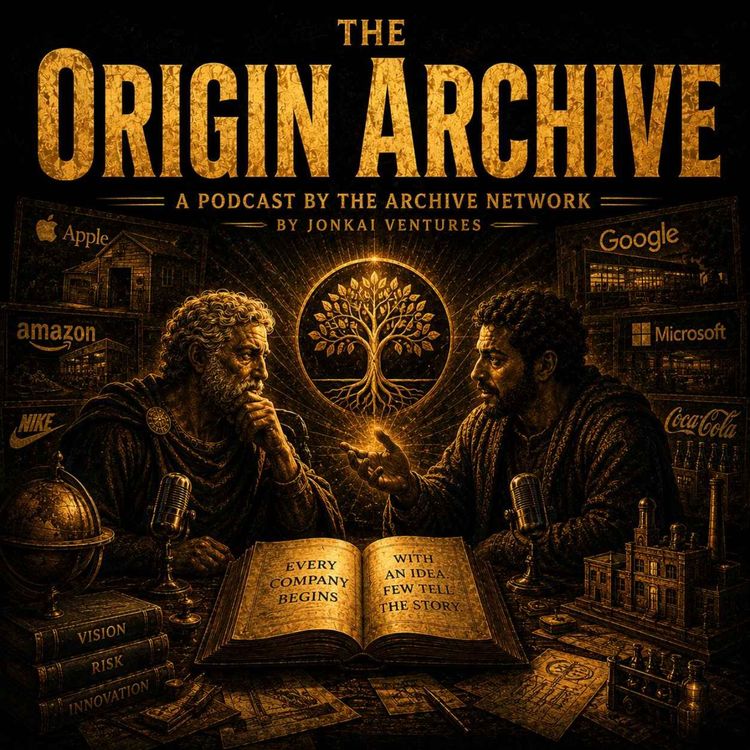
The Origin Archive Dialogues is part of The Archive Network by Jonkai Ventures. In every episode, curators Aurelius and Malik take one company and trace how it came to exist — one following the build, the other pressing on what the official history leaves out.
The Archive Network is an independent, solo-run project. Everything is free, with no ads and no paywalls. Support doesn't unlock anything; it simply keeps the work going:
https://thearchivenetwork.com/support
Explore this archive:
https://theoriginarchive.com
Discover more archives and stories:
https://thearchivenetwork.com
More episodes
View all episodes
68. SNCF
35:45||Season 1, Ep. 68The metallic clang of coupling cars, the hiss of steam, the distant shriek of a whistle – sounds that once defined a nation's pulse. But listen closer. Beneath the symphony, a deep, persistent discord. A century of ambition, innovation, and fractured power culminates in a single, audacious moment. France, on the precipice of a new era, prepares to forge its destiny on unified rails. For over a century, the sprawling iron arteries of France had stretched and intertwined, a testament to pioneering spirit and industrial might. From the very first public line laid in 1827, the nation had embraced the transformative promise of rail, connecting burgeoning cities and facilitating the swift movement of goods and people across its diverse landscapes. Yet, this robust early expansion, driven primarily by private enterprise, had inadvertently woven a complex, often inefficient tapestry across the national territory. The year is 1938, and the stage is set for a profound, sweeping shift in how a nation moves, how it connects, and how it defines its very future. Aurelius and Malik take on this case in full — 5 chapters, 36 minutes, one complete story. Learn more at: https://theoriginarchive.com/origin/sncf67. Eli Lilly
34:47||Season 1, Ep. 67Imagine a time when healing was a gamble, when the very medicines meant to save lives could just as easily betray them. The air thick with the scent of dubious elixirs, the promise of cure often a whispered lie. In the chaotic aftermath of America’s bloodiest conflict, a silent threat lurked in every bottle, every potion, challenging the very trust between healer and patient. The years following the American Civil War were a paradox. A nation scarred, yet surging with a desperate need for recovery, saw medicine advance on the battlefield only to falter in the marketplace. The bustling streets and quiet homes were awash with 'patent medicines' – grandly advertised concoctions, often potent with alcohol, opium, or mercury, yet utterly devoid of scientific basis. Labels offered fanciful claims, not precise dosages. The apothecary’s counter, once a place of measured craft, became a crucible of uncertainty, where bulk ingredients of unknown purity were mixed into remedies whose effects were, at best, inconsistent, and at worst, actively harmful. A profound public skepticism took root, poisoning the very wellspring of medical trust. Aurelius and Malik take on this case in full — 5 chapters, 35 minutes, one complete story. Learn more at: https://theoriginarchive.com/origin/eli-lilly66. Carlsberg
35:58||Season 1, Ep. 66Imagine a world where every batch of beer was a high-stakes gamble. A roll of the dice against unseen forces of spoilage and inconsistency. In the flickering gaslight of mid-19th century Europe, this was the stark, often frustrating reality for brewers, a constant battle waged in dimly lit vats, hoping for a stable, drinkable product. The air in a 19th-century Danish brewery hung heavy with the pungent, often sour tang of fermentation, a wild and unpredictable alchemy. Hundreds of small, regional operations dotted the rolling green landscape, their weathered wooden vats bubbling with top-fermented ales and porters. These were traditional brews, steeped in centuries of local custom, but plagued by an inherent instability. Sour notes, cloudy appearances, and fleeting shelf lives were common woes, the bitter taste of inconsistency. Yet, beyond these rustic walls, the world was rapidly transforming. Urbanization was accelerating its pace, and a burgeoning middle class clamored for reliability, safety, and consistent quality in their everyday consumables. The old ways, reliant on inherited wisdom rather than scientific understanding, were struggling to keep pace with this evolving, modern demand. Aurelius and Malik take on this case in full — 5 chapters, 36 minutes, one complete story. Learn more at: https://theoriginarchive.com/origin/carlsberg65. Timberland
34:03||Season 1, Ep. 65The scent of tanned leather, the rhythmic tap of a shoemaker’s hammer echoing through generations, a legacy whispered across continents. From the bustling, often turbulent streets of late 19th-century Odessa, Ukraine, a profound craft was meticulously passed down within the Swartz family. This wasn't just about crafting shoes; it was about resilience, an unwavering tradition, and the quiet determination to build something enduring. A transatlantic journey, fueled by an ancient, indispensable skill. As the early 1900s dawned, the promise of a new world beckoned with industrious fervor. Nathan Swartz, a direct descendant of master shoemakers, carried his family's invaluable heritage across the vast, often daunting Atlantic, seeking opportunity amidst the socio-political upheaval of Eastern Europe. He found his new home in the vibrant, industrial heartland of New England, a region synonymous with robust American footwear manufacturing. Cities like Lynn, Brockton, and Haverhill hummed with the ceaseless rhythm of factories, their formidable brick facades rising against the skyline, churning out countless boots and shoes for a rapidly expanding nation on the move. Here, amidst the pervasive clatter of machinery, the sharp tang of leather, and the oil-scented air, Swartz began to meticulously weave his destiny. Aurelius and Malik take on this case in full — 5 chapters, 34 minutes, one complete story. Learn more at: https://theoriginarchive.com/origin/timberland64. Reuters
35:22||Season 1, Ep. 64Imagine a world where fortunes turned on a whisper, where market crashes were hours old before they reached your desk. The mid-19th century: a crucible of ambition, innovation, and agonizing delay. Capital flowed, industries roared, but information, the very lifeblood of commerce, crawled. A desperate race against time, where every ticking clock meant lost opportunity. Picture the bustling docks of London, the opulent trading floors of Paris and Frankfurt. The air hummed with the promise of industrial might, of railway lines stretching to distant horizons, and steamships charting global trade routes. Fortunes were made and lost in the blink of an eye, yet crucial market intelligence, bond prices, and commodity futures traveled at the pace of a galloping horse or a slow-moving ship. The electric telegraph, a marvel of the age, offered glimpses of the future, but its fragmented wires left vast, silent gaps across the continent. A 12-hour journey for a letter from Paris to London wasn't just an inconvenience; it was a financial chasm. Aurelius and Malik take on this case in full — 5 chapters, 35 minutes, one complete story. Learn more at: https://theoriginarchive.com/origin/reuters63. General Mills
34:26||Season 1, Ep. 63Feel the roar of St. Anthony Falls, a relentless force shaping destiny. Hear the distant rumble of trains, carrying the golden bounty of the plains. In the wake of civil war, a new industrial pulse quickens across America, driven by ambition and the very earth beneath our feet. This is where an empire begins. The mid-19th century was a crucible of transformation across a recovering nation. The burgeoning Midwest, especially Minnesota, began to hum with a new kind of energy. Westward expansion had unleashed a torrent of wheat cultivation across the vast, fertile Great Plains, creating an unimaginable surplus – a golden tide flowing eastward. And there, in Minneapolis, the mighty Mississippi River roared over St. Anthony Falls, offering an unparalleled, untamed hydropower source. This natural energy, coupled with a dense web of railway lines weaving across the continent, created an irresistible magnet for entrepreneurs. This strategic confluence of raw materials, limitless power, and advanced transportation laid the foundational context for industrial enterprise on an immense scale. Aurelius and Malik take on this case in full — 5 chapters, 34 minutes, one complete story. Learn more at: https://theoriginarchive.com/origin/general-mills61. Paramount Pictures
35:26||Season 1, Ep. 61Imagine a flickering world, a nascent industry bursting with raw energy, yet choked by chaos and the iron grip of a powerful trust. Before the silver screen became a cathedral of dreams, it was a wild west, a landscape of fleeting images and fragmented visions, awaiting its architects. The year is 1912. The air crackles with the frantic energy of a new century, and across America, a nascent art form is taking hold: cinema. But this isn't the grand spectacle we know today. Instead, audiences huddle in dimly lit nickelodeons, captivated by flickering, single-reel shorts, a fragmented tapestry of fleeting moments. The industry, a chaotic frontier, was dominated by Thomas Edison's Motion Picture Patents Company, a formidable trust wielding patent law like a club, stifling independent voices. Yet, beneath the surface, a revolutionary idea simmered: the dream of longer, more sophisticated narrative films – feature films – and the desperate need for a system to bring them to the masses. Aurelius and Malik take on this case in full — 5 chapters, 35 minutes, one complete story. Learn more at: https://theoriginarchive.com/origin/paramount-pictures60. Canadian Pacific Railway
35:52||Season 1, Ep. 60Imagine a fledgling nation, stretching across a continent, yet fractured, vulnerable. Its very survival hung on a single, impossible dream: a ribbon of steel, binding east to west, through mountains and prairies, defying nature itself. This was the audacious vision, born of urgent necessity, that birthed Canada's most ambitious project. The year is 1871. Just four years after its birth, the Dominion of Canada faced a monumental challenge. British Columbia, a vast jewel on the Pacific coast, had agreed to join the nascent confederation, but only on one audacious condition: a transcontinental railway, connecting it to the existing eastern provinces within a mere decade. Without this iron lifeline, the sprawling dominion remained a collection of isolated regions, whispering distance from a rapidly expanding United States, whose own transcontinental lines had just pierced the continent. The shadow of 'Manifest Destiny' loomed large, a stark warning of potential economic and territorial encroachment. Aurelius and Malik take on this case in full — 5 chapters, 36 minutes, one complete story. Learn more at: https://theoriginarchive.com/origin/canadian-pacific-railway