Share
The Media Mentor
Why mentoring matters more than ever
In this episode I talk to Jonathan Paterson, Chair of Trustees at the John Schofield Trust, about the changing pathways into journalism and why mentoring, networking and practical support can make such a difference to people starting out.
The traditional route into journalism once often involved starting at a local newspaper or radio station before moving on to bigger organisations. But as local opportunities have declined, university and postgraduate courses have become increasingly important, potentially creating new barriers because of their cost and accessibility.
At the same time, a growing independent media and creator sector is opening up new possibilities. But, as Jonathan explains, many of the people succeeding in that space are already established journalists, making it difficult for newcomers to break in.
Jonathan also discusses the John Schofield Trust's mentoring, networking and masterclass programmes, including work designed to support emerging leaders and improve the retention of diverse talent within the industry.
The John Schofield Trust works to improve social mobility in UK and Irish newsrooms through mentoring and other support programmes. Find out more about its work here.
About The Media Mentor
I have helped hundreds of people navigate their careers in journalism, radio, podcasting, broadcasting and communications.
This is is done through one-to-one sessions, including CV reviews, application and cover letter advice, interview preparation and wider career mentoring.
You can book via the website.
There are also 6 pages of media jobs to browse and a WhatsApp channel for alerts.
Read and subscribe to my newsletter on Substack and LinkedIn.
More details about The Media Mentor can be found here.
For all the latest job listings head here.
To get alerts on media jobs as they drop follow the MM WhatsApp channel here.
More episodes
View all episodes
13. The Power of Community
39:20||Season 3, Ep. 13In this special episode I am on the road at the Community Media Festival in London, meeting people working across radio, podcasts and audio.The episode begins with radio futurologist James Cridland, who argues that while listeners can now get music, news and information from almost anywhere, the need for human connection and shared experience hasn't disappeared.I also speak to Aradhna Tayal Leach, Managing Director of the Audio Academy, about the organisation's move from the Radio Academy to the Audio Academy and why that change reflects the much broader world of audio today. Aradhna explains why audio's greatest strength is its ability to create a deep, personal connection with an audience.Lauren Underwood, radio presenter and host of the event, talks about how community radio helped her get started and why she believes people entering media shouldn't feel they have to have their entire career mapped out.Dom Chambers of Sound Vision explains why community media can provide a valuable pathway into the industry for people who might otherwise never see themselves as part of it and CMA council member Kevin Field talks about what community means to him.About The Media MentorI have helped hundreds of people navigate their careers in journalism, radio, podcasting, broadcasting and communications.This is is done through one-to-one sessions, including CV reviews, application and cover letter advice, interview preparation and wider career mentoring.You can book via the website.There are also 6 pages of media jobs to browse and a WhatsApp channel for alerts.Read and subscribe to my newsletter on Substack and LinkedIn.
11. How much should you work for free to get into media?
34:01||Season 3, Ep. 11How much should you work for free to get into the media industry? Volunteering, work experience, internships and placements can all be valuable ways to develop skills, build confidence and make contacts. But where is the line between gaining meaningful experience and simply doing a job without being paid?In this episode I chat to Emily Robinson-Hardy, a journalism student at the University of Northampton whose route into the industry has been anything but conventional.Before studying journalism, Emily was a semi-professional magician and appeared on Penn & Teller: Fool Us, Britain's Got Talent and America's Got Talent. She also became a member of the Magic Circle.Now preparing for her final year of a journalism degree, Emily has gained considerable experience through volunteering and community radio.She joins me to ask some difficult questions about working for free in media.As the Media Mentor I help people navigate careers in journalism, radio, podcasting, broadcasting and communications.I offer one-to-one support including CV reviews, application and cover letter advice, interview preparation and wider career mentoring.You can book via the website.There are also 6 pages of media jobs to browse and a WhatsApp channel for alerts.Read and subscribe to my newsletter on Substack and LinkedIn.
10. The Squiggly Line: Careers, Luck and Finding Your Way
25:55||Season 3, Ep. 10What does it really take to build a career in media?In this episode I am joined by data journalist Umar Hassan, almost ten years after he first had a mentoring session.Umar’s career has taken anything but a straight line. From B2B magazines and freelance work to a master’s in data journalism. His experience is a great example of why careers rarely follow the neat staircase we are sometimes promised.We discuss the realities of the media job hunt, including why working hard and wanting something badly enough isn't necessarily enough. We also discuss demonstrating what you can actually do, the importance of luck and how you can sometimes create your own opportunities.If, like Umar, you want some career advice, you can book via the website.There are also 6 pages of media jobs to browse and a WhatsApp channel for alerts.Read and subscribe to my newsletter on Substack and LinkedIn.
9. Rethinking the BBC: What should public media look like?
31:23||Season 3, Ep. 9The BBC's current Charter comes to an end in 2027. So what happens next?The media landscape around it has changed dramatically as audiences move online, traditional television viewing declines, competition grows and the licence fee itself is increasingly difficult to defend.So should we simply renew the existing system or is this an opportunity to rethink public media completely?This week I'm joined by Matt Deegan, host of The Media Club Podcast and one of the UK's leading voices in radio and audio. Matt has produced a detailed proposal, Public Media 2028, looking at what could replace the current BBC model.We discuss why Matt thinks the status quo is no longer sustainable, whether we need public broadcasting or public content and what happens to the BBC when traditional prominence on television and radio disappears.For my career advice, you can book via the website.There are also 6 pages of media jobs to browse and a WhatsApp channel for alerts.Read and subscribe to my newsletter on Substack and LinkedIn.
8. Your career isn't over when the job ends
21:38||Season 3, Ep. 8What happens when the job you've loved for years suddenly disappears? And what do you do when the skills you've spent decades developing seem tied to one particular industry?In this episode, my guest is Peter Gordon, my first radio mentor and a colleague from the very beginning of my own career.Peter and I first worked together at Star FM in Slough more than 30 years ago. He went on to become the breakfast presenter at Eagle Radio in Guildford, where he spent more than two decades. But when the radio landscape changed, Peter's career changed with it.Rather than seeing himself simply as a former radio presenter, Peter recognised that his broadcasting experience had given him a whole range of skills that could be used elsewhere. Listen to find out more and also discover what my Gladiator name would have been, had I had the skills and muscle to star in the show!For my career advice, you can book via the website.There are also 6 pages of media jobs to browse and a WhatsApp channel for alerts.Read and subscribe to my newsletter on Substack and LinkedIn.
7. Know your worth and value: The reality of freelancing
30:26||Season 3, Ep. 7What should you charge for your work? How do you know whether you're being paid fairly? And how do you build a sustainable career when your workload, income and even your job title can change from week to week?In this episode, I talk to freelance journalist and podcast host Grace McIntosh about the realities of building a freelance career in media.Grace has been freelancing in one form or another since she was a child, but says that the education and training she received didn't necessarily prepare her for the less glamorous side of freelance life, money, tax, pensions, workload, work-life balance and managing an ever-changing workflow. Here I answer some of her questions about that and we talk about being black, from Wakefield and working-class in the media industry.The Media Mentor is here to help your media career whether you are starting out, or if you are further on in your career or struggling with job applications. Support and mentoring sessions are available via the website.There are also 6 pages of media jobs to browse and a WhatsApp channel for alerts.Read and subscribe to my newsletter on Substack and LinkedIn.
6. From radio to YouTube. Reinventing your media career
27:56||Season 3, Ep. 6What exactly counts as a media job?For Clare Mansell, the answer has changed dramatically over a 30-year career that has taken her from commercial radio and BFBS to podcasting, digital marketing and, ultimately, becoming a successful YouTube content creator.Clare now runs one of the UK's biggest home appliance YouTube channels, with more than 14 million views and content reaching around two million people a month across her social platforms.But this episode isn't really about numbers. It's about the journey that got her there.Clare talks to me about her early fascination with making media, the unpredictable nature of freelance radio, reaching a career crossroads in her late 20s, returning to media after the pandemic and the extraordinary chain of events that eventually led her back to YouTube.We also explore the difference between an "influencer" and a content creator, why Clare thinks the distinction matters.Clare's story is fantastic and she got herself out of feeling stuck by hard work and perseverance but sometimes you need help to do that.The Media Mentor is here to help your media career whether you are starting out, or if you are further on in your career or struggling with job applications. Support and mentoring sessions are available via the website.There are also 6 pages of media jobs to browse and a WhatsApp channel for alerts.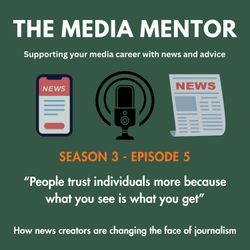
5. How news creators are changing journalism
29:25||Season 3, Ep. 5What happens when audiences increasingly get their news from people rather than news organisations? In this episode of The Media Mentor, I talk to Nic Newman, Senior Research Associate at the Reuters Institute for the Study of Journalism at the University of Oxford, about the rise of news creators and influencers and what their growing influence means for traditional journalism.What exactly is a “news creator”? Why do audiences increasingly trust individuals over established news brands? And if people say they don't trust social media or AI, why are they continuing to use both to consume news?Nic explores the changing relationship between audiences, journalists and news organisations, including:Why the US has become such a fertile market for news creators.Why individual creators can sometimes generate more trust than institutions.The growing fragmentation of news consumption.The opportunities and challenges created by niche and hyperlocal journalism.Why traditional publishers increasingly need to think of themselves as being in the “relationship business.”What this changing landscape means for the next generation of journalists.Nic also discusses the continuing importance of traditional journalism, arguing that audiences still want accurate, fair and trustworthy information — but increasingly want it delivered in formats and styles that fit the way they consume media.The Media Mentor is here to help your media career whether you are starting out, or if you are further on in your career or struggling with job applications. Support and mentoring sessions are available via the website.There are also 6 pages of media jobs to browse and a WhatsApp channel for alerts.