Share
The Italy Now Podcast
Ideas, islands & impact: the Berggruen Institute lands in Venice
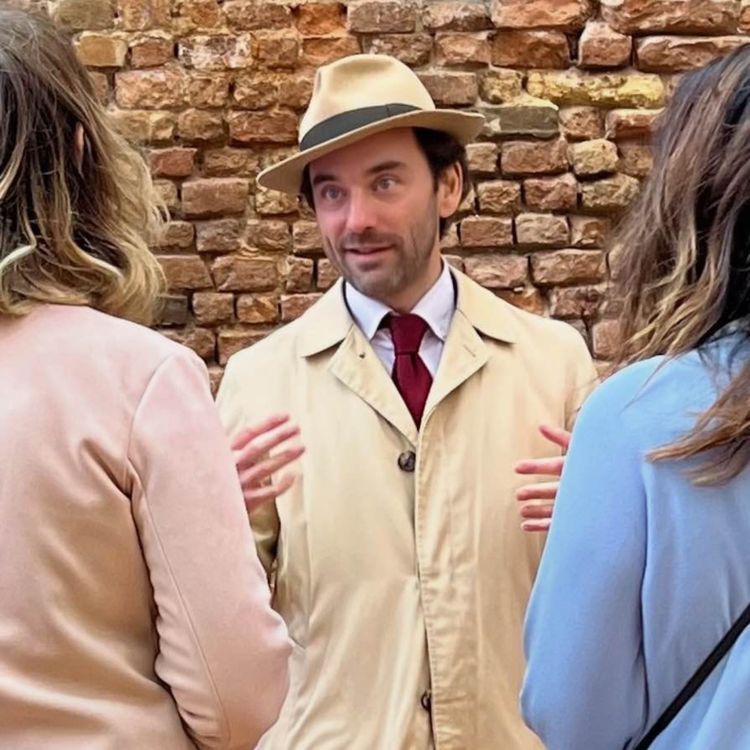
We sit down with Lorenzo Marsili, philosopher, writer and founding director of Berggruen Institute Europe, inside Casa dei Tre Oci, the 1911 artist's studio on the Giudecca that now serves as the Institute's European home.
Marsili explains why a global think tank founded in Los Angeles chose Venice over Berlin, Paris or Rome, and how three Venetian buildings have quietly become a gathering place for some of the most provocative minds of our time, from Carlo Rovelli and Giorgio Agamben to Slavoj Žižek and Peter Sloterdijk.
From a Joseph Kosuth solo show at Casa dei Tre Oci to a Hans Ulrich Obrist exhibition on protocol art at Palazzo Diedo, this is the story of a city that has always traded in ideas, and the next chapter being written from a window on the Giudecca.
More episodes
View all episodes
13. Five centuries, one square & 1.3 million lives: inside the Procuratie Vecchie
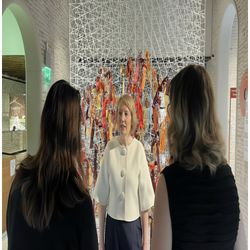
06:53||Season 1, Ep. 13We step inside the Procuratie Vecchie on Piazza San Marco in Venice, a 500-year-old palace closed to the public for five centuries and reopened in 2022 after a complete restoration by David Chipperfield Architects.Emma Ursic, CEO of The Human Safety Net Foundation, tells us how Generali transformed this extraordinary space into a global home for social innovation, reaching more than 1.3 million vulnerable people across 25 countries since 2017.From a refugee turned Parisian barber giving back to his community, to free exhibitions, family workshops & very good Italian coffee, this is the story of a building, a foundation & a quietly radical idea: that the most famous square in the world should also be a place where people rise by lifting others.
14. Cannes, cinema & a count's cinema passion: Marianne Borgo's Italian roots
08:41||Season 1, Ep. 14We meet larger-than-life French actress Marianne Borgo in Cannes, where she was practically born into the film festival itself — her uncle was one of the four men who, on a train back from Venice just before the war, decided France needed a festival of its own.But Marianne's heart belongs equally to Italy. She tells us about her grandfather, an Italian count who gave up everything to follow a young Scala singer to France, the elegance of Italian women on set in the 1960s, and the morning a purple Saint Laurent shirt cost her the role of a lifetime with the great Dino Risi in Profumo di donna.It's a story of two countries, one career, and the quiet wisdom of an actress who has walked the Cannes red carpet forty-nine times — and still believes the best is yet to come.
17. Music, peace & diplomacy. The woman bringing female composers to the world's stages
06:52||Season 1, Ep. 17We meet Veronica Sabbag in Cannes at the World Women Foundation, the Brussels based international lawyer and former EU diplomat who left twenty years of conflict management to pick up a different instrument of peace, music.She is the founder of United Voices for Peace and the force behind Global Women in Music, a project born with the United Nations Symphony Orchestra to put female composers and conductors back where they belong, on the world's greatest stages. And it began in Italy. Veronika tells us how a chance meeting at UNESCO with the late artist Patricia Atkinskisi led to a landmark concert with the Santa Cecilia Orchestra in Rome, celebrating the anniversary of the Universal Declaration of Human Rights through pieces written by women.It's the story of a promise kept, of an idea that travelled from Rome to New York, and of an Italy that, from the Venice Biennale to the Accademia Nazionale di Santa Cecilia, has always known that culture is the most powerful form of diplomacy there is.A conversation about closed doors, open stages, and what the next generation of Italian girls picking up a violin needs to hear.18. Venice, lineage & cinema. An Iranian American filmmaker comes home to Italy
06:25||Season 1, Ep. 18We meet Sohrab Mirmont at the World Woman Foundation during the Cannes Film Festival, just as he prepares to shoot his new film in Venice with the cinematographer who once worked alongside his uncle, the late Iranian master Abbas Kiarostami.The producer behind Riddle of Fire, which premiered at Directors' Fortnight in Cannes edition 2023, tells us how a single ride on a Venetian water taxi sparked the idea for his next project, why he sought out Luca Bigazzi, the cinematographer of Certified Copy, to shape its visual language, and how Italian actor Riccardo Scamarcio came on board after a long dinner at the St. Regis in Rome that had almost nothing to do with the film itself.It's a conversation about family legacy, the gravitational pull of Italy on global cinema, and what happens when an American filmmaker steps into a 1,500 year old city where every corner is already set design.A new name to keep on your radar, and you heard it here first.16. Terra Amara, an Amalfi grandmother & the road to Sicily: Selin Yeninci's Italian love affair
08:57||Season 1, Ep. 16We catch Turkish actress and producer Selin Yeninci in Cannes, fresh from a panel and even fresher from her second appearance on Verissimo, where Italian audiences welcomed her as one of their own. As Saniye in Terra Amara, the Turkish drama that ran for 121 episodes and travelled to more than 150 countries, she became a household name from the Amalfi Coast to Anatolia.Selin tells us about the mother and daughter who chased her down a Positano street at half past six in the morning, the Napoletano café owner who FaceTimed his grandmother on the spot - and then watched her leave the house for the first time in years just to meet her favourite actress, and the journalists at Mediaset who unearthed details about her childhood she didn't think existed online.We also follow her on the road: Milan, Florence, Naples, a rented car all the way down to Sicily and back, and the dream of one day producing a Turkish-Italian co-production of her own. It's a conversation about two Mediterranean cultures that, as Selin puts it, share the same daily rhythm - and recognise each other on sight.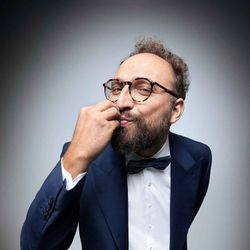
11. Hands, history & heritage: Vullo and the secret language of Italian gestures
11:14||Season 1, Ep. 11We sit down with Luca Vullo, actor, director, author and cultural ambassador, to explore the gestural language that runs beneath Italian speech like a second grammar. And makes Italy unlike anywhere else on earth.Luca has spent years cataloguing and teaching the more than 250 recognised Italian gestures, touring his one-man show La Voce del Corpo from San Francisco to Sydney, often with his mother Angela on stage beside him. He tells us why a Roman hand in motion can say more than a paragraph, how regional gesture dialects survive alongside a shared national code, and why he is fighting to have Italian gestural language recognised as UNESCO intangible heritage.By the end, you may find yourself gesturing along, and wondering how you ever communicated without it.Photo credits:Cinzia Capparelli.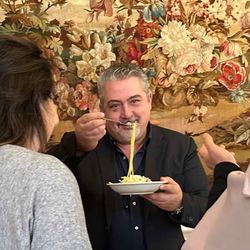
10. Wind, wheat & 260 shapes: the philosophy of Gragnano pasta
08:58||Season 1, Ep. 10We travel to Gragnano, a hilltop town outside Naples where the mountain wind, sea air and light conspire to create conditions unlike anywhere else on earth. And where Pastificio Di Martino has been making Pasta di Gragnano IGP for over a century.Giuseppe Di Martino walks us through 260 handcrafted shapes, each one designed not for beauty alone but for the precise company it will keep on the plate. He speaks about 100 percent Italian wheat, bronze dies and slow drying at low temperature, and about a family philosophy as old as the town itself: pasta will never make you rich, but it will never let you go hungry.From a landmark collaboration with Dolce & Gabbana that gave rise to the Devozione restaurant in New York, to the pastificio's sponsorship of the San Carlo opera house in Naples, Giuseppe draws a straight line from pasta to Puccini, and traces how this most Italian of arts travelled with emigrants to every corner of the world.
9. Stone, whitewash & soul: inside Potenti, Puglia's most poetic masseria
06:46||Season 1, Ep. 9We arrive at Masseria Potenti near Manduria, a 16th-century fortified farmhouse in the heart of Puglia, where a family's dream of sharing their corner of southern Italy has quietly grown into one of the region's most beloved destinations.Maria Grazia Di Lauro and her daughter Chiara Tommasino tell us how a holiday home became an agriturismo by accident, shaped entirely by the guests who loved it first. And they reveal what comes next: a monastery in Nardò, six years in the making, where the ancient philosophy of healing through craft, connection and slowness is being brought back to life.It is a story about olive oil, whitewashed walls and the particular kind of hospitality that only happens when a family opens its home and never quite closes the door.