Share
The Italians
The Italians who came early Part 1
Author Jerre Mangione's book {America is also Italian, narrated by Chef Walter Potenza.
Mr. Mangione became a professor in the English department of the University of Pennsylvania in 1961 and was named emeritus professor of American literature upon his retirement in 1978. Among the works he produced during his tenure were ''Passion for Sicilians: The World Around Danilo Dolci'' (1968) and ''An Ethnic at Large: Memoirs of America in the '30s and '40s'' (1978). Upon completing his last book, ''La Storia: Five Centuries of the Italian-American Experience,'' which he wrote with Ben Morreale, Mr. Mangione was honored by the Library of Congress with an exhibition of his works and papers.
Honoring the memory of Jerre Mangione
This podcast aims to explain Italian characters and behavior. A full-length portrait of my compatriots may occasionally be witty, grave, cynical, compassionate, melancholy, glittering, scholarly, and stimulating. What is important is that we share these emotions. Italians have discovered America for the Americans; taught poetry, statesmanship, and the ruses of trade to the English; military art to the Germans; cuisine to the French; acting and ballet dancing to the Russians; music to everybody. Suppose someday this world of ours should be turned into a cloud of radioactive dust in space. In that case, it will be by nuclear contrivances developed with the decisive aid of Italian scientists—{Luigi Barzini, in the Italians}.
More episodes
View all episodes

1. THE ITALIANS BENVENUTI
02:49||Season 1, Ep. 1This podcast aims to explain Italian characters and behavior. A full-length portrait of my compatriots may occasionally be witty, grave, cynical, compassionate, melancholy, glittering, scholarly, and stimulating. What is important is that we share these emotions. Italians discovered America for the Americans; taught poetry, statesmanship, and the ruses of trade to the English; military art to the Germans; cuisine to the French; acting and ballet dancing to the Russians; music to everybody. If someday this world of ours should be turned into a cloud of radioactive dust in space, it will be by nuclear contrivances developed with the decisive aid of Italian scientists. {Luigi Barzini, in the Italians}.Between 1880 and 1920, over four million Italians entered the United States. No other ethnic group has sent so many immigrants in such a short time. Before 1870 only scattered thousands of Italians had come to areas outside of Europe to either North or South America. Up to 1900, most Italians had emigrated to either Argentina or Brazil. Those entering the United States were primarily male, and many intended to return to Italy after making some money. However, many ended up staying in America for various reasons. {Oscar Handlin in The Uprooted].The Italian Heritage Network
2. The Italians who came early Part 2
12:56||Season 1, Ep. 2Author Jerre Mangione's book {America is also Italian} proudly narrated by Chef Walter Potenza.Mr. Mangione became a professor in the English department of the University of Pennsylvania in 1961 and was named emeritus professor of American literature upon his retirement in 1978. Among the works he produced during his tenure were ''Passion for Sicilians: The World Around Danilo Dolci'' (1968) and ''An Ethnic at Large: Memoirs of America in the '30s and '40s'' (1978). Upon completing his last book, ''La Storia: Five Centuries of the Italian-American Experience,'' which he wrote with Ben Morreale, Mr. Mangione was honored by the Library of Congress with an exhibition of his works and papers.Note: the podcast intends to honor and glorify the memory of Jerre Mangione and the immense contributions he left behind!The Italian Heritage Network
4. The Italians who came early Part 3
10:09||Season 1, Ep. 4Enjoy the third part of America is also Italian. Narrator, Walter PotenzaMr. Mangione became a professor in the English department of the University of Pennsylvania in 1961 and was named emeritus professor of American literature upon his retirement in 1978. Among the works he produced during his tenure were ''Passion for Sicilians: The World Around Danilo Dolci'' (1968) and ''An Ethnic at Large: Memoirs of America in the '30s and '40s'' (1978). Upon completing his last book, ''La Storia: Five Centuries of the Italian-American Experience,'' which he wrote with Ben Morreale, Mr. Mangione was honored by the Library of Congress with an exhibition of his works and papers.The Italian Heritage NetworkMore podcasts by Chef Walter Potenza
4. The Flight to Ellis Island
10:38||Season 1, Ep. 4Author Jerre Mangione's book {America is also Italian} proudly narrated by Chef Walter Potenza.Mr. Mangione became a professor in the English department of the University of Pennsylvania in 1961 and was named emeritus professor of American literature upon his retirement in 1978. Among the works he produced during his tenure were ''Passion for Sicilians: The World Around Danilo Dolci'' (1968) and ''An Ethnic at Large: Memoirs of America in the '30s and '40s'' (1978). Upon completing his last book, ''La Storia: Five Centuries of the Italian-American Experience,'' which he wrote with Ben Morreale, Mr. Mangione was honored by the Library of Congress with an exhibition of his works and papers.Note: The podcast intends to honor and glorify Jerre Mangione's memory and the immense contributions he left behind!The Italian Heritage Network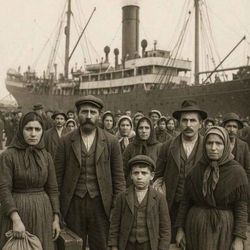
1. Immigrant's Early Arrivals
02:52||Season 1, Ep. 1This episode explores the Immigrant's Early ArrivalsThroughout the colonial and early national periods, immigrants from the Italian peninsula maintained a small but well-established presence in the North American population. Italian craftsmen were renowned the world over, and many traveled to the New World to help build its new institutions, working as sculptors, woodworkers, and glassblowers. Thomas Jefferson had a particular affinity for Italian culture; he recruited Italian stonemasons to work on his home at Monticello, and brought musicians from Italy to form the core of the Marine Band. In addition, he invented his own hand-operated pasta machine, the designs for which are still in the Library's collections.Italian immigration continued at a trickle throughout the middle of the 19th century. Although travelers from the peninsula continued to roam the world, most chose to settle in Argentina and Brazil. Between 1820 and 1870, fewer than 25,000 Italian immigrants came to the U.S., mostly from northern Italy. These early arrivals settled in communities all across the country, from the farm towns of New Jersey and the vineyards of California to the ports of San Francisco and New Orleans.The impact of their contributions can still be seen today. The poet Lorenzo da Ponte built the first opera house in the U.S., became a professor of Italian at Columbia University, and almost single-handedly established Italian opera in the United States. The abolition movement received key support from the prominent Philadelphia rabbi Sabato Morais, who brought a fierce commitment to freedom and human rights from his native Tuscany. Starting in the mid-1850s, painter Constantino Brumidi spent decades creating the paintings and frescoes that adorn the U.S. Capitol, including the spectacular images on the building's great dome.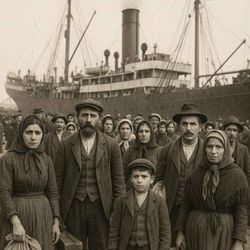
2. The Great Arrivals
03:39||Season 1, Ep. 2This episode explores the Great ArrivalMost of this generation of Italian immigrants took their first steps on U.S. soil in a place that has now become a legend—Ellis Island. In the 1880s, they numbered 300,000; in the 1890s, 600,000; in the decade after that, more than two million. By 1920, when immigration began to taper off, more than 4 million Italians had come to the United States, and represented more than 10 percent of the nation's foreign-born population.What brought about this dramatic surge in immigration? The causes are complex, and each hopeful individual or family no doubt had a unique story. By the late 19th century, the Italian peninsula had finally been brought under a single flag, but the land and its people were by no means unified. Decades of internal strife had left a legacy of violence, social chaos, and widespread poverty. The peasants in the primarily poor, mostly rural south of Italy and on the island of Sicily had little hope of improving their lot. Diseases and natural disasters swept through the new nation, but its fledgling government was in no condition to bring aid to the people. As transatlantic transportation became more affordable and as word of American prosperity spread through returning immigrants and U.S. recruiters, Italians found it increasingly difficult to resist the call of "L'America".This new generation of Italian immigrants was distinctly different in makeup from those who had come before. The immigrant population no longer consisted mostly of Northern Italian artisans and shopkeepers seeking a new market in which to ply their trades. Instead, the vast majority were farmers and laborers looking for a steady source of work—any work. There was a significant number of single men among these immigrants, and many came only to stay a short time. Within five years, between 30 and 50 percent of this generation of immigrants would return home to Italy, where they were known as ritornati.Those who stayed usually maintained close contact with their families in the old country and worked hard to earn money to send back home. In 1896, a government commission on Italian immigration estimated that Italian immigrants sent or took home between $4 million and $30 million each year, and that "the marked increase in the wealth of certain sections of Italy can be traced directly to the money earned in the United States."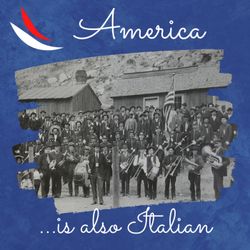
7. Ellis Island
03:29||Season 2, Ep. 7For most of this generation of Italian immigrants, their first steps on U.S. soil were taken at Ellis Island, now a legend.Ellis Island was founded as a solution to a serious social crisis. New York's previous immigrant processing station, a decaying fortress called Castle Garden, had become a pit of corruption and theft, where new immigrants had to run a gauntlet of swindlers, pickpockets, and armed robbers before escaping with their freedom and their paperwork. To ensure a safe, controlled, and regulated entry process, the federal government took over immigration processing and built a set of new, purpose-built facilities on an island in New York Harbor.The immigration station at Ellis Island represented a new type of government institution and has become an enduring symbol of the immigrant experience in the United States. During the forty years it operated, Ellis Island saw more than 12 million immigrants pass through its gates, at a rate of up to 5,000 people a day. For many generations of Americans, and for almost all Italian Americans, Ellis Island is the first chapter of their family's story in the United States.When the first group of immigrants disembarked on Ellis Island in 1892, they found themselves in the grip of a bewildering, though still orderly, regime of bureaucratic procedures. Newcomers were numbered, sorted, and sent through a series of inspections, where they were checked for physical and mental fitness and for their ability to find work in the U.S. The consequences of failing an eye exam or of seeming too frail for manual labor could be devastating; one family member could be sent back to Italy, perhaps never to see his or her loved ones again, because of a hint of trachoma or a careless inspector. Fear of being separated from family led some immigrants to call Ellis Island 'the Island of Tears'.Even for those who successfully navigated the battery of inspections, Ellis Island was generally not a pleasant experience. The regulations were confusing, the crowds disorienting, the officials rushed, and the hubbub of countless competing languages must have jangled the nerves. The moment of departure, when successful immigrants boarded ferries for New York City or destinations further west, came as a tremendous relief.The third part of our special edition ends here. Thanks for listening
8. Tenements and Toil
03:34||Season 2, Ep. 8Tenements and ToilUrban life was often hazardous for the new immigrant, and housing could be one of the greatest dangers. At the turn of the century, more than half the population of New York City, and most immigrants, lived in tenement houses, narrow, low-rise apartment buildings that were usually grossly overcrowded by their landlords. Cramped, poorly lit, under-ventilated, and usually without indoor plumbing, the tenements were hotbeds of vermin and disease, and were frequently swept by cholera, typhus, and tuberculosis. The investigative journalist Jacob Riis, himself a Danish immigrant, launched a public campaign to expose and eradicate the exploitative housing that new immigrants were forced to endure.For Italians, this way of living came as an enormous shock. In Italy, many rural families slept in small, cramped houses; however, they spent most of their waking hours out of the house, working, socializing, and taking their meals outdoors. In New York, they found themselves confined to a claustrophobic indoor existence, using the same small room for eating, sleeping, and even working. A substantial percentage of immigrant families worked at home performing piecework—that is, doing work that paid them by the piece, such as stitching together garments or hand-assembling machinery. In a situation like this, an immigrant woman or child might go days without seeing sunlight.Immigrants' workplaces could be as unhealthy as their homes. A substantial number of southern Italian immigrants had only worked as farmers and were thus qualified only for unskilled, and more dangerous, urban labor. Many Italians went to work on the growing city's municipal works projects, digging canals, laying paving and gas lines, building bridges, and tunneling out the New York subway system. In 1890, nearly 90 percent of the laborers in New York's Department of Public Works were Italian immigrants.By no means was all Italian immigrants' work grim and hazardous. Italians found work throughout the city, in many of the improvised trades that have long been a haven for immigrants, such as shoemaking, masonry, bartending, and barbering. For a time, some observers felt that Italians operated every fruit vendor's cart in the city. For many immigrants, though, and especially women and children, work could only be found in sweatshops, the dark, unsafe factories that sprang up around New York. When a fire broke out at the Triangle Shirtwaist factory in 1911, killing 146 workers, nearly half of the victims were young Italian women.