Share
The Ireland Podcast
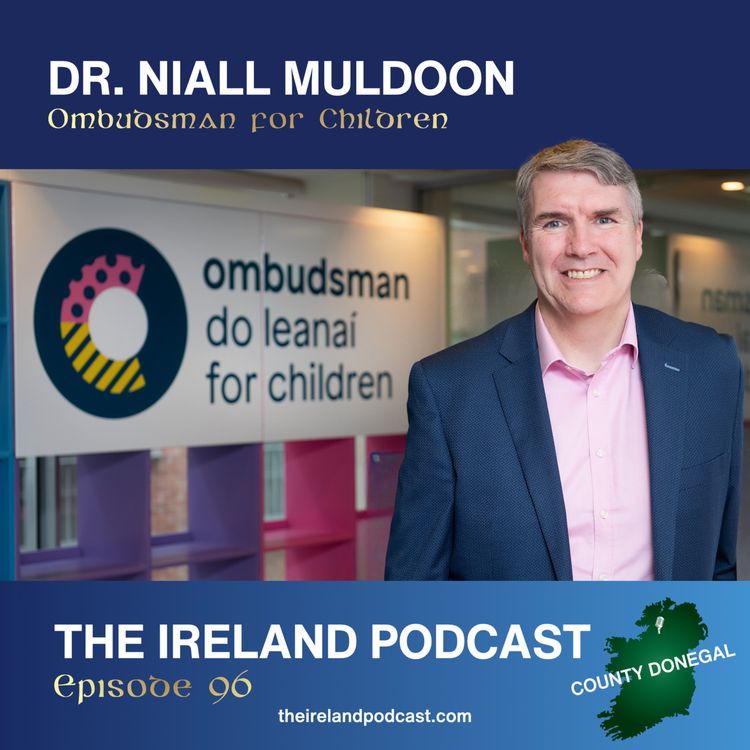
96. Dr. Niall Muldoon: Ombudsman For Children In Ireland
Episode 96 has the Ombudsman for Children in Ireland Dr Niall Muldoon conversing with Fender Jackson. Niall has held this position since February 2015, and his work focuses on promoting and protecting the rights and welfare of children in Ireland. This interview is the latest link in ‘Muldoon’s Chain’. This interview is the latest link in ‘Muldoon’s Chain’, a series initiated through a conversation with Paul Muldoon on The Ireland Podcast.
Conversation includes: interactions; Niall’s journey to his current role; interview tips; Chris Hadfield; the fixed maximum time of two terms (12 years); the genesis of the ombudsman for children’s office; what Niall’s day-to-day job is; the role of the office of the Children’s Ombudsman; the three sections of taking complaints, raising awareness of children’s rights and of the office and advising government on policy and legislation; the growing team; Chris Quinn; cross border work between both commissioners and their teams; advice to a members of family in a difficult situation; alcoholism and stopping drinking; reasons why people stay in domestic violent situations; Derek Ryan; benefits and challenges of the job; scoliosis; Minister Donnelly; housing; repetition of the same mistakes; sports coaching; compartmentalising; reaching one’s potential; Mike Tyson; kids’ concerns; the privilege of a politician who has the power to affect change for the people of Ireland; advice to Irish American billionaires; Grandpa Hanky’s Pancakes and other topics.
Face to face recording in The Ireland Podcast studio in Salthill, Galway at approximately 7pm on Thursday 25th July 2024.
Relevant Links
Additional Links
More episodes
View all episodes
214. Fender Jackson: Arranging “Sensitize” by That Petrol Emotion
30:49|In this special episode of The Ireland Podcast -which is really a continuation of Ep. 213 - Fender Jackson breaks down the harmony and emotional architecture of “Sensitize” by That Petrol Emotion through live piano demonstrations, storytelling and performance.Drawing connections to David Bowie, The Beach Boys, Queen and jazz harmony, the episode explores:split chords and slash chordsborrowed harmonyadd9 chordsmajor vs minor movementemotional tension in songwritingMingus and hard bop influencesTwin Peaks-style harmonyarranging music for pianoand the relationship between music theory, emotion and intuition.The episode concludes with a live performance-inspired arrangement of “Sensitize.”Spotify Playlisthttps://open.spotify.com/playlist/38Eohpgg54xtkHWscjxHc2?si=02db29285e534bef
213. Slash Chords Explained - Bowie, Beatles & Beach Boys
28:53|In Part 1 of this two-part music special from The Ireland Podcast, Fender Jackson explores the emotional power of slash chords - also known as split chords - and how artists such as The Beatles, The Beach Boys and David Bowie used them to create richer and more dramatic harmony.Along the way, he discusses:“God Only Knows”“The Long and Winding Road”“Life on Mars?”“Where Are We Now?”as well as:four-track recording in the 1960sBrian Wilson and The Beatlesrecording technologyFeaturing live piano demonstrations throughout the episode.A video version of this episode with chords on the screen is on Spotify and YouTube.
212. Jonathan Kemp: Walking 4,200km for Mental Health - Leg 1
50:48|Jonathan Kemp joins The Ireland Podcast to discuss his extraordinary 4,200km Finding Peace of Mind Walk 2026 - a journey across the UK and Ireland in support of mental health awareness and recovery.Starting in the Shetland Islands on January 1st and finishing in Galway later this year, Jonathan shares the deeply personal experiences that led him to undertake the walk, including his lifelong struggles with bipolar disorder, depression, dyslexia, addiction, and suicidal ideation during COVID.Jonathan speaks openly about diagnosis, medication, recovery, neurodiversity, addiction, and the importance of seeking help. He also reflects on the physical and emotional realities of walking thousands of kilometres while raising funds and awareness for mental health charities across Scotland, England, Wales, Northern Ireland, and Ireland.This is Leg 1, Part 1 of an ongoing series following Jonathan’s journey toward Galway.Relevant Linkshttps://www.gofundme.com/f/Jonathansupporting4mentalhealthcharitieshttps://linktr.ee/jonathankemplondon
211. Steve Mack 2: That Petrol Emotion - The Band That Influenced 1,000 Others
46:57|Part 2 of conversation with Steve Mack of That Petrol Emotion.In this episode, Steve goes deep on what really makes a great record - not just what you hear, but the space between the notes. From the genius of the Stayin' Alive to the importance of restraint in music, this is a masterclass in listening differently.We also explore the evolution of That Petrol Emotion - how Brendan Kelly joined the band, the albums that defined their sound, and ultimately how the band began to come apart after years of getting close without breaking through to that next level. It’s an honest look at ambition, pressure, and the reality behind life in a band.Along the way, Steve shares stories about fans, legacy, and the unexpected ways music travels through generations - including the moment he discovered his biological father was connected to Dion and the Belmonts.This is a conversation about music, identity, and the ripple effect of songs that never really go away.Relevant Linkshttps://linktr.ee/smack206https://open.spotify.com/playlist/7lEmb06zxltC0M1TMDfLXd?si=179a45e302864e50
210. Steve Mack 1: That Petrol Emotion to R.E.M. and Nirvana
01:13:59|A wide-ranging and thoughtful conversation with the lead singer of one of Ireland’s most seminal bands, looking back on origins, identity, and the winding path of a life in music. He reflects on early influences, the experience of being adopted, and the sense of instinct that shaped both his voice and his direction.There are vivid stories from Belfast - including the surreal reality of playing gigs while staying in the Europa Hotel, known as the most bombed hotel in Europe - alongside moments that capture both the humour and tension of the time. Throughout, he returns to a simple but firm belief: that the song always comes first.The conversation moves through the highs and the missteps - from early promise to periods where production and expectation began to overshadow the music itself. There’s an honest look at the excesses of 80s sound, and a clear philosophy that great songs should stand on their own, without being buried under layers of production.It’s also a story of rediscovery - of finding the groove again, reconnecting with what matters, and trusting instinct over noise. Along the way, he shares insights into creativity, influence, and the fine line between sound and substance, offering a candid perspective on what it really means to make music that lasts.Relevant Linkshttps://linktr.ee/smack206https://open.spotify.com/playlist/7lEmb06zxltC0M1TMDfLXd?si=179a45e302864e50
209. Graham Linehan: Writer, Journalist & Activist - Part 2
01:05:08|In this episode of The Ireland Podcast, writer Graham Linehan joins for a wide-ranging, long-form conversation.The discussion covers a career in comedy, including the creation of Father Ted, along with how life and work have evolved in recent years. Broader cultural and societal topics are also explored, including the role of media and institutions, and the challenges of discussing difficult issues in today’s climate.This is Part 2 of a two-part conversation.The Ireland Podcast aims to create space for open, respectful dialogue and to present a range of perspectives, allowing listeners to make up their own minds.
208. Graham Linehan: Writer, Journalist & Activist - Part 1
43:08|Part 1 of a long-form conversation with Graham Linehan on The Ireland Podcast.The conversation moves quickly into the activism and controversies that have come to define Graham Linehan’s public life in recent years, before touching at points on his career - from Father Ted, Black Books and The IT Crowd.The discussion covers public backlash, media narratives, free speech, Gaza, comedy, the early internet, and the personal and professional consequences of speaking out.A wide-ranging and, at times, unpredictable conversation on one of the most contested areas in public life.
207. Bill Laswell - Producer
53:39|In this long-form conversation, producer and musician Bill Laswell reflects on the making of Album, the 1986 record by Public Image Ltd.Laswell discusses how the project came together in New York, recording early tracks with legendary drummer Tony Williams, and later bringing in musicians including Ginger Baker, Steve Vai, Bernie Worrell, and Ryuichi Sakamoto.He describes the recording process, the use of first takes, and the production philosophy behind the album’s distinctive sound. The conversation also explores how the music was constructed, the role of improvisation in the studio, and how different musicians helped shape the final record.Laswell also addresses a long-circulating story that Miles Davis once appeared at the sessions. In the interview he explains that the visitor was actually Ornette Coleman, who briefly stopped by the studio but did not record. The anecdote has circulated in different forms over the years, and John Lydon also revisits the story in his memoir Anger Is an Energy: My Life Uncensored, where he reflects on the same period from his own perspective.The result is a detailed look at one of the most unusual recording sessions of the 1980s and the creative decisions that shaped the album.
206. Steve Vai: Guitarist - Part Two
01:02:05|Steve Vai returns for Part Two of this special conversation marking the 40th anniversary of Public Image Ltd’s Album. Because we don’t have a licence to play the record in the episode itself, listeners are encouraged to line up their own copy of Album and press play at the countdowns as Steve and Fender listen through the tracks in real time. Vai reflects on what he played, how the sessions unfolded from inside the control room, and why Album remains one of the most enjoyable and creatively free guest projects he ever jumped into - minimal direction, total space, and a sound that still feels unique forty years on. Along the way, he recalls dinner with John Lydon, being asked about joining PiL, and the gear he used at the time: Guitar: Charvel Custom (“The Green Meanie”)Amp: Carvin X100B (“ice pick” sharp tone)Delay: Roland SDE-3000 rack delaySetup: two SDE-3000s - one for mono delay, one used as chorus via chainingOverdrive: amp set with drive + a kick-in pedal for solosSitar: Choral sitar (electric)Play-along track cues and full notes are included below.00:40 - Track 1: FFF (countdown and play)06:15 - Track 2: Rise12:20 - Track 3: Fishing17:39 - Track 4: Round28:40 - Side Two begins - Bags (countdown and play)34:11 - Track 6: Home40:03 - Track 7: EaseThanks / credit:Shout-out and thanks to Ned Evett for connecting the conversation and for the Galway link-up. Honourable mention to drummer, Colin McMahon.