Share
The Ireland Podcast
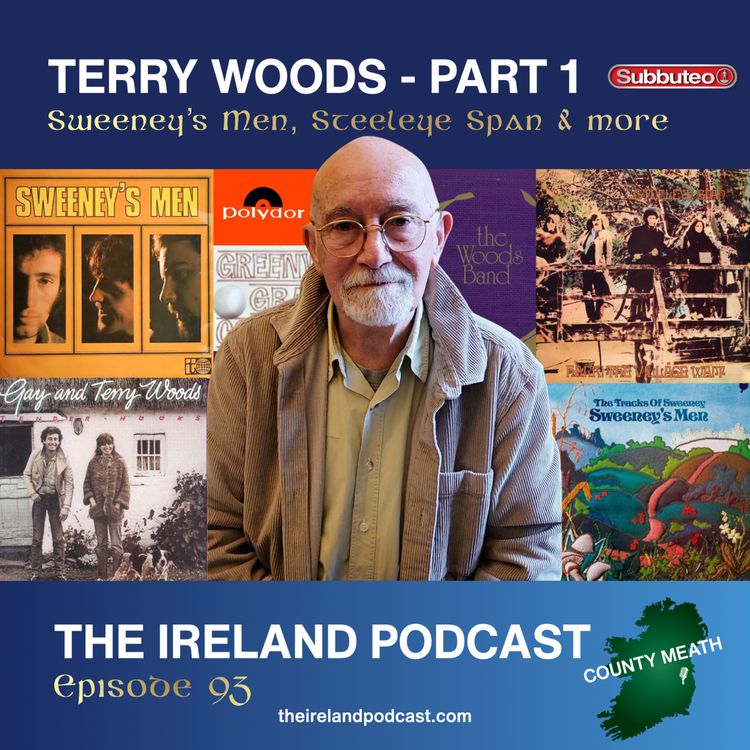
93. Terry Woods: Sweeney's Men, Steeleye Span & More - Part 1
Episode 93 is the first part of a conversation with Terry Woods as he takes us from his childhood into his first bands including Sweeney’s Men, Steeleye Span, The Woods Band and more.
Conversation includes introductions; schools days; first jobs; Terry’s sister’s influence; first gigs as a punter; AFM Radio; Ronnie Drew’s first gigs in The Gate Theatre; The Coffee Kitchen in Molesworth St; first instruments; bluegrass vs. old-timey; The Prentice Folk; Neptune Rowing Club; Billy Connolly & Josh MacRae; Sweeney’s Men; Andy Irvine; Galway Joe Dolan; Subbuteo; Johnny Moynihan, Yigael Yadin and Masada; Billy Connolly; Henry McCullough; Joe Cocker; Al O’Donnell; Ashley “Tyger” Hutchings & Fairport Convention; Sandy Roberton; Tim Hart; Steeleye Span’s reunion offer; Greenwich Gramophone; Jimmy McCulloch; Wayne Bickerton of Polydor UK; John Woods of Polydor Ireland; Roddy Hickson; The Rubettes - the band in white suits and caps with the four hit singles; getting a mortgage; Frank Murray and Paul Scully; Thin Lizzy as well as other topics.
Face to face recording in the Dunboyne Castle Hotel, County Meath at 2.50pm on Thursday 8th August 2024. Subscribe using your favourite podcast player to ensure you don’t miss an episode of The Ireland Podcast.
Relevant Links
95. Terry Woods: The Pogues - Part 2
97. Terry Woods: The Pogues & Beyond - Part 3
https://www.instagram.com/thepoguesofficial/
https://en.wikipedia.org/wiki/Terry_Woods
Additional Links
More episodes
View all episodes
252. Bernard Fowler: Singing for Philip Glass - and Facing Paul Simon
16:01|What happens when a young singer walks into a recording studio to work with Philip Glass, having never met the composer, heard the music or even seen the lyrics?In 1986, Bernard Fowler was invited to record Changing Opinion for Philip Glass's landmark album Songs from Liquid Days, with lyrics written by Paul Simon.Fowler recalls arriving at the studio terrified, repeating a rather colourful mantra to calm his nerves. After just a handful of takes, Glass appeared delighted with the performance.Then Paul Simon walked in.In this conversation with Fender Jackson on The Ireland Podcast, Fowler recalls Simon's reaction, how Philip Glass stood by his performance, and what happened after he left the studio not knowing whether his voice would make the finished record.The conversation also explores Fowler's early musical ambitions, his desire to cross genres, his performances with Philip Glass, and a memorable appearance at Lincoln Center.Fender shares his own connection to Songs from Liquid Days, including an extraordinary encounter with Laurie Anderson at her Meltdown Festival in London in 1997.This is Part 1 of a three-part conversation with Bernard Fowler.Coming next:Part 2: Public Image Ltd – recording Album and working with John Lydon, Bill Laswell and the musicians involved.Part 3: The Rolling Stones – Fowler's decades of performing and recording with the band.Subscribe to The Ireland Podcast and turn on notifications so you don't miss the remaining conversations.The Ireland Podcast is an independent, long-form series hosted by Fender Jackson, recording conversations with people whose lives and experiences help tell the story of our times.
251. Jonathan Kemp: The Final Steps of a 292-Day Walk
23:48|After 292 days on the road, Jonathan Kemp reaches Galway, bringing his extraordinary Finding Peace of Mind Walk to an end.On Sunday 18 October 2026, Fender Jackson joins his old friend for the final stretch along Galway's Long Walk towards the Spanish Arch, recording their conversation as Jonathan completes a journey that began in Shetland on New Year's Day.It's an unscripted, sometimes funny and often moving conversation about what happens when an extraordinary adventure finally comes to an end.Jonathan reflects on the physical and psychological challenges of spending more than nine months walking across Britain and Ireland, the people he's encountered, and the mental-health crisis that inspired him to undertake the journey.He talks openly about living with bipolar II disorder, the importance of receiving appropriate treatment, and how walking has taught him to concentrate on one day at a time.There are stories from the road, including an alarming encounter with cattle, thoughts about writing another book and even the possibility of a future adventure in Asia.As they approach the finish line, an unexpected encounter with an image of Sinéad O'Connor prompts Jonathan to reflect on her life and his changing understanding of her struggles.The conversation concludes with a personal moment between two friends who have known each other for 20 years.Finding Peace of MindJonathan's walk has been raising awareness and funds for four mental-health charities:Aware — Republic of IrelandAWARE NI — Northern IrelandSAMH — ScotlandMind — England and WalesTo learn more about Jonathan's journey, support the charities or access his free e-book:https://linktr.ee/jonathankemplondonRecorded on location in Galway, Ireland, on 18 October 2026.
250. Alan Shatter: Gaza, Antisemitism & Ireland’s Israel Divide | Part 2
01:02:39|In Part 2 of this extended conversation, former Irish Minister for Justice Alan Shatter continues his discussion with Fender Jackson about Israel, Gaza, antisemitism and Ireland's relationship with the Israeli-Palestinian conflict.The conversation explores Shatter's perspective on the war in Gaza, the distinction between criticism of Israel and antisemitism, and the increasingly polarised debate surrounding Israel and Palestine in Irish public life.How should Ireland approach its relationship with Israel? What constitutes legitimate political criticism, and when does it cross into antisemitism? And how do history, identity and political loyalties shape the positions people take?Shatter offers his arguments and interpretations in his own words, in a conversation that listeners may find challenging, thought-provoking or deeply contentious.The Ireland Podcast is committed to recording a broad range of voices and perspectives across the island. The views expressed by guests are their own and do not necessarily reflect those of the podcast.The Ireland Podcast - Recording the island.Also listen to:Part 1 - Episode 247: Alan Shatter: October 7, Gaza & Israel
249. Drumcree: Why We Said No | Breandán Mac Cionnaith
24:45|On Sunday, 11 October 2026, Fender Jackson visited Garvaghy Road following the end of the latest Drumcree standoff. The road was completely quiet. Then, by chance, he met Breandán Mac Cionnaith of the Garvaghy Road Residents’ Coalition. In this spontaneous walking interview, Mac Cionnaith explains why residents opposed the proposed Orange Order parade, discusses the human cost of the Drumcree dispute, addresses his own imprisonment and recalls alleged attempts on his life. Fender challenges him on whether a small, silent parade could have provided a compromise, the Orange Order’s responsibility for loyalist violence, and unionist concerns that the dispute offers a glimpse of life within a united Ireland. This conversation presents Breandán Mac Cionnaith’s account and perspective. TIP has invited representatives of the Orange Order and the wider unionist and loyalist communities to discuss Drumcree. That invitation remains open. Recorded on Garvaghy Road, Portadown, on 11 October 2026. 🎙️ The Ireland Podcast Recording the island. Subscribe for long-form conversations about Ireland’s people, politics, history and culture.
248. When Is It Depression? | Dr Susan Brannick, Aware
26:07|What is the difference between feeling low and clinical depression? When does an inner critic become destructive? How do psychologists arrive at a diagnosis? And what does good mental health treatment actually look like? In this conversation with Fender Jackson, Dr Brannick discusses depression, rumination and self-criticism, behavioural activation, diagnosis, bipolar disorder, the role - and limitations - of AI in mental health, barriers to seeking help, therapy, suicide awareness and recovery. The conversation was recorded in Dublin as Jonathan Kemp passed through the city during his 4,200km Finding Peace of Mind walk from the Shetland Islands to Galway. Jonathan is raising awareness and funds for four mental health charities: Aware, AWARE NI, SAMH and Mind. Support Jonathan's Finding Peace of Mind Walking Challenge: https://www.gofundme.com/f/Jonathansupporting4mentalhealthcharitiesAware is the national charity providing support, therapy, education and information to those affected by depression, bipolar and anxiety. They provide free accessible support to tens of thousands of people across Ireland each year. Visit aware.ie or call the Aware Support Line 1800 80 4848. Jonathan is due to complete his journey in Galway on Sunday 18 October 2026.
247. Alan Shatter: October 7, Gaza & Israel | Part 1
01:30:58|Alan Shatter is a former Irish Minister for Justice and Defence, former Fine Gael TD, solicitor and author.In Part 1 of this extended conversation with Fender Jackson, Shatter reflects on growing up Jewish in Dublin and how his experience of being Jewish in Ireland has changed over the course of his life.He gives his personal account of waking to news of the Hamas attacks on October 7, discusses the intelligence and security failures that preceded the attack, and considers the political responsibility of the Israeli government.The conversation then turns to the history of the Israeli-Palestinian conflict, the creation of Israel, Palestinian and Jewish displacement, the Six-Day War, Gaza following Israel's 2005 withdrawal, Hamas's rise to power and the conditions in Gaza before October 7.Fender challenges Shatter on Israel's responsibility for conditions in Gaza, restrictions on fuel and essential supplies, the scale of civilian deaths, the conduct of the war and the accusation that Israel is committing genocide.Part 2 turns more directly to Ireland: antisemitism, anti-Zionism, sanctions and boycotts, the description of Israel as an apartheid state, Ireland's unusually strong identification with Palestinians, and Shatter's concerns about the future of Jewish life in Ireland.Recorded in Dublin.The Ireland Podcast - Recording the island.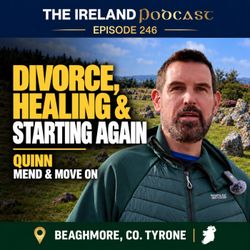
246. Divorce, Healing & Starting Again | Quinn (Mend & Move On)
58:08|Quinn is the creator behind Mend & Move On, an online community of almost 600,000 people built around hope, healing and starting again.In this walking conversation at the ancient Beaghmore Stone Circles in County Tyrone, Quinn speaks about the breakdown of his marriage, the difficult months that followed and how sharing a few simple words of encouragement online developed into a worldwide community.Quinn and Fender discuss counselling, male friendship, vulnerability, imposter syndrome, becoming an accidental content creator and whether Mend & Move On could eventually become Quinn’s full-time work.Fender also shares his own experience of divorce, grief and returning to Ireland as the pair discover that neither the path through Beaghmore nor the journey through life is always straightforward.Relevant LinksInstagram: https://www.instagram.com/mendandmoveon/ TikTok: https://www.tiktok.com/@mend2moveon YouTube: https://www.youtube.com/@mendandmoveon Facebook: https://www.facebook.com/mendandmoveon/
245. Understanding Drumcree: John Manley
49:49|Why has the Drumcree dispute returned after almost three decades?John Manley, political correspondent with The Irish News, explains the history of the Orange Order parade, opposition from Garvaghy Road residents, the major stand-offs of the 1990s and the recent legal challenge involving the Parades Commission.Fender and John also discuss the competing rights at the centre of the dispute, the involvement of Sinn Féin and unionist politicians, the approach of an Assembly election and whether Drumcree could destabilise Northern Ireland’s political institutions.This conversation reflects John Manley’s own knowledge, analysis and perspective. The Ireland Podcast has also invited a corresponding conversation exploring Drumcree and Orangeism from a unionist perspective.Recorded remotely on 29 September 2026.The Ireland Podcast is a long-form, non-partisan podcast. Recording the island.Relevant Linkshttps://www.irishnews.com/
244. Stephen Averill: The Art Behind U2 & Ireland’s Iconic Album Covers
32:22|Stephen Averill has spent nearly five decades shaping how some of Ireland’s most important music looks.From his beginnings with The Radiators From Space to a remarkable creative relationship with U2 spanning Boy, War, The Joshua Tree, Achtung Baby and beyond, Stephen has helped create images that became inseparable from the music itself.In this episode of The Ireland Podcast, Fender Jackson talks to Stephen about the art of the record sleeve: discovering album artwork as a young music fan, designing before computers, working with musicians and photographers, the relationship between music and image, and what makes an album cover become iconic.They also discuss Stephen’s work beyond U2, the changing Irish music scene, the creative possibilities that come from limitations, and what happens to album artwork as music moves from vinyl and CD into the digital age.Relevant Linkshttps://www.stephenaverill.com/Chapters00:00 Introduction01:33 When Album Covers Became Art04:07 How Record Sleeves Changed06:11 Creating a Visual Identity for a Band07:16 How Stephen Designs an Album Cover10:00 Designing for U211:02 Art vs the Record Company13:17 Can an Album Cover Sell the Music?16:08 Working with Great Photographers18:15 When Record Labels Change Your Artwork20:20 How Limitations Can Improve Creativity22:59 What Makes an Album Cover Iconic?24:00 U2, Success & Creative Relationships26:22 Logos, T-Shirts & Band Identity26:49 Stephen Averill's Archive27:44 From Advertising to Album Design31:01 Designing for Ireland's Music Scene32:01 Outro