Share
The Impact Equation
Alexis Normand: Making Carbon Accounting Accessible to Every Business
Alexis Normand is the co-founder and CEO of Greenly, the Paris-based carbon management platform helping businesses measure and reduce their emissions. After starting his career in public policy and spending six years at health tech company Withings, Alexis turned his attention to climate and founded Greenly with the vision of making carbon accounting as accessible and scalable as financial accounting. Originally launched as a consumer app, Greenly pivoted to B2B and now serves businesses ranging from small and medium-sized companies to large enterprises, helping them track emissions across their operations and supply chains. In this episode, Alexis discusses why sustainability can be a profitability driver rather than simply a cost, how regulation and procurement are pushing carbon accounting down through supply chains, and how AI can simplify complex carbon data and give sustainability teams more time to focus on actual emissions reduction. He also shares his vision for Greenly to build a powerful network of supplier and product-level carbon data that could help businesses make more informed decisions and accelerate the transition to a lower-carbon economy.
More episodes
View all episodes
112. Paul Van Zyl: Building Coalitions to Turn Social Impact into Lasting Change
39:46||Season 1, Ep. 112In this episode of The Impact Equation, Rafi is joined by Paul van Zyl, former executive secretary of South Africa’s Truth and Reconciliation Commission and co-founder of The Conduit, to explore how collaboration, trust, and collective action can help tackle some of the world’s most complex challenges. Paul reflects on his experiences working in the struggle against apartheid, helping establish the Truth and Reconciliation Commission, and the importance of acknowledging victims, uncovering the truth, and building a path towards lasting peace. He then shares the inspiration behind The Conduit, a community and convening space that brings together people working towards positive social change. The conversation explores how The Conduit has evolved from facilitating meaningful connections to building coalitions that address systemic issues, including the Flood Action Coalition, which aims to coordinate investment in natural flood management and strengthen water resilience. Paul also discusses the potential of sports stadiums to become year-round social infrastructure, the role of collaboration in tackling extreme heat, and why trust is essential to creating solutions that benefit entire communities. He closes with a powerful reminder that meaningful progress requires people to move beyond division, work across differences, and focus on practical solutions that create lasting impact.
111. The Tyndall Centre: Turning Climate Research into Real-World Action
46:27||Season 1, Ep. 111In this episode of The Impact Equation, Rafi is joined by Andy Jordan, Alistair Ford, and Carly McLachlan from the Tyndall Centre for Climate Change Research to explore how interdisciplinary research can help accelerate climate action. Celebrating 25 years of the centre, they discuss the importance of connecting climate science with policymaking, practical solutions, and collaboration across sectors. Andy shares how Tyndall’s research has helped shape the UK’s approach to decarbonisation and climate policy, while Alistair explains the growing challenges of climate adaptation, from extreme heat and flooding to building more resilient cities and transport systems. Carly highlights how partnerships with Massive Attack and local authorities are helping transform the live music and events industries through low-carbon innovation, as well as supporting Greater Manchester’s decarbonisation ambitions. The conversation also explores how climate solutions can deliver wider benefits for public health, communities, and economic prosperity. Despite the seriousness of the climate crisis, the guests share why they remain hopeful and emphasise the need to turn research into action, scale successful solutions, and keep climate change part of everyday conversations.
110. Emily Bolton: Rebuilding Communities Through Citizen-Led Regeneration
39:37||Season 1, Ep. 110Emily Bolton is the founder and CEO of Our Future, an organisation working with local residents, community leaders and businesses to drive citizen-led regeneration and create lasting change in towns across the UK. With a background in social finance and systemic innovation, Emily helped establish the world’s first social impact bond at Peterborough Prison, designed to reduce reoffending through preventative support, and later founded the Impact Incubator to tackle complex social challenges. After a serious illness prompted her to reflect on the future she wanted to help create, Emily turned her attention to post-industrial communities and how they could regain the power to shape their own futures. In this episode, she explains how Our Future is working with residents and Grimsby Town Football Club to build a shared vision for Grimsby, strengthen community connections and develop a fund that can support locally driven initiatives. She also explores the importance of trust, civic leadership and social infrastructure in regeneration, why communities must have a genuine say in decisions that affect them, and how government and businesses can become enablers of local change rather than directing it. Emily shares her vision for extending this model to other towns and calls on people to think boldly about what their communities could become and take action to make that future possible.
109. Claire Hill: Improving teaching quality through evidence-based professional development
26:34||Season 1, Ep. 109Claire Hill is the director of StepLab, a professional development platform helping schools improve teaching quality through structured coaching, practical training and evidence-based feedback. Having worked as a teacher and school leader, Claire brings first-hand experience of the challenges educators face in developing their classroom practice and supporting student achievement. Since joining StepLab four years ago, she has helped lead its growth from a small organisation working with a few thousand teachers to a platform now used by more than 200,000 teachers across the UK, Australia and other international markets. In this episode, Claire explains why traditional one-off training sessions often fail to change teaching habits, how deliberate practice, classroom modelling and precise feedback can help teachers continually improve, and how StepLab uses research to make effective professional development accessible at scale. She also discusses the role of technology and AI in expanding the platform internationally, the importance of government investment in teacher training, and why giving teachers more time to develop their skills is essential to improving educational outcomes and strengthening the teaching profession.
108. Community-Led Conservation: How Health, Livelihoods and Local Leadership Can Protect Nature
45:37||Season 1, Ep. 108Ashley Emerson, co-CEO of Business and Scale at Health in Harmony; Adam Miller, co-founder and executive director of Planet Indonesia; and Sam Shaba, CEO of Honeyguide, are leading organizations that demonstrate how empowering local communities can deliver lasting conservation results. Working across Indonesia, Tanzania, Madagascar, Brazil and other regions, their organizations help communities protect forests, wildlife and biodiversity by addressing the needs that make conservation possible, including healthcare, livelihoods, land rights and local governance. Health in Harmony uses its Radical Listening approach to fund community-designed solutions, while Planet Indonesia supports community rights, sustainable livelihoods and locally managed institutions, and Honeyguide helps wildlife management areas become financially self-sustaining. In this episode, Ashley, Adam and Sam discuss why conservation must work alongside communities rather than exclude them, how investing in local priorities can improve both human well-being and environmental outcomes, and why successful conservation depends on listening, humility and collaboration. They also share their vision for scaling community-led solutions by equipping local organizations to lead independently, shifting resources and decision-making power toward frontline communities, and redefining conservation success by how many landscapes can thrive without continued dependence on external NGOs.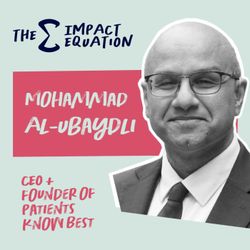
106. Mohammad Al-Ubaydli: Joining-up records of 15 million UK citizens
33:28||Season 1, Ep. 106Mohammad Al-Ubaydli is the founder and CEO of Patients Know Best (PKB), the personal health record platform that has crossed six million registered users in the UK and was the first Personal Health Record to integrate with the NHS App. He trained as a physician at Cambridge, worked as a staff scientist at the US National Institutes of Health, before founding Patients Know Best in 2008. He has written eight books on healthcare technology, and in 2012 was elected an Ashoka Fellow as a social entrepreneur. Mohammad lives with a rare disease, an experience that led him to conclude that patients, not institutions, should hold the canonical copy of their own health data. The platform now underpins joined-up records for more than fifteen million UK citizens, and is one of the few B Corp social enterprises operating at that scale inside the NHS.105.105. 105up
25:41||Season 1, Ep. 105.105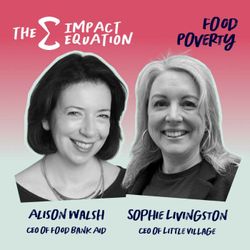
105. Schools Out, Foods Out
35:40||Season 1, Ep. 105Alison Walsh and Sophie Livingston lead two of London's most effective responses to child poverty. Alison is CEO of Food Bank Aid, a charity born in a double garage in Highgate in April 2020 that now supplies 33 food banks across North London and Hertfordshire, reaching around 20,000 people, including 5,000 children every week. Sophie is CEO of Little Village, London's largest baby bank network. Providing pre-loved clothes, kit, and connection to families with under fives. A serial social entrepreneur, Sophie was the founding CEO of City Year UK. She co-founded Generation Change, chairs the Baby Bank Alliance she helped to create in 2024, and chairs the End Child Poverty Coalition. Sophie was awarded an MBE in 2020.