Share
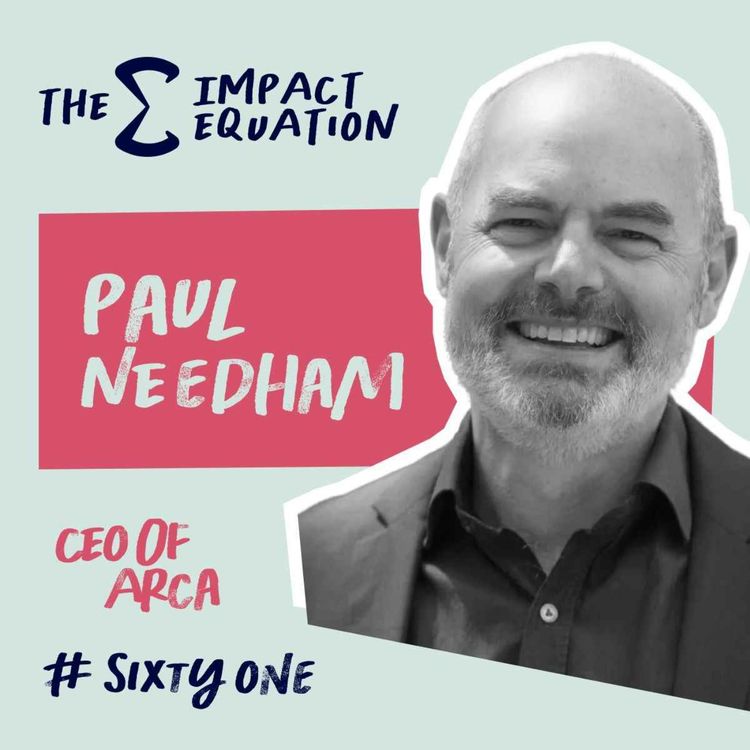
The Impact Equation
Paul Needham: from solar cells in India to gigantic carbon sponges
In this episode, we go deep into chemistry and mining with Paul Needham, CEO of ARCA, a company using carbon mineralisation to turn mine waste into giant, permanent carbon sponges. In 2025, Arca signed a 10-year deal with Microsoft to remove 300,000 tonnes of carbon from the atmosphere. Certain rocks naturally react with CO₂, pulling it out of the air and locking it away forever as stone. ARCA has found a way to massively accelerate that natural process, transforming mining tailings from an environmental liability into a climate solution. Paul's no stranger to scaling impact: he previously built Simpa Networks, bringing pay-as-you-go solar to hundreds of thousands of people in rural India. In this episode we learn about scaling pay-as-you go solar in India and how carbon mineralisation turns mining waste into carbon removal at scale.
More episodes
View all episodes

98. Michael Young: AI Drug Discovery & Clinical Trials
38:03||Season 1, Ep. 98Michael Young is co-founder and co-CEO of Lindus Health, an AI-native contract research organisation that runs clinical trials end-to-end and has begun licensing therapeutics to take through trials itself. A former special adviser in the Home Office and 10 Downing Street, where he worked on the UK Life Sciences Strategy, Michael joined Adam and Rafi to explain why running trials, not discovering drugs, has become the biggest bottleneck in medicine. He unpicks the incentives that keep contract research slow and expensive, reflects on Kate Bingham and the Vaccine Taskforce, describes how Lindus can now run five drug programmes for the cost of one a decade ago, and looks ahead to a wave of AI-discovered drug candidates the current system cannot absorb. He closes with a practical ask of every listener: sign up for a clinical trial.
97. Maia Ramarosandratana: Scaling sex education in Madagascar
31:06||Season 1, Ep. 97Maia Ramarosandratana is the Founder of Projet Jeune Leader, an organisation she launched in 2013 and has since built into one of the most ambitious efforts to drive to deliver comprehensive sex education through public schools in Madagascar. Maia has led PJL from an early initiative to a scale model now serving more than 50,000 students each year. Maia has scaled while insisting on programme quality, investing in rigorous monitoring and evaluation, building partnerships with government, including the Ministry of Education, and expanding both budget and reach tenfold. Shantanu is a Mulago Fellow and this interview is the third in a series of three episodes with our friends at the Mulago Foundation https://www.mulagofoundation.org.
96. Mary Long-Dhonau OBE: Flood Mary (keep on advocatin')
36:44||Season 1, Ep. 96Mary Long-Dhonau OBE has spent more than 25 years helping people prepare for one of the UK's fastest-growing climate risks. Known across the country as Flood Mary, she became an advocate after her own family home flooded repeatedly with contaminated sewage. Faced with little practical support and caring for a young son with severe autism, she turned that experience into a mission to help others recover more quickly and prepare more effectively. In this episode of The Impact Equation, Mary explains why flooding is no longer something that only affects communities beside rivers. As our climate changes, surface water flooding is becoming an increasing threat, and she argues that homeowners, businesses and policymakers all need to rethink what resilience looks like.
95. Shantanu Agarwal: The $100m Carbon Removal Breakthrough
44:54||Season 1, Ep. 95Mati Carbon, led by founder and Mulago fellow Shantanu Agarwal, made history in April 2025 by winning the $100 million XPRIZE Carbon Removal. In this episode, Shantanu shares how Mati uses enhanced rock weathering to turn pollution into soil-enriching fertilizer for smallholder farmers in the Global South. We discuss the unique model that combines rigorous climate science with a non-profit governance structure, exploring whether effective climate solutions can be both technically credible and distributively fair. Shantanu is a Mulago Fellow and this interview is the second in a series of three episodes with our friends at the Mulago Foundation https://www.mulagofoundation.org.
94. Peter Briffett: Taking On & Beating Payday Loans
40:04||Season 1, Ep. 94Today's episode we welcome Peter Briffett, CEO and co-founder of Stream. Most people are paid at the end of each month but bills and emergencies don't keep to a calendar, so the lowest-paid end up borrowing - through overdrafts and payday loans - to bridge the gap. Stream lets workers draw earnings they've already accrued, and has grown from there into savings, financial coaching and benefits, built around the employer rather than a bank. It now reaches more than three million workers across roughly a thousand employers, including the NHS, is backed by social-impact investors and recently closed a $90m Series D that took total funding past $200m.
93. Folake Owodunni: Creating emergency infrastructure in Africa
24:57||Season 1, Ep. 93Folake Owodunni is the co-founder and CEO of Emergency Response Africa. ERA is a healthcare technology company improving how medical emergencies are managed across Africa, starting in Nigeria. They operate the largest network of trained First Responders, ambulances, and verified emergency-ready hospitals. This network allows them to connect people experiencing medical emergencies to the help they need, anytime, day or night. Folake is a Mulago Fellow and this interview is the first in a series of three episodes with our friends at the Mulago Foundation https://www.mulagofoundation.org.
92. Lord Maude: Fixing the State, from Thatcher to Cameron
44:55||Season 1, Ep. 92Lord Francis Maude is a senior British political figure and former minister. His career spans three Governments, four decades and multiple continents. Having had his first ministerial post under Margaret Thatcher, Francis has long experience and deep understanding of how governments work. From his early days in the HM Treasury to leading reform in the Cabinet Office, he became one of the architects of modern UK public service reform. As Minister for the Cabinet Office during the coalition years, he drove efficiency, digital transformation, and a sharper focus on execution inside government.
91.91. 91up
19:07||Season 1, Ep. 91.91Adam and Rafi review the last seven episodes in our regular wash up conversation
91. Dr Danny Sriskandarajah: Power to the People
42:50||Season 1, Ep. 91