Share
The Impact Equation
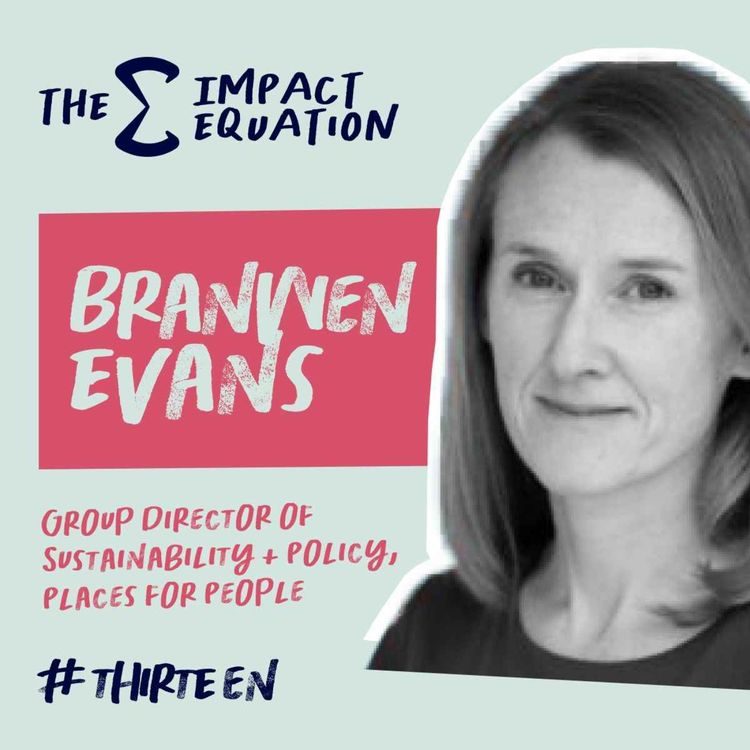
Branwen Evans, Director of Sustainability and Policy, Places for People
Season 1, Ep. 13
•
In this episode, we’re joined by Branwen Evans, a leader in housing and social policy. Branwen has held senior roles at the Department for Communities and Local Government and the Homes and Communities Agency, focusing on housing strategy and community development. Branwen is now at Places for People, one of the UK’s biggest social enterprises, managing over 245,000 homes and investing millions into building communities — Branwen’s work focuses on how Places for People can change lives every day, creating homes and thriving communities.
More episodes
View all episodes
59. Hans Stegeman, Chief Economist of Triodos Bank: Rethinking Growth, Economic Systems and GDP
45:37||Season 1, Ep. 59What if the way we think about money is fundamentally wrong? In our latest episode of The Impact Equation, Rafi and Adam sit down with Hans Stegeman, Chief Economist at Triodos Bank - one of the few banks where sustainability isn’t a bolt-on, but the organising principle. Hans’s central critique is this: we haven’t just chosen economic growth - we’ve hard-wired it into everything. Our markets, financial returns, debt system, pensions, and public budgets all depend on the assumption that the economy must keep expanding. The problem is that this version of growth is material by design, and material growth always comes with ecological and social costs. His argument isn’t that progress is bad - it’s that we’ve confused progress with GDP. No amount of “green” investing can fix a system that structurally requires ever-greater extraction, consumption, and future growth just to stay standing. So what does he want to change? Hans calls for an economy, and a financial system, that is less dependent on growth, and that fundamentally success ought to be measured in wellbeing, resilience, and social outcomes, not just economic output. In this episode, Hans challenges us to question our assumptions and what we’ve accepted as “just how the world works”.
58. Elizabeth Boggs Davidsen, CEO, GSG Impact
38:59||Season 1, Ep. 58In this episode, GSG Impact CEO Elizabeth Boggs Davidsen joins the show to share her journey from being mentored by Madeleine Albright to leading global efforts in impact investing. Drawing on her formative years working in conflict zones like Sudan and Afghanistan, Elizabeth explains how those experiences shaped her belief that traditional aid isn't enough and that we need new models to drive change. She dives into her work pioneering a $1 billion "blended finance" fund in Latin America and her time in the Biden administration, before looking ahead to the 2026 launch of the "Impact Economy Index"—a new tool designed to spark a "race to the top" for countries prioritizing people and the planet. It’s a fascinating look at how capital can be a force for good, wrapped in some great advice for anyone starting a career in social justice.
57. Gaia Vince, Journalist & Author, Nomad Century
37:42||Season 1, Ep. 57This podcast episode features Gaia Vince, a trailblazing journalist, broadcaster, and award-winning author, discussing the profound intersections of climate change and human migration. In this episode, Rafi explores Vince’s career shift from science journalism to documenting the "front lines" of our changing planet, culminating in the urgent thesis of her latest book, Nomad Century. You can buy her book here: https://amzn.to/49b8ltk
56.56. 56up
28:48||Season 1, Ep. 56.56Across the previous seven episodes of The Impact Equation, we spoke with Charlotte O'Leary, Nick Wise, Lucy Heller, Stephen Cowan, Lord Browne, participants in the Mining Roundtable, and Tiffany Yu, exploring how lasting impact is built at scale across finance, oceans, education, cities, energy, extractives, and disability rights. Together, these conversations examined the tension between idealism and pragmatism, showing how commercial rigour, financial ingenuity, and institutional design are essential to sustaining impact; why policy alone is insufficient without deep cultural and mindset shifts; and how leaders must commit to the long game amid political, economic, and social volatility. From pensions as a powerful lever for climate action, to AI-driven enforcement against illegal fishing, inclusive urban growth, realistic energy transition pathways, responsible mining for clean energy, and reframing disability through culture rather than charity, the episodes collectively argue that systemic change happens when values, incentives, technology, and human dignity are deliberately aligned - and relentlessly pursued over time.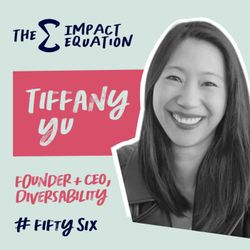
56. Tiffany Yu, Founder & CEO, Diversability
47:26||Season 1, Ep. 56In this episode, Rafi is joined by Tiffany Yu—a fierce disability advocate, entrepreneur, and changemaker whose work is reshaping how the world understands disability. As the founder and CEO of Diversability, Tiffany has built a thriving global community empowering disabled voices and fostering real inclusion. From a life-changing injury in her childhood to becoming a powerful force on the global stage, including speaking at the World Economic Forum and authoring the groundbreaking book "The Anti-Ableist Manifesto," Tiffany’s journey is one of resilience, vision, and transformative impact. In this episode, we’ll hear how she’s smashing stereotypes, forging change, and challenging us all to build a disability-inclusive world. Check out her book here: https://amzn.to/4qeCFKi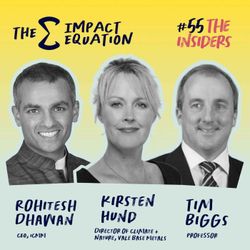
55. Can responsible mining accelerate the clean energy transition?
51:22||Season 1, Ep. 55This episode on The Impact Equation, we dive into one of the biggest tensions of the clean energy transition: the world wants an affordable, renewable future - yet achieving it requires a massive increase in critical minerals like copper, lithium, nickel and cobalt. So how do we mine what we need responsibly, safely and sustainably?To explore this, we bring together Ro Dhawan (CEO, ICMM), Kirsten Hund (Director of Climate & Nature, Vale Base Metals), and Professor Tim Biggs (Camborne School of Mines). We discuss why the energy transition is impossible without new mines, the trade-offs around coal and critical minerals, the innovations reshaping the sector, the rise of nature-based and “circular” mining, and why trust and social licence will ultimately decide the industry's future. A challenging, timely, and essential conversation for anyone who cares about climate, energy or the materials that underpin modern life.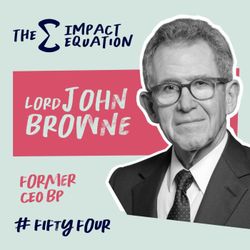
54. Lord John Browne: From BP to investing in the energy transition
45:19||Season 1, Ep. 54Lord John Browne was born just after the war in Hamburg to a Hungarian mother who survived Auschwitz and a British father who was a professional soldier. His parents met because his father needed an interpreter; she spoke six languages because, as she said, “in Hungary no one spoke your language, so you learned many.” From that unlikely beginning came a child who travelled the world, was pushed into self-sufficiency, and absorbed the lessons of survival, resilience, and ambition. From that childhood, he rose from a university apprentice at BP to its Chief Executive - leading the mega-mergers that turned it into a global super-major. And in a defining moment, he became one of the very first oil CEOs to say publicly that climate change was real, urgent, and demanded action from his own industry. Long before “net zero” entered the mainstream, he acknowledged the scientific risks, committed BP to measuring and reducing its emissions, and put Beyond Petroleum on the map - a deeply controversial move at the time that forced competitors, regulators, and investors to rethink the role of big energy in the transition.Since leaving BP, Lord Browne has shifted from running hydrocarbons to funding the transition beyond them, co-founding BeyondNetZero to back high-growth companies in decarbonisation, efficiency, advanced materials, and climate technology.
53. Stephen Cowan, Leader of Hammersmith & Fulham Council
32:32||Season 1, Ep. 53This is our second live podcast at EdCity, with our friends at Ark. Stephen Cowan, Leader of the London Borough of Hammersmith & Fulham, has been a force in local public service since 1998, when he was first elected as councillor for Grove Ward. Since becoming Leader in 2014, he’s driven some of the most ambitious, people-centred policies anywhere in the UK - from free adult social care, to free breakfasts for every primary school child, to an industrial strategy that’s brought billions in investment into the borough. And where better to have this conversation than at EdCity - the £150 million regeneration project jointly shaped by Ark and H&F Council. EdCity blends new schools, affordable homes, community spaces and innovation hubs, standing as a living example of what bold public-third sector partnership can achieve. This is a fascinating, live, and candid conversation with a leader determined to change the world - starting with a small bit of West London.
52. Lucy Heller, CEO, Ark
30:09||Season 1, Ep. 52The first of two podcasts recorded live at EdCity. We kicked it off with an amazing guest, Lucy Heller, CEO of Ark and the architect behind one of the most influential education transformations in the UK. Ark began in 2002 with a bold ambition: change life chances for children who need it most. Under Lucy’s leadership, that ambition has become a movement — growing from a single turnaround school to 39 schools, 30,000+ pupils, and a network of 20+ ventures reshaping the wider education system.In this live conversation, we go into: Lucy’s unexpected path into education, the original spark behind Ark, what really drives school improvement, how Ark scaled impact across communities without losing its soul, and what the future of education looks like.