Latest episode
107. Alexis Normand: Making Carbon Accounting Accessible to Every Business
34:16||Season 1, Ep. 107Alexis Normand is the co-founder and CEO of Greenly, the Paris-based carbon management platform helping businesses measure and reduce their emissions. After starting his career in public policy and spending six years at health tech company Withings, Alexis turned his attention to climate and founded Greenly with the vision of making carbon accounting as accessible and scalable as financial accounting. Originally launched as a consumer app, Greenly pivoted to B2B and now serves businesses ranging from small and medium-sized companies to large enterprises, helping them track emissions across their operations and supply chains. In this episode, Alexis discusses why sustainability can be a profitability driver rather than simply a cost, how regulation and procurement are pushing carbon accounting down through supply chains, and how AI can simplify complex carbon data and give sustainability teams more time to focus on actual emissions reduction. He also shares his vision for Greenly to build a powerful network of supplier and product-level carbon data that could help businesses make more informed decisions and accelerate the transition to a lower-carbon economy.
More episodes
View all episodes
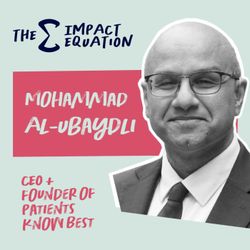
106. Mohammad Al-Ubaydli: Joining-up records of 15 million UK citizens
33:28||Season 1, Ep. 106Mohammad Al-Ubaydli is the founder and CEO of Patients Know Best (PKB), the personal health record platform that has crossed six million registered users in the UK and was the first Personal Health Record to integrate with the NHS App. He trained as a physician at Cambridge, worked as a staff scientist at the US National Institutes of Health, before founding Patients Know Best in 2008. He has written eight books on healthcare technology, and in 2012 was elected an Ashoka Fellow as a social entrepreneur. Mohammad lives with a rare disease, an experience that led him to conclude that patients, not institutions, should hold the canonical copy of their own health data. The platform now underpins joined-up records for more than fifteen million UK citizens, and is one of the few B Corp social enterprises operating at that scale inside the NHS.105.105. 105up
25:41||Season 1, Ep. 105.105
105. Schools Out, Foods Out
35:40||Season 1, Ep. 105Alison Walsh and Sophie Livingston lead two of London's most effective responses to child poverty. Alison is CEO of Food Bank Aid, a charity born in a double garage in Highgate in April 2020 that now supplies 33 food banks across North London and Hertfordshire, reaching around 20,000 people, including 5,000 children every week. Sophie is CEO of Little Village, London's largest baby bank network. Providing pre-loved clothes, kit, and connection to families with under fives. A serial social entrepreneur, Sophie was the founding CEO of City Year UK. She co-founded Generation Change, chairs the Baby Bank Alliance she helped to create in 2024, and chairs the End Child Poverty Coalition. Sophie was awarded an MBE in 2020.
104. Eye in the Sky: How Space Tech and AI Are Saving Earth’s Wildlife
44:44||Season 1, Ep. 104In this episode of The Impact Equation, host Rafi Addlestone explores how space technology, satellite imagery, and artificial intelligence are transforming wildlife protection. Joining the discussion are Hania Tabet (Airbus Foundation), Sophie Maxwell (Executive Director, Connected Conservation Foundation), and Japheth Akimel (Connected Conservation Foundation).The panel breaks down how high-resolution Earth observation—such as Airbus's Pleiades Neo constellation operating at 30 cm resolution—is replacing traditional binoculars to monitor habitats, predict animal movements, and protect species facing extinction. Through practical field examples ranging from tracking Andean bears in Peru to protecting the last 21 desert-adapted elephants in Namibia, the episode demonstrates why combining high-tech tools with local community leadership is essential for long-term coexistence and ecosystem resilience.
103. Remi Sobomehin: From Oregon to Stanford & Palo Alto
39:26||Season 1, Ep. 103Remi Sobomehin is the founder and CEO of Ambition Angels, a Palo Alto based non-profit that delivers career exposure and skill building to teenagers through an app and pays them to use it. Only about 11 % of teens go to after school programming, while more than 95 % own a smartphone and spend roughly eight hours a day on it. Rather than compete with the phone, Remi and his team have built his programme inside it. Remi grew up in Portland, Oregon. With his childhood friend, Demetrius Sanders, he set his sights on Stanford and got there eight years later. After graduating, he went to Palo Alto to lead after-school programmes at the boys and girls clubs and kept hitting the same wall. He couldn't get teens to walk through the door. Demetrius, meanwhile, had joined Facebook's team building product for teens, and could see exactly what was reaching them at scale. This is the next episode in our series with our friends with US-based Fast Forward, empowering people to build technology for humanity.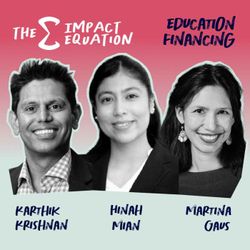
102. Education Financing Roundtable
41:16||Season 1, Ep. 102How do we solve a $97 billion global education funding shortfall when investments take decades to yield returns? In this episode of The Impact Equation, host Rafi Addlestone is joined by Karthik Krishnan (CEO of IFFEd), Hinah Mian (Jacobs Foundation), and Martina Gaus (UBS Optimus Foundation) to explore the innovative financial and pedagogical strategies needed to secure the future of global education. The guests dissect the structural barriers that often cause education to lose out to other sectors, showcase how a new guarantee model is turning every dollar invested into seven dollars of concessional financing, and discuss the critical need for evidence-based teaching that meets students at their specific competency levels. This conversation offers a masterclass on overcoming institutional hurdles to ensure that when it comes to philanthropic partnership, the sum is truly greater than its parts.