
Latest episode
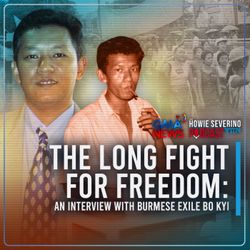
The Long Fight for Freedom — An Interview with Burmese exile Bo Kyi
01:10:05|"ASEAN countries need to support Burmese people, not to give legitimacy to the military regime." For Bo Kyi, a 2026 Ramon Magsaysay Awardee and longtime political prisoner, terminology matters. While international bodies like the United Nations and ASEAN officially use "Myanmar," Bo Kyi and fellow activists insist on calling their homeland Burma, rejecting the name imposed by the military regime. Since fleeing into exile in Thailand more than 25 years ago, Bo Kyi has tirelessly advocated for the release of an estimated 15,000 political prisoners in Burma. Receiving the prestigious Ramon Magsaysay Award in Manila on the eve of the ASEAN Summit proved to be a powerful stroke of timing, giving him a prominent global platform to spotlight the ongoing human rights crisis in his country. In an interview at the Magsaysay Center, journalist Howie Severino spoke with Bo Kyi about his seven years behind bars in Burma, where he taught himself English with the help of a professor and fellow prisoner. That prepared him for the global advocacy that would eventually earn him international recognition. Bo Kyi also shared a sobering update on Aung San Suu Kyi, the Nobel laureate and former Burmese leader who remains imprisoned by the junta. Beyond calling out regional ambivalence toward the military regime, Bo Kyi left Filipinos with a sharp reminder: guard your freedoms closely, because once lost, reclaiming them is an arduous struggle. Yet, even in the darkest confines of captivity, he imbibed an enduring truth — there is one freedom that no one can ever take away.
More episodes
View all episodes

The Godzilla El Niño—A Scientist-Pastor’s Guide to Climate, Faith, and Survival
45:44|It’s being called a "Godzilla" of extreme weather – a potentially record-breaking Super El Niño threatening severe drought, heat waves, and water shortages well into 2027.Preparing for this crisis requires more than short-term fixes, according to prominent Filipino environmental scientist Dr. Rodel D. Lasco. A pioneer in climate change research, he stresses the urgent need to pair nature-based solutions with individual responsibility in our daily consumption.Beyond his scientific work, Dr. Lasco is also a church pastor with a master’s degree in theology. From this rare intersection of faith and science, he joins Howie Severino to discuss how the principles of order in both disciplines help him find harmony in his lifelong commitment to environmental stewardship.
Dapat nga bang katakutan ang mga multo?
55:35|Ground-breaking psychologist and former Kapuso actor Carl Lorenz Cervantes unpacks the Filipino belief in the paranormal. Drawing on Sikolihiyang Pilipino, he explains how ‘kababalaghan’ bridges the visible and invisible worlds to help us understand ourselves, our ancestors, and our shared humanity or what we know as “kapwa.”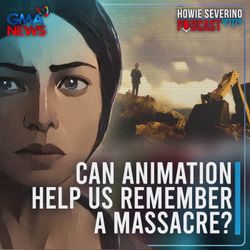
Can animation help us remember a massacre?
59:03|“‘Yun ang power ng animation. It gave life to the voiceless. Nabigyan namin sila ng itsura… ng boses ulit.” Director Carl Joseph Papa joins Howie Severino from the Busan International Film Festival in South Korea, where his groundbreaking animated documentary "58th" premiered. The film follows Reynafe Momay in her relentless search for closure for her father, photojournalist Reynaldo Momay — the officially missing 58th victim of the 2009 Maguindanao Massacre. A trained software engineer, Papa talks about his uncommon filmmaking journey and the deeply emotional toll of immersing himself in archives about the massacre. In this discussion, he explores how animation serves as a vital, empathetic medium to preserve a painful chapter of history and engage younger generations who may not have lived through it.
Barangay Elections postponed again; how will the Supreme Court Rule?
45:07|“Ipapabarangay kita.”The common neighborhood warning highlights the real authority at the most grassroots level of government. Barangays are not just community hubs; it is said their officials serve as vital foot soldiers in the political machinery of higher leaders.In this episode, analyst and professor Edmund Tayao talks to Howie Severino about how the postponement yet again of barangay elections may be connected to the high-stakes national elections.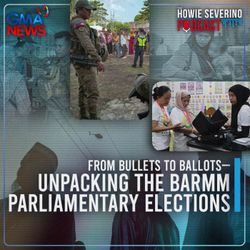
From Bullets to Ballots — Unpacking the BARMM parliamentary elections
41:00|“Napatunayan po nila na war, guns, is not the only option of attaining peace and development in our communities.” As the Bangsamoro Autonomous Region in Muslim Mindanao (BARMM) concludes its historic first parliamentary elections, the region marks a monumental shift from decades of armed conflict to an experiment in democratic self-determination. In this episode, Mindanao State University (Marawi) political science professor Dr. Zainal Kulidtod discusses with Howie Severino how this political project aims to regulate dynasties, dismantle private armies, and deliver good governance for lasting peace. Dr. Kulidtod also talks about his personal experience of growing up in a conflict zone before becoming a leading scholar of the peace process.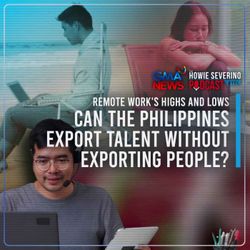
On remote work — Can the Philippines export talent without exporting people?
50:00|Being a virtual assistant (VA) is now the dream job for most Filipinos, according to a new Remitly study. As one of the growing professions in the remote work sector, VA work has given Filipinos greater access to international job opportunities.Across the Philippines, a growing workforce of remote professionals is serving overseas clients from laid-back hubs like Bohol and El Nido. But behind the flexibility lies a tough reality: social isolation, job insecurity, and zero employee benefits.In this episode, Howie Severino talks to Maria Sucgang, a millennial CEO pioneering a model that networks freelancers to provide the safety nets that foreign employers don’t give. They discuss the potential to keep talent in the provinces, reducing the need for foreign migration, and whether AI threatens the future of remote work.