The Green Steel Challenge
All Episodes
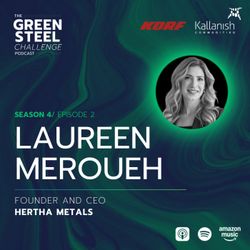
2. Turning low-grade iron ore into steel with Hertha Metals
41:59||Season 4, Ep. 2Iron ore resources in the US are mainly low-grade taconite-type ores that require beneficiation and agglomeration to make them commercially viable for steel production. As such, around 70% of the country’s steel production comes from scrap, while the rest is increasingly relying on imports.According to Laureen Meroueh, founder and CEO of Hertha Metals, there is another way. The Texas-based startup, which closed a $133.6 million Series A funding in September 2026, has developed a proprietary platform technology powered by natural gas, hydrogen, and electricity to enable steel production from any grade of iron ore or waste oxide, including fines and lumps.In this episode of The Green Steel Challenge, Laureen tells co-hosts Astrid Korf and James Moss about Hertha Metals’ plans for the future of reaching 2 million tonnes/year capacity. Delving deeper into how the technology works, she explains why the company decided to specialise in high-purity iron for rare earth magnets, one of the fastest-growing markets in the US as it decouples from the Chinese supply chain.Access our comprehensive Green Steel Glossary at Kallanish Commodities.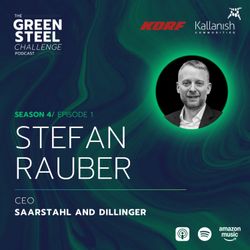
1. Is green steel economically viable? Inside Saarstahl’s €4.6 billion bet with Stefan Rauber
38:52||Season 4, Ep. 1The European steel industry is facing an existential crisis: energy prices are high, demand from key sectors is weak, and cheap imports are affecting competitiveness. How can decarbonisation go ahead in these challenging conditions?In the first episode of Season 4, we sit down with Stefan Rauber, CEO of Saarstahl and chairman of the SHS - Stahl-Holding-Saar GmbH & Co. KGaA group, which has embarked on a €4.6 billion programme to shift toward green steel by building two electric arc furnaces and a DRI plant, alongside increased use of hydrogen.In conversation with The Green Steel Challenge co-hosts, Astrid Korf and James Moss, Stefan talks through the company's decarbonisation plans and how it's leaning into its multi-century experience to build the steel industry of the future. The discussion covers European carbon policy, the green steel premium, decommissioning, and buyers' demand for low-carbon products, finding an answer to a difficult question: is it economically worth it?Access our comprehensive Green Steel Glossary at Kallanish Commodities.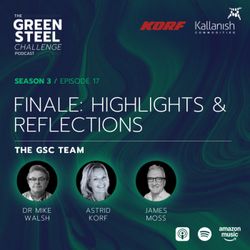
Season 3/Episode 17: The GSC Team
22:30|As season 3 of the Green Steel Challenge draws to an end, join Astrid, James and Mike as they reflect on the highlights.Since January, a lot of ground has been covered through an eclectic mix of industry perspectives, from Tata Steel’s view on electrification and wider system change, to geologic hydrogen with Koloma, advanced nuclear power with newcleo, and the growing strategic value of scrap in the steel transition.With insights from leaders at U. S. Steel, Vale, UK Steel and others, the second half of the season has examined the practical business strategies, policy choices, and technology pathways shaping the future of steel.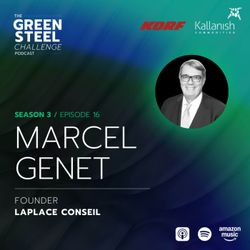
Season 3/Episode 16: Marcel Genet, Laplace Conseil
51:23|Marcel Genet, Independent Steel & Metals Consultant and Founder & Managing Director, Laplace Conseil in Neuilly, France. Marcel has been a consultant in the steel industry for 47 years, first with McKinsey & Company, where he built and led the Firm’s Global Steel Practice. 1995, he founded Laplace Conseil, a boutique strategy firm, where he has predominantly worked with the scrap recycling and EAF minimill sectors.
Season 3/Episode 15: Gareth Stace, UK Steel
51:52|Gareth Stace, Director General of UK Steel, the voice of the UK steel industry.Gareth represents producers at a critical moment, where competitiveness, energy costs, and decarbonisation are collidingFrom policy and trade to the realities of transitioning legacy assets, he sits right at the intersection of industry and government, helping shape what the future of British steel will look like.
Season 3/Episode 14: Dave Burritt, US Steel
43:19|Dave Burritt, President and CEO of US STEEL, one of the most iconic names in global steel.Under Dave’s leadership, U.S. Steel has gone through a fundamental transformation: reshaping its asset base, investing heavily in electric arc furnaces, and positioning itself for a lower-carbon future, while still operating some of the most demanding blast furnace assets in the world. And of course, he led the groundbreaking partnership between U. S. Steel and Japan’s Nippon Steel.Dave is known for being pragmatic rather than ideological when it comes to decarbonization. He talks about what can scale, what can be financed, and what can actually be delivered in today’s steel markets.
Season 3/Episode 13: Peter Kinzel, SMS Group
40:20|Peter Kinzel has a degree in chemical engineering and PhD in process engineering.Peter started his career at Paul Wurth (today SMS Group) in 1999, has been living for 11 years abroad in South America, Chile and Brazil enabling him to gain experience in several ferrous and non ferrous processes.Since 4 years Peter is working on reducing the CO2 footprint for the traditional BF/BOF route by introducing the BLUE blast furnace and EASyMelt concept. Fluent in 5 languages and having a strong process background. Participation in over 30 patent families as well as co author in many scientific publications.
Season 3/Episode 12: Stefano Buono, Newcleo
44:09|Our guest is Stefano Buono, physicist, entrepreneur, and CEO of Newcleo, a company developing next-generation reactors that run on recycled nuclear waste.We’ll dive into how advanced nuclear could provide clean, reliable power and heat for green steel – from hydrogen production to electrified plants – and what it would take to bring this from concept to reality over the next two decades.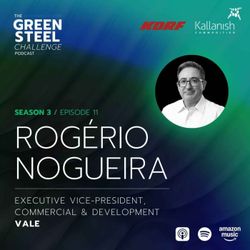
Season 3/Episode 11: Rogério Nogueira, Vale
46:55|We welcome from Brazil, Rogério Nogueira, Executive Vice President of Vale.Vale is one of the world’s largest producers of high-grade iron ore and nickel, headquartered in Brazil, with major operations across South America, Asia, and the Middle East. The company supplies a significant share of the global steel industry and plays a central role in the decarbonisation of iron and steel value chains.
loading...