
Latest episode
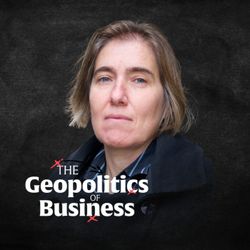
11. AI, energy and the fight for the future: Prof Helen Thompson
47:35||Season 4, Ep. 11Professor Helen Thompson is Professor of Political Economy at the University of Cambridge and the author of Disorder: Hard Times in the 21st Century. With the Iran conflict still unresolved, we hear how the battle for energy is redrawing the geopolitical map, and what it means for business leaders, investors and democracies. Drawing on her research into the political economy of energy, Professor Thompson explains why the energy shock from the Strait of Hormuz crisis is now a gas shock as much as an oil shock, and why she sees a geopolitical logic in US pressure where China has energy dependencies. She argues that AI competition is energy competition, and that Europe starts that race in real difficulty. The conversation explores the impact of high energy costs; US pressure on Venezuela, Iran and Greenland; China's strategic preparation and progress on electrification; Europe's rising dependence on US gas; the legal limits set by the Climate Change Act; the rise of privately built gas power for data centres, and why energy price shocks so quickly become democratic discontent. For business leaders, the core message is clear: energy is now a geopolitical, financial and political risk all at once, and public unhappiness about AI and the cost of energy cannot be ignored. Host: Sam Gyimah, Founder, The Geopolitics of Business Intelligence Producers: Clare Williamson and Duncan Williamson for TGOB Media Ltd Music composed by: Sophie Sirota Get in touch: info@thegeopoliticsofbusiness.com You can find a summary of the key points in this episode in The Geopolitics of Business Newsletter. Disclaimer: The content of this podcast is for informational purposes only and should not be considered or relied upon as financial, investment, legal or tax advice. While we seek to ensure the information shared is accurate and up to date at the time of release, no warranties or representations are made regarding its accuracy or completeness and any liability therefore is expressly disclaimed. The opinions and views expressed in this podcast are solely the participant's own personal opinions and do not reflect the opinions of The Geopolitics of Business Ltd. or SG&.
More episodes
View all episodes
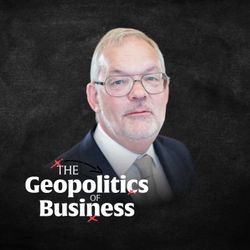
10. The Budget, The Bank and the AI Boom: Sir Charlie Bean
35:34||Season 4, Ep. 10The Budget, The Bank and the AI Boom: Sir Charlie Bean Hosted by Sam Gyimah Sir Charlie Bean is one of Britain's most influential macroeconomists and central bankers, a former Chief Economist and Deputy Governor of the Bank of England he’s now emeritus professor of economics at the London School of Economics. In this episode Sir Charlie sets out the state of the UK economy ahead of Chancellor Healey's first Budget and asks how a country with sluggish growth can pay for rising demands on the state. Drawing on experience at the Bank of England, the Office for Budget Responsibility and the LSE, Sir Charlie argues that geopolitics should be built into fiscal planning via greater resilience and fiscal space for shocks and outlines the inflation risks tied to energy prices and events in the Gulf. The conversation also explores the future direction of interest rates, the credibility of central banks in an age of populism and the potential of AI for the UK economy. Host: Sam Gyimah, Founder, The Geopolitics of Business Intelligence Producers: Clare Williamson and Duncan Williamson for TGOB Media Ltd. Music composed by: Sophie Sirota For listener questions or business inquiries please email info@thegeopoliticsofbusiness.com. You can find a summary of the key points in this episode in The Geopolitics of Business Newsletter on Linkedin. Disclaimer: The content of this podcast is for informational purposes only and should not be considered or relied upon as financial, investment, legal or tax advice. While we seek to ensure the information shared is accurate and up to date at the time of release, no warranties or representations are made regarding its accuracy or completeness and any liability therefore is expressly disclaimed. The opinions and views expressed in this podcast are solely the participant's own personal opinions and do not reflect the opinions of TGOB.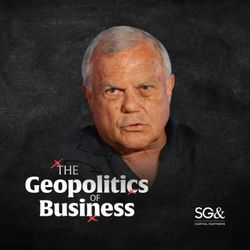
9. AI, advertising and global CEOs: Sir Martin Sorrell
53:29||Season 4, Ep. 9AI, advertising and global CEOs: Sir Martin Sorrell Hosted by Sam Gyimah Sir Martin Sorrell built WPP into one of the world's largest advertising conglomerates before stepping down to found S4 Capital. His model was digital-first and data-driven from day one, and eight years on the company generates roughly $1 billion in revenue. In this conversation he brings that vantage point to bear on the most pressing question facing every global business today: how do you navigate a world shaped by AI, geopolitical fragmentation, and the slow death of the business models that defined the last 40 years? Drawing on decades of operating at the intersection of commerce and politics, Sir Martin explains why AI adoption inside companies is far slower than the technology itself warrants – and why the pressure to change will intensify sharply. He argues that the traditional advertising agency model, is already obsolete: becuase AI collapses the cost and time of production, forcing a shift to output-based pricing that the major holding companies are ill-prepared for. The conversation ranges across the $5 trillion CapEx gamble being made by the four hyperscalers, the selective globalisation imperative for businesses operating in a world of immutable US-China, Russia, and Iran tensions, and Sir Martin's bullish views on South America, India, and China as the growth markets of the next decade. On Taiwan, he is characteristically direct: Xi will squeeze, not invade. On the UK and Prime Minister, Andy Burnham, he is wary – worried that style is running ahead of substance. For business leaders the core message is clear: the world will grow more slowly, inflation will stay higher than central banks would like, and AI will widen inequality. In that environment, efficiency and geographic selectivity are not optional – they are the only viable strategy. Host: Sam Gyimah, Founder and CEO of SG& Capital Partners Producers: Clare Williamson and Duncan Williamson for TGOB Media Ltd in partnership with SG& Capital Partners Ltd. Music composed by: Sophie Sirota For listener questions or business inquiries please email info@thegeopoliticsofbusiness.com, and to contact SG& Capital Partners please email info@sgand.com. You can find a summary of the key points in this episode in The Geopolitics of Business Newsletter. Disclaimer: The content of this podcast is for informational purposes only and should not be considered or relied upon as financial, investment, legal or tax advice. While we seek to ensure the information shared is accurate and up to date at the time of release, no warranties or representations are made regarding its accuracy or completeness and any liability therefore is expressly disclaimed. The opinions and views expressed in this podcast are solely the participant's own personal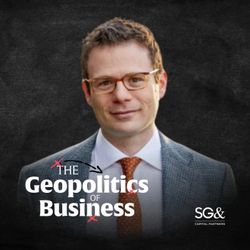
8. Conflict, capital and the new rules of economic warfare: Edward Fishman
38:42||Season 4, Ep. 8Conflict, capital and the new rules of economic warfare: Edward Fishman Hosted by Sam Gyimah Edward Fishman is the New York Times bestselling author of Choke Points and one of the world's foremost experts on economic warfare. He served in the US State Department under President Obama, designing the landmark sanctions imposed on Russia and Iran, and has spent the last decade mapping how choke points — both geographic and economic — have become the primary instrument of power in the global order. Sam Gyimah speaks with him about what this means for businesses, investors and governments navigating a world in which the rules of economic engagement have been fundamentally rewritten. Drawing on his experience at the State Department and in subsequent research, Fishman explains why economic warfare has undergone a revolution: where imposing hard economic pain once required a naval blockade, today a single presidential signature can impose crippling pressure on any country in the world. He argues that three conditions — dominant market share, difficulty of substitution, and asymmetric effect — must all be present for a choke point to function as a true weapon, and that understanding these criteria is now essential for every board and investment committee. The conversation explores the geography of power from the Strait of Hormuz to semiconductor supply chains, the strategic calculation of middle powers like the UK and Europe as they seek leverage of their own, what genuine sovereignty means in a world of concentrated dependencies, and how businesses should map both the headwinds and the tailwinds that choke points create. For business leaders, the core message is clear: geoeconomic analysis can no longer be confined to the dinner speech or the quarterly board update. Understanding your choke point exposure, as both a risk and an opportunity, is now a continuous operational imperative. Host: Sam Gyimah, Founder and CEO of SG& Capital Partners Producers: Clare Williamson and Duncan Williamson for TGOB Media Ltd in partnership with SG& Capital Partners Ltd. Music composed by: Sophie Sirota For listener questions or business inquiries please email info@thegeopoliticsofbusiness.com, and to contact SG& Capital Partners please email info@sgand.com. You can find a summary of the key points in this episode in The Geopolitics of Business Newsletter. Disclaimer: The content of this podcast is for informational purposes only and should not be considered or relied upon as financial, investment, legal or tax advice. While we seek to ensure the information shared is accurate and up to date at the time of release, no warranties or representations are made regarding its accuracy or completeness and any liability therefore is expressly disclaimed. The opinions and views expressed in this podcast are solely the participant's own personal opinions and do not reflect the opinions of SG&.
7. AI, Competition and China’s Next Era: Nick Leung
39:02||Season 4, Ep. 7Nick Leung is the former Chairman of McKinsey's Greater China operation and Director of the McKinsey Global Institute in Hong Kong. With dual Swiss-Chinese heritage and three decades advising Chinese and multinational companies, he brings a rare inside-out perspective on the world's second-largest economy. His new book, co-authored with Joe Ngai, is The Next China is Still China — and in this conversation, he explains exactly why the title is not simply a slogan. Drawing on his experience at the centre of China's extraordinary economic transformation, Leung argues that the search for the "next China" fundamentally misunderstands the nature of China's role in the global system. Nine out of ten things made in China stay in China: the country is not simply an export platform but the world's most dynamic consumer market, and its combination of scale, supply-chain depth and brutal domestic competition has forged genuinely world-class industries in electric vehicles, pharmaceuticals and robotics. He argues that this competitive intensity — what he calls the Hunger Games model, where thousands of companies enter a sector and most are destroyed — is Schumpeter's creative destruction operating at a speed and scale the world has not previously seen. The conversation explores the concept of involution and what it means for investors, why the US-China AI race is not a race at all but two distinct ecosystems pursuing fundamentally different objectives, the structural reasons multinationals are struggling in China and what the successful ones are doing differently, and the succession wave now bearing down on Chinese family businesses — a risk that, because the Chinese economic miracle happened all at once, is arriving across multiple major companies simultaneously. For business leaders, the core message is clear: China is not a market you can read from the outside, and geopolitics cannot be treated as someone else's problem. As Leung puts it — "You're not interested in geopolitics, but geopolitics is interested in you" — and that, he says, applies to every single decision-maker operating in the world today. Host: Sam Gyimah, Founder and CEO of SG& Capital Partners Producers: Clare Williamson and Duncan Williamson for TGOB Media Ltd in partnership with SG& Capital Partners Ltd. Music composed by: Sophie Sirota For listener questions or business inquiries please email info@thegeopoliticsofbusiness.com, and to contact SG& Capital Partners please email info@sgand.com. Disclaimer: The content of this podcast is for informational purposes only and should not be considered or relied upon as financial, investment, legal or tax advice. While we seek to ensure the information shared is accurate and up to date at the time of release, no warranties or representations are made regarding its accuracy or completeness and any liability therefore is expressly disclaimed. The opinions and views expressed in this podcast are solely the participant’s own personal opinions and do not reflect the opinions of SG&.
6. Financing Ukraine’s war economy: Mikael Björknert, Group CEO, PrivatBank
42:16||Season 4, Ep. 6In this episode Mikael Björknert, CEO of PrivatBank, joins Sam to discuss what it means to run Ukraine’s largest bank during a full-scale war. As head of the country’s largest state-owned bank, Mikael offers a rare front-line perspective on how financial infrastructure, operational resilience and national security have become inseparable in wartime Ukraine. The conversation covers how wartime conditions have forced a level of speed and adaptability on the bank that outpaces many Western organisations and also examines Ukraine’s wider economic trajectory, from the rise of the drone economy and the role of international investors to PrivatBank’s eventual privatisation as part of the country’s EU accession path. Mikael reflects on the resilience of Ukrainian entrepreneurs, the bank’s work supporting veterans and why investors waiting for complete stability may find that the real opportunity has already passed. Host: Sam Gyimah, Founder and CEO of SG& Capital Partners Producers: Clare Williamson and Duncan Williamson for TGOB Intelligence Ltd in partnership with SG& Capital Partners Ltd. Music composed by: Sophie Sirota For listener questions or business inquiries please email info@thegeopoliticsofbusiness.com, and to contact SG& Capital Partners please email info@sgand.com. You can find a summary of the key points in this episode in The Geopolitics of Business Newsletter. Disclaimer: The content of this podcast is for informational purposes only and should not be considered or relied upon as financial, investment, legal or tax advice. While we seek to ensure the information shared is accurate and up to date at the time of release, no warranties or representations are made regarding its accuracy or completeness and any liability therefore is expressly disclaimed. The opinions and views expressed in this podcast are solely the participant’s own personal opinions and do not reflect the opinions of SG&.
5. SpaceX, technological sovereignty and the American Dream: Anthony Scaramucci
54:52||Season 4, Ep. 5In this episode, Sam Gyimah speaks with Anthony Scaramucci — founder of SkyBridge Capital, co-host of The Rest Is Politics: USA, and former White House Communications Director. Ahead of the SpaceX IPO, Anthony explores what the rise of the commercial space economy, the concentration of tech power, and the evolution of digital assets mean for business and investors. He reflects with Sam on the risks and rewards of investing in space, the state of US capitalism, and the strategic importance of the American public-private innovation model. The conversation also examines the K-shaped economy, the narrowing of the American Dream, and the growing influence of major technology platforms on markets and policy. Scaramucci also sets out his view on crypto and the role blockchain-based assets could play in the future of finance. Host: Sam Gyimah, Founder and CEO of SG& Capital Partners Producers: Clare Williamson and Duncan Williamson for TGOB Media Ltd in partnership with SG& Capital Partners Ltd. Music composed by: Sophie Sirota For listener questions or business inquiries please email info@thegeopoliticsofbusiness.com, and to contact SG& Capital Partners please email info@sgand.com. You can find a summary of the key points in this episode in The Geopolitics of Business Newsletter. Disclaimer: The content of this podcast is for informational purposes only and should not be considered or relied upon as financial, investment, legal or tax advice. While we seek to ensure the information shared is accurate and up to date at the time of release, no warranties or representations are made regarding its accuracy or completeness and any liability therefore is expressly disclaimed. The opinions and views expressed in this podcast are solely the participant’s own personal opinions and do not reflect the opinions of SG&.