Share
The Diplomat's Cabinet
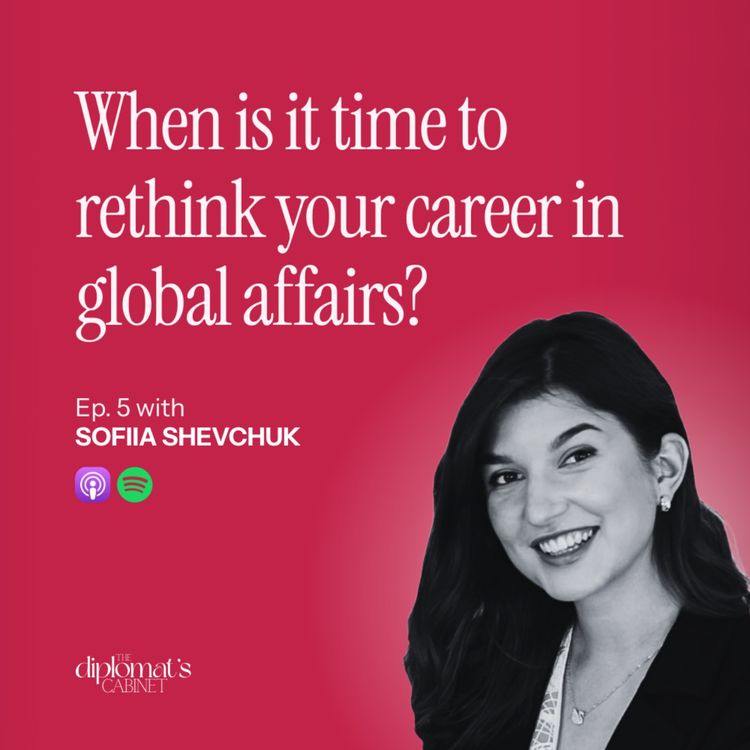
When is it time to rethink your career in global affairs? with Sofiia Shevchuk
•
What happens when the traditional path through foreign affairs institutions stops making sense? Sofiia Shevchuk, the Ukrainian founder of the consultancy VONA and the NGO The Tide, talks with host Maria Luísa Moreira about walking away from NATO and the European Parliament to build something of her own, what a genuinely non-linear career in international relations looks like in practice, and why the freedom of working outside institutions can be worth the uncertainty it brings. A candid conversation for anyone questioning the career path they were told to follow.
The Diplomat's Cabinet: thediplomatscabinet.com · thediplomatscabinet.substack.com · instagram.com/diplomatscabinet · linkedin.com/in/marialuisamoreira
More episodes
View all episodes
Why does AI development leave so many people behind? with Julia Stamm
26:09|Julia Stamm, founder of She Shapes AI, joins host Maria Luísa Moreira to talk about the trust gap most governments are still ignoring, what biased AI systems cost in concrete, measurable terms, and the economic case for building inclusion into technology development from the start, rather than retrofitting it later. A conversation on who gets a say in shaping the systems increasingly shaping all of us.
What do NATO’s silences reveal about Europe’s security future? with Marta Mucznik
26:44|Behind every NATO summit's declarations of unity, the real story often lies in what goes unsaid. Marta Mucznik, senior EU analyst at the International Crisis Group, joins host Maria Luísa Moreira to unpack what the Hague summit left unresolved: looming U.S. troop reductions, Europe's uneven defence spending, Ukraine's elusive security guarantees, and the quiet rise of ad-hoc coalitions of the willing. A conversation on what these silences are shaping for the future of European security and the transatlantic alliance.
Who gets to redefine a more inclusive foreign policy? with Ambika Vishwanath
30:09|Ambika Vishwanath, founder director of the Kubernein Initiative and a DFAT-funded research fellow at La Trobe Asia, joins host Maria Luísa Moreira to examine feminist foreign policy's unfinished promise and the alternative approach India has taken, one that is deliberately inclusive in practice without adopting the label. The conversation looks at the limits of exporting global frameworks without local adaptation, and at why a foreign policy approach built around the people who designed it, rather than around durable institutions, struggles to survive once those people move on.
Is strategic foresight the EU's missing superpower? with Ricardo Borges de Castro
31:20|Ricardo Borges de Castro, EU affairs analyst and foresight expert, joins host Maria Luísa Moreira to explain what strategic foresight is actually for, and why democracies so consistently struggle to plan beyond the next crisis. The conversation covers why permacrisis stopped being a useful buzzword some time ago, why foresight exercises fail without real political translation into policy, and how Brussels could use its existing mandate to take long-term thinking seriously instead of treating it as an afterthought.
What happens when masculinity meets economic precarity? with Javier Carbonell
27:21|Across Europe, growing numbers of young men are drawn to anti-feminist and far-right political narratives, and the reasons are as much economic as cultural. Javier Carbonell, policy analyst at the European Policy Centre, joins host Maria Luísa Moreira to unpack his research on the collapse of the traditional provider role, rising job insecurity and downward mobility, and how that economic frustration gets channelled into politics, often at progressive movements' expense. A conversation on what happens to democratic coalitions when economic anxiety finds a political home on the far right.
Could the 2025 NATO Summit be a turning point for Article 5? with Luka Ignac
22:21|Ahead of the 2025 NATO summit in The Hague, with President Trump in attendance, long-standing questions about the alliance's core guarantee were gaining new urgency. Foreign policy analyst Luka Ignac joins host Maria Luísa Moreira to discuss the political mood heading into the summit, what a push for five percent defence spending really signals, and the risk of a two-tier alliance emerging if U.S. security guarantees become more conditional. A conversation on what it would mean for Europe to actually be ready to stand on its own.
Why do political elites fail on climate policy? with Dr. António Valentim | The Power Diplomat
14:16|Extreme weather keeps intensifying, yet mainstream political parties still hesitate to name climate change as the cause, let alone build it into their platforms. António Valentim, political scientist and assistant professor at the London School of Economics, joins host Maria Luísa Moreira to explain why climate shocks so rarely translate into lasting political shifts, why prevention remains a hard sell to voters, and what it would actually take for public opinion and activism to force the issue onto the agenda before the next crisis arrives.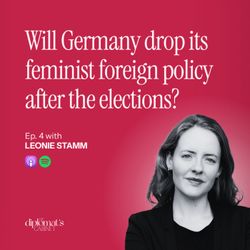
Will Germany drop its feminist foreign policy? with Leonie Stamm
22:51|When Germany's 2025 coalition agreement was published, one striking detail was what it left out: feminist foreign policy, a framework the previous government had built into its diplomatic strategy, disappeared from the text entirely. Leonie Stamm, research fellow at the German Council on Foreign Relations, joins host Maria Luísa Moreira to ask what that omission signals in the current political climate, whether individual ministries will keep pursuing the framework quietly, and how fragile equality-focused foreign policy commitments become once war and rearmament dominate the EU affairs agenda.