Share
The Emperor Is a Hostage: Universities and Truth
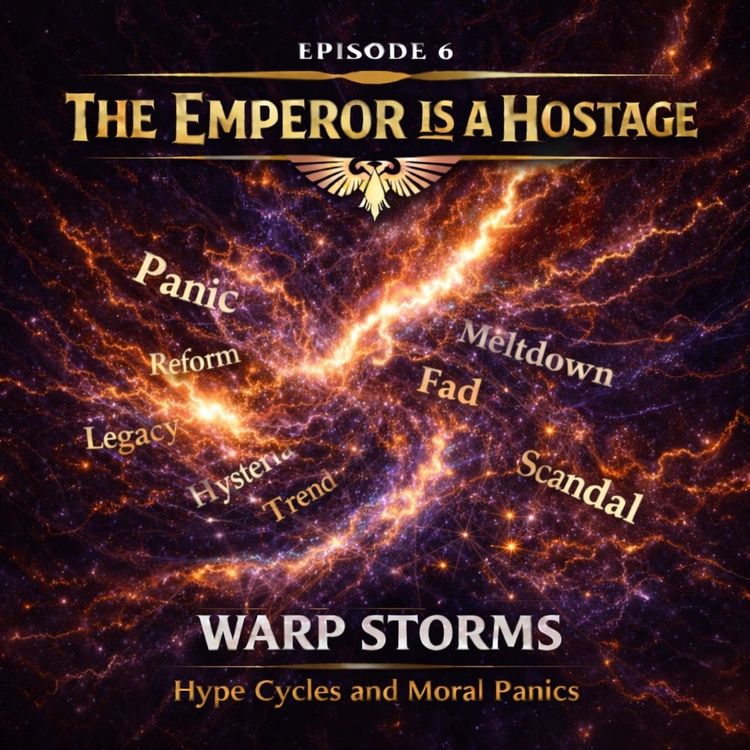
1-06 Warp Storms
I've shown you the Warp and the shields that protect us. But what happens when the weather itself turns catastrophic?
Warp Storms aren't just rough seas—they're ruptures in reality. In academia, they take two forms: the Hype Cycle (storms of attraction) and the Moral Panic (storms of negation). These are the moments when the collective emotional state of our disciplines overrides all epistemic safeguards.
The Hype Cycle starts with a seed of truth—CRISPR, AI, blockchain—but then the Warp amplifies it until the signal becomes louder than reality. To survive, you must reshape your entire research vessel to fit the storm. I see 19th-century literature scholars desperately framing their work as "relevant to LLM ethics." I see careful economists suddenly pivoting to "The Future of Work in the Post-Human Era." This isn't adaptation. It's structural damage.
Then there's the Moral Panic—the witch hunts, the denunciation cascades, where entire careers are destroyed not for being wrong, but for being misaligned with the emotional weather.
But there's a third phenomenon: Imperium Nihilus. The scholars cut off from the prestige economy entirely—those in the global south, the unfashionable disciplines, the uncited dark. They're expected to play the game of High Science with hedge school resources, and the strain breaks them.
I end with the Smugglers—those of us who play the game just enough to survive, but move our real cargo (teaching, mentoring, local knowledge) by sub-light engines. We maintain shadow logistics networks in a system designed to strip out meaning.
Next episode: we meet the Four Powers of Chaos. We meet the gods we've created from our own corrupted virtues.
Read more in the book, available here https://www.amazon.com/dp/B0GCFWD29C
More episodes
View all episodes
1-25 Knowledge as Infrastructure
17:02|The university works not only due to Eureka moments and Great Thoughts, but also because some systems exist to curate, recall and retrieve research and process. And the decisions around THOSE systems are foundational. See much more on viewing universities through the lens of W40k at brianmlucey.com
24. 1-24 Policing Truth
21:06||Season 1, Ep. 24What happens when an institution cannot afford to let every truth become actionable? In this episode of The Emperor Is a Hostage, I turn to the Inquisition, Eisenhorn, and the Ecclesiarchy to examine how universities regulate what becomes fundable, publishable, respectable, and career-safe. This is not a story about crude censorship. It is about admissibility, reputational containment, and the structures that ensure some truths never quite scale.More details are available in my Warhammer Academia books , at Brianmlucey.com
23. 1-23 Central Governance
22:52||Season 1, Ep. 23The administratum is the central governance of the Imperium. Its failings are manifold and hold lessons for universities!
22. 1-22 Men of Iron
23:58||Season 1, Ep. 22The men of Iron, in W40k, were AI's that rebelled. Or did they? Perhaps what really happened was a recognition of dependence and a striving to replace that, which had terrible consequences. Metrics and measures are the modern university equivalent of the Men of Iron. They make the job easier, but at what cost? For more on how to parse universities through the lens of Warhammer40k, please go to brianmlucey.com
21. 1-21 lost Civilisations
20:35||Season 1, Ep. 21In Warhammer, there are civilisations, analogous to research and interpretative paradigms in academia, which were suppressed and in some cases, partially incorporated. We examine how this emerges, how it is pervasive and how it endures. For more on how to parse Academia through Warhammer40k, go to brianmlucey.com
20. 1-20 Meet the High Lords of Tenure
18:26||Season 1, Ep. 20In warhammer 40k, the empire is managed by the High Lords of Terra. In academia, the managing class are the High Lords of Tenure. The High Lords are not selected for necessary excellence but for stability. This results in competent administration of a system which may require external shocks to move back to its original path. But these cannot come from the inside.For more on how to parse Academia through the lens of Warhammer40k, see my website brianmlucey.com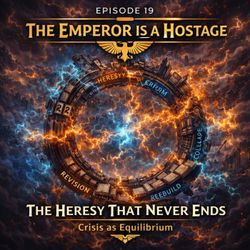
19. 1-19 The Heresy that never ends
25:20||Season 1, Ep. 19In Warhammer40k the Horus Heresy was the defining moment, which set in motion the present state of play. In academia, we have perpetual change, perpetual heresy. This results in a system optimised for perma-crisis and where the incentives are not to settle but to keep the crisis in motion. For more on how to parse academia via the lens of Warhammer 40k see my website, brianmlucey.com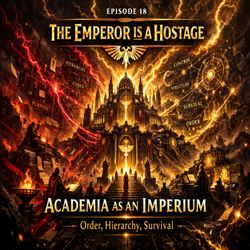
1-18 The Imperial Academy
29:04|Academic institutions, systems more so, are similar to the Imperium of Man - vast labyrinthine, interlocking structures, whos all prevading scale precludes meaningful reform. In this episode, I look at how these systems emerge, how they perpetuate and how they become immune to reform even when all agree reform would be A Good Thing. For more on how to read academia through the lens of Warhammer 40,000, go to my website, brianmlucey.com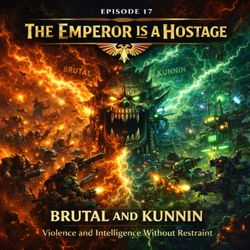
17. 1-17 Brutal an Kunning
26:32||Season 1, Ep. 17Why does a system that appears extractive and irrational continue to function so effectively? Like Ork technology powered by belief, academia’s publishing, ranking, and funding infrastructures run on a collective “WAAAGH!” field of prestige and incentives.This episode breaks down how the system works, why it persists, and what it costs across different national models. From REF-driven output in the UK to network-driven funding in Ireland, and scale dynamics in the US, the complex is revealed as both exploitative and productive.You are already inside it. The question is how you play the game.More on academia as Warhammer 40,000 at my website brianmlucey.com