Share
the Curb
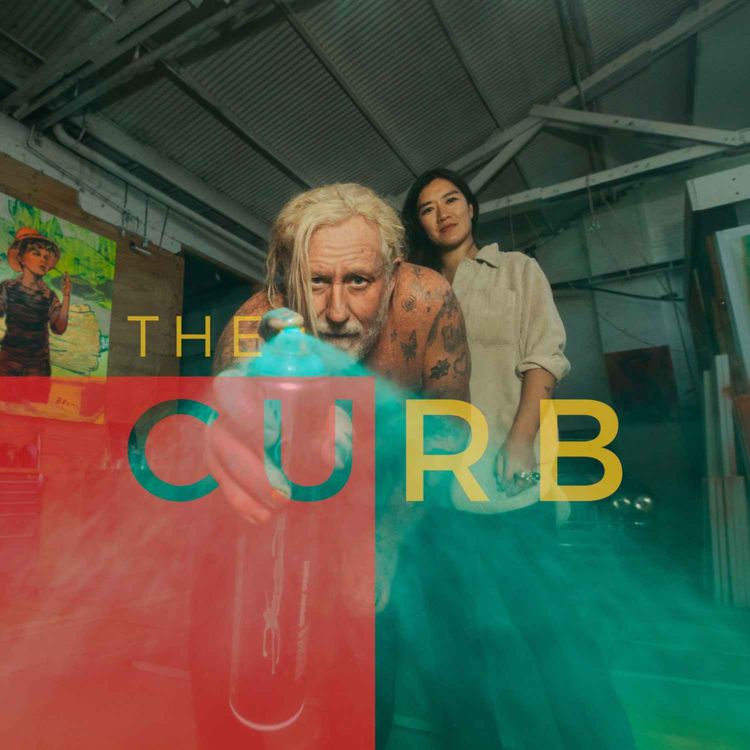
Bromley: Light After Dark - David & Yuge Bromley and Director Sean McDonald Chat About Creating a Space for Open Vulnerability in This Interview
Every so often a presence swirls into our lives in an unexpected manner and changes it just a little bit. For many Australians, whether they be wealthy or not-so-wealthy, that presence is David Bromley. Here is a celebrated artist whose work features on the walls of galleries and private art collectors, while the same artwork adorns cologne labels, reusable water bottles, and more.
As mentioned in Sean McDonald's raucous and energetic documentary Bromley: Light After Dark, in Australian cinemas from today, David's work gives people hope, and hope is not something that should be restrained for those who want to access it by how much money is in your bank account. What this means for Bromley as an artist is that his work is everywhere. His critics would say he's overproduced and mass marketed, while his supporters - myself being one of them - would say that he's making high art accessible to all.
Either way you look at it, a David Bromley art piece is a slice of his personality, and through Bromley: Light After Dark that we get to see that personality writ large on the cinema screen. Here is a person that's larger than life, full of energy, and supported by a loving family who champion his work and give his mind the space to be what it is: an ever roaming, occasionally anxious, place of darkness that, thanks to a wealth of soul-searching and self-realisation, has been splashed with enough bright paint that it has become a source of lightness and joy. It is, quite simply, the light after dark.
There's an openness and a frankness to David Bromley as a person that encourages people in his orbit - and that includes the audience watching this documentary - to feel ok about sharing who they are as people. Watching Bromley: Light After Dark made my partner and I feel seen in an way that precious few films have made us feel. In one sequence, David and his wife Yuge drive a roller over his artwork to create a weathered aesthetic. It's one of the many moments that show creativity let loose. It's bloody energetic and entertaining, and it's done by two people who love and support each other in their creative endeavours.
Thanks to the work that I do with The Curb, I get to chat or write about the plentiful creative minds that exist within Australia. I'm always in awe of their creative spirit, and how people manage to express themselves in a country that sometimes wilfully rejects creativity. For creative souls, there is a need to pour yourself into your work, and that need comes with a wealth of vulnerability. Allowing the melding of a creative mind like a documentarian to play with that vulernability amplifies that openness even more. It's that line of questioning which I put forward to Sean McDonald, David and Yuge Bromley in the following interview.
As you'll hear, giving David a brief questions opens up a well of ideas and possibly responses. There is a level of generosity that comes with his answers, and I'm grateful that I was able to discuss his work with him.
The following interview was recorded on the day of the Optus outage, so there are some occasional audio blips, but the essence of the discussion is still there. I begin by talking about the film with Sean, followed by the arrival of David who brings his own perspectives.
Bromley: Light After Dark is cinemas from today and deserves to be seen on the big screen. To listen to previous interviews, visit TheCurb.com.au.
Sign up for the latest interviews, reviews, and more via https://www.thecurb.com.au/subscribe/
More episodes
View all episodes
10. Floodland director Jordan Giusti & producer Rachel Forbes on capturing the fate of Lismore on screen
41:35||Season 21, Ep. 10Filmmaker Jordan Giusti's Floodland is an impactful documentary that takes audiences to the flood-prone landscape of Lismore, NSW. Thousands of people call the region home, and yet, due to the climate crisis and government inaction, they find themselves in horrifying situations where their homes are swept away, they lose friends and family, and pets and livestock end up as collateral damage for an ongoing emergency that has no solution in sight. Resilience is a word that's used for those who call Lismore home, the flood capital of Australia, but Jordan's documentary shows that there is a way to solve this crisis.Shot with an immediacy and the level of compassion and understanding that elevates the crisis at hand, Floodland is a powerful document for the region, the people who call it home, and their future.The following interview sees Nadine Whitney, someone who lived in the region, interview Jordan and producer Rachel Forbes about making the film. This interview was recorded ahead of the films screenings at the Sydney Film Festival, and is being published now ahead of Floodland's release around Australia this week.For screening dates and information, visit Floodland.com.au.
11. Sophie Hyde and Aud Mason-Hyde on the queer kaleidoscope that is their stunning film Jimpa
22:51||Season 22, Ep. 11Sophie Hyde's films have often explored identity, self-realisation, and the path to finding your place in this messy, mucked up world. 52 Tuesdays sees a child growing to understand the gender transition that one of her parents is going through, while Good Luck to You, Leo Grande sees Emma Thompson's 55-year-old Nancy reclaim her sexuality.In Jimpa, Sophie's finest and most mature film yet, we follow Aud Mason-Hyde's Frances, child to Olivia Colman's Hannah and Daniel Henshall's Harry. Frances is finding their place in the world as a nonbinary queer kid, eager to push out of the restrictive boundaries of Adelaide and engage with queer culture that they feel part of and as if they can grow within. A trip to Amsterdam to meet Hannah's father, Jim (John Lithgow), has Frances feeling that his proudly gay lifestyle and advocacy for gay rights would make for a suitable place for them to spend a gap year, growing, learning, and studying.In the following interview with Sophie and Aud, we talk about that kaleidoscopic nature of the film, what it's like to grow up with a parent like Sophie Hyde, and finally, what it's like to have a story captured on screen by the stunning cinematography of Matthew Chuang.the Curb is a completely independent and ad free website that lives on the support of listeners and readers just like you. Visit our subscription page where you can support our work from $2 a month. Paid subscribers get access to our monthly competitions, exclusive interviews and articles, and more. Follow us on Instagram, Facebook, and Bluesky.
9. Haydn Green on ten years of Hear My Eyes and conjuring sensory experiences by combining films with new live music compositions
34:49||Season 21, Ep. 9Haydn Green has been the creative force of Hear My Eyes, a sonic-visual, hybrid experience which blends film and music in creatively intriguing and boundary pushing ways. As the founder and artistic director of Hear My Eyes, Haydn reaches out to contemporary musicians to craft new scores for pre-existing cinema.Collaborations include Sampa the Great rescoring Céline Sciamma's Girlhood, The Murlocs putting their spin on Gregor Jordan's Two Hands, while Springtime and Mick Harvey explored a new sonic landscape for Andrew Dominik's Chopper.For its tenth anniversary, Haydn Green has tapped Belgian electronic musician Peter Van Hoesen, powered by the Melbourne Electronic Sound Studio, to reimagine the music of James Cameron's iconic sci-fi classic, Terminator 2: Judgment Day (the original theatrical cut).Visit HearMyEyes.com.au for all tickets to the screenings taking place on the below dates:Melbourne: Feb 25-28, Hamer HallSydney: March 7, City Recital HallCanberra: March 18-19, Canberra Theatre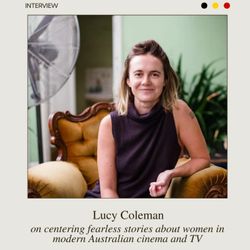
8. Lucy Coleman on centering fearless stories about women in modern Australian cinema and TV
01:41:02||Season 21, Ep. 8This interview has been a long while in the can, waiting to be published. This in depth discussion with filmmaker, creative, and fearless storyteller Lucy Coleman was recorded early in 2025 and due to reasons you'll hear in the long intro (recorded in the foyer of Luna Cinemas Leederville, a home away from home), it's now finally being released into the world.Lucy Coleman is the creative vision behind films like Hot Mess and Lean In, both featured in the best films list of their respective years, with Hot Mess getting a mention in the Best Aussie Films of the 2010s list. These are biting, searing comedies that tear apart what we think Australian comedy can or should be. Then, there's Lucy's Stan. series Exposure, a change of pace, a drama which she wrote. This powerful series follows Alice Englert's Jacs Gould as a photographer returning home to find out why her best friend took her life. It's powerful, but also flips the script of the routine and tired 'cop returns to his country town home to solve a murder that he discovers is linked to him'. It's always a man solving these crimes. Always small town. Exposure changes that: it's not a murder, but a suicide. It's not a woman trying to figure out what's happening, but a friend, a very close one at that. It's a devastating series that left me hollowed out by its end. Exposure, like Hot Mess and Lean In, is an experience which lingers in my mind, changing how I see the next film or TV show that I watch. This interview, like those works, hasn't left me. And now, I'm releasing it into the world. Enjoy. Thank you Lucy for your patience with me getting this into the world.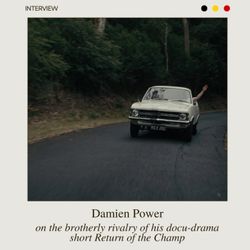
7. Damien Power on the brotherly rivalry of his docu-drama short Return of the Champ
30:52||Season 21, Ep. 7One of the standout films from the 2026 batch of Flickerfest shorts has been Damien Power's docu-drama Return of the Champ. With this excellent hybrid experience, the stand up comedian turned director spins the cameras on his relationship with his brother, Will Power, a world champion and Indy 500 winner, who spins a story about a crash that he once witnessed. It's a story that Damien hadn't heard before, and within Return of the Champ he utilises that story to explore sibling rivalry, masculinity, and what it means to be vulnerable or open with one another.If I'm painting the film to be a deep experience, the rest assured, it definitely is. What Damien has crafted here is something that will stick with me for quite a while, with the resulting film creating a fascinating and memorable nexus points of the quiet space of ocker comedy, reserved masculinity, loud cars, laughter at stand up comedy gigs, and frustration about fathers. There's a lot going on under the hood of this flick, with the film simmering along at a neat 18-minutes and creating a lasting impact. Amplifying the vibe of the film is cinematography by Julian Panetta which is both immersive and observational in tone, pulling viewers into the Power's brothers world. Equally amplifying the tone is the score by Adrian Diery which adds a rather chill and contemplative backdrop to the whole experience. Return of the Champ is the first film by Damien Power, and if this is the style of film we might get from him, then I'm looking forward to seeing where his filmography takes us.This interview was recorded ahead of the films world premiere at Flickerfest 2026. Keep an eye out for it as it rolls out through the festival circuit. You'll not want to miss this one.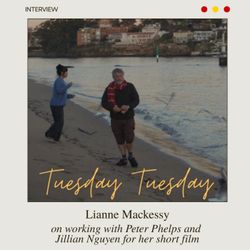
5. Tuesday Tuesday director Lianne Mackessy on honouring the lives of people living with dementia in her short film
25:50||Season 21, Ep. 5Lianne Mackessy is a multi-hyphenate creative whose work spans from acting in front of the camera in films like 2025's Smoke, to writing and directing her own work, like her 2026 drama short film Tuesday Tuesday. Making its world premiere at FlickerFest 2026, Tuesday Tuesday follows a young support worker, played by Jillian Nguyen, who spends a final day with her long-time client, played by Peter Phelps, who lives with younger-onset dementia and will be shifting into a care facility the following day.Co-written with Emily Sheehan, Tuesday Tuesday is a tender and considered film about what it means to be a support worker, helping someone live a life where they may not even recognise you the very next day. In the following interview, Lianne talks about her own experience as a support worker, the process of building the characters with Peter Phelps and Jillian Nguyen, while she also talks about her work at Bus Stop Films.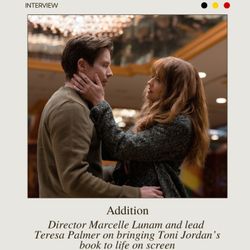
6. Addition Director Marcelle Lunam and lead Teresa Palmer on bringing Toni Jordan’s book to life on screen
18:14||Season 21, Ep. 6Addition is the latest film from director Marcelle Lunam and actor Teresa Palmer. It's a screen adaptation of the novel by Toni Jordan, telling the story of Grace, a woman who counts everything because numbers hold her world together. Yet, when she meets Seamus (Joe Dempsie), her world is thrown upside and her ordered life becomes disordered.In the following interviews, recorded ahead of Addition's release in Australian cinemas, Nadine Whitney talks to both director Marcelle Lunam and Teresa Palmer about making the film and respectfully presenting neurodivergence on screen.the Curb is a completely independent and ad free website that lives on the support of listeners and readers just like you. Visit thecurb.com.au/subscribe, where you can support our work from $2 a month. Paid subscribers get access to our monthly competitions, exclusive interviews and articles, and more.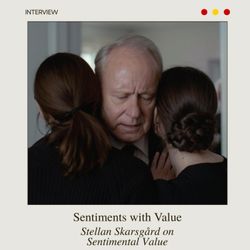
4. Stellan Skarsgård on Sentimental Value
08:33||Season 21, Ep. 4Stellan Skarsgård as Gustav Borg in Joachim Trier’s Sentimental Value is a man who is searching for connection with the two daughters, Nora (Renate Reinsve) and Agnes (Inga Ibsdotter Lilleaas) he effectively abandoned when he split from their just deceased mother. The once storied director turns up at the funeral for his ex-wife and one of the first things he does is to reclaim a set of speakers from the home (a longstanding character in itself) that has housed members of his family for generations. Gustav is opinionated, arrogant, funny, and awkward. He’s written a screenplay for Nora, who is now a respected theatre actress, to star in but she doesn’t want anything to do with it or him.The quiet truth is that Nora and Gustav are two similar souls who both struggle with connection and loneliness. Art is their form of expression but it can also be a burden they don’t know how to negotiate.Nadine Whitney speaks with Stellan about how Gustav sees Nora and longs for her to return the recognition.the Curb is a completely independent and ad free website that lives on the support of listeners and readers just like you. Visit thecurb.com.au/subscribe, where you can support our work from $2 a month. Paid subscribers get access to our monthly competitions, exclusive interviews and articles, and more.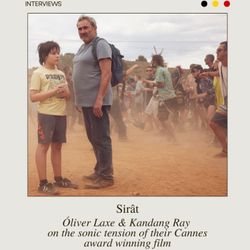
3. Óliver Laxe & Kanding Ray on the sonic tension of Sirāt
20:46||Season 21, Ep. 3In unison, director Óliver Laxe & composer Kandang Ray have created one of the most intense and heart racing cinematic experiences in recent years with their Cannes award winning film Sirāt (winning the Jury Prize). Playing out like a modern version of Wages of Fear with a missing daughter and a rave in the desert supplanting that films explosive cargo, Sirāt is as intense as experience as any other that follows Luis (Sergi López) and his son Esteban (Bruno Núñez Arjona) as they ask a swathe of desert ravers where their family member is. Óliver throws viewers into the fray from the first frame, utilising Kandang Ray's thumping electronic music to provide a sonic backbone to the anxiety provoking experience. That's a tone that never lets up throughout the films 114 minute runtime, ensuring that by the time credits role you'll be pushing down an oncoming panic attack.For some, that sensory experience of tension driven filmmaking isn't exactly fitting with the idea of a 'good time at the movies', but Sirāt isn't a film that intends to make you feel good. Instead, Laxe is looking to expand upon the current state of the world, leaving just enough space for the viewer to draw their own meaning from the metaphor that Laxe and Kandang Ray are spinning.In the following interviews, Nadine Whitney talks to director Óliver Laxe about the landscape and use of music in the film, while in the second interview, Andrew F Peirce talks to composer Kandang Ray about building that sonic profile for the film. Both interviews were recorded ahead of the film receiving two nominations at the 83rd Golden Globe Awards, picking up noms for Best Foreign Language Film and Best Original Score.Sirāt arrives at Perth Festival's Lotterywest Films from 19 January to 25 January 2026. It will receive a wider release thanks to Madman Entertainment from 26 February 2026.the Curb is a completely independent and ad free website that lives on the support of listeners and readers just like you. Visit thecurb.com.au/subscribe, where you can support our work from $2 a month. Paid subscribers get access to our monthly competitions, exclusive interviews and articles, and more. Sign up this week to be in the running to win a double pass to see The Secret Agent.