Share

The COO Solution Podcast
The Missing Piece to Scaling Your Business with Ease
Latest episode
48. The Strategist and the Orchestrator: How CEOs and COOs Scale Together with Verne Harnish
30:46||Ep. 48Scaling a business takes more than a great strategy. It requires the right leadership partnership, clear priorities, and an operating structure that turns ideas into consistent results.In this episode of The COO Solution Podcast, Derek Fredrickson sits down with Verne Harnish, founder of Scaling Up and author of Scaling Up and Mastering the Rockefeller Habits, to explore what makes companies scale successfully.Together, they discuss why the CEO is the strategist and the COO is the orchestrator, how founders can protect the unique "soul" of their businesses, and why effective execution requires both strong people leadership and well-defined processes.Verne also shares lessons from decades of working with entrepreneurs, including how daily huddles, operational playbooks, and the four Scaling Up decisions help leadership teams grow with less complexity.In This Episode:[00:30] The Strategist and the Orchestrator: Why CEOs must lead strategic thinking while COOs turn strategy into execution.[03:31] Building a Successful CEO-COO Partnership: How trust, shared experience, and clear responsibilities strengthen the relationship.[06:45] Protecting the Soul of the Business: Why founders need room to focus on what makes their company unique without disrupting operations.[12:41] Running Your Business Like a Professional Sports Team: How playbooks, scoreboards, and training create consistent execution.[17:14] Removing Obstacles Through Better Leadership: Why COOs must address unnecessary complexity, ineffective processes, and team challenges.[24:57] The Four Decisions That Drive Scaling: Why People, Strategy, Execution, and Cash require the entire leadership team's attention.Why This MattersA strong CEO-COO partnership allows founders to focus on strategy while operational leaders turn that vision into results.Systems and boundaries don't restrict growth. They create the structure that gives leaders and teams greater freedom.Scaling requires both strong people leadership and disciplined execution, not one at the expense of the other.The most effective leadership teams identify their biggest constraint and work together to address it.Action Steps for Listeners:Clarify your CEO-COO responsibilities. Define who leads strategic thinking and who owns execution planning.Protect your company's unique strengths. Identify where the founder's direct involvement adds the most value.Build your operational playbook. Establish clear processes, scoreboards, and training expectations.Start a daily huddle. Ask your team, "Where are you stuck?" and remove obstacles before they grow.Evaluate your four Scaling Up decisions. Identify whether People, Strategy, Execution, or Cash needs your leadership team's attention most.Resources & Links:Verne Harnish Website & Free Resources: https://www.scalingup.comBooks: Scaling Up (Rockefeller Habits 2.0), Start to Scale, Scaling Up Compensation, Super Players, The Greatest Business Decisions of All TimeVerne Harnish on LinkedIn: https://www.linkedin.com/in/verneharnishVerne Harnish on YouTube: https://www.youtube.com/channel/UCra5rcYo1GgLrfOu6kJx3NgFree Quiz – See if your business is ready for the support of a Fractional COO: https://thecoosolution.comPodcast Page – https://thecoosolution.com/podcastSubscribe & Stay Connected:New episodes drop soon; subscribe to The COO Solution Podcast so you don't miss one!Let's connect:➡️ LinkedIn➡️ Instagram➡️ Facebook👉 If this episode resonated with you, share it with a founder or CEO who is trying to scale without becoming the bottleneck. Great strategy matters, but it's the right partnership and consistent execution that turn vision into results.
More episodes
View all episodes
47. Right Person, Right Seat: Building a Healthy Leadership Team That Runs Without You with Megan Piper
34:06||Ep. 47Building a successful business isn't just about having talented people. It's about putting the right people in the right seats, setting clear expectations, and building a leadership team that can operate without the founder constantly stepping in.In this episode of The COO Solution Podcast, Derek Fredrickson sits down with Megan Piper, Expert EOS Implementer, who has facilitated more than 500 EOS sessions and previously helped scale a company from $3 million to $52 million in revenue as its CFO and COO.Together, they explore what makes the Visionary-Integrator relationship successful, how to build accountability across an organization, and why avoiding difficult conversations about team performance can hold a business back.Megan also shares how EOS tools like GWC (Gets It, Wants It, Capacity to Do It) and LMA (Leadership + Management = Accountability) help founders build stronger teams, including those working remotely.In This Episode:[01:48] From CFO and COO to EOS Implementer How Megan helped scale a company from $3 million to $52 million and discovered the value of a structured operating system.[06:12] The Visionary-Integrator Relationship Why a COO must protect the company's priorities instead of constantly responding to the founder's latest ideas.[10:40] The Leadership Conversations Founders Avoid Why honest feedback, clear expectations, and compassionate conversations are essential to building a healthy team.[16:29] Right Person, Right Seat: Understanding GWC How to determine whether someone gets their role, wants it, and has the capacity to succeed.[22:09] Building Accountability Through LMA Why effective leadership and management are the foundation of an accountable organization.[26:00] Leading Distributed Teams Successfully How intentional communication, consistent meeting rhythms, and outcome-based accountability help remote teams thrive.Why This MattersMany founders recognize when someone isn't the right fit for a role but delay addressing it, hoping the situation will improve.As Megan explains, avoiding these conversations doesn't protect the employee or the business.Building a healthy leadership team means setting clear expectations, providing honest feedback, and making decisions that support both the individual and the organization.The goal isn't simply to delegate more. It's to build a team that takes ownership, makes decisions, and delivers results without depending on the founder for everything.Action Steps for Listeners:Evaluate your team using GWC. Ask whether each person truly Gets It, Wants It, and has the Capacity to succeed in their role.Have the difficult conversations. Address performance concerns early with clear expectations, honest feedback, and compassion.Strengthen your Visionary-Integrator relationship. Make sure your COO is focused on executing agreed priorities rather than reacting to every new idea.Be intentional with communication. Establish consistent meeting rhythms, clear ownership, and outcome-based expectations, especially for distributed teams.Resources & Links:Connect with Megan Piper, Expert EOS Implementer: https://implementer.eosworldwide.com/megan-piper/Connect with Megan Piper on LinkedIn: linkedin.com/in/meganpiperEOS Worldwide Events: https://www.eosworldwide.com/eventsFree Quiz – Take the free quiz to see if your business is ready for the support of a Fractional COO: https://thecoosolution.comPodcast Page – https://thecoosolution.com/podcastSubscribe & Stay Connected:New episodes drop soon; subscribe to The COO Solution Podcast so you don’t miss one! Let’s connect: ➡️ LinkedIn ➡️ Instagram ➡️ Facebook👉 If this episode resonated with you, share it with a founder or CEO who has been avoiding a difficult conversation about someone on their leadership team. The conversation doesn't have to damage the relationship, but it does have to happen.
46. What Founders Get Wrong Before They Get It Right (and What Finally Changed)
14:45||Ep. 46Welcome back to The COO Solution Podcast. In this episode, host Derek Fredrickson shares hard-earned leadership lessons that have fundamentally changed how he builds and leads his business.Rather than teaching frameworks or strategies, Derek reflects on the beliefs that shaped his early years as a founder and the moments that forced him to rethink them. From realizing he was unintentionally becoming the product instead of the business model to understanding the difference between refusing to let go and intentionally holding onto a responsibility, this is a candid conversation about the mindset shifts required to build a company that can truly scale.If you've ever struggled to delegate, felt responsible for every important decision, or believed that no one could do it as well as you, this episode offers a practical perspective on what it takes to move beyond founder dependency.In This Episode:[00:02] The Moment Everything ChangedDerek shares the client meeting that revealed he was unintentionally becoming the product instead of the operating model he had built.[02:09] When the Founder Becomes the BottleneckWhy staying involved to protect quality can quietly undermine the very business you're trying to scale.[06:29] Why I Still Own Business DevelopmentThe difference between intentionally keeping ownership of a function and refusing to let it go before you've earned the right to delegate it.[09:37] The Belief That Cost Me the MostHow the mindset of "Nobody does it better than me" limits both the business and the people inside it.[11:43] Delegate Outcomes, Not TasksWhy building systems that consistently produce results matters more than personally overseeing every detail.[13:42] Three Questions Every Founder Should AskSimple questions to uncover where founder dependency still exists and what beliefs may be holding the business back.Why This MattersMany founders believe the biggest challenge in scaling a business is finding better people.Often, the real challenge is letting those people fully own the outcomes they can deliver.As long as the founder stays at the center of every important meeting, decision, and relationship, the business keeps reinforcing the idea that success depends on one person.Sustainable growth requires something different.It requires building a model, a team, and a leadership structure that can consistently deliver results without the founder's constant presence.This episode will help you:Recognize where your own beliefs may be limiting growthUnderstand the difference between intentional ownership and founder dependencyBuild systems that create accountability instead of oversightDelegate outcomes instead of individual tasksDevelop a business that scales through leadership rather than founder involvementAction Steps for Listeners:Identify one area where your presence is unintentionally limiting someone else's ownership.Ask yourself whether you're holding onto a responsibility because you've earned the right to keep it or because you're afraid to let it go.Replace one task delegation with outcome delegation this week.Evaluate whether your business is built around you or around a repeatable operating model.Write down one belief about your own irreplaceability and challenge whether it's still serving the business.Resources & Links:Free Quiz – Take the free quiz to see if your business is ready for the support of a Fractional COO: https://thecoosolution.comPodcast Page – https://thecoosolution.com/podcastSubscribe & Stay ConnectedNew episodes drop soon; subscribe to The COO Solution Podcast so you don’t miss an episode! Let’s connect: ➡️ LinkedIn ➡️ Instagram ➡️ Facebook👉 If this episode resonated with you, share it with a founder who is still carrying more of the business than they need to. Sometimes the biggest breakthrough doesn't come from learning something new. It comes from letting go of a belief that's been holding your business back.
45. What's In It for Them? The Question That Changes Everything with Joe Polish
53:47||Ep. 45Welcome back to The COO Solution Podcast. In this episode, host Derek Fredrickson sits down with entrepreneur, marketer, and Genius Network founder Joe Polish to explore one deceptively simple question that has shaped Joe's life, business, and philosophy for decades: "What's in it for them?"Long before Joe built one of the world's most respected entrepreneurial communities, he was a struggling carpet cleaner trying to figure out why his business wasn't working. What followed was a complete shift in how he thought about marketing, sales, relationships, and service.In this conversation, Joe shares the lessons that transformed his career, from learning the difference between marketing and sales to building trust before making an offer. He also explains why generosity, genuine connection, and creating value for others have become the foundation of everything he builds, including Genius Network, Genius Recovery, and Genius Youth.If you're looking to build a better business by becoming a better entrepreneur, this episode offers practical wisdom that extends far beyond marketing.In This Episode:[01:05] From Carpet Cleaner to Marketing PioneerJoe shares how financial struggle led him to discover the power of marketing and fundamentally changed his career direction.[11:38] Marketing vs. SalesJoe explains why marketing attracts qualified prospects while sales simply helps them make a confident buying decision.[22:45] The Power of "What's In It for Them?"How one simple question became the guiding principle behind Joe's business philosophy, relationships, and life.[41:17] Building Genius NetworkThe story behind creating one of the world's most respected entrepreneurial communities and why its mission has always been about building better entrepreneurs, not just more successful businesses.[52:05] A Simple Practice That Can Change Your NetworkJoe closes with a timeless reminder about handwritten notes, gratitude, and creating meaningful human connection in an increasingly digital world.Why This MattersMany entrepreneurs believe better marketing starts with better tactics.Joe Polish believes it starts with a better question.When you shift your focus from getting what you want to creating value for someone else, everything changes.Your marketing becomes more authentic.Your sales conversations become more helpful.Your relationships become stronger.And your business becomes built on trust instead of persuasion.This episode will help you:Understand the difference between marketing and salesBuild trust before asking for the saleCreate stronger relationships through genuine generosityImprove your marketing by focusing on customer outcomesThink differently about business, leadership, and human connectionAction Steps for Listeners:Ask yourself, "What's in it for them?" before your next meeting, email, or sales conversation.Review your marketing and identify whether it focuses more on your business or your customer's desired outcome.Look for one opportunity this week to create value without expecting anything in return.Write one handwritten thank-you note to someone who has positively impacted your life or business.Focus on becoming someone others trust before trying to persuade them.Resources & Links:Ask Joe Polish AI: https://askjoepolish.comGenius Network: https://www.geniusnetwork.comGenius Recovery: https://www.geniusrecovery.orgFree Quiz – Take the free quiz to see if your business is ready for the support of a Fractional COO: https://thecoosolution.comPodcast Page – https://thecoosolution.com/podcastLet’s connect: ➡️ LinkedIn ➡️ Instagram ➡️ Facebook👉 If this episode resonated with you, share it with a founder who wants to build a business by creating more value for others. Sometimes the biggest breakthrough starts with asking a better question: "What's in it for them?"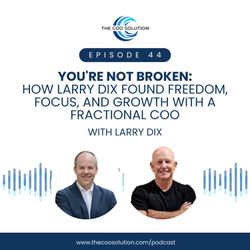
44. You're Not Broken: How Larry Dix Found Freedom, Focus, and Growth with a Fractional COO
34:29||Ep. 44Welcome back to The COO Solution Podcast.In this episode, host Derek Fredrickson sits down with client Larry G. Dix II, founder of Apex, a multimillion-dollar company he built from the ground up.Larry started working in a lumberyard as a teenager. Today, he is an entrepreneur, bestselling author, podcast host, rancher, real estate investor, marathon runner, and mentor.But this conversation is about more than Larry's success.It is about what happened when he realized he was trying to carry too much of the business himself.For years, Larry handled everything from CEO and CFO responsibilities to sales, management, and purchasing. He knew he wanted to grow, but he also knew something had to change.Then he realized something important: He wasn't broken. He just didn't have the right pieces.Larry shares what changed after bringing the right operating people around him, including our fractional COO, Warren. He talks about finding his role as a visionary, building systems around his ideas, making better decisions through healthy pushback, and creating a business that can grow without depending on him every day.In This Episode:[01:18] Lessons From the LumberyardThe early work experiences that shaped Larry’s approach to business, work, and leadership.[03:18] Turning Negative Energy Into Positive EnergyLarry shares how criticism and setbacks fueled his growth and motivation.[05:22] The "Do What's Right" PhilosophyThe story behind Larry’s guiding principle and its role in his business and life.[07:49] Why Larry Felt StuckAfter years of building a successful business, Larry reflects on what kept him from reaching the next level.[08:32] "I'm Not Broken. I'm Just Different."Larry realizes he was a visionary who needed the right people and structure around him.[09:06] Finding the Right IntegratorThe impact of bringing in an Integrator, from better processes and data to greater freedom for Larry.[20:49] Building a Business Beyond the FounderCreating systems and a sustainable business that can support Larry’s family and future.[22:30] Getting Business Knowledge Out of Your HeadWhy relying on what you know instead of documenting it can leave a business vulnerable.[24:59] The Freedom That Comes From the Right SupportLarry talks about the relief, focus, and energy that came from having the right people around him.[28:16] Making a Virtual Team WorkLarry shares what makes remote collaboration work across his business, team, and fractional COO.[34:00] Larry’s Advice to Founders Who Need HelpHis message to founders who know they need support: stop waiting and take the first step.[36:03] Where to Find LarryWhere listeners can connect with Larry and learn more about Apex, his coaching, podcast, and books.Action Steps for Listeners:Identify what only you should own as the founder.Look at the responsibilities you are still carrying that someone else could own.Find the operating support you need to turn your vision into execution.Build systems that make your knowledge transferable.Choose the one or two priorities that will move the business forward.Define your North Star beyond revenue and growth.Stop waiting for the perfect time to get the support you need.Resources & Links:Connect with Larry Dix on LinkedIn - linkedin.com/in/larry-dix-ii-62b75312Free Quiz – Take the free quiz to see if your business is ready for the support of a Fractional COO: https://thecoosolution.comPodcast Page – https://thecoosolution.com/podcastSubscribe & Stay ConnectedNew episodes drop soon; subscribe to The COO Solution Podcast so you don’t miss an episode! Let’s connect: ➡️ LinkedIn ➡️ Instagram ➡️ Facebook👉 If this episode resonated with you, share it with a founder or CEO who has been carrying too much of the business for too long. It may be the conversation they need to build a leadership life they can actually sustain.
43. What Your Business Is Actually Worth, and Why Operations Drives the Number
14:48||Ep. 43Welcome back to The COO Solution Podcast. In this episode, host Derek Fredrickson explores the connection between operational strength and business value.Most founders think valuation starts with revenue, profit, and financial performance. But buyers also want to know whether the business can continue performing without the founder.Derek explains how systems, team structure, accountability, leadership layers, and institutional knowledge can directly affect what someone is willing to pay for a business.He also shares a real client story about a founder whose business once depended on him for nearly every major decision. By building stronger processes, ownership, accountability, and systems, the business became more valuable while giving the founder something he had not had in years: real time away from the business.The goal isn't to prepare every business for a sale.It's to build a business that has the strength, flexibility, and operational health to give the founder more options.In This Episode:[00:21] Building for Scale and Building for ValueThe operational work that helps a business scale also creates the systems, structure, and independence that increase its value.[02:46] What Buyers Actually Look ForRevenue and profit matter, but buyers also assess the business's strength beyond its financial performance.[05:01] The Switzerland Structure and Hub-and-Spoke ModelConcentration around the founder, a key customer, or a critical supplier creates risk that can affect business value.[07:10] When Systems Replace a Person's KnowledgeDocumented knowledge and repeatable systems reduce dependency on individuals and make the business easier to operate without them.[07:40] When the Founder Becomes the BusinessA successful company can still carry significant risk when the founder remains responsible for every major decision, relationship, and problem.[09:35] Building a Business That Can Outlast the FounderClear ownership, accountability, processes, and systems create a business that can continue performing without the founder at the center.[14:05] Three Questions Every Founder Should AskThree questions that expose founder dependency, reveal operational gaps, and show where the business may be losing value.[15:30] Exit Readiness Is Operational HealthA business does not need to be preparing for a sale to benefit from strong operations, clear ownership, and the ability to perform without the founder.Why This MattersA business that depends on its founder for every important decision carries more risk.If the founder steps away and the business slows down or stops, the company has not built enough operational independence.Strong operations change that.When teams have clear ownership, systems capture institutional knowledge, and leaders can make decisions without the founder, the business becomes easier to run and more valuable.The work that improves operational health also creates more freedom for the founder.Action Steps for Listeners:Ask what would break if you stepped away for 90 days.Identify who can make significant decisions without you.Look at whether someone could step in and run the business with the systems and documentation you currently have.Identify one process that still depends too heavily on you.Start building the systems, leadership, and accountability needed to remove that dependence.Resources & Links:Free Quiz – Take the free quiz to see if your business is ready for the support of a Fractional COO: https://thecoosolution.comPodcast Page – https://thecoosolution.com/podcastSubscribe & Stay ConnectedNew episodes drop soon; subscribe to The COO Solution Podcast so you don’t miss an episode! Let’s connect:➡️ LinkedIn➡️ Instagram➡️ Facebook👉 If this episode resonated with you, share it with a founder or CEO who has spent years building their business but has never stopped to ask what it's actually worth.
42. Why 10X Is Easier Than 2X: The Science of Scaling with Blake Erickson
34:10||Ep. 42Welcome back to The COO Solution Podcast. In this episode, host Derek Fredrickson sits down with Blake Erickson, co-founder of Scaling.com and co-author of The Science of Scaling, to challenge one of the most common beliefs about business growth: that more leads, more effort, and more hustle are the answer.Blake explains why growth and scale aren't the same and why businesses that want exponential growth have to think, operate, and build differently. Rather than simply doing more of what is already working, true scale requires a different model, the right people, simple systems, clear ownership, and a willingness to rethink how the business operates.Derek and Blake explore why businesses plateau even when demand is there, why adding more leads can sometimes make things worse, and how founders can reverse engineer their business from the result they want. They also discuss leadership, accountability, hiring, systems, founder mindset, and the importance of saying no to what keeps a business from becoming truly world-class.Whether you're trying to grow your business, break through a revenue ceiling, or build a company that can scale without everything depending on you, this episode offers a practical look at what it really takes to create exponential growth.In This Episode:[01:07] Why More Leads and More Hustle Won't Create ScaleWhy doing more of what you're already doing may create growth, but won't necessarily create exponential scale.[02:23] The Difference Between Growth and ScaleBlake explains why scale requires businesses to reconsider their current model, not just do more.[04:19] What Scale Won't TolerateWhy mediocre teams, complex systems, and weak leadership may survive during growth but become major obstacles when you're trying to scale.[14:55] Do You Want More Leads or More Revenue?Why business owners need to focus on the end result instead of getting distracted by metrics that don't directly create the outcome they want.[19:05] One Person, One ResultWhy every person on a team should have clear ownership and accountability for a specific result.[25:53] The Hidden Things Keeping You From ScalingWhy control, security, comfort, and other competing priorities can quietly work against a founder's goal of scaling.[28:51] Why Systems Create FreedomWhy structure, systems, processes, and accountability aren't meant to restrict entrepreneurs; they are necessary inputs for creating the freedom and scale they want.[30:36] Why Saying No Is a Scaling StrategyBlake explains why doing too many things can keep a business from becoming world-class and why extreme focus matters.Why This MattersMany business owners believe the answer to growth is doing more.More leads. More activity. More people. More opportunities.But exponential scale requires a different approach.This episode explores why businesses need to simplify, focus on the right outcomes, build the right team, and create systems that support the future rather than constantly fixing the past.Action Steps for Listeners:Define the outcome you want before deciding what actions to take.Look at whether your current systems can support the level of growth you want.Evaluate whether you're measuring activity or the actual outcome that matters.Build your team and systems for where you're going; not just where you are today.Let your future goal expose the areas where you need to grow as a leader.Resources & Links:Free Audiobook – The Science of Scaling: https://scaling.com/freeLearn more about Scaling.com: https://scaling.comConnect with Blake Erickson on LinkedIn Free Quiz – Take the free quiz to see if your business is ready for the support of a Fractional COO: https://thecoosolution.comPodcast Page – https://thecoosolution.com/podcastLet’s connect: ➡️ LinkedIn ➡️ Instagram ➡️ Facebook👉 If this episode resonated with you, share it with a founder who is ready to stop chasing incremental growth and start building a business designed to scale.