Share
Circular Coffee Break for Leaders, Innovators, and Practitioners
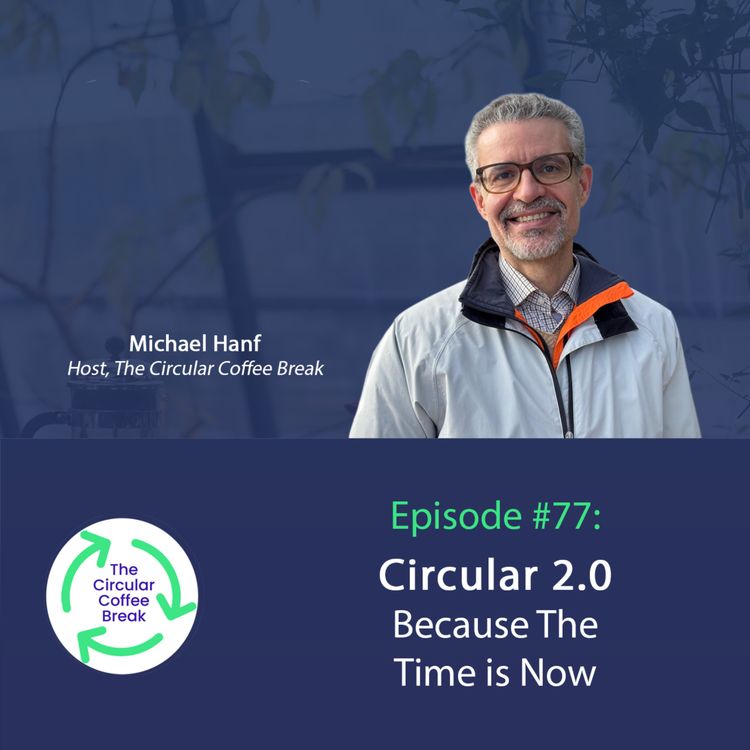
#77 - Circular 2.0 - Because The Time is Now
Season 4, Ep. 1
•
The Circular Coffee Break was never meant to end. After 80 episodes and a community that refused to let the conversation fade, we are back with a renewed focus. This season, under the theme Circularity 2.0, we explore why the world needs circularity now and how we are evolving to meet the moment. From circular growth to business renewal, we dive into the ideas, people, and actions shaping a future where sustainability is not a niche but a necessity.
Tune in to hear:
- The story behind our return and what has changed since we paused
- Why circularity is now the core principle of competitive business
- A preview of the conversations and perspectives coming this season
This is for the curious, the bold, and the doers. The conversation starts now. Subscribe, rate, and join the movement.
More episodes
View all episodes
4. #80 - SPIRIT Programme and the Future of Circular Plastics
29:33||Season 4, Ep. 4What does it take to build a circular economy for plastics in practice? In this episode of The Circular Coffee Break, Jaakko Tuomainen, Sustainability Manager at Borouge International and former leader of Borealis’ SPIRIT programme, shares insights into one of Finland’s most ambitious initiatives to increase plastic waste recycling rates and create high-quality recyclates.Jaakko reflects on the SPIRIT programme’s journey, from its design to its implementation, and the lessons learned along the way. He discusses the importance of collaboration across industries, the role of policy in driving demand for circular products, and the technological advancements that are making circular plastics a reality. With concrete examples from trials with companies like Valio and Froneri, Jaakko highlights how the programme addressed challenges in feedstock innovation, offtake demand, and economic viability. He also explores the future of circular plastics, the remaining barriers to scaling, and why creating viable business cases is the next critical step.Why listen?Understand how the SPIRIT programme aimed to transform Finland’s plastics value chain through collaboration and innovation.Explore the balance between policy-driven change and bottom-up innovation in circular economy initiatives.Learn about the technological advancements in mechanical and chemical recycling that are enabling circular plastics.Discover concrete examples of circular principles in action, from trials with major companies to consumer-facing products.Gain insights into the economic challenges of scaling circular initiatives and the importance of creating demand for recycled materials.Whether you are a sustainability professional, a business leader, or simply interested in the future of circular economy, Jaakko’s story offers a thoughtful and practical perspective on the opportunities and challenges of building a circular plastics ecosystem. Read more on the SPIRIT Programme website or in the Final Report.Keywords: circular economy, plastics recycling, SPIRIT programme, circular plastics, sustainability, Finland, Borealis, Borouge International, mechanical recycling, chemical recycling, feedstock innovation, offtake demand, policy and regulation, collaboration, circular business models, Jaakko Tuomainen, The Circular Coffee Break
3. #79 - Circular for Profit in the Built Environment
28:56||Season 4, Ep. 3Energy efficiency in buildings is often framed as a cost, but what if it could be the most profitable decision a business makes? In this episode of Circular Coffee Break, Michael speaks with Nikolas Salomaa, Founder and CEO of nollaE, about how profitability can drive circularity in the built environment. Nikolas shares his journey from entrepreneur to innovator in energy-efficient and circular HVAC solutions, and how his company’s software identifies the most cost-effective and sustainable measures for each building.Nikolas explains why financial viability is critical to scaling energy efficiency and circularity. He reflects on his time at Savumax, a company that developed zero-carbon housing products but ultimately went bankrupt due to market resistance. At nollaE, he has shifted the focus to engineering solutions that are both sustainable and economically compelling, proving that circularity in buildings can be achieved without sacrificing profitability.The conversation also explores how digital tools and data-driven approaches enable nollaE to reuse HVAC equipment across projects, reducing costs and waste while maintaining energy efficiency. Nikolas provides a concrete example of a project where reusing equipment and optimizing energy systems saved a building owner nearly 1.4 million euros, demonstrating that circularity and profitability can go hand in hand.Why listen?Learn how profitability can catalyze sustainability in the building industry.Understand the role of software and data in identifying the most efficient energy solutions for buildings.Explore how circular economy principles apply to HVAC systems and the built environment.Hear about the challenges of market resistance to innovation and how nollaE addresses them.Discover real-world examples of cost savings and energy efficiency achieved through circular solutions.Whether you are a building engineer, sustainability professional, or simply interested in how circularity and profitability can coexist, this episode offers practical insights into the future of sustainable buildings.Keywords: energy efficiency, circular economy, HVAC systems, sustainability in buildings, profitability-driven sustainability, nollaE Oy, Nikolas Salomaa, building retrofits, digital tools for energy efficiency, circular HVAC solutions, cost savings in construction, sustainable building practices, energy simulation software, reuse of HVAC equipment, Circular Coffee Break
2. #78 - Circular Growth and Regenerative Living
30:12||Season 4, Ep. 2What does it take to transition from linear to circular systems in urban planning and infrastructure? In this episode of Circular Coffee Break, Tuija Pakkanen, Portfolio Lead for Circular Growth and Business Renewal in Regenerative Living and Transport at VTT Technical Research Centre of Finland, shares her journey from forest management to shaping sustainable cities. With a background in geography, GIS, and digital twins, Tuija explores how data and innovation can drive systemic change in the built environment.Tuija reflects on her work in Finland’s national digital twin for the built environment (RYHTI), the challenges of interoperability in urban planning, and the role of collaboration in scaling circular solutions. She discusses the importance of human-centric design, the balance between policy and bottom-up innovation, and why resilience, both in materials and knowledge, is critical for Europe’s future. From dismantling buildings to giving them a voice through digital tools, her work bridges the gap between research and real-world impact.Why listen?Understand how digital twins and data interoperability can unlock circularity in urban planning.Explore the human and technological dimensions of regenerative living and transport.Learn about the role of resilience in circular economies, from materials to geopolitical knowledge.Discover practical examples of circular growth in action, from material reuse to AI-driven building management.Gain insights into the balance between policy, innovation, and collaboration in driving systemic change.Whether you are a sustainability professional, urban planner, or simply curious about the future of circular cities, Tuija’s perspective offers a grounded and actionable take on rethinking how we build, live, and thrive.Keywords: circular economy, regenerative living, sustainable urban planning, digital twins, built environment, GIS, interoperability, circular growth, resilience, VTT, Tuija Pakkanen, Circular Coffee Break, urban innovation, material reuse, data-driven sustainability, collaboration in sustainability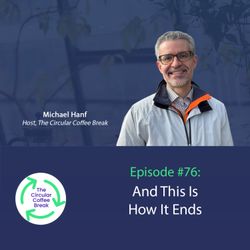
32. #76 - And This Is How It Ends
07:22||Season 3, Ep. 32After three years and over eighty conversations, The Circular Coffee Break comes to a close. This final solo episode is not a recap but a reflection on why the podcast existed, what was learned, and why it feels right to end it now.Host Michael Hanf shares the origins of the podcast, which began in early 2023 with a simple intention: to slow down the conversation around circularity and sustainability. At the time, much of the public discussion felt fragmented, fast, and overly focused on frameworks and targets. The Circular Coffee Break was created as a space for long-form conversations with people working on circularity in practice, across business, policy, research, and entrepreneurship. The metaphor of a coffee break was intentional—a moment to pause, think out loud, explore trade-offs, and sit with uncertainty rather than presenting circularity as a linear journey from problem to solution.Over the course of these conversations, several patterns became clear:Circularity is rarely a technical problem. The technologies exist, the models are known, and the data is improving. The harder challenges lie in governance, incentives, organizational boundaries, and decision-making.Circularity is a team sport. Progress depends on coordination, trust, and shared direction across many actors, each playing different but critical roles.Progress is uneven but not absent. Meaningful advances are happening, often quietly and in specific contexts, while inertia persists at scale.Context matters. What works in one sector or region does not automatically translate elsewhere. Circularity is not a blueprint but a direction of travel that looks different depending on where you start.Circularity is increasingly strategic. Conversations often touched on resilience, supply risks, competitiveness, and long-term value creation, not just environmental concerns.So why end The Circular Coffee Break now? The simplest answer is that this format has done what it set out to do. It created a body of conversations that captured a specific moment in how circular economy and sustainability were being understood and practiced. Continuing the podcast would either lead to repetition or require a shift that no longer fits its original purpose. Ending deliberately is a form of focus and discipline.This is not a pause, nor a rebranding. It is a clean ending. The archive will remain available, and it is hoped that it continues to be useful as a record of conversations that tried to engage honestly with complexity rather than simplifying it.Michael’s work continues through a separate podcast called Matters of Consequence, which takes a broader lens on the systems change needed in a never-normal world to make companies, institutions, and organizations future-ready.Before closing, Michael expresses his gratitude to the guests who trusted the space enough to think out loud, to the listeners who stayed with the long conversations and nuances, and to everyone who shared episodes, challenged ideas, or carried the conversations forward in their own work.For The Circular Coffee Break, this episode marks a clear and intentional ending.Keywords: circular economy, sustainability, reflection, purpose, Circular Coffee Break, Michael Hanf, Matters of Consequence, podcast, circularity, strategic circularity, progress, context, governance, decision-making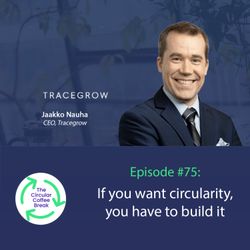
31. #75 - If you want circularity, you have to build it
36:36||Season 3, Ep. 31What does it take to build a circular business in practice? In this final interview episode of The Circular Coffee Break, we welcome back Jaakko Nauha, CEO of Tracegrow, who was the very first guest on the podcast in early 2023. Almost three years later, Jaakko returns to reflect on Tracegrow’s journey from a battery recycling innovator to a broader clean technology company, and what it really means to scale circular solutions in the real world.Jaakko shares how Tracegrow has evolved from recovering micronutrients like zinc and manganese from used alkaline batteries to processing industrial side streams, such as manganese sludge from zinc smelters. He discusses the company’s expansion into seed treatment, which has shown remarkable results in improving crop resilience and yield, as well as the development of battery-grade manganese sulfate for electric vehicles and industrial energy storage systems. The conversation also explores the challenges of finding product-market fit in agriculture, entering the European battery ecosystem, and scaling under regulatory, logistical, and cost constraints.Why listen?Discover how Tracegrow has expanded from battery recycling to processing broader industrial side streams.Learn about the company’s move into seed treatment and the impact on crop resilience and yield.Explore the development of battery-grade manganese sulfate and its role in electric vehicles and energy storage.Understand the challenges of scaling circular solutions under real-world constraints, from regulation to logistics.Gain insights into Jaakko’s journey from business development to CEO and what it takes to lead a circular business.Whether you are an entrepreneur, a sustainability leader, or simply curious about the realities of building and scaling circular businesses, this episode offers practical insights and inspiring reflections from the frontlines of circular innovation.Keywords: circular economy, Tracegrow, Jaakko Nauha, circular business, battery recycling, industrial side streams, seed treatment, battery-grade manganese, electric vehicles, energy storage, scaling circularity, product-market fit, regulatory challenges, logistics, leadership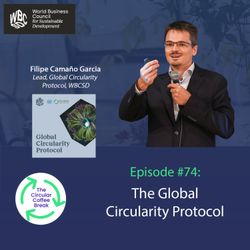
30. #74 - The Global Circularity Protocol
38:29||Season 3, Ep. 30What does it take to move circularity from ambition to action? In this episode of The Circular Coffee Break, we welcome Filipe Camaño Garcia, Lead of the Global Circularity Protocol (GCP) at the World Business Council for Sustainable Development (WBCSD). Filipe shares the story behind the GCP, a groundbreaking framework designed to do for resources what the Greenhouse Gas Protocol did for emissions: provide a globally aligned, science-based approach to measure, manage, and communicate circular performance.Filipe dives into the journey of creating the GCP, from its origins at Stockholm+50 to its launch at COP30 in Brazil. He discusses the challenges of balancing a holistic, cross-sectoral approach with the need for industry-specific relevance, and how the protocol empowers companies to move from fragmented pilots to scalable, comparable circular strategies. The conversation also explores the role of the GCP in reframing circularity as a strategic lever for competitiveness, resilience, and long-term value creation, and what success looks like as the protocol evolves.Why listen?Discover the story behind the Global Circularity Protocol and why it was created to address the fragmentation in circular economy efforts.Learn how the GCP provides a common language and framework for companies to measure, manage, and communicate circular performance.Explore the challenges of balancing a cross-sectoral approach with industry-specific needs and how the GCP addresses them.Understand how the GCP reframes circularity as a strategic tool for de-risking supply chains and driving business value.Gain insights into the future of the GCP, its potential impact, and how it can help scale circularity from ambition to action.Whether you are a business leader, a sustainability professional, or simply curious about how to turn circular ambition into measurable impact, this episode offers practical insights and inspiring stories from the frontlines of global circularity efforts.Keywords: circular economy, Global Circularity Protocol, Filipe Camaño Garcia, WBCSD, circular performance, circular metrics, cross-sectoral collaboration, strategic circularity, supply chain resilience, COP30, circular framework, circular impact, circular measurement
A short Update on the Circular Coffee Break
02:59||Season 3This short episode shares an update on the future of The Circular Coffee Break.Host Michael Hanf explains the decision to bring the podcast to a close in February 2026, what listeners can expect from the remaining episodes, and what will happen to the existing archive.
29. Christmas Special
10:26||Season 3, Ep. 29What if circularity could make Christmas more meaningful? In this special Christmas edition of The Circular Coffee Break, we explore how circular thinking can enhance the holiday season by reducing stress, minimizing waste, and strengthening connections. From gift-giving to traditions, we dive into how small, intentional choices can align with the values of care, stewardship, and continuity that define both Christmas and circularity.Host Michael Hanf shares reflections on how circularity can support what many of us want more of at Christmas: less stress, more meaning, better use of resources, and stronger connections. Along the way, you’ll hear perspectives from leaders in circularity:Madeleine Brun Landmark (TOMRA Collection) on reducing waste during the holidays and choosing recyclable or reusable gift wrap.Dan Dicker (Circular&Co) on trends in sustainable gift-giving, the value of second-hand gifts, and the principles of circular design.Björn Schultz (WWF Germany) on how families are integrating circular practices into their Christmas traditions, from gift swaps to shared experiences.Why listen?Discover how small, intentional choices can reduce waste and enhance the meaning of Christmas.Learn about the trends in sustainable gift-giving and how circular design principles can guide your holiday purchases.Explore how families and communities are adopting circular practices, often without even labeling them as sustainability.Gain insights into how circularity can support the magic of Christmas by fostering connection, reducing clutter, and promoting thoughtful traditions.Whether you are looking for ways to make your holiday season more sustainable or simply curious about how circularity can align with Christmas traditions, this episode offers practical insights and heartwarming stories to inspire a more thoughtful and joyful celebration.Keywords: circular economy, Christmas, sustainable traditions, thoughtful gifting, TOMRA, Circular&Co, WWF Germany, gift wrap, second-hand gifts, circular design, holiday waste, meaningful traditions, connection, resource efficiency