Share
The Circular Coffee Break
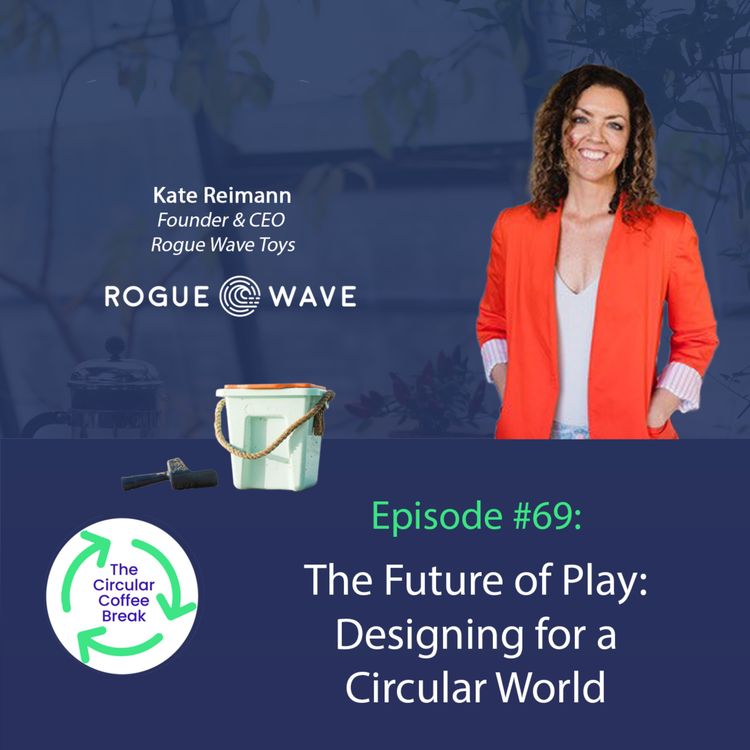
#69 - The Future of Play: Designing for a Circular World
In this episode of The Circular Coffee Break, host Michael Hanf speaks with Kate Reimann, Founder and CEO of Rogue Wave Toys, about how a single day at the beach led to a breakthrough in sustainable design.
When a wave swept her children’s plastic toys out to sea, Kate decided to rethink what play could look like in a world drowning in plastic. The result was Rogue Wave Toys, a company creating durable, compostable beach toys made from biopolymers, plastics made from plants instead of petroleum.
Together, Michael and Kate discuss:
🔸 The long road from an idea to a viable circular product
🔸 How compostable biopolymers work and why they matter
🔸 The hidden challenges of consumer education and pricing in sustainability
🔸 The importance of storytelling and authenticity in building awareness
🔸 How circular design can reshape industries far beyond toys
Kate also shares lessons learned from building a mission-driven company, the importance of persistence, and her vision for scaling sustainable materials across industries, from beach toys to everyday products.
As she puts it, “If we want a different future, we have to be brave enough to build it — even if that starts with something as small as a beach toy.”
🎧 Listen to The Future of Play: Designing for a Circular World
More episodes
View all episodes
76. #76 - And This Is How It Ends
07:22||Season 3, Ep. 76This is the final episode of The Circular Coffee Break.In this solo episode, host Michael Hanf reflects on why the podcast was created, what he learned through three years of conversations, and why it feels right to bring the series to a close now.Rather than offering a recap, the episode explores recurring themes that emerged over time: circularity as a governance and decision-making challenge rather than a technical one, the importance of collaboration across systems, uneven but real progress, and the role of context in shaping what change can look like in practice.The episode marks a clear and intentional ending. The archive remains available as a record of conversations that tried to slow the discussion down and engage honestly with complexity.
75. #75 - If you want circularity, you have to build it
36:36||Season 3, Ep. 75Jaakko Nauha was the first interview guest of The Circular Coffee Break back in early 2023. Almost three years later, he returns as the final interview guest of the podcast, now as CEO of Tracegrow.In this conversation, we look at what has changed since those early days and what building a circular business looks like once initial ideas meet market realities. We discuss Tracegrow’s expansion from recycled battery-based fertilizers into broader industrial side streams, the move into seed treatment, and the development of battery-grade manganese for energy storage and electric vehicles.The episode explores product market fit in agriculture, the challenges of entering the European battery ecosystem, and the practical work of scaling under regulatory, logistical, and cost constraints.A reflective closing conversation for the interview series of The Circular Coffee Break.
74. #74 - The Global Circularity Protocol
38:29||Season 3, Ep. 74Circular economy has been discussed for more than a decade, yet for most companies it remains fragmented, difficult to scale, and hard to explain to investors and decision-makers. While pilots and innovations abound, the lack of a shared framework has made it challenging to turn circular ambition into business strategy.In this episode of Circular Coffee Break, host Michael Hanf sits down with Filipe Camaño Garcia, Lead, Global Circularity Protocol at the World Business Council for Sustainable Development. Filipe has spent more than a decade working across supply chains, humanitarian operations, policy, and sustainability transformations, and now leads one of the most ambitious global efforts to standardize how businesses approach circularity.The conversation explores why circular economy urgently needs a common language and governance model, similar to what the Greenhouse Gas Protocol created for climate accounting. Filipe explains how the Global Circularity Protocol was developed through a two-year multistakeholder process involving more than 80 organizations, including global companies, governments, development banks, scientists, and civil society actors from both the Global North and the Global South.Michael and Filipe discuss what the protocol actually does in practice. Rather than focusing on abstract principles, the Global Circularity Protocol provides a step-by-step framework to help companies measure, manage, and communicate their circular performance based on real material flows. The discussion highlights how circularity can be embedded into corporate strategy, risk management, and capital allocation, rather than remaining a sustainability side project.A key theme of the episode is the reframing of circular economy as an economic and resilience agenda. Filipe shares insights on supply chain de-risking, resource volatility, and why circular strategies are becoming essential for long-term competitiveness. The conversation also reflects on the role of global policy moments such as COP, where circularity is beginning to gain recognition as a strategic lever for development, not just a waste or recycling issue.The episode goes beyond frameworks and metrics, touching on leadership, systems thinking, and the importance of inclusivity. Filipe explains why the protocol was designed from the outset as a global tool, incorporating perspectives from emerging economies and regions where circular practices already exist but are often undervalued or informal.This conversation is for sustainability leaders, strategy professionals, board members, and anyone working to translate circular economy from concept to action. It offers a grounded, pragmatic look at what it takes to scale circularity in real business environments, and why the next decade will be decisive for how companies value and manage resources.
A short Update on the Circular Coffee Break
02:59||Season 3This short episode shares an update on the future of The Circular Coffee Break.Host Michael Hanf explains the decision to bring the podcast to a close in February 2026, what listeners can expect from the remaining episodes, and what will happen to the existing archive.
73. Christmas Special
10:26||Season 3, Ep. 73In this Christmas special of the Circular Coffee Break, Michael Hanf explores what the holiday season looks like through the lens of circularity. From gift wrapping and waste, to circular design and community traditions, the episode reflects on how small, thoughtful choices can reduce pressure and add meaning to Christmas.Featuring short perspectives from TOMRA, Circular&Co, and WWF Germany, this episode shows how circular practices often emerge naturally during the holidays, not out of obligation, but from a desire for simplicity, connection, and care.Wishing you a thoughtful and circular Christmas.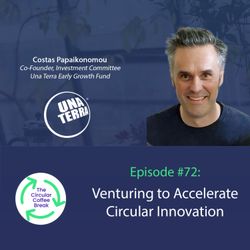
72. #72 - Venturing to Accelerate Circular Innovation
30:52||Season 3, Ep. 72In this episode of the Circular Coffee Break, Michael Hanf speaks with Costas Papaikonomou, co-founder of Una Terra, a 200-million-euro early growth venture capital fund investing in solutions that accelerate the shift to a more circular and regenerative economy. Costas brings more than twenty-five years of experience in engineering, manufacturing, innovation consulting, and entrepreneurship. He has helped global consumer goods companies turn creative thinking into real products that work at scale. Today he applies the same hands-on mindset to impact investing.The conversation explores what it truly takes to finance the transition to a circular world. Costas explains why circular innovation is still grounded in the physical realities of making things and why the fundamentals of commercial adoption determine whether impact can grow. He outlines why desirability always comes before impact and why technologies must fit into existing manufacturing systems if they are going to scale. A good idea is not enough. It must be something that large companies can buy, produce, and integrate with as little disruption as possible.Michael and Costas dive into the long sales and adoption cycles that challenge early stage circular ventures. They discuss why many startups struggle to cross the gap between promising technology and successful industrial integration, and how investors can support them in staying flexible, reducing unnecessary capital expenditure, and using existing manufacturing capacity instead of building from scratch.A key theme is the critical role of technical sales and customer fit. Costas shares how circular startups often underestimate the number of stakeholders involved in making a material or product switch inside a large organization. Success requires engaging procurement, R&D, product design, logistics, and innovation teams. It also requires being able to tell the difference between customers who are serious about adopting a solution and those who are engaged in what he calls pilot washing. He explains how simple signals can help startups protect their time and focus their efforts on real opportunities.Looking ahead, Costas sees strong momentum for circular investment. Environmental pressure, new regulation, concerns around human health, and the need for supply chain resilience are creating a perfect storm that will push industries to rethink how materials are produced, used, and reused. He argues that circularity is not only an environmental requirement. It is also a strategic and commercial one that will shape Europe’s competitiveness in the decades to come.The episode closes with an optimistic but grounded reflection. The circular transition is a century scale journey. It requires investors and innovators who understand the realities of physical products, industrial systems, and commercial adoption. Una Terra aims to be part of this shift by backing companies that combine strong impact potential with practical pathways to market.Tune in to learn how capital can become a catalyst for systemic change, what it takes to scale circular solutions, and how the next generation of ventures can reshape the material basis of our economy.
71. #71 - CCB on the Road: Slush 2025 Special
30:37||Season 3, Ep. 71In this special Circular Coffee Break episode recorded live at Slush 2025 in Helsinki, host Michael Hanf explores how circular innovation is moving from vision to implementation across Europe. While circularity was not a headline theme this year, it was noticeably more present, reflected in the founders shaping new solutions in energy storage, materials, electronics, chemistry, agriculture, and even space.Across seven conversations, listeners hear directly from the innovators building practical, scalable circular models. From second-life batteries and plastic-free hemp materials to circular smartphones, regenerative filters made from human hair, bio-based polyols, recyclable paper coatings, and responsible satellite end-of-life systems, each founder shares how circularity is becoming an operational advantage, not an afterthought.If you want a concise, real-world snapshot of where circular innovation stands today, this episode offers a grounded look at the ideas gaining momentum and reshaping industries.
70. #70 - CCB on the Road: Circular Valley Forum 2025
57:23||Season 3, Ep. 70Circularity is accelerating, and the 2025 Circular Valley Forum in Wuppertal offered a vivid snapshot of how fast the transition is unfolding. The event brought together leaders from industry, science, public institutions, startups and civil society. The atmosphere was buzzing with energy, ideas and a shared determination to turn circular concepts into real action.In this special episode of the Circular Coffee Break Podcast, we bring together conversations from across the Forum to explore what circularity looks like in practice today. Each voice offers a different window into the transition, and together they reveal how interconnected and dynamic this field has become.We begin with Tim Janßen of the Cradle to Cradle NGO, who reflects on how circularity has evolved over the past decade and why the social and ecological foundations of the movement matter more than ever.From there we turn to science and applied research with Prof. Dr. Manfred Renner of Fraunhofer UMSICHT, who discusses how breakthrough technologies move from lab to real-world implementation.The industry perspective comes from Rolf Bayersdörfer of Henkel Consumer Brands, Adrian Blum of Evonik, and Björn Hoffmann of BASF. They explore how large companies navigate complex supply chains, develop circular raw materials, scale circular business models and build partnerships that make change possible.We then move into systems thinking with Inge Neven, CEO of VITO, who explains how real scale demonstrators and mini factories help bridge the gap between research and industry.Steffen Knodt, representing the German Aerospace Centre and the UN Ocean Decade, expands the conversation to ocean health and global material flows, showing how circularity and planetary boundaries are closely linked.Several startup founders share how circularity is becoming an engine of innovation. Marc Diefenbach of rhinopaq introduces reusable solutions for B2B packaging. Felix May of recarbished explains how new ownership models can secure valuable materials at the end of vehicle lifecycles. Peter Johnson of LightEd offers a powerful story about turning waste into solar solutions for off-grid communities in Nigeria and Rwanda, highlighting the social dimension of circularity.We close with a cultural perspective from Carsten Cramer of Borussia Dortmund, who reflects on how football can make sustainability and circularity accessible to millions of fans.Across all conversations, a few themes stand out. Circularity is no longer a concept. It is becoming a strategic necessity across industries. Progress depends on collaboration across borders and systems. Innovation must be demonstrated at scale, not only discussed in theory. And culture, storytelling and public engagement are essential for driving societal adoption.This episode offers a panoramic view of circularity at a moment of real momentum. It highlights the people, ideas and partnerships pushing the movement forward and invites listeners to reflect on what it will take to accelerate the transition even further.Listen in and join the conversation.