Share

The Brown Box
Aleya Kassam on Stepping Out of the Brown Box
Season 2, Ep. 3
•
In this episode of The Brown Box, I speak to Aleya Kassam, a multidisciplinary writer, performer and self-described samosa experimenter. Her story, and the stories she tells, are rooted in questions of ancestry and identity, and in the courage to step outside the brown box.
In this conversation, we explore:
- Two formidable great-grandmothers who embodied strength in very different ways, and the missing chapters in her family's history, including the stories lost to the Swahili seas
- Two photographs of her grandfather, and the mystery of what happened between the young man who arrived in Kenya and the older man whose eyes had changed
- A notebook containing the rules that guided a young man navigating life far from home
- The divide between the Brown and Black communities, why it persists, and what we can do to bridge it
- The inherited fear of the 1982 coup, the 2024 protests, and how trauma travels across generations
- Growing up between cucumber sandwiches at school and dal khichdi at home, and the prejudices attached to each
- Falling in love across racial boundaries, and the contrasting acceptance of one relationship and rejection of another
- How a role in The Vagina Monologues opened the door to writing and performing, and why she decided to create the roles she couldn't find
- Pani Puri, her musical about a Brown-Black love story, and the importance of imagining a different ending
- Why the Kenyan Indian community needs to get out of the Brown Box, and what it might discover beyond its familiar borders
More episodes
View all episodes

2. The Importance of Being a Bridge - Karishma Bhagani
38:24||Season 2, Ep. 2In our next episode of the podcast, I speak to Karishma Bhagani, a theatre-maker and producer, whose story begins in Mombasa but has brought her to Stanford where she is currently pursuing a PhD with a special focus on Black and Brown intimacies.In this conversation, we explore:Her family’s migration story, a journey that was meant to end in Durban, but stopped at the beautiful shores of MombasaGrowing up in Old Mombasa, with mahamri on Sundays, the azaan at 4.30 am, and a maulvi who occasionally fell asleep at the microphoneThe greatest gift her mother gave her: permission to dreamHer grandmother, the pendant on the family necklace, and the Saturday lunches spent cooking by her sideHer father, driving soda trucks at 14The day she sat at the rich kids’ lunch table, only to watch them all get up and leaveWhy caste still matters in East Africa, even determining which community hall you celebrate Diwali inFive generations in East Africa, and why she considers herself Kenyan firstThe BMW rule: “No Black, no Muslim, no white.” Where it comes from, and what it revealsHer research into Black and Brown intimacies, why the divide persists, and how we might bridge itWhy now is the time to take up creative arms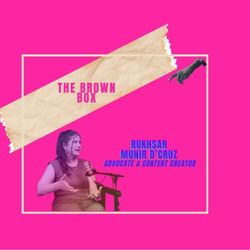
1. Rukhsar D’Cruz and the Case for Being Opinionated
43:10||Season 2, Ep. 1Welcome to the first episode of a new series of The Brown Box recorded in East Africa. In this episode we sit with Rukhsar D'Cruz, a lawyer and the voice behind the Instagram account The Daily E-vent. ⚠️ Content note: this episode includes a discussion of sexual assault.. 🎧 Press play to hear: * The day she told her mum she was a "fake Indian" and what she understands now * Her parents' love story: a Hindu-born mother who followed Jesus, an Ismaili father, and a courthouse wedding on a Tuesday morning * Growing up between three faiths* Why she is an island girl, and the feeling of landing in Mombasa and knowing she's home * Becoming a bookworm, from the Bible and CS Lewis to Aristotle at 13 * Not fitting into the brown box* Talking openly about sexual assault, and why she believes we need to talk more about therapy and sex * Meeting her husband at a fellowship night in her parents' home, and getting married six weeks after he proposed * Her mum as a mirror, and how their relationship found its way to a good place * Why ownership of who you are is worth more than anyone's opinion about your brown box #thebrownbox #kenya #mombasa #lawyer #womeninlaw #identity #therapy #eastafrica #podcast #women
Mandakini Arora's Journey to Finding Home
30:26|In this episode of The Brown Box, we sit with Mandakini Arora — historian, writer, and feminist.We talk about belonging, displacement, and how you build a home in a place you choose. 🎧 Press play to hear:How her parents' refugee story shaped her childhood — and her search for belongingThe comfort she found in books and the (very British) world they opened up for herWalking into AWARE and feeling, for the first time, like she was homeThe incredible women of AWAREThe AWARE saga, from the insideWhy she believes every person who cares about equality should be a feministWhat a road rage incident taught her about belonging and being Indian in SingaporeHow she went back to school at 59 — and graduated alongside her own daughterHer next book about the English women who chose Singapore and shaped the nationAnd her advice to her younger self about writing and not waiting. 👂 Full conversation waiting for you. Listen now — link in bio.#thebrownbox #belonging #feminism #singapore #identity #podcast #women #awaredsg
Ivy Singh, Singapore's Gentle Warrior, Prepares to Fight For Her Farm
34:23|She has been called Singapore's Gentle Warrior. And right now, she is preparing for her biggest fight yet!In this episode of The Brown Box, we sit with Ivy Singh — farmer, philosopher, provocateur. We meet her at a crucial moment, as the lease on Bollywood Farms, her life's work, runs out in December, 2026.💡 Press play to hear:Ivy's childhood on Rose Lane and how her father taught her that land is lifeStories of kampong spirit — and what Singapore has lost sinceHer journey from Netball Singapore president to finding love at a FairPrice openingHow a newspaper article on a plane changed everythingThe Bollywood Farms origin story — and the government she had to convinceThe origins of agri-tainment and Ivy's twenty six year argument for Singapore's countrysideWords from her staff and the legacy she wants to leave behindAnd the question the whole episode is really about — what do we lose if we lose Bollywood Farms?💡 Full conversation waiting for you. Listen now — link in bio.✍️ Sign the petition. Help us save Bollywood Farms.🌿🔗 Link in bio.Grace Kalaiselvi: Bringing Brown Stories to the Stage
24:37|Who gets to stand under the spotlight makes a difference. In this episode of The Brown Box, we sit with Grace Kalaiselvi — theatre actor, director and educator. We talk about family, absence and survival, and how theatre became a way to make sense of it all — and how Grace, when she couldn’t see herself in the stories on stage, began creating them herself.🎧 Listen to hear about: • Grace’s early family struggles and how theatre became her escape • Her journey from Tamil theatre to English theatre, and the challenges she faced • Her realisation that there was little space for brown faces in English theatre • The founding of Brown Voices to tell more Indian stories • Her creative process — from idea to opening night • Her most recent play, ‘Invisible’ • Advice to other aspiring actors who want to join her under the spotlightListen now — link in bio.#thebrownboxpodcast #singaporetheatre #sgpodcasts #singaporeartists #southasianvoices
Sofie Buligis's Love Letter to Being Celup
29:20|In this episode, Sofie talks about the word celup, as she grapples with her own celup-ness and what it means to not fit neatly into the Malay box of the CMIO.Listen to hear about:what celup means, and Sofie’s journey towards understanding her own celup-nessher complex heritage — Javanese, Boyanese and Indian — and why her name leaves her with many unanswered questionsa grandmother who was given a Malay identity card despite being of Chinese and Indian heritagebecoming super duper halal as a form of teenage rebellionfinding belonging in a P. Ramlee filmmusic in her family, a grandfather with a music room, and a household where everyone had to learn an instrumenther admiration for her mother’s fierceness, and her belief in the power of her own softnessthe pain of having to put her Malayness in her back pocketthe lack of roles — and nuance — for brown actors in Singaporeher advice for others struggling with their own celup-nessThe Storyteller's Gift: Kamini Ramachandran on the Power of Stories
01:02:53|In this episode, we sit with Kamini Ramachandran, a storyteller, educator, and creative force behind MoonShadow Stories and Storyfest Singapore.🎧 Listen to hear about:* Her grandfather, the storyteller: a planter from Kerala who lived in Malaya, from whom Kamini learnt to love stories* The wildness of nature 🐍: a cobra encounter at four, the love of a dog named Bobby 🐕, and how he protected her* Cherishing books 📚 that allowed her to travel into her imagination, and magazines that allowed her to travel everywhere else* The living, breathing art of oral storytelling, and why it matters beyond childhood* Why she disdains the idea of “moral endings” in stories, asking her audience to find meaning that is personal and discovered* Nights spent with the Elders of the Temiar, and her time visiting the Orang Asli* The importance of sharing stories — sharing with permission, consent, and acknowledgement* Working with AI 🤖 and realizing that she no longer fears it* Immersive storytelling through projects like Harry Potter and Jurassic World 🎭* The power of stories to remind you that you are not alone — to ground, connect, and heal 💛Chef Devagi: Recipes, Resilience & Reinvention
53:27|Does your family history live in its favourite foods? Do you see food not just as sustenance, but as legacy, identity, and history — passed from hand to hand, from kitchen to kitchen? If so, this podcast is for you.In this episode, we speak to Chef Devagi, the Spice Queen of Singapore. She shares recipes, yes — but more importantly, stories of resilience and reinvention. Listen to hear about:* migration stories that stretch from India and East Timor to Burma and, finally, Singapore* glimpses of 1950s Singapore — kampung life, Waterloo Street hawkers, and walking to Paya Lebar airport to wave at strangers* the letter to The Straits Times, signed “poor student”, that would fund her education* United Nations food rations turned into pancakes, payasam, gulab jamun* HDB stories of food crossing corridors: Chinese, Malay, and Indian families exchanging dishes and ideas* the three women who shaped her — her grandmother, mother, and periamma — and their thosai stalls* how she went from school clerk to cooking teacher, to becoming the Spice Queen of Singapore* original recipes and stories of Singaporean Indian dishes: Thanni saaru, tahu sambal, pink condensed-milk kesari, appam jala/roti jala, and an Indian-style mutton rendang* resilience and reinvention — how Chef Devagi kept moving forward and stayed hungry