Latest episode
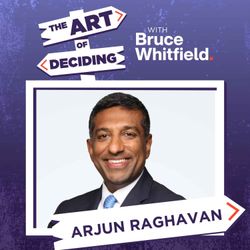
20. Arjun Raghavan - CEO of Partners Capital
25:51||Season 1, Ep. 20Would you take a pay cut for the career you want? Would you even take two? And what if the world's default position is actually chaos? How do we make decisions then? Arjun Raghavan is CEO of Partners Capital, making million-dollar decisions every day. He took some big decisions to get himself on the career path he wanted and to achieve his ambitions. Find out how he makes his choices in the last episode before our summer or winter break (depending on the hemisphere you're in!).00:00 – The Asymmetry of OutcomesRaghavan introduces his decision-making philosophy: optionality, assessing upside vs. downside, and treating choices like investment bets.02:10 – From Engineering to ConsultingEarly career pivots from engineering to Andersen Consulting (now Accenture), and eventually, an MBA at INSEAD.04:50 – A 60% Pay Cut and Ostrich FarmsA bold detour into nonprofit consulting in Namibia through Accenture Development Partnerships, with key lessons on timing and impact.08:15 – The Leap into FinanceJoining a small hedge fund led by ex-Goldman Sachs professionals, learning the hard truths of investment careers, and taking a second massive pay cut.11:30 – Finding the Right Fit at Partners CapitalDiscovering a multifaceted, client-facing, global investing role at Partners Capital that aligned with his love for variety and challenge.14:20 – Managing Billions Amid Global ChaosReflecting on how Partners Capital operates with $60–65 billion AUM across 8 global offices—navigating geopolitical, economic, and market volatility.17:00 – Annie Duke and Decision-Making PhilosophyDrawing from Thinking in Bets by Annie Duke to stress separating decision quality from outcomes; investing is a long-term, probability-based game.20:15 – Human Behaviour, Loss Aversion, and ClientsHow emotional utility shapes investment decisions, and why sometimes logic alone doesn’t serve client needs.23:00 – Barack Obama and Sleeping WellQuoting Obama on making the best decision with available data and learning to sleep peacefully with uncertainty. ReferencesAnnie Duke – Thinking in Bets: A guide to probabilistic thinking and decision-making in uncertainty.Hans Rosling – Factfulness: A data-based antidote to fear and pessimism.David McWilliams (economist): Featured in earlier episodes discussing how markets discipline populists.Barack Obama (on decision-making): Knowing you made the best call with the information available brings peace of mind."Where Are the Customers’ Yachts?" by Fred Schwed Jr.: A classic critique of Wall Street’s appearance vs. reality.Discover more about Bruce Whitfield here - https://www.brucewhitfield.com/ The Art of Deciding is produced by Podcart - https://www.podcart.co.uk/Series Producer: Jayne Morgan
More episodes
View all episodes
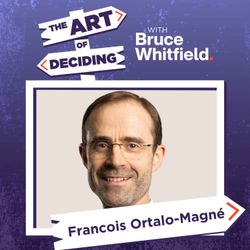
19. François Ortalo-Magné - former Dean of The London Business School
26:13||Season 1, Ep. 19How do you steer one of the world's most prestigious business schools through a global pandemic? What is a "leadership script"? And what happens when Bruce is introduced to "success squared"? François Ortalo Magné was Dean of the London Business School between 2017 and 2024. He successfully led the organisation through COVID's near catastrophic consequences. He has some very clear advice about how he makes decisions, how to tap into 'good luck', how to take the future into account ... and how to take your teams with you whatever decisions you make.Key TakeoutsUse a Leadership Script: Anchor decisions in your organisation's purpose and personal values. Francois drew on institutional strategy from LBS and principles developed during his tenure at the Wisconsin School of Business.Don’t Default to Binary Choices: The “third alternative” method echoes practices seen in systems thinking and decision design.Transparency Builds Trust: Rather than parroting "safety first," Francois and his team communicated a nuanced dual priority—resonating with an academically sophisticated audience.Empower the Collective: The LBS community embraced a shared mission that echoed ideas of collective action and organisational behaviour common in management literature.Simplify to Persuade: Referencing research on persuasion, Francois underscores the need to distil complex arguments into a few strong points.Tune Your Radar to Opportunity: Citing psychological research into luck, Francois explains how openness to possibility enables us to see and seize opportunityFrancois’s decision framework (01:11–03:00)Research, multiple perspectives, mental models, and the use of a “leadership script.”Admissions Dilemma During COVID (03:01–04:30)Faced with major income loss, would LBS lower standards to admit more students?Defining Priorities: Safe and Open (04:31–06:20)Why Francois rejected the simplicity of “safety first” and instead embraced honest tension.Community-Driven Trade-Offs (06:21–08:00)How clarity in messaging inspired collective responsibility across the school.Fast Thinking, Structured Governance (08:01–09:50) Creating task forces with focused remits, and leveraging contrasting personalities for balance.The Power of Thinking Twice (09:51–12:00) Inspired by a meeting with the C-suite of a Fortune Global 500 company; reinforces the value of stepping back and asking again.Learning from a Personal Property Miss (12:01–14:20)A story about London housing and the anticipated impact of the Jubilee Line expansion—an example of economic foresight.Bending the Curve of the Future (14:21–16:00) Long-term investments in teaching spaces and faculty capabilities paid off unexpectedly when remote teaching became necessary.Think in 3D, Speak in 2D (16:01–18:10) Wisdom from an LBS Governor on visualizing institutional complexity and simplifying messaging.References:Francois Ortalo-Magné: Economist and academic, former Dean of London Business School and Wisconsin School of Business.London Business School (LBS): One of the world’s premier institutions for business education.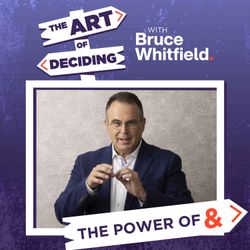
18. The Power of And
15:50||Season 1, Ep. 18Can one word change your life? Bruce thinks so. In this solo episode he unpacks a deceptively simple but transformative idea. Drawing from personal insight, academic influence, and examples from previous episodes, Bruce challenges listeners to step away from the comfort of binary choices and embrace the complexity of the real world.Key Takeaways"And" vs. "But":The word “but” often shuts down possibilities. Replacing it with “and” fosters openness, creativity, and more constructive dialogue.The Binary Trap:We instinctively seek simplicity — growth or security, tradition or innovation — but this limits our ability to navigate real-world complexity.Embracing Complexity:Success in today’s world belongs to those who can hold opposing truths, navigate ambiguity, and resist the pressure to simplify.The Unreasonable Advantage:Progress is driven by those willing to defy convention. As George Bernard Shaw said, "All progress depends on the unreasonable man."Examples in Action:Companies like Patagonia, LEGO, and Tony’s Chocolonely show that it’s possible to be profitable and purposeful, legacy-honouring and innovative.Decision-Making in Practice:Real-world decisions don’t follow linear logic. Leaders must think more like jazz musicians — adaptive, improvisational, and collaborative.Notable Quotes"Every time you want to use the word 'but', use 'and' instead."— Professor Chris Dalton (as quoted by Bruce)"Comfort isn’t a metric of a good decision. Discomfort is often required."— Bruce Whitfield"The real world isn’t an either/or world. It’s messy. It’s uncertain. It’s full of conflicting data, competing priorities, and impossible expectations. It is the world of 'and'."— Bruce Whitfield"All progress depends on the unreasonable man."— George Bernard Shaw (quoted by Bruce) References & MentionsChris Dalton – Henley Business School professor whose advice on conjunctions inspired this episode’s theme.George Bernard Shaw – Quoted for his insight on the nature of progress and unreasonableness.Past Guests Referenced:Lord Karan Bilimoria – On serendipity and seeing differently.Noula Walsh – On pausing before action.Lee Child – On betting on oneself and the cost of timidity.Companies & Examples:Patagonia – Profitable and fighting climate change.Tony’s Chocolonely – Expanding and ethical.LEGO – Rooted in tradition and digitally transforming.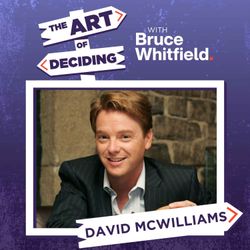
17. David McWilliams - economist, author and broadcaster
24:57||Season 1, Ep. 17ACAST NOTESMoney doesn’t exist. Economics isn’t about equations, it’s about us. Irish economist, David McWilliams, talks about the invention of money, how it drives our choices and how to make better decisions about it - our greatest, yet most divisive, invention so far. Why does traditional economics miss the mark? How can humour democratise economic literacy? Why is investing in yourself the most liberating financial decision you can make?David is talking about his book Money: A story of Humanity - Money: A Story of Humanity - https://www.amazon.com/Money-Story-Humanity-David-McWilliams/dp/1982152958at the Franschhoek Literary Festival in South Africa 16 - 18 May 2025. https://www.flf.co.za/https://www.flf.co.za/participants/david-mcwilliams/ 00:00 – 01:52 | The Nature of EconomicsWhy economics is about humanity, not numbers. Money as a made-up but powerful force.01:53 – 05:45 | What Economists Get WrongThe plumbing analogy: why economists understand mechanics but not meaning. The limits of academic jargon.05:46 – 06:40 | The Origins of MoneyMesopotamia, the move from barter to symbols, and how money emerged as a trust technology.06:41 – 09:10 | Commerce, Counting, and ReligionHow commerce required writing, courts, laws, and even religion to underpin trust at scale.09:10 – 14:11 | Weaponized Economics & Global DecisionsHow money disciplines power—particularly in US politics. Financial markets as democracy’s silent opposition.14:12 – 17:54 | Supercycles and Global VolatilityUnderstanding the big turning points in modern economic history and the new age of economic nationalism.17:55 – 21:08 | Kilkenomics & Humor as a LensHow comedy disarms economic elitism. Making economic insight accessible through laughter.21:09 – 24:52 | The Ultimate Decision: Invest in YourselfWhy the most powerful financial move is personal investment—and why time always wins over money.Kilkenomics Festival – An economics and comedy festival in Kilkenny, Ireland - https://www.kilkenomics.com/Paul Krugman – Nobel laureate economist and Kilkenomics speaker - https://paulkrugman.substack.com/Reagan & Thatcher Era – Markers of the last economic supercycle - https://adst.org/2016/07/extra-special-relationship-thatcher-reagan-1980s/Xi Jinping and U.S. politics – Case studies in economic decision-making under global flux - https://en.wikipedia.org/wiki/Xi_Jinping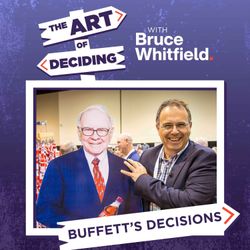
16. Warren Buffett's Decisions
30:43||Season 1, Ep. 16Warren Buffet’s current net worth is around $165 billion. Have you ever wondered what makes him the most successful investment decision-maker in the world? This time every year, thousands of finance professionals flock to his company, Berkshire Hathaway’s AGM in Omaha, desperate to find some answers to that question. Two of the people who went last year - experienced investors, Hywel George and Terence Moll - let us in on what really goes on at what’s been called the ‘Woodstock for capitalists’. And on how Warrren Buffet has influenced their own decision-making.Key takeaways: Simplicity and Patience Win: Buffett’s genius lies in making few decisions but executing them exceptionally well over time.Integrity Over Everything: Integrity in leadership is non-negotiable for sustainable business success.Emotional Intelligence Matters: Successful investing is deeply human; it requires judgment about character and emotion.Long-Term Mindset: Buffett’s success is powered by a focus on the next 10–50 years, not the next quarter.Learning from Mistakes: Buffett’s early mistakes, particularly with Berkshire Hathaway itself, helped shape a stronger investment philosophy.Importance of Structure: GEICO’s acquisition and use of "float" — permanent capital — was a masterstroke in capital allocation.Avoid Hype: Buffett and Munger’s refusal to chase trends, even at the cost of missing out temporarily, shows the value of sticking to core principles.Philanthropy as a Decision: Buffett’s commitment to giving away his fortune represents perhaps his most profound decision, impacting millions.ReferencesBerkshire Hathaway AGM – Often called the "Woodstock for Capitalists."· Warren Buffetthttps://www.berkshirehathaway.com/Key Figures:Charlie Munger (Buffett’s late business partner)Tim Cook and Bill Gates (noted attendees at the AGM)Companies Mentioned:Coca-Cola, Apple, Kraft Heinz, Bank of AmericaGoldman Sachs, Amazon, NvidiaPhilanthropy:Bill and Melinda Gates FoundationClip of Buffett addressing University of Georgia here https://youtu.be/Aa_TPj2pWLU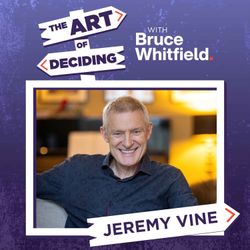
15. Jeremy Vine - broadcaster and author
29:50||Season 1, Ep. 15Jeremy Vine is one the UK's most popular presenters. Millions of people tune in to hear him – and talk to him - on Channel 5 and BBC Radio 2 every day. He opens up about some of the many decisions he’s made during a nearly 40-year broadcasting career. What should he have done when John Prescott gave him an off-camera scoop at the 1995 Labour Conference (and what did he do)? How do he and his team decide what goes into his shows? Why did he decide that the next thing for him was writing a crime novel? And why did he really decide to do Strictly? Listen in as one of our most versatile and best-loved broadcasters lets us in on some of his innermost thought processes.Murder on Line One comes out 24 April 2025🕰️ Chapters00:00 – Introduction: "TV is squash. Radio is snooker."02:00 – Jeremy's manic morning routine and show preparation04:20 – The power of radio and its fiercely loyal audience07:10 – Relevance as a life force and decision-making in show content10:35 – Values vs. views: Navigating BBC impartiality13:00 – From Africa correspondent to Radio 2 host: Career pivots16:15 – The Prescott tape dilemma: Should it air or not?19:40 – What makes a good producer and working with unpredictable teams22:15 – Real stories that resonate: The hold-all campaign for children in care24:00 – Writing Murder on Air One: A novel rooted in personal experience26:40 – Strictly Come Dancing, punk bands, and letting your real self show28:30 – No retirement, only beginnings: Jeremy’s outlook on the futureReferencesBBC Radio 2 – Jeremy’s flagship show with 7M+ listenersChannel 5 – Current affairs show taking live callsNewsnight / Panorama / The Today Programme – Previous rolesJohn Prescott – A story of journalistic discretionMurder on Line One – Jeremy Vine's novel (Out April 24)Thursday Murder Club – Richard Osman’s whodunnit seriesStrictly Come Dancing (2015) – Vine’s dance floor debutFind out more about Bruce here - https://www.brucewhitfield.com/This is a Podcart production.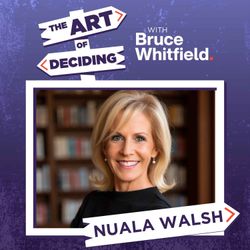
14. Nuala Walsh - author of Tune In: How to Make Smarter Decisions in a Noisy World
27:40||Season 1, Ep. 14“The more successful you are the more vulnerable you are to bias”. Nuala Walsh has identified 200 biases that affect all our decisions! In her book Tune In: How to Make Smarter Decisions in a Noisy World she explores how biases cloud judgment and why even smart, successful people make bad decisions. Drawing from her 30-year career in the corporate world and her behavioural science expertise, she’s created the Perimeters Framework—a practical tool to help individuals and organizations mitigate decision risk.00:00 – Intro: The Real Risk Is Decision Risk Bruce introduces the core theme of decision risk and welcomes guest Nuala Walsh.01:30 – Why Nuala Walsh Chose Decision Science Nuala shares her corporate background and what drew her to behavioural science.04:15 – What Is ‘Decision Risk’? Exploring why poor decision-making is often overlooked compared to economic or political risks.05:40 – The Perimeters Framework: 10 Decision Traps Nuala introduces her signature framework derived from 200 cognitive biases.09:29 – Bias Bingo and Real-World Case Studies From Trump to Theranos—how bias shows up in politics, business, and history.12.23 – The Myth of Fast Decisions The problem with speed over substance and the lure of decisiveness in leadership.14:10 – Slowing Down with Decision Friction Tactics for creating pause, using reflection, and the 5 Why’s method.21:00 – Emotion, Fear & The Probability Test Strategies to remove emotion and fear from high-stakes decisions.23:15 – Regret, Self-Awareness & Long-Term Learning How regret shapes future behaviour and why self-awareness is critical.25:49 – Final Insights & Tools for Better Decisions Reflection on key lessons and practical tools from Nuala’s work.Resources & MentionsBook: Tune In: How to Make Smarter Decisions in a Noisy World by Nuala WalshFramework: The Perimeters Framework – 10 decision traps based on over 200 cognitive biasesReferenced Thought Leaders:Noah Yuval Harari – “True power means knowing what to ignore.”Morgan Housel – Same as Ever, focusing on what doesn’t changeMary Budd Rowe – Research on reflection improving judgmentAdam Grant – Challenger Networks for diverse thinking