Share
The Art Bystander
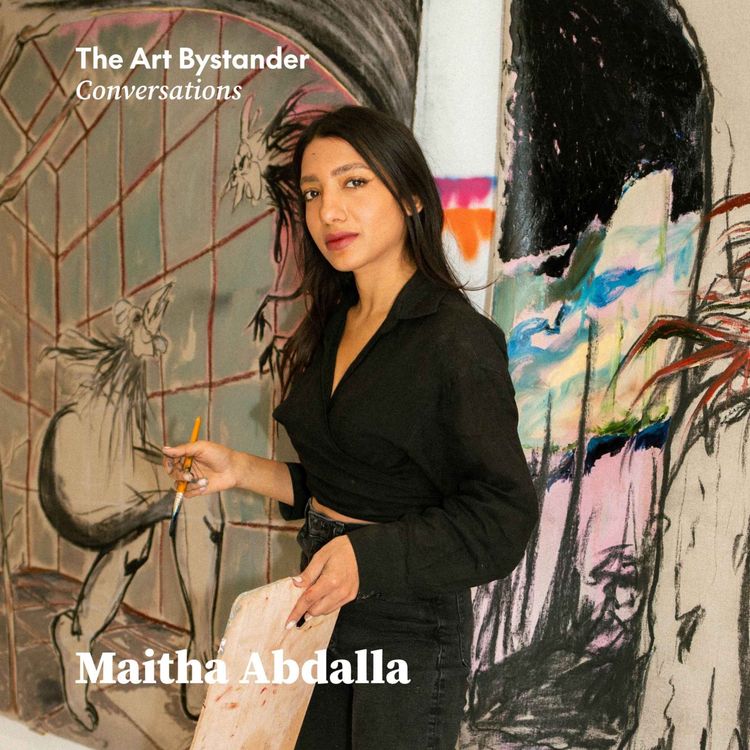
#63 Maitha Abdalla
Maitha Abdalla on folklore, guilt and the landscapes she paints. At her grandmother’s house in Khorfakkan, Maitha Abdalla remembers waking to the call to prayer, her grandmother’s voice and a rooster she had been taught could see angels. Years later she gave the bird a companion in her paintings. The rooster and the pig might fight, hold a conversation or become intimate. Both, she says, are her.
Roland-Philippe Kretzschmar met the Emirati artist in Paris in October 2026 to record The Art Bystander Podcast. Abdalla works across painting, sculpture, film and performance. One of eleven children, Abdalla recalls the drawing of a doll that first made her feel seen, the anger she carried as a teenager and the bargain she struck with her father to travel alone at eighteen. A year in London and several months teaching art and English in Turkey gave her time to write about the characters she remembered from home.
Abdalla explains why she writes a character before deciding whether to paint it or give it a part in a performance. She describes working on a canvas spread across the studio floor, applying paint with her fingertips while one song plays on repeat. We discuss the women she grew up among, the masculine qualities of some of her female figures, and her interest in what guilt can do to a body. She explains why sadness makes her want to write, and why she hesitates when asked if she goes looking for it. A comparison between Swedish forests and the Gulf desert prompts her to consider why a family might need a story to live with the loss of someone who went missing.
The conversation turns to the imagined forests Abdalla began seeing before sleep on an earlier stay in Paris. Those landscapes are now on view in London. A pink sky or a crooked branch can suggest that someone has passed through, been hurt or fallen in love. When asked where she finds herself in these places, Abdalla answers, “I’m the landscape.” She also introduces Sit on the Chair Before It Forgets Its Purpose, a project she began during a research residency in Sharjah. In Tunisia she is exploring Stambeli, a tradition of music and trance. She explains why she hopes to take part in the rituals herself.
Afterglow: From the Residue of a Departed Sun
Maitha Abdalla, Omar Kholeif, Mohamed Monaiseer and Randa Maddah
Presented by Tabari at No.9 Cork Street, London
30 October–21 November 2026
More episodes
View all episodes
62. #62 Juergen Teller & Dovile Drizyte
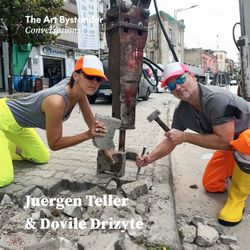
52:09||Season 1, Ep. 62Juergen Teller and Dovile Drizyte join Roland-Philippe Kretzschmar for a conversation about the creative partnership at the centre of their shared life.From his portraits of Kate Moss and Kurt Cobain to his collaborations with Marc Jacobs, Helmut Lang and Vivienne Westwood, Teller has developed one of photography’s most recognisable approaches. Here, he and Drizyte discuss how working together changed that practice, the role she plays across ideas and production, and why she encouraged him to continue when commercial photography was beginning to lose its appeal.We talk about building trust with the people in front of the camera, fashion as theatre, the value of uncertainty and the risks both took to be together. Drizyte also reflects on her path from political science and diplomacy to a career in New York and their life in London.The conversation leads into Guten Morgen Sonnenschein, Teller’s exhibition at Galerie Suzanne Tarasieve in Paris. They discuss images of their bodies appearing to merge and the morning coffee photographs he describes as a love letter to his wife.Guten Morgen SonnenscheinGalerie Suzanne Tarasieve, 7 rue Pastourelle, 75003 Paris7 November 2026–16 January 2027Also mentioned: The 90s: Art and Fashion, curated by Edward Enninful with the Tate team, at Tate Britain until 14 February 2027.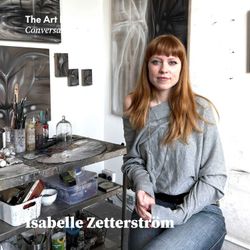
61. #61 Isabelle Zetterström
34:58||Season 1, Ep. 61Isabelle Zetterström on painting the inner world. In her London studio, British-Swedish artist Isabelle Zetterström joins Roland-Philippe Kretzschmar to discuss the imagined landscapes through which she explores emotion, memory and the changing self.Recorded in October 2026, the conversation begins with a new series of paintings made for Stockholm. Zetterström describes using light and shadow to examine the self we show to others, the person we hope to become and the experiences we keep partly concealed. She reflects on why darkness can feel protective, and how drawing once helped her recognise feelings she could not otherwise name.We discuss growing up between two cultures, receiving a dyslexia diagnosis at eighteen and finding her way to the Royal College of Art, where she completed her MA Painting in 2026. The conversation also explores daydreaming, poetry, spirituality and the unexpected intimacy of hearing someone else describe what they see in her work.Zetterström features in Shapeshifting at Belenius, Stockholm, alongside Jenny Palén, Dorothea Tanning and Elsa Thoresen. Co-curated by Kretzschmar and Belenius, the exhibition runs from 6 November to 12 December 2026.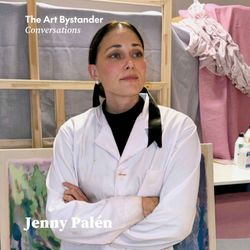
60. #60 Jenny Palén
32:57||Season 1, Ep. 60Jenny Palén on dreams and making art before understanding it. In her studio outside Stockholm, artist Jenny Palén joins Roland-Philippe Kretzschmar for a conversation about the images that arrive before their meaning becomes clear.Moving between painting, sculpture, film, textiles and scenography, Palén follows an idea before deciding what form it needs. Sometimes, she only understands what a work was about months or years after making it. We discuss her beginnings in Stockholm’s graffiti scene, studying art while raising children, and the role of meditation and lucid dreaming in her creative life. She describes how older works return in new forms, why film can feel like the ultimate medium, and what draws her to the meeting of hyperreality and Surrealism.The conversation also explores humour, the uncertainty of artistic legacy and her connection to Dorothea Tanning’s sculpture and textiles.The conversation was recorded ahead of Shapeshifting at Belenius, Stockholm. The exhibition brings together Palén, Tanning, Elsa Thoresen and Isabelle Zetterström. Co-curated by Kretzschmar and Belenius, it runs from 6 November to 12 December 2026.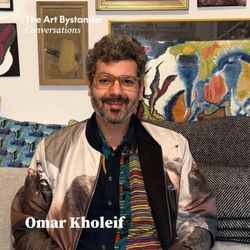
59. #59 Omar Kholeif
57:14||Season 1, Ep. 59Omar Kholeif has curated more than 100 exhibitions and written or edited over forty books. Showing their own paintings under their own name, however, meant giving up something they had wanted to keep private. Recorded at Kholeif’s home in East London, this episode of The Art Bystander brings Roland-Philippe Kretzschmar into conversation with the artist, author, curator and broadcaster about the experiences behind their work.Kholeif is Professor of Global Modern and Contemporary Art History at the Glasgow School of Art and leads its postgraduate programme in curatorial practice, delivered jointly with the University of Glasgow. They previously held senior positions at Sharjah Art Foundation, the Museum of Contemporary Art Chicago and Whitechapel Gallery. Their books include Internet_Art: From the Birth of the Web to the Rise of NFTs.We discuss Fellow Travellers at Tabari in Dubai, which brings five women artists into conversation with Kholeif’s paintings, and the research, friendships and personal decisions behind the exhibition. Kholeif recalls the trickster stories of their childhood, the influence of Jean Fisher and the encounter with Derek Jarman’s Blue that helped them understand why they had to make art.The conversation also addresses the art world’s fixation on biography, the financial reality behind a public career, and “dreamwork”: protecting the conditions in which people can imagine and create. We conclude with Afterglow in London and paintings made through experiences of physical pain, family separation and survival.Fellow Travellers: Tabari, DIFC, Dubai, until 10 January 2027.Afterglow: From the Residue of a Departed Sun, No.9 Frieze Cork Street, London, 30 October–21 November 2026.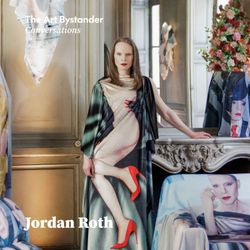
58. #58 Jordan Roth & Adam Charlap Hyman
44:02||Season 1, Ep. 58Jordan Roth spent years helping other people bring their creative visions to the stage. Eventually, he began to miss his own. His route back started with something he could practise every day: getting dressed.Recorded in Paris during Art Basel week in October 2026, this episode brings together the artist, actor and seven-time Tony Award-winning theatre producer and designer Adam Charlap Hyman for a conversation with Roland-Philippe Kretzschmar about identity, performance and the emotional lives of objects.Their starting point is Roth’s exhibition To Think of the Tranquil Life of Things, designed by Charlap Hyman & Herrero. Before leaving the New York apartment where he had lived for 15 years, Roth was photographed wearing clothes from different chapters of his life. Those photographs became collages printed onto silk crepe and draped over furniture, giving physical form to the memories held within a home. The exhibition takes its title from Georges Perec’s Life: A User’s Manual.Roth speaks candidly about being a child who struggled to make sense to others, finding belonging on stage, and the professional uniform that eventually began to feel restrictive. He explains why performance is a way of revealing himself, and why he now imagines identity as an expanding circle that continues to contain earlier versions of a life.Charlap Hyman describes translating the apartment into a Parisian exhibition, where rooms and objects recur in altered forms. Together, they consider the home as a self-portrait, collecting as a means of changing ourselves, and the difficulty of distinguishing our own instincts from other people’s expectations.There are also deeply personal memories: a chair where Roth fed his baby, a kitchen sink used for a first bath, and a child making music with his great-grandmother.To Think of the Tranquil Life of Things is presented in partnership with Salon 94 Design and Design Miami at 72 rue de l’Université, Paris, from 20 to 25 October 2026.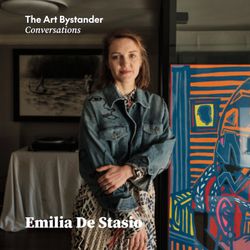
57. #57 Emilia De Stasio
52:13||Season 1, Ep. 57You can love a work of art and still question its price. You can support an artist and still want to understand what happens when you need to sell.In this episode of The Art Bystander, Roland-Philippe Kretzschmar joins collector and Artscapy co-founder Emilia De Stasio in London for a conversation about the emotional convictions and financial decisions that shape a collection.With a background spanning the European Central Bank, Moody’s and technology investment, Emilia brings an analytical eye to a deeply personal pursuit. Together with her husband, Alessandro, she owns around 200 works, with one firm rule: they buy living artists. Their collection explores identity, social politics and the relationship between humanity and the natural world.We discuss what draws her to difficult, demanding art; how galleries and institutions influence an artist’s market; and the uncomfortable gap between buying a work and being able to sell it. We also examine why useful technology can struggle to gain acceptance in an industry built on personal relationships.Those questions led the couple to establish Artscapy. Now, the platform is entering the auction market: its first Modern and Contemporary Art sale runs online from 2–12 November 2026, with 0% seller commission and a 16% buyer’s premium.I ask Emilia whether those economics are sustainable, how the model serves collectors over time, and what support remains when a work fails to sell. Throughout our conversation, one question persists: whose interests does the art market actually serve?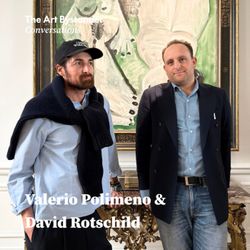
56. #56 Valerio Polimeno & David Rotschild
25:08||Season 1, Ep. 56What happens when you spend enough time with a painting to imagine living with it? In this episode of The Art Bystander, our host Roland-Philippe Kretzschmar speak with David Rothschild, Sotheby’s Head of Contemporary Art Private Sales in the UK and Global Lead for Private Sales Exhibitions, and Valerio Polimeno, founder of _POLIMENO, about Chez Sotheby’s.Taking place from 19–24 October during Art Basel Paris, the project brings nearly $150 million of art into an apartment on Rue de Rivoli overlooking the Jardin des Tuileries. Works by Picasso, Matisse, Warhol, Richter, Bacon and others inhabit rooms conceived for dining, conversation and the pleasure of looking. The curation is just perfect.Our conversation follows the collaboration from its beginnings in Gstaad and London to the personal experiences that shaped Valerio’s approach to hospitality. He recounts how a dismissive remark about the pasta served at an earlier exhibition helped inspire this project, and why creating a welcoming space begins with the intentions of its hosts.David discusses sourcing works from private collections and the connections that emerge when different periods share a room. Among them is a pairing both guests would happily take home: Degas’s ballerinas and a painting by Cecily Brown, whose encounters with Degas helped inspire her work.We also discuss the business behind the invitation. Everything is available for private sale, and the setting allows collectors to consider art within the rhythms of everyday life. Drawing on Paris’s history of salons, homes and restaurants, Chez Sotheby’s asks how the company we keep, the rooms we inhabit and the time we give a work might influence what we see.Chez Sotheby’s | Paris | 19–24 October 2026Viewing enquiries: chezsothebys@sothebys.comAddress supplied on request.Exhibition details and catalogue:https://www.sothebys.com/en/digital-catalogues/chez-sothebys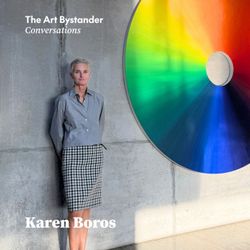
55. #55 Karen Boros
29:18||Season 1, Ep. 55Collector Karen Boros joins Roland-Philippe Kretzschmar in the latest episode of The Art Bystander podcast. Karen Boros and her husband Christian began by collecting artists of their own generation. As they grew older, they made a deliberate decision to keep following younger artists, eventually those of their son’s generation. Collecting became a way of staying engaged with experiences and ideas beyond their own.That willingness to remain curious runs through our conversation, recorded in Karen’s home above the Boros bunker in Berlin, after she had taken us through the collection downstairs.Opened to the public in 2008, the collection occupies a former air-raid shelter that has also served as a prison, a warehouse and a techno club. Its changing presentations bring contemporary art into spaces where the building’s history remains impossible to ignore.Karen’s experience extends across several parts of the art world. With a background in psychology and art history, she worked in galleries before joining Art Basel in 2005, working in VIP relations for Germany. Alongside building the collection with Christian, she has spent years engaging with other collectors and the relationships through which people find their way into art.She is candid about how their own decisions happen. “Sometimes I think we should have a strategy, but we don’t,” she tells me. The collection grows through exhibitions, encounters and conversations, supported by longstanding trust in particular galleries.I wanted to explore how an initial interest becomes a lasting commitment to an artist. What gives you confidence in a practice? What happens when it develops in a direction you hadn’t expected? And what can collectors contribute through the works they buy, the projects they support and the audiences they help artists reach?Karen makes a point about galleries that deserves more attention: they produce exhibitions that anyone can visit for free. She also speaks about the importance of a work leaving the studio, being seen and entering into discussion. Supporting art involves making those encounters possible.We talk about Berlin’s changing artistic communities, the challenge of encouraging younger people to collect, and the care involved in opening a private collection to the public. Some people arrive at the bunker knowing the artists; others come for the building and discover the art.Karen calls them guests. By the end of our conversation, you understand how much work goes into making that word meaningful.