Share

The Art Bystander
#38 Daniel Arsham
In this episode of The Art Bystander, host Roland-Philippe Kretzschmar sits down with Daniel Arsham, one of the most influential contemporary artists working today — an artist whose work treats the present as if it were already history. Arsham is internationally known for what he calls “fictional archaeology”: sculptures, objects, and environments that imagine contemporary culture as relics of the future — eroded, crystallized, and excavated from time yet to come.
Born in Cleveland, raised in Miami, and educated at The Cooper Union in New York, Arsham has built a practice that moves fluidly between fine art, architecture, design, fashion, and popular culture. His work is held in major museum collections around the world and has reached audiences far beyond the traditional art world, shaping how an entire generation encounters contemporary art.
With his recent book Future Relic, Arsham turns the lens inward. The book offers a rare and unvarnished account of what it actually takes to build a life in art — the failures, detours, discipline, and belief that exist behind the finished works we usually encounter only at the end of the journey.
From photographing the aftermath of Hurricane Andrew as a teenager in Miami, to formative years at Cooper Union, to collaborations with Merce Cunningham, Pharrell Williams, Christian Dior, and the Cleveland Cavaliers, Arsham shares the experiences that shaped both his work and his worldview.
Future Relic is not a romanticized memoir. It’s closer to a masterclass — a brutally honest guide to the realities of building a creative life. Arsham speaks candidly about the grind behind the work: how to find a gallery, why having the right lawyer matters, how to think like a creative entrepreneur, and why surrounding yourself with ambitious people is essential.
In this conversation, we talk about time, ambition, rejection, visibility, and the long game of making art — not just objects, but a practice capable of enduring.
More episodes
View all episodes
52. #52 Michael Sailstorfer
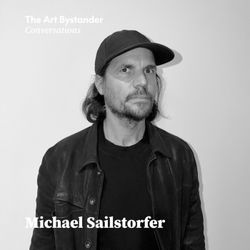
35:39||Season 1, Ep. 52In Berlin, a gallery floor is disappearing, one stone at a time.In this episode of The Art Bystander Podcast, Roland-Philippe Kretzschmar meets Michael Sailstorfer at Galerie Judin’s Mercator Höfe space for a conversation about artistic freedom, physical labour and the uncertainty that runs through the German artist’s latest installation, Pull the Rug.Around 11,000 paving stones cover the exhibition floor. Every 50 seconds, a worker removes one and feeds it through an opening in the wall. A concealed machine then propels it into an adjoining room, sending the sound and vibration of its impact back into the gallery. Over the course of the exhibition, the floor is gradually removed, exposing the sand beneath.Born in Bavaria in 1979, Sailstorfer grew up around his family’s stone workshop before studying at the Academy of Fine Arts in Munich and Goldsmiths in London. Now based in Berlin, he has spent more than two decades expanding sculpture through movement, sound, scent and processes of transformation and destruction.Their conversation moves from his childhood and early ambitions to the pressures of finding success while still at art school, the importance of working directly with materials, and the unpredictable relationship between an idea and its realisation. Sailstorfer explains why he once considered becoming a farmer or an architect, and why the freedom of art ultimately persuaded him to take another path.Returning to Pull the Rug, they discuss the stability he remembers from his own childhood, the world his children are growing up in, and the uneasy proximity of repetitive labour, contemplation and aggression. A simple act of feeding a stone into a wall becomes the starting point for a wider discussion about machinery, responsibility and what happens when the consequences of our actions are hidden from view.Recorded at Galerie Judin, Berlin, during Berlin Art Week 2026.Michael Sailstorfer: Pull the Rug10 September to 10 October 2026Galerie Judin, Mercator Höfe, BerlinExplore Michael Sailstorfer’s workExhibition information at Galerie Judin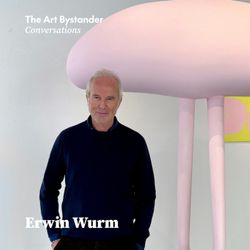
51. #51 Erwin Wurm
37:34||Season 1, Ep. 51In this episode of The Art Bystander Podcast, Roland-Philippe Kretzschmar is joined by Erwin Wurm on the occasion of Mind Bubbles & More at Carling Dalenson in Stockholm, running from 22 September to 31 October 2026. One could easily say Erwin Wurm is one of the world's most recognized and respected artists today.Born in Bruck an der Mur, Austria, in 1954, Wurm has spent more than four decades expanding what sculpture can be, finding material in clothing, furniture, cars, houses and the human body. He originally wanted to become a painter, but found himself placed in a sculpture department. His response was to keep testing the discipline until he could make it his own, eventually returning to painting through works he calls Flat Sculptures.That resistance to a fixed definition runs through his practice. In the 1992 video 59 Positions, a man and his sweater move through a sequence of poses, making sculpture out of the changing relationship between a body and its clothes. His later One Minute Sculptures invite participants to follow instructions involving everyday objects, adopting positions that can be awkward, funny or difficult to maintain. A sculpture exists briefly through someone's willingness to take part, with balance, embarrassment and the presence of an audience becoming part of the work.Wurm's distorted objects extend these questions into the things we buy and inhabit. In his Fat Car series, luxury vehicles acquire swollen bodies, exaggerating the excess already associated with them. Fat House turns domestic security into something ungainly and overgrown, while Narrow House compresses his childhood home into proportions that make moving through it uncomfortable. Possessions become a way of examining the expectations attached to success, respectability and belonging.These works can also be understood against the background of Wurm's childhood in postwar Austria, where the recent Nazi past often remained unspoken and conformity shaped everyday life. The absurd gives him a way of approaching the habits people accept without much examination. Following an instruction, dressing correctly or choosing a particular car becomes material for thinking about how we learn to fit in.There is a useful connection here with Pierre Bourdieu's account of taste and social distinction: the objects around us communicate class and aspiration, whether or not we intend them to. Wurm makes those objects physically strange enough for their social meanings to become harder to overlook. His humour can leave us wondering why we laughed, and how much of our own behaviour we recognise.Mind Bubbles & More brings together three-dimensional sculptures and recent Flat Sculptures. The Mind Bubbles borrow the familiar thought-bubble form from comic books while withholding the words or images we expect to find inside. The viewer supplies an imagined thought, continuing Wurm's interest in participation through an encounter that takes place in the mind.Across sculpture, performance, photography, video and painting, Wurm returns to questions of volume, identity and perception. Wurm’s work is held in major public collections including the Solomon R. Guggenheim Museum, Centre Pompidou, and Walker Art Center. He has received Austria’s Grand State Prize for Fine Arts (2013), the GNMH Award (2021), and an honorary doctorate from the University of Belgrade (2022). He is represented by Thaddaeus Ropac, Lehmann Maupin, and König Galerie.An introduction to an artist whose work makes the everyday a subject of sustained scrutiny, from the clothes on our bodies to the instructions we follow and the homes we build around ourselves. And be ready for some laughter!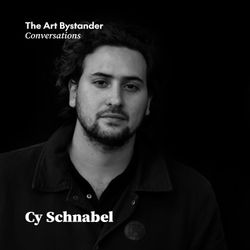
50. #50 Cy Schnabel
43:37||Season 1, Ep. 50“If I was going to open a gallery, it needed to have a very personal identity.” I met Cy Schnabel at Villa Magdalena in Madrid during Apertura Madrid Gallery Weekend to record a conversation for The Art Bystander podcast.Born in New York in 1993 to Julian Schnabel and Basque designer Olatz López Garmendia, Cy grew up around artists, filmmakers and musicians, with access to his father’s studio from childhood. He studied political science at Bard, imagining a future in journalism, before moving to Mexico City and discovering exhibition-making through the Centro Cultural de España en México.“I just discovered that curating was a storytelling medium.”Villa Magdalena opened in 2020 in Julian’s former studio at the family home on Monte Igueldo in San Sebastián. The setting was personal: summers spent surfing with his twin brother, his mother’s Basque heritage, and his work on the archive of his uncle, Alejandro Garmendia, whose estate remains central to the gallery.Madrid followed in June 2025. Opposite San Nicolás, away from the city’s established gallery concentrations, Cy found a space whose history appealed to him, with timber beams concealed beneath plaster. The move gave his artists greater visibility and a permanent base in a city he sees as an essential connection between Europe and Latin America.His programme returns to narrative painting, symbolic figuration and the ways mythology and folklore survive in images. He writes the texts and curates the exhibitions himself, working with emerging artists alongside older practices that deserve renewed attention.There is a practical responsibility behind that commitment. Artists need sales, and developing an audience for a body of work can take several exhibitions. “I’m running a business,” he says.We spoke about the privileges and assumptions attached to the Schnabel name, his admiration for his father’s painting, and the years of attention an artist’s work requires. His response to questions of inheritance is an invitation to look at what he has made: “People can judge me based on my work.”
50. #49 Anne Vieth & Philipp Solf
30:27||Season 1, Ep. 50Berlin’s cultural power was built on cheap space, unfinished buildings and artists willing to live precariously. The city is wealthier now, but can the people who created its value still afford to remain?For this episode of The Art Bystander Podcast, Roland-Philippe Kretzschmar speaks with Philipp Solf, entrepreneur, collector and one of the people behind Wilhelm Hallen and HALLEN 07, and Dr Anne Vieth, Head of the Mercedes-Benz Art Collection.Why does Solf resist calling HALLEN an art fair? What happens when contemporary art turns an industrial building into a desirable address? And what does a company such as Mercedes-Benz owe the culture from which it draws prestige?Vieth takes us inside SEEING FORMS, the collection’s exhibition at HALLEN 07, and speaks about using art to unsettle habits within a corporation. Solf is equally candid about art’s power to position property within a city, bringing the conversation to gentrification, public funding and who gains when culture makes an address valuable. This is a conversation about how Berlin might become wealthier without driving out the artists who made it culturally necessary.49. #48 Michèle Lamy & Scarlett Rouge
47:41||Season 1, Ep. 49In this episode of The Art Bystander, Roland-Philippe Kretzschmar enters a conversation with Michèle Lamy and Scarlett Rouge.Michèle Lamy is often introduced in relation to Rick Owens, but that has always felt like an incomplete way of understanding her.Born in France’s Jura region in 1944, into a family shaped by the Resistance, Lamy studied law in Lyon, attended the philosophy lectures of Gilles Deleuze and worked as a criminal defence lawyer while also performing striptease and cabaret.In 1979, she moved to Los Angeles without having visited the city. There she established her clothing line, created Café des Artistes and Les Deux Cafés, and treated hospitality as a form of theatre.Around 1990, she hired a pattern cutter named Rick Owens. Their working relationship became a partnership in life, and by 2003 they had moved to Paris and were building Owenscorp together. Lamy’s work has since moved through furniture, jewellery, music, film, performance and boxing. She has variously described herself as a storyteller, performer and entrepreneur, resisting any single professional title.Joining her is her daughter, Scarlett Rouge, an interdisciplinary artist raised between California and France. The daughter of Lamy and experimental filmmaker Richard Newton, and Owens’s stepdaughter, Rouge trained in photography at CalArts before developing a practice across painting, installation, sculpture, video, textiles and performance.Her work draws on myth, symbolic language, Jungian thought and ritual, asking how art might reconnect spirit and matter. Mother and daughter have also performed together in LAVASCAR alongside Nico Vascellari.In this episode, we speak about resistance and freedom, Los Angeles, family and artistic inheritance, collaboration, ritual, commerce and the making of spaces in which outsiders can belong.47. #47 Michele De Lucchi
48:34||Season 1, Ep. 47In today's episode Roland-Philippe Kretzschmar meets with design legend Michele De Lucchi. Born an identical twin, he grew up being treated, as he remembers it, almost as half of the same child. At 18, the brothers chose different disciplines, different cities and different appearances. His brother shaved; Michele grew the beard that has stayed with him ever since.“When you design something, you have to create an identity.”It is a wonderfully disarming beginning to a conversation with someone whose career runs through more than five decades of Italian architecture and design: Alchimia, Memphis, Olivetti, the Tolomeo lamp, major buildings, interiors, furniture, drawing, painting and sculpture. Yet I became less interested in making him recite that history than in understanding the person who has continued to question what design is for.De Lucchi speaks about objects as carriers of memory. His father appeared able to “listen” to a glass, a watch or a building and understand who made it, where and when. Function was never the whole story. Materials could hold a narrative; architecture could shape the life unfolding inside it.When I told him that his work makes me happy, he answered that it was the most beautiful compliment I could give him.“We don’t need pessimistic architects and designers because we don’t need a pessimistic future.”That may be the key to Michele De Lucchi. Radicalism, for him, is not a colour palette or a historical style. It is the courage to resist convention, grasp the energy of one’s own time and give form to a future worth entering.In the full episode, we travel from 1970s Florence to Olivetti and the beginnings of Memphis, but also into far more personal territory: his twin brother, Ettore Sottsass, a journey around the world, fashion, serendipity, meditation, AI and the unknown. Some stories are far better heard in his own voice, and I will not give them away here.Several of his designs will also appear in Radical Rooms, the exhibition I am curating for Mankovsky Gallery in Stockholm this August, bringing radical Italian design into conversation with contemporary painting.46. #46 Jérôme Pantalacci
35:48||Season 1, Ep. 46In this episode of The Art Bystander Podcast, I speak with Jérôme Pantalacci, founder and director of Art-o-rama in Marseille.At the end of August, I will travel to Marseille for Art-o-rama, a fair that has developed one of the most distinctive identities on the European art calendar. Founded by Jérôme in 2007, Art-o-rama has become known for its concentrated scale, its commitment to emerging galleries and artists, and its willingness to give space to presentations that are more experimental, specific and ambitious than the conventional art-fair booth.Held at La Friche la Belle de Mai, a former tobacco factory transformed into a major cultural complex, the fair is deeply connected to Marseille itself. The city’s position between Europe, North Africa and the wider Mediterranean gives it a cultural intensity that feels markedly different from the established art capitals. Marseille is layered, contradictory, international and resistant to easy definition, and Art-o-rama has grown from that context rather than attempting to impose a standardised global model upon it.In our conversation, Jérôme and I discuss how the fair began, what it means to build an international contemporary-art platform outside the traditional centres of market power, and how Art-o-rama has maintained its independence and curatorial character as it has grown.We also speak about the challenges facing younger galleries, the changing expectations placed on art fairs, the importance of discovery, and the tension between experimentation and commercial reality. What does a smaller fair make possible that a larger one cannot? How can a fair remain relevant without becoming predictable? And what can Marseille teach us about the future geography of the art world?As I prepare to visit Art-o-rama later this month, this conversation offers an introduction not only to the fair, but to the ideas, relationships and local conditions that have shaped it over almost two decades.This is a conversation about Marseille, independence, risk, discovery and the future of the contemporary art fair.45. #45 The Art Daddy
01:07:24||Season 1, Ep. 45For this summer episode, I’m joined by The Art Daddy for their first-ever interview.The Art Daddy is a New York City-based art and culture reporter, critic, educator and artist who has spent more than a decade covering the contemporary art world.Their writing has appeared in The Art Newspaper, ELLE, ARTnews, Artnet News and many other publications, and they have taught and lectured at universities across the United States.They studied performance art at the School of the Museum of Fine Arts in Boston and minored in Women’s Studies. That background remains central to The Art Daddy, which they see not simply as a media platform, but as an extension of their artistic practice.Across Substack and Instagram, The Art Daddy combines reporting and criticism with gossip, satire and cultural analysis. Often described as the TMZ of the art world, the platform looks beyond official narratives to examine the personalities, hierarchies and power structures shaping contemporary art.I am, of course, a middle-aged white man working within the art world, precisely the demographic that frequently appears in Art Daddy’s criticism. This gave us a particularly open, self-aware and entertaining starting point.We talk about the art market, generational shifts in taste and power, the problem with middle-aged men, and the often invisible labour dynamics sustaining the art world. We also get into the individuals, behaviours and hypocrisies that frustrate The Art Daddy most, and much more.It is candid, intelligent and very funny. Perfectly relaxed summer listening, but certainly not without bite.44. #44 Miramar Al-Nayyar
25:55||Season 1, Ep. 44In this episode, our host Roland-Philippe Kretzschmar is joined by Miramar Al-Nayyar, the Iraqi artist whose UK solo debut opens today (July 3, 2026) at Saatchi Yates in London. Miramar is the inaugural winner of the Saatchi Yates Fellowship Prize, selected from more than 5,000 submissions worldwide. She is 29, based between Amman and Abu Dhabi, and paints with a maturity that shows in her command of atmosphere, silence, and inner force.Her exhibition brings together paintings shaped by the vastness of the Middle Eastern desert: rock formations, flowers, solitude, and the slow intelligence of nature. Made between Lebanon and Jordan against a backdrop of conflict and unrest, these are not abstract landscapes. They are meditations on endurance, on what can still bloom under pressure.At the centre of the exhibition is the desert rose: a formation at once geological and floral, mineral and symbolic. In Miramar's hands it becomes visionary, a flower of the mind that emerges from silence, heat, distance, and memory. Her surfaces hold that tension between barrenness and abundance, fragility and force, the physical world and the invisible one. The work draws from desert landscapes and natural movement, but also from meditation, seclusion, and the ornamental rhythms of classical Islamic geometry. The paintings unfold like inner architectures: psychedelic, atmospheric, embodied. Her process is intuitive and physical, gesture as a way of listening. She paints less to depict nature than to receive it.What stayed with me was the spiritual depth of our conversation. We spoke about art as a form of surrender, about solitude as a creative condition, about the desert as both real landscape and inner state, about how images arrive from somewhere beyond language.Something in the way Miramar speaks about nature, intuition, prayer, and the unseen resonated with me. It reminded me that painting, at its most powerful, is not only visual. It can be a vessel for transformation, a way of making contact with what is buried, what is sacred, and what is still becoming. We speak about the desert rose, movement, memory, meditation, conflict, hope, and what it means for a young Iraqi artist to bring this personal, spiritually charged visual language into her first UK solo show.