Share
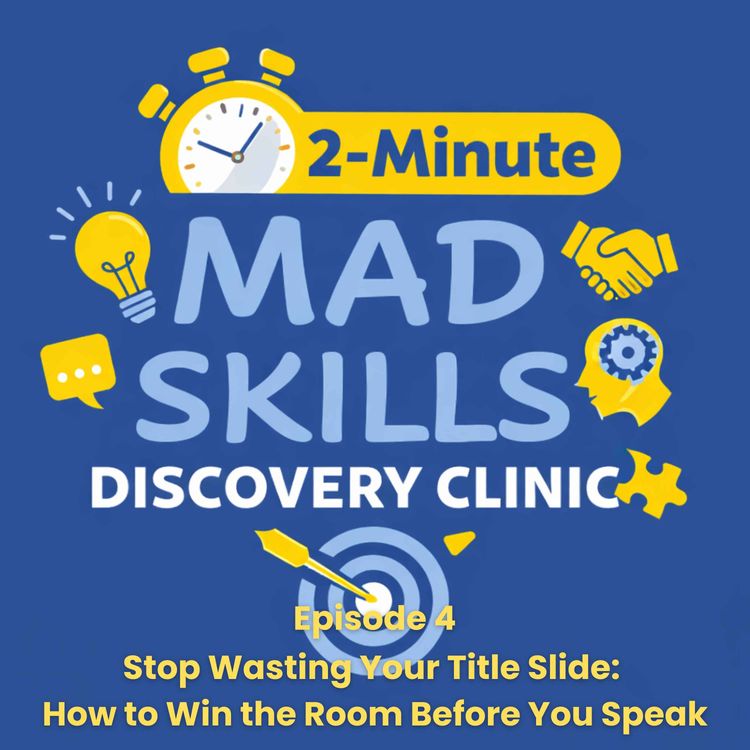
The 2-Minute MAD Skills Discovery Clinic
Stop Wasting Your Title Slide: How to Win the Room Before You Speak
Season 1, Ep. 4
•
Most presentations lose the room before the first sentence is spoken.
In this Two Minute Mad Skills Discovery Clinic, Cam Welsh explains why your title slide is the most overlooked—and most powerful—slide in your entire presentation.
After 25+ years of coaching case competitions and presentations, Cam breaks down:
- Why repeating the case title is a wasted opportunity
- How your title slide quietly sets expectations and credibility
- What details signal insight before you even speak
- How to use curiosity, context, and clarity to engage judges early
If you want the room leaning in before you say your first word, this episode shows you how.
More episodes
View all episodes
7. Rainmaking: The Presentation Skill That Creates Momentum and Makes Ideas Inevitable
01:51||Season 1, Ep. 7Rainmaking isn’t selling. It’s not pitching harder. It’s creating awareness, building trust, and generating momentum.In this episode, Cam Welsh shares a pivotal moment inspired by Mid-Day Squares cofounder Jake Karls — and how it transformed his approach to coaching, case solving, and presentations.You’ll discover why most presentation hooks fail, how rainmakers build lasting engagement, and how to turn any presentation into a relationship-building moment.If you want your ideas to resonate, stick, and move people to action, this episode will give you a powerful new framework.Don’t just present your solution. Rainmake it.
6. The Scorecard Secret
02:01||Season 1, Ep. 6Why do smart, hardworking teams still lose?In this episode of Two Minute Mad Skills Discovery Clinic, Cam Welsh reveals the most important lesson from his coaching career: the difference between average teams and podium teams isn’t talent — it’s alignment with the scorecard.After a defining moment at EngComm 2016, Cam realised that winning comes down to execution and constantly asking: “Does this hit the criteria?”If you compete, coach, or want to perform at a higher level, this episode will shift how you prepare.Real mad skills aren’t about doing more. They’re about doing what counts.
5. Your Slides Aren’t the Problem — Your Perspective Is
01:34||Season 1, Ep. 5Most presentations don’t fail because of weak slides — they fail because presenters forget the audience by slide three. In this episode, Cam Welsh shares a powerful lesson from a Georgetown University competition that transformed his coaching approach: always think from the audience’s seat.You’ll learn why engagement beats impressiveness, how storytelling outperforms slide dumping, and how positioning and role-play make ideas feel real rather than academic. This mindset shift helped lead teams to consistent podium finishes — and it can do the same for your presentations and leadership.If you’ve ever felt frustrated that your message isn’t landing, this episode will change how you think about communication forever.
3. Why Most Presentations Fail by Slide 3 (It Starts at the Beginning)
02:00||Season 1, Ep. 3Why do so many presentations start strong… then fall apart by slide three?It’s not a delivery issue.It’s not a slide design issue.It’s a starting issue.In this Two-Minute Mad Skills Discovery Clinic, Cam Welsh explains why most presentation openings fail—and what great presenters do differently. Spoiler: it’s not about bold tricks, dramatic quotes, or clever hooks. It’s about connection and positioning.In this episode, you’ll learn:The real job of a presentation openingWhy disconnected openings lead to disengaged audiencesHow to position yourself and your audience from the startHow great openings carry through the problem, solution, and conclusionWhen your audience feels seen, they lean in—and your presentation becomes one cohesive story instead of a stack of slides.👍 Like, subscribe, and leave a review to help others discover the show. Until next time—keep building those Mad Skills.
2. Role-Playing: Bridging the Gap in Case Presentations
02:03||Season 1, Ep. 2Quick question 👀Before your last case presentation… did you choose your role or did you just default to “outside consultants”?If it was the default, you’re not alone.One of the biggest challenges teams face in case-solving pitches isn’t the analysis.It’s positioning.Who are you supposed to be? And who are you actually talking to?In Episode 2 of this series, I break down:Why teams often drift out of role halfway through a presentationHow the case itself tells you who the real audience isA common myth about always presenting to the boardAnd why defaulting to “outside consultants” might be holding your team backSometimes the strongest pitches come from choosing a role that’s harder, but more authentic to the case: internal strategist, product teams, entrepreneurs, and even inventors.Great case pitches don’t start with slides. They start with a deliberate choice: Who are we and who are we talking to?
1. Role-Play Transforms Case Presentations
02:01||Season 1, Ep. 1In Episode 1, we dive into a crucial but often overlooked part of case presentations: role-playing. Many teams struggle because they treat their pitch like a simple conversation instead of stepping into the role of a problem solver advocating for their solution.This video breaks down why embracing your role and clearly defining your audience’s role can transform your case-solving pitches from forgettable summaries into compelling, persuasive presentations.What you’ll learn:Why most case presentations fall flatHow role-playing sharpens your analysis and deliveryPractical tips to clearly define roles and maintain them throughout your pitchHow to build confidence and professionalism in a low-risk environmentWhether you’re competing, presenting in class, or preparing for professional pitches, this episode sets the foundation for becoming a more effective and confident problem solver.Subscribe for more lessons on mastering case presentations and pitching skills.