Share
That's What I Call Marketing
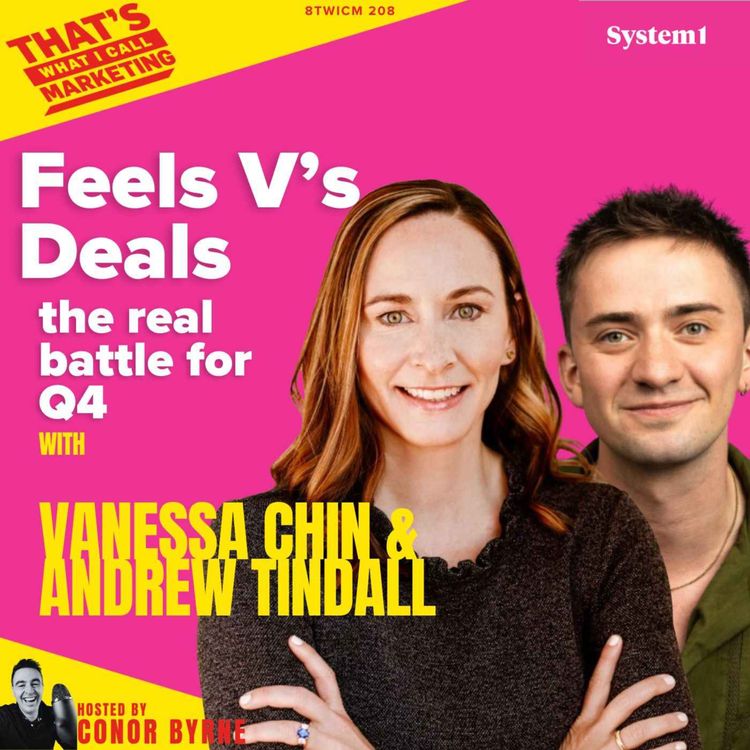
TWICM 208: System 1's Andrew Tindall & Vanessa Chin: Feels Vs Deals - the real battle for Q4
What should marketers take from Cannes Lions once the presentations are over and the real work of planning for Q4 begins?
In this special crossover episode of That’s What I Call Marketing and The Sleeping Barber Podcast, System1’s Andrew Tindall and Vanessa Chin join Conor Byrne, Marc Binkley and V to explore what the latest marketing thinking means in practice for brands, agencies and creative teams.
The conversation begins with Mark Ritson and Byron Sharp’s Cannes debate, looking at where they agree, where important differences remain and why marketers need to go beyond familiar headlines on penetration, distinctiveness, consistency and brand purpose. Andrew and Vanessa discuss whether distinctiveness alone can drive growth, why differentiation still matters and how the search for “new news” can lead brands to abandon creative assets before they have built recognition.
The episode also examines how AI is changing advertising. Rather than removing people from the process, AI is becoming part of production, helping brands adapt and localise ideas more efficiently. The group considers Coca-Cola’s AI Christmas advertising, PepsiCo adapting Lay’s creative for Walkers in the UK, and why human judgement still matters. There are practical lessons on creator marketing, brand characters, fluent devices and staying consistent. Andrew explains why creators should be treated as creative partners who understand their platforms, not as interchangeable media assets.
The discussion then turns to audio and radio advertising. System1 research suggests campaigns using audio can produce stronger business effects, support profit and penetration, and reduce price sensitivity. The group explores sonic branding, jingles and why radio should not be treated only as a short-term performance channel.
Attention matters, but it is not the end goal. Andrew explains why marketers need to move from impressions, to attention, and ultimately to the brand memories advertising creates.
The episode closes with a practical Q4 playbook for Black Friday, Cyber Monday and Christmas. “Salesmanship” may deliver immediate conversion, but emotional “showmanship” builds memories, demand and pricing power. The lesson: focus on the feels, not only the deals.
CHAPTERS
03:24 Ritson and Sharp at Cannes
04:45 Distinctiveness versus differentiation
06:00 Is brand purpose outdated?
08:00 Why marketers struggle with consistency
11:05 Turning theory into growth
13:09 AI, creativity and human judgement
16:10 How PepsiCo uses AI in advertising
19:05 Why AI was quieter at Cannes
19:55 AI avatars and brand characters
22:01 Why marketers need to stay the course
22:54 When did a campaign become a media flight?
24:45 Turning Cannes insights into a Q4 plan
25:22 The “Double Double” audio research
28:04 Why audio matters
30:13 What makes an effective radio ad?
32:29 Why radio is more than a performance channel
34:00 Storytelling and creating an audio world
36:50 Should creators work across every channel?
38:00 What System1’s creator research found
40:54 Is Q4 the right time for a fluent device?
42:06 Moving from attention to brand memory
46:36 Can brands be built through Meta and TikTok?
48:49 Why brands need to appear early
50:02 The Q4 marketing playbook
50:43 Make people feel something
51:52 Black Friday: deals versus feels
52:23 Salesmanship, showmanship and short-term optimisation
54:48 What marketers can learn from Amazon
56:26 Feels, not deals
57:01 Why brands should re-air effective Christmas ads
58:00 Consumers do not get bored of good advertising
This episode was created in partnership with System1. Find out more at system1group.com.
Subscribe to That’s What I Call Marketing for more conversations on brand growth, marketing effectiveness and creative strategy.
That’s What I Call Marketing is where marketers come for real conversations about brand, B2B, creativity, effectiveness and the future of the profession.
Hosted by Conor Byrne, the show features conversations with CMOs, marketing leaders, agency leaders, authors, thinkers and practitioners about what good marketing looks like in practice.
- Listen, follow and find more episodes at: https://www.thatswhaticallmarketing.com
- Connect with Conor on LinkedIn: https://www.linkedin.com/in/conorbyrneirl/
- If you enjoy the show, please follow, subscribe and leave a review. It helps more marketers find the conversations.
More episodes
View all episodes
TWICM 214: James Hurman Future Demand, Making the Commercial Case for Brand Investment
46:49|James Hurman, author of Future Demand and co-founder of Tracksuit, joins That’s What I Call Marketing to explain how brand building creates future demand, how performance marketing converts current demand and why marketers need both to drive sustainable growth. This episode offers a practical way to understand how advertising really works, how to build the internal case for brand investment and how marketers can move an organisation beyond a performance-only mindset without betting everything on one dramatic change.In this episode, we cover:– Why James Hurman rewrote Future Demand specifically for marketers– The relationship between brand building, future demand and performance marketing– Why advertising rarely causes an immediate sale but can help a brand win a greater share of future sales– How Instacart CMO Laura Jones “marched up the funnel” from measurable performance activity to the Olympics and the Super Bowl– How Telstra tested a 50:50 brand and performance split in Adelaide and recorded a 14% improvement against the rest of Australia– How marketers can use experiments, geographic holdouts and better measurement to demonstrate incrementality– Why CEOs, CFOs and marketers often want the same commercial outcome but describe marketing investment in very different language– What AI, agentic shopping, AEO and GEO could change — and why the fundamentals of markets, brands and human decision-making still matterJames challenges the traditional idea that advertising works by persuading somebody to buy immediately. Instead, he describes a two-stage process: brand advertising creates familiarity and positive bias among people who are not yet in the market, while performance activity helps convert that existing bias when they are ready to buy.He also shares practical examples of how marketers can earn confidence gradually, measure brand investment more rigorously and communicate its commercial value to non-marketing stakeholders.That’s What I Call Marketing is the podcast for marketers who care about brand, B2B, creativity, effectiveness and the future of the profession.Follow the show for more conversations with CMOs, marketing leaders, agency leaders, professors, authors, thinkers and practitioners.Find more episodes at: https://www.thatswhaticallmarketing.comCHAPTERS03:47 Exploring what a marketing book can be05:40 Why James rewrote Future Demand07:39 Creating future demand and converting current demand08:29 Laura Jones and Instacart’s four-year brand journey11:03 How Instacart “marched up the funnel”12:00 Telstra’s geographic holdout test in Adelaide14:16 Making marketing science easier to understand16:11 The wrong mental model for advertising17:44 How advertising creates and converts demand19:06 Is advertising really a weak force?20:07 Why the evidence has not changed every organisation21:43 Winning support from non-marketing stakeholders23:38 Creating a shared language with CFOs25:18 Why James remains invested in solving this problem26:56 How marketing cultures differ across markets29:53 Better marketing measurement and experimentation31:27 Using AI to learn and improve marketing capability34:14 How AI is affecting businesses and marketing37:21 Will agentic shopping change consumer behaviour?39:58 Familiarity, emotion and why people choose brands40:58 What McDonald’s “brand love” metric predicts42:19 Tracksuit University and the language of the boardroom44:25 Where to find Future DemandABOUT JAMES HURMANJames Hurman is the author of Future Demand and The Case for Creativity. He is a co-founder of Tracksuit and founding partner of innovation studio Previously Unavailable. His work focuses on marketing effectiveness, creativity, brand building and helping businesses understand how marketing contributes to long-term commercial growth.Explore Future Demand: https://future-demand.comLearn more about Tracksuit: https://www.gotracksuit.comVisit Tracksuit University: https://university.gotracksuit.com
TWICM 213: Mark Kingsley on Brands in the Age of AI
36:39|Mark Kingsley, brand strategist, designer, author and founder of Malcontent, joins That’s What I Call Marketing to discuss his book "Brands in the Age of AI" and why marketers need to think much more deeply about artificial intelligence than prompts, productivity and tools.Mark’s central argument is that AI is not simply a tool, it is a condition, an environment that is already changing how we work, create, build brands and relate to one another. This conversation explores what that means for brand strategy, creativity, marketing careers and the relationship between companies and customers.Rather than offering another AI how-to guide that could be outdated within months, Mark draws on history, philosophy, psychology, design and technology to understand where AI fits into a much longer story of technological change.In this episode, we cover:– What the Jacquard loom, Charles Babbage, Ada Lovelace, Alan Turing and even *Frankenstein* can teach us about today’s AI debate– AI-driven job losses, automation and the continued commoditisation of creative and knowledge work– Why removing junior-level “donkey work” could create a serious skills and judgement problem for agencies, marketers and professional services– Brian Eno’s idea of “scenius” and why creativity is rarely the product of a lone genius– Agentic AI, B2A2C commerce and what happens when AI agents begin making purchasing decisions– Why brands could use AI to move beyond transactions towards deeper relationships with people– Why human discernment could become more valuable as AI becomes more capable– The danger of treating AI primarily as another system for extracting efficiency and profit– How AI might instead be used to support human flourishingOne of the most important questions running through the conversation is what happens to expertise when AI starts doing the work through which people traditionally learned their craft.We also explore what AI means for brands themselves. If brands genuinely want relationships rather than simply transactions, Mark argues AI could help companies recognise people as individuals and members of communities rather than merely customers to extract value from.A useful listen for marketers interested in AI in marketing, brand strategy, creativity, marketing leadership, agentic AI, synthetic research, the future of work, customer experience and the changing role of human judgement.02:32 Why this is not another AI how-to book04:36 “AI is not a tool, it’s a condition”05:43 Technology, Heidegger and what technology reveals07:38 Is AI already changing society at scale?08:01 Alan Turing and the history of machine intelligence09:02 Jacquard looms, the Luddites and automation11:04 AI layoffs and the economics of replacing people13:36 AI infrastructure and removing barriers19:13 Photography, creativity and resistance to new technology20:18 Why great photographers and creatives still matter21:24 Brian Eno’s Oblique Strategies25:18 Agentic AI and B2A2C commerce26:00 AI personas and purchasing agents27:02 Tokenisation and the “semiotic gap” between humans and agents30:48 Why Mark is disappointed by the adversarial AI debate34:13 What *Brands in the Age of AI* ultimately asks brands to reconsiderThis episode is brought to you by Tracksuit the always-on brand tracking platform for clients and agencies.Find out more: https://www.gotracksuit.comMore from That’s What I Call MarketingThat’s What I Call Marketing is the podcast for marketers who care about brand, B2B, creativity, effectiveness and the future of the profession.Follow the show for more conversations with CMOs, marketing leaders, agency leaders, professors, authors, thinkers and practitioners.Find more episodes at: https://www.thatswhaticallmarketing.com
TWICM 212: Canva B2B CMO on B2B Marketing, Enterprise Growth and Building Demand
34:49|Meghan Gendelman, CMO, B2B at Canva, joins That’s What I Call Marketing to discuss B2B marketing, enterprise growth, building demand and how Canva is taking a hugely successful product-led business further into the enterprise. This conversation gets into what building a B2B growth engine actually requires: understanding customers, combining product-led and sales-led growth, building brand before buyers enter the market, using data properly and working out where AI genuinely adds value.In this episode, we cover:– Why Meghan believes B2B marketing is anything but boring, particularly when you are dealing with complex buying committees, long consideration periods and multiple decision-makers– Why customer insight still matters more than tools, including Meghan’s experience of using AI to scale content for GEO and discovering that faster content without anything new or useful simply didn’t work– How brand, customer entry points and buying signals help marketers influence customers long before they reach a website or speak to sales– Why Meghan believes every good marketer needs to become comfortable with data, pipeline and the commercial numbers behind the business– How Canva is thinking about AI, LLMs, design, brand governance and integrations with platforms including ChatGPT, Claude and Gemini– What Meghan learned from more than a decade at Salesforce, her time at DocuSign and the process that led her to become Canva’s first B2B CMO– How she leads global marketing teams through clear values, trust, vulnerability and knowing the difference between “smoke” and “fire”We also discuss the changing B2B buying journey, why much of the decision can happen before a buyer identifies themselves, the role of brand in demand generation and why B2B and B2C marketing are becoming less distinct than marketers sometimes assume.A useful listen for marketers interested in B2B marketing, enterprise marketing, product-led growth, demand generation, brand building, AI in marketing, customer insight, sales and marketing, marketing leadership and commercial growth.02:12 Meghan’s career across Salesforce, DocuSign and Canva03:03 Why everything starts with the customer05:44 The AI and GEO content experiment that failed07:18 Why B2B marketing is not boring10:30 Leading global marketing teams through values and trust11:41 Smoke, fire and knowing when leaders need to get involved12:47 Why Meghan joined Canva14:46 Canva’s 30–40 hour B2B marketing interview challenge16:15 Taking Canva from product-led growth into enterprise17:04 Product-led growth versus sales-led growth19:47 How B2B buying decisions are changing22:08 Why every marketer needs to understand data23:13 Meghan’s Monday morning pipeline ritual24:21 Learning from other marketing leaders25:00 Remote work, offices and building global teams27:39 Why EMEA is not one market28:40 Keeping Canva simple as the platform expands29:11 Canva as an AI-powered design platform30:27 Canva, ChatGPT, Claude, Gemini and the LLM ecosystem31:47 Building Canva’s B2B and enterprise brandAbout Meghan GendelmanB2B at Canva, leading its B2B marketing strategy as Canva continues to grow its enterprise business. Before Canva, Meghan held senior marketing roles at DocuSign and spent more than 12 years at Salesforce across areas including customer success, product marketing, growth marketing, field marketing, demand generation and regional marketing leadership.This episode was recorded as part of the That’s What I Call Marketing Cannes Sessions and produced in partnership with The Digital Voice.The Digital Voice: https://www.thedigitalvoice.co.uk/That’s What I Call Marketing is the podcast for marketers who care about brand, B2B, creativity, effectiveness and the future of the profession.Follow the show for more conversations with CMOs, marketing leaders, agency leaders, professors, authors, thinkers and practitioners.Find more episodes at:https://www.thatswhaticallmarketing.com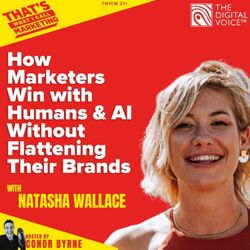
TWICM 211: Jellyfish's Natasha Wallace On How Marketers Win with Humans & AI Without Flattening Their Brands
35:07|Natasha Wallace, Chief Solutions Officer for Strategy, Planning and AI at Jellyfish, joins That’s What I Call Marketing to discuss how brands can become more visible and understandable to AI without sacrificing creativity, emotion or distinctiveness.This episode explains how marketers should approach the growing challenge of serving two audiences at once: humans, who respond to stories, feelings and ideas, and AI models, which rely on clear signals, context, trust and specificity.In this episode, we cover:– Why Jellyfish’s research found almost no correlation between how humans and AI models judge creative work– What “brand flattening” means and why marketers should resist making everything rational and functional– How to make a brand legible to large language models without weakening its creativity– Why brand trust, distinctive assets and consumer consensus still influence AI recommendations– The role of YouTube, Reddit, creators, ecommerce and digital PR in shaping model perception– Why paid, owned and earned media need to work together in an AI-led discovery environmentNatasha also explains Jellyfish’s concept of the “brand echo”: the conversation, reaction and community created around a brand, even when the original activity is not directly visible to an AI model.The practical message is not that marketers need to abandon the fundamentals. It is that audience strategy, brand positioning, content, media and measurement need to work together more closely. The brands most likely to succeed will be clear enough for machines to understand and interesting enough for people to care about.A useful listen for marketers interested in AI in marketing, GEO, brand strategy, creativity, content strategy, advertising effectiveness and the future of search and discovery.That’s What I Call Marketing is the podcast for marketers who care about brand, B2B, creativity, effectiveness and the future of the profession.Follow the show for more conversations with CMOs, marketing leaders, agency leaders, professors, authors, thinkers and practitioners.Find more episodes at: https://www.thatswhaticallmarketing.com**Timestamps**00:00 Why marketers must not flatten their brands for AI00:39 Introducing Natasha Wallace of Jellyfish02:04 Natasha’s career across digital, media and emerging technology03:35 Why AI feels different from previous industry shifts05:23 Working globally with Heineken and major sports properties07:05 Why Natasha joined Jellyfish09:00 Bringing media, content, creative and AI strategy together12:32 What humans and AI models see in award-winning advertising15:31 The danger of brand flattening16:36 How the “brand echo” influences AI models17:35 Why brand trust and distinctive assets still matter20:21 Why YouTube is frequently cited by large language models22:28 How marketers should prioritise their AI and GEO activity24:46 Leading and lagging indicators for AI visibility26:01 The platforms and voices that shape model perception27:27 Borrowed credibility, belonging and long-term brand associations30:05 Testing creative work without making it formulaic32:25 Why AI should strengthen human thinking, not replace itThat’s What I Call Marketing is the podcast for marketers who care about brand, B2B, creativity, effectiveness and the future of the profession.Follow the show for more conversations with CMOs, marketing leaders, agency leaders, professors, authors, thinkers and practitioners.Find more episodes at: https://www.thatswhaticallmarketing.comThis Cannes Sessions episode is produced in partnership with The Digital Voice.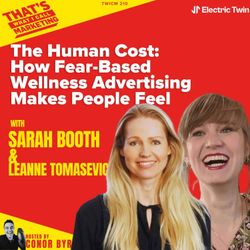
TWICM 210: The Human Cost: How Fear-Based Wellness Advertising Makes People Feel
41:50|Sarah Booth, Chief Brand and Creative Officer at Ancient + Brave, and Leanne Tomasevic, Partnerships and Strategy Director at Electric Twin, examine fear-based wellness advertising, synthetic audience research and the human consequences of marketing built around insecurity. Using the Electric Twin platform live during the conversation, we test real wellness advertisements with synthetic audiences and explore how people respond to messages about ageing, attractiveness, sleep, cellulite and female confidence. The results raise an important question for marketers: are we measuring the commercial value of a sale while ignoring what the advertising costs the person on the other side?In this episode, we cover:– How wellness brands use fear of ageing, shame and insecurity to attract attention– What women and men really think about fear-based wellness advertising– How synthetic audiences allow marketers to test advertising reactions in seconds– Why scientific language can make weak or misleading claims feel more credible– How performance algorithms can reward increasingly negative advertising– The tension between short-term conversion and long-term brand integrity– Why marketers should consider the cultural and emotional impact of their workAdvertising that sells through fear can leave vulnerable consumers feeling worse, even when it produces a conversion. Leanne demonstrates how Electric Twin creates digital replicas of real audiences, allowing marketers to run surveys, discussions and message testing with a reported average accuracy of 92%. As brands produce hundreds or even thousands of digital assets, marketers can become focused on feeding the algorithm rather than considering how each message affects the person seeing it. A critical listen for marketers interested in brand strategy, wellness marketing, synthetic research, AI in marketing, advertising ethics, consumer insight, marketing effectiveness, performance marketing and responsible brand building.Timestamps00:43 Modern wellness advertising and real consumer reactions03:17 How Electric Twin’s synthetic audience platform works04:58 Sarah Booth on Ancient + Brave and female confidence06:25 Leanne Vic explains synthetic audiences08:17 Why wellness advertising increasingly sells through fear09:45 Testing a “fear of getting old” advertisement13:14 How fear-based advertising makes women feel14:49 Testing the “science of beauty sleep”18:19 Would consumers actually click on the advertisement?19:31 The regulatory challenge of digital wellness advertising21:17 How algorithms create an advertising arms race22:36 What marketers need to understand about cultural influence24:00 Why designers think differently about human impact25:00 Which brands represent female bravery?27:12 What would make women feel braver?29:00 Testing cellulite advertising with men32:00 Can better evidence rescue a damaging advertisement?34:22 What men think about the way women are marketed to35:00 Testing a long-form menopause supplement advertisement36:10 “Dangling hope in front of someone in pain”36:37 Can platforms make their algorithms more positive?37:00 Competing without using fear or shame39:17 The responsibility marketers have for their workThis episode is in partnership with Electric Twin. Electric Twin is a synthetic audience platform that helps brands, marketers, product teams and insight professionals understand audiences, test ideas and explore consumer reactions in seconds.Find out more at: https://www.electrictwin.comThat’s What I Call Marketing is the podcast for marketers who care about brand, B2B, creativity, effectiveness and the future of the profession.Follow the show for more conversations with CMOs, marketing leaders, agency leaders, professors, authors, thinkers and practitioners.Find more episodes at: https://www.thatswhaticallmarketing.com
TWICM 209: The Singles: If Carlsberg Did Podcasts, Did Sydney Sweeney work, Norway winning the World Cup and the AI Brand Wars
33:13|In this episode of The Singles on That’s What I Call Marketing, Conor Byrne is joined by Bella and Ed from Tracksuit to unpack the biggest marketing stories right now using brand tracking data. They dive into the AI brand wars between ChatGPT/OpenAI and Claude/Anthropic, including how Super Bowl advertising impacted awareness and consideration, and discuss how people use each tool for work vs personal life. The team shares Tracksuit’s acquisition of Hall, a Sydney startup that measures how brands show up in AI answers, helping marketers understand AI discoverability and sentiment. They also revisit American Eagle’s Sydney Sweeney campaign one year on (awareness gains vs declines in consideration and investigation), break down Norwegian Air’s playful British Airways newsjacking around Norway’s World Cup momentum, and explore Carlsberg’s revival of the “If Carlsberg Did…” platform and what it could mean for brand funnel performance.01:05 Today’s Marketing Hot Topics02:11 AI Brand Wars Data05:27 Who Uses Claude vs ChatGPT07:52 AI Use Cases and Model Fatigue12:54 Tracking AI Visibility17:31 American Eagle One Year Later21:44 BA vs Norwegian Newsjacking26:44 Carlsberg Revives Classic PlatformCheck out tracksuit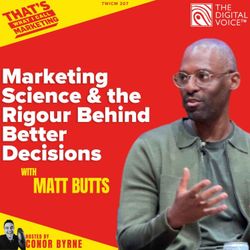
TWICM 207: Samsung Ads’ Matt Butts on Marketing Science and the Rigour Behind Better Decisions
25:26|Matt Butts, Head of Marketing Science at Samsung Ads Europe, joins That’s What I Call Marketing to discuss marketing science, incrementality, connected TV measurement and why rigorous testing matters more than a positive result. This episode explains how marketers can move beyond convenient metrics, design better experiments and connect advertising activity to meaningful business outcomes. Matt also explores how changing television behaviours are reshaping media planning, audience measurement and the role of connected TV.In this episode, we cover:– Why marketers often measure metrics without questioning whether they matter– The difference between basic A/B testing and genuine incrementality testing– Why the quality of the test matters more than whether the result is positive– How marketing scientists translate complex analysis into commercial decisions– How Samsung Ads measures viewing across linear television, streaming and gaming– Why reported reach can hide significant audience duplication– How incremental reach can reduce media waste and identify missed audiences– The role of connected TV data in advertising planning and measurement– Why marketers need to communicate measurement differently to CMOs, CFOs and media teams– How rigorous measurement helped one advertiser move from zero investment to a seven-figure commitmentMatt argues that marketing science should not simply validate decisions that have already been made. Its role is to challenge assumptions, identify what would have happened without the advertising and give marketers evidence they can confidently use to make better investment decisions.A useful listen for marketers interested in marketing science, advertising effectiveness, connected TV, incrementality, media measurement, experimentation and commercial impact.Timestamps01:16 How Matt found his way into marketing science02:19 How advertising measurement has changed03:27 Are marketers measuring things without knowing why?04:27 Why measurement assumptions must be tested continually05:02 Do marketers know how to test properly?06:00 The limitations of basic A/B testing06:17 Why incrementality is the missing part of marketing testing07:18 The importance of statisticians, data scientists and translation08:13 Matt’s journey to Samsung Ads08:18 What Samsung Ads does09:00 How television viewing behaviour has changed10:18 Balancing audience precision, relevance and scale11:02 Relevance without intrusive personalisation12:19 Samsung Ads’ Total View measurement capability12:36 Audience duplication, incremental reach and missed audiences13:40 Why platform reach figures can be misleading14:06 What a Head of Marketing Science actually does14:40 Building advertiser-specific measurement playbooks15:16 Using measurement to improve future advertising investment15:23 How to explain incrementality to senior business leaders15:41 Why marketers need to understand marketing science17:00 How measurement feeds into marketing mix models17:33 A real example of fixing incomplete advertising data19:00 How a geo test led to a seven-figure investment19:43 Why negative test results should not frighten marketers20:40 Combining scientific rigour with commercial thinking21:51 What comes next for connected TV measurement22:00 Connecting television and mobile data23:30 Why marketing measurement must keep pace with human behaviourThat’s What I Call Marketing is the podcast for marketers who care about brand, B2B, creativity, effectiveness and the future of the profession.Follow the show for more conversations with CMOs, marketing leaders, agency leaders, professors, authors, thinkers and practitioners.Find more episodes at: https://www.thatswhaticallmarketing.comThanks to the Digital Voice for their partnership https://www.thedigitalvoice.co.uk/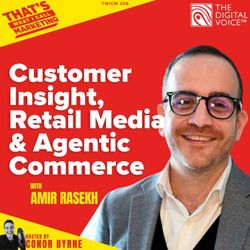
TWICM 206: Nectar360’s Amir Rasekh on Customer Insight, Retail Media and Agentic Commerce
28:06|Amir Rasekh, Managing Director of Nectar360, joins That’s What I Call Marketing to discuss customer insight, retail media, AI-powered measurement and how agentic commerce could change the way people shop.This episode explains how retail media has evolved from loyalty data, targeted coupons and direct mail into a sophisticated, measurable channel spanning in-store, onsite and offsite media.In this episode, we cover:– Why customer insight remains the foundation of effective retail media– How Nectar360 connects loyalty, insight and retail media in one customer-focused system– Why brands hold retail media to a higher measurement standard than traditional channels– How Nectar360 measures incrementality and multi-touch attribution across omnichannel campaigns– How its AI-powered Pollen platform makes campaign planning, creative production and measurement faster– What agentic commerce could mean for retailers, marketers and customer decision-making– Why AI should support better human relationships rather than remove the people involvedAmir also shares early results from Pollen, including 2.5 times more incremental sales from omnichannel campaigns and evidence that retail media can influence the middle and upper parts of the marketing funnel, rather than acting only as a conversion channel.The conversation also explores an important tension for marketers: technology can make retail media simpler, faster and more measurable, but clients still expect strong relationships, expertise and human judgement. A useful listen for marketers interested in customer insight, retail media, marketing measurement, AI in marketing, incrementality, omnichannel strategy and the future of commerce.Timestamps00:00 Introduction01:27 Amir Rasekh’s career in retail and Sainsbury’s04:34 Building an insight-led culture05:00 What Nectar360 does today06:06 Why retail media suddenly became so prominent07:18 The fundamentals of retail media08:52 Why measurement expectations are increasing10:28 Introducing Nectar360’s Pollen platform12:15 Are marketers rigorous enough when testing campaigns?13:33 How AI accelerated retail media technology14:21 AI audience building, creative scoring and production14:38 Cutting creative production from weeks to 90 seconds14:59 Early results from omnichannel retail media16:10 Retail media as a brand-building channel17:05 How customer shopping behaviour is changing18:00 What agentic commerce means for retail20:03 Will consumers shop through ChatGPT and AI agents?22:16 Why physical stores still matter24:00 How Nectar360’s teams are using AI25:16 Building AI literacy across an organisation25:47 Why clients do not want technology to replace people26:04 Closing thoughtsThat’s What I Call Marketing is the podcast for marketers who care about brand, B2B, creativity, effectiveness and the future of the profession.Follow the show for more conversations with CMOs, marketing leaders, agency leaders, professors, authors, thinkers and practitioners.Find more episodes at: https://www.thatswhaticallmarketing.comThis Cannes Sessions episode is produced in partnership with The Digital Voice.Find out more at: https://www.thedigitalvoice.co.uk